The Black Study Group That Transformed a Generation: The Afro-American Association

by © Leslye Joy Allen

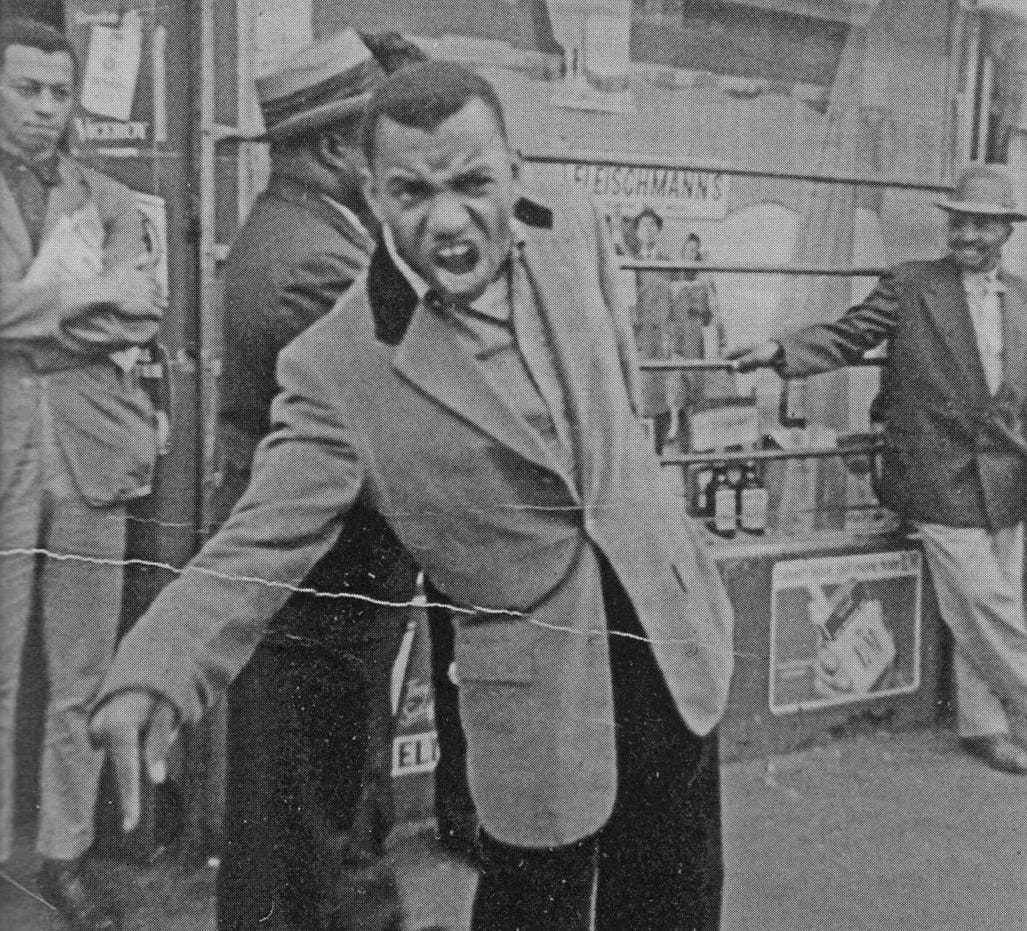
The photo below of Don Warden is from the archives of Khalid and Jamila al Mansour. Don Warden was one of the founders of the Afro-American Association at the University of California at Berkeley. The other founding members were Donald Hopkins, Otho Green, and Henry Ramsey. 

This organization formed in late 1961 and began as a student study group in 1962 at the University of California at Berkeley when there were literally no identifiable Afro-American and African Studies programs on any U. S. college and university campus. The group devoured works by Ralph Ellison, W.E.B. DuBois and other Black scholars that were left out of many colleges curricula. Study meetings of its members initially began at the off-campus home of a UC Berkeley student, and grew from there. In fact, chapters of this organization appeared on hundreds of college campuses in the United States with members numbering in the thousands by the mid-1960s.
The objective of the group was to read and study about the Afro-American, African, and Afro-Diasporic past in order to confront the institutional racism, colonialism and bigotry found in the United States and throughout the world. 

Warden, a UC Berkeley law student, regularly went into Black neighborhoods and literally spoke to young Black citizens directly on street corners or wherever they were. He encouraged them to study about Afro-American and African history in order to fight against their feelings of worthlessness that often accompanied experiencing chronic racism. 

He listened to them tell him about their problems of unemployment, poor housing, you name it. He, like most of his members, espoused that in order to change all systems of oppression, one needed to study about the past in order to do so. Warden eventually became a lawyer for the Black Panther Party of Self-Defense as well as granting legal assistance to the Nation of Islam when Malcolm X was still a member of the group.

The Afro-American Association was heavily influenced by the ideologies of Black American activists Robert F. Williams and Malcolm X. The AAA understood that only sustained study of Black people/s would foster the kind of thinking and strategies for combating systems that sought to suppress and control Black and Brown communities all over the world. Only deep research would correct the far-too-often feelings of inadequacy that came with being Black and oppressed. 

In 1962 when this study group, that was soon named the Afro-American Association, began its study group meetings at UC Berkeley there were roughly only about 100 Black students out of 20,000 white students. And in 1962 there were only two members of the group that were not born in the United States. One was from Jamaica; the other was from India.

In 1962 this tall, skinny, young Black man from Orange Hill, Jamaica and this petite and short, very brown young woman from Chennai, Tamil Nadu (in Southern India) dressed in her Sari and sandals met in an AAA group meeting.

The young man from Jamaica gave a pristine evaluation of how Great Britain had created a rather stiff and proper group of elite Black Jamaicans that often mimicked the mores and habits of British society. It was done, he said, to shield the world from knowing how racist the British empire actually was. The young man was calm, studious with very edgy ideas about the colonization of Black people/s around the world. 

The young brown woman in her Sari and sandals was intrigued. She too had been a British subject in her native state of Tamil Nadu in southern India. She knew something about what this young man spoke of, but not all of it. Back then, the typical path for academically talented Indian and Jamaican students was to study in England, that is if they could secure a path to graduate school. 

She rejected that path because there was no major in Biochemistry in India or in the UK that would have been available to a female. The skinny guy from Jamaica also rejected the educational path to the UK. His decision was so unusual that the approval for his exit from Jamaica took so long that he arrived at UC Berkeley two weeks after the Fall 1961 semester begun.

He, Dr. Donald Harris became a leading economist and she, Dr. Shyamala Gopalan-Harris became a leading biomedical scientist, a contributor to the identification of the function of rMNA, which greatly improved treatments for breast cancer. 

The early members of the Afro-American Association described her as warm, funny, “down for the cause” of Civil Rights and an end to colonialism, and also a fiery debater. At first one member of the AAA noted that some of them thought she was royalty because of the way she carried herself. Yet, she fit right in, several members noted. He was described as professorial even though he was in his early 20s. While their eventual marriage didn’t last (they married roughly 10 months after meeting), their firstborn daughter Kamala noted that she knew they loved each other and felt that if they had been a bit older and a bit more emotionally mature they might have made it. 

She cited them both as activists, and remembers going to protest marches with her parents in a stroller. The blueprint for their activism and for the creation of Afro-American and African Studies as disciplines were rooted in the activities in the Afro-American Association. While at UC Berkeley, Shyamala met and influenced arguably, one of Afro-America’s most important philosophers, Cedric Robinson.

Robinson’s book Black Marxism, first published in 1983, remains one of the most brilliant critiques and reassessments of the Eurocentric theories of Marxism. It has become a must-read in the literary canons of both Afro-American and African Studies.

It was Robinson who coined the phrase “Racial Capitalism.” He argued that capitalism was always based on race and race came before capitalism. Importantly there never was a clean break from European feudalism. He was one of the first Black scholars to identify “race,” as a component that European empires used when feudalism morphed into capitalism. 

Any study he maintained had to be central to Black people/s’ lived experiences wherever they were in the world. When I first read him, it became apparent that European Marxist scholars either forgot or tried to ignore that the peoples of Europe were once considered “races,” races and national identities that were eventually erased in exchange for their being identified as “white” which served the interests of European countries in their quest to colonize and dominate large portions of the world.

In 1959, Shyamala Gopalan was standing in line behind Cedric Robinson while they were both registering for classes. Both became members of the Afro-American Association. In the first edition of Black Marxism, there was only one person who was not a Black American listed in his group of early friends that Robinson acknowledged as influential on the development of his ideas. That person was Dr. Shyamala Gopalan-Harris.

So here’s a brief mini-history of the continuing of the Afro-American Association of University of California at Berkeley. Huey Newton and Bobby Seale who founded the Black Panther Party became members. Huey dared to show up at a meeting of AAA without having read the book assigned for that session. The members sent him home. He never showed up again unprepared. 

Future Congressman Ron Dellums was a member of the AAA at one time as was Kenny Freeman, a contributor to the Black Panthers 10-Point Plan. The AAA literally laid the academic groundwork for Afro-American and African Studies programs throughout the nation as underscored by historian and author Donna Jean Murch who traced the evolution and development of the Black Panther Party from its roots in the Afro-American Association. None of it began without the required reading and research and the on-the-ground grassroots activism that met Black communities in the Oakland area where they were.

I could go on about how police monitored the group’s members particularly when they spoke on street corners, or visited high schools to encourage reading and research among members of the Black community. Yet, I will not do that mainly because well-meaning, good people have started to use the internet like an online set of Cliffnotes

If you’re old enough to remember Cliffnotes you also remember that occasionally they were used instead of reading the actual book or doing the actual research. Yet, your ass was grass when a teacher or professor asked you a highly specific question that Cliffnotes did not cover and you hadn’t bothered to read the whole book.

So there’s a small bibliography below with a list of books that are worth your time. The message is clear: Either you put in the time and read or you remain a dilettante on matters that you need to know both for your safety and your sanity.

© Leslye Joy Allen

This essay was previously posted on Substack on January 22, 2026.

I am an Independent Historian, Oral Historian and Dramaturge. Please consider supporting my work and research with a few bucks for Coffee and Eggs via my CashApp or become a paid subscriber to me on Substack to help me sustain my research.

Recommended Readings:

Living For the City: Migration, Education, and the Rise of the Black Panther Party in Oakland, California by Donna Jean Murch

Fanon for Beginners by Deborah Baker Wyrick

Remaking Black Power: How Black Women Transformed an Era by Ashley D. Farmer

Black Marxism: The Making of the Black Radical Tradition by Cedric Robinson

Oregon Police Department Surveillance Files on Donald Warden and the Afro-American Association which kept surveillance documents on Donald Warden when he visited Oregon to encourage students to read and research.

The Afro-American Association: Forerunner to the Panthers

“How Kamala Harris’ Immigrant Parents Found a Home, and Each Other, in a Black Study Group” by Ellen Barry, September 13, 2020, New York Times.

The Truths We Hold: An American Journey by Kamala Harris

Remembering Cedric Robinson: Humanistic Imaginaries and the Black Radical Tradition

All blogs written by Leslye Joy Allen are protected by U. S. Copyright Law and licensed under a Creative Commons Attribution-NonCommercial-NoDerivs 3.0 Unported License. Any partial or total reference to any blog authored by Leslye Joy Allen, or any total or partial excerpt of any blog authored by Leslye Joy Allen must contain a direct reference to this hyperlink: https://leslyejoyallen.com with Leslye Joy Allen clearly stated as the author.  Postings or blogs placed here by other writers should clearly reference those writers.  All Rights Reserved.

Sayonara 2015…Changes in 2016

by Leslye Joy Allen

“Self Portrait” by Copyright © 2015 Leslye Joy Allen.  All Rights Reserved.

“Self Portrait” by Copyright © 2015 Leslye Joy Allen. All Rights Reserved.

Copyright © 2015 by Leslye Joy Allen. All Rights Reserved.

I lost a lot and gained a lot in the year 2015. When this happens you reassess what makes sense in your life, and what you need to let go of. So, with that said…

I lost my dissertation advisor Dr. Clifford M. Kuhn, who died of a massive heart attack in November 2015. Yet, I learned that I had the support of the wonderful faculty of the History Department at Georgia State University; and I thank them all. I had to agree to stop teaching for at least a couple of semesters in order to fulfill the requirements of a dissertation fellowship, but that is okay—I won that dissertation fellowship.

I had the love and support of supremely talented actor Margo Moorer—one of many members of my extensive theatre family—who ensured that I witnessed the phenomenal stage play “Uprising.” Margo and that cast were superb in this great play and she generously pressed some money in my hand when I was dead broke.  I should also acknowledge that Margo was one of the first members of Atlanta’s theatre community to show up when my Mama passed in 2013.  Her fellow actor and co-star LaParee Young said it best, “Margo will be there for you.”  LaParee was damn right.  THANK YOU MARGO!  She also insisted that I meet the author of “Uprising” Gabrielle Fulton, who is a brilliant playwright whose literary and artistic maturity are far beyond her years.

As an only child, I naturally have “adopted” brothers and sisters. I could not let this year go by without thanking my long-time “adopted” brother (and fellow only child) Marc Freeman for covering me, praying for me, and for letting me hear some amazing music that no one else has heard.  He is an amazing composer and producer. We have been friends for fifty years and counting.  I must thank Wafa who is my “sister from another mother,” and who has covered my behind more times than I can count.  I also have to thank my cousins Saundi, Yolanda (Yandi), Lorena, and Cynthia for reminding me that I am loved and for showing up to make sure that I knew it.  My cousin Saundi lost her Mom (my Aunt Sara) this year, but I have one of her angel ornaments to remind me of her.  I thank Claude and Don, my “adopted” brothers and favorite couple for always making me laugh and for reminding me that only children often inherit loving siblings late in life.  

I thank Dr. Karcheik Sims-Alvarado—the Historian in Heels—for “talking me back from the ledge” so to speak, as she understood/understands the stress and frustration that comes with being a doctoral candidate; and I must give a special shout to the GSU History Department’s Business Manager Paula Sorrell for getting all that paperwork handled so that I could get paid on time; and I also must thank Paula for always remaining cool when she is dealing with crazy Ph.D. candidates like myself.

I thank all of my former students who are too numerous to mention by name. They remind me that the future is in good hands. I also thank the young men and women who have chosen me as their mentor.  It is an honor to be chosen by such wonderful young people from everywhere around the United States, and from as far away as Nigeria, Ghana, Pakistan, United Arab Emirates, Antigua, and Québec.  All of my students, protégés and protégées will change the world.  

This year I participated as a historical consultant in the directorial debut of Keith Arthur Bolden, a brilliant actor and artistic director of the phenomenal Spriggs Burroughs Ensemble of Spelman College. I thank Keith for inviting me along on his very special journey. Okay, I give up!  Margo, Keith and several other performance artists have called me a dramaturge, and I am finally accepting the label.

I must give super props to my adopted “Baby Sister,” the phenomenally talented actor Nevaina Rhodes (pronounced “Nih-Von-Yah”), who is also a drama coach and founder of Real Actors Workshop (RAW).  She also remains the only person I can honestly call a bona fide prayer warrior. Her midday prayers at 12:00 Noon every weekday are a revelation. I know of no one who prays with as much intensity or belief or talent…and she and I have also laughed at some supreme silliness—that is always a blessing!

I met and befriended talented young Black male doctoral scholars like Jerquil “JC” Campbell and Malcom Devoe (his Malcom does not have that second “L”), and talented young doctoral scholars like Jessica Ramadhin, Cinnamon Mittan, and Corrianne Bazemore-James. Cori was my roommate during “The Compact for Faculty Diversity: Institute on Teaching and Mentoring Conference” for SREB Doctoral Scholars held in Washington, DC.  Meeting these young dedicated scholars of color is/was always a blessing and inspiration…

I recognize and embrace the fact that I am a fierce and brilliant intellectual who owes so much to so many scholars and artists who invested their time and energy in my intellect and abilities. I am also the daughter of two now-deceased parents who knew that my purpose and destination would exceed the limits of their lifetimes. Therefore, some changes for 2016 are in order so that I might fulfill my ancestral legacy and complete my sacred God-ordained mission.

I am saying, “Sayonara,” “Adios,” “O da abọ,” “Kwaheri,” “Au Revoir” and “Goodbye” to that small group of men who narrowly envision me (and women in general) as someone designated to sit and listen to their plans, their projects, and their problems. If any of these men are reading this and need some kind of advice, I suggest that they call a counselor or their Mamas, but they need not call me. Too many of these same men who dialed my phone for all kinds of help and assistance have also routinely compensated other men for doing what they expected me to do free of charge…Therefore…

I will no longer vet projects and/or consult and/or render my academic expertise without some form of compensation. The wonderful people that I have individually thanked above in this blog deserve me as one who operates at full capacity for myself and for them.  Mess over or mistreat or mishandle any one of these phenomenal people and I will take it as a personal insult.  I have only one thing, however, to say to those men who think I am some kind of built-in, automatic, academic workhorse meant for their personal use: Delete my phone number until you recognize my value and until you can pay me what I am worth; and we need not speak unless I consider my association with you to be a plus rather than a liability. And please understand that all of the people I care about know who you are, so do not bother calling them either!

To all those friends and colleagues who have encouraged me in some way this year:  You are too numerous to name in a single blog, and I am sure I have forgotten someone, but charge it to my head and not my heart.  Please know that I appreciate every one of you.  Happy New Year!  Àṣé!

Copyright © 2015 by Leslye Joy Allen. All Rights Reserved.

This Blog was written by Leslye Joy Allen and is protected by U. S. Copyright Law and licensed under a Creative Commons Attribution-NonCommercial-NoDerivs 3.0 Unported License. Any partial or total reference to this blog or any total or partial excerpt of this blog must contain a direct reference to this hyperlink: http://leslyejoyallen.com with Leslye Joy Allen clearly and visibly stated as the author. All Rights Reserved.


Mama’s “Drew Dinner”

by Leslye Joy Allen

Copyright © 2015 by Leslye Joy Allen. All Rights Reserved.

Whenever I arrived home and was greeted by very particular smells coming from our kitchen, I knew Drew had swung by my Mama’s house and picked up what she knew was his favorite meal. On many occasions, she just called him and told him to come pick it up. My Mama, the late Syble Wilson Allen-Wms., named this meal “The Drew Dinner” back in the mid-1980s. She enjoyed the way he would often show up. “What are you cooking?,” he asked.  “Your favorite,” she said.      

So on Tuesday, 13 October 2015, on what would have been his 59th birthday, I am eating “his dinner” in his honor so designated by my Mama.  Gone now for twenty-two years, he was mercurial, occasionally difficult, yet sweet in ways that many people missed, artistically talented, and physically gorgeous.  He was devoted to me and routinely defended my honor.  And unlike so many other men who were enamored with their “idea” of me, he loved me exactly as I am.  He meant so much to me for so many reasons, and for so many other reasons that he and I promised we would never, ever share with anyone (and we/I have kept that promise).

I miss him and Mama. I still remember when the two of them occasionally debated about me.  Two dominant personalities, both of them wanted the final say-so on whatever I was doing or planning to do; and neither of them ever got the final say-so.  They would debate to a draw and then I would do what I wanted to do.  They would laugh and shrug their shoulders.  And even when the debates turned into heated arguments, those occasional dramas never interfered with one of my late Mama’s favorite past-times: cooking his favorite dinner.

I still remember times when I would hang up the phone with Mama and yell down the hallway, “Drew, Mama said…”  And before I could finish telling him what she had cooked he was halfway out the door saying, “Tell her I’m on my way.”  LOL!  Memories of them are occasionally mournful, occasionally celebratory, often both; but always funny, warm, and delicious.  Àṣé.


“The Drew Dinner” is a menu and a Trademark ™ of the Estate of Syble Wilson Allen-Wms. Registered Trademark ® pending. All Rights Reserved.

The Drew Dinner:

Meatloaf made from ground chicken and beef

Mashed Potatoes made from red potatoes

Collard Greens with Sautéed Okra 

Homemade Cornbread (baked in a cast-iron skillet)

Sliced homegrown Tomatoes & Spring Onions

Homemade Pickled Beets

Homemade Peach Cobbler…and

a bottle of Cabernet Sauvignon


Copyright © 2015 by Leslye Joy Allen. All Rights Reserved.

This Blog was written by Leslye Joy Allen and is protected by U. S. Copyright Law and licensed under a Creative Commons Attribution-NonCommercial-NoDerivs 3.0 Unported License. Any partial or total reference to this blog or any total or partial excerpt of this blog must contain a direct reference to this hyperlink: http://leslyejoyallen.com with Leslye Joy Allen clearly and visibly stated as the author. All Rights Reserved.

Her Name was Cynthia Diane Morris

By Leslye Joy Allen                                                                                                     Historian, Educator, Theatre and Jazz Advocate & Consultant, Ph.D. Candidate

Copyright © 2013 by Leslye Joy Allen.  All Rights Reserved.

Back in August of 2013, I spoke with my friend Erich McMillan-McCall whose theatre organization Project1Voice was preparing to do a live streaming of a staged reading of the Christina Ham play “Four Little Girls” from the Kennedy Center.  September 15, 2013 marked the 50th anniversary of that tragic day in 1963 when a bomb planted by White racist terrorists killed four young Black girls at the Sixteenth Street Baptist Church in Birmingham, Alabama.  One of them was a young girl recorded in most articles, essays, and books as “Cynthia Wesley.”  Yet, she was born Cynthia Diane Morris.

After recognizing Cynthia’s academic talents, Cynthia’s mother, Mrs. Estelle Morris, allowed her young daughter to live with a childless and affluent Black couple named Claude and Gertrude Wesley in order to give her daughter access to a better school and, perhaps, a more financially stable future.  The Wesley family was well-known throughout Birmingham’s Black community for their generosity, warmth, and a deep love of children.  Yet, the generous and kind-hearted Wesley family, who could not have biological children, never legally adopted Cynthia.  For more information about this, please revisit my previous blog titled “Thoughts on the Eve of the 50th Anniversary of the Sixteenth Street Church Bombing.”  This blog discussed the wonderful tradition in Black communities where people took in and cared for children when they needed assistance. This particular blog also contains a hyperlink to a copy of Cynthia Diane Morris’ amended death record.

Cynthia’s brother Fate Morris wants to set the historical record straight.  The commemorative statues and the U. S. Congressional Gold Medal of Honor awarded in May 2013 posthumously to the four girls who lost their lives in that church bombing all read with the names: Addie Mae Collins, Carole Robertson, Denise McNair, and Cynthia Wesley.  Federal, state and city officials in Birmingham and elsewhere have tepidly acknowledged Fate Morris as Cynthia Morris’ brother, yet they have done so with little regard for his feelings about how her name appears in public records.  I need not pontificate about this matter.  However, if you will take the time to review my previous blogs from late August to September 2013 you will know that this is a sensitive subject.  I also encourage you to listen (when you have time to sit at length) to the lengthy Blog Talk conversation I had with host Preston Washington on Lesley Gist’s Radio Show “Gist of Freedom” program back in September.  Once you hear our long conversation, along with the testimony of Fate Morris, you will know why getting the historical record straight is important.  (“Related Material – a Blog Talk Radio Interview and an important new CNN article 9-14-2013”)

The state of Alabama amended his sister’s death records to reflect her real birth name.  Yet, there seems to be a genuine reluctance in some quarters to even acknowledge Mr. Fate Morris and other members of his family as the family members of Cynthia Diane Morris (aka Cynthia Wesley).  Fate Morris was a young boy when he lost his sister.  His present mission does not appear to be an attempt to deny what the Wesley family did for his sister or how much they loved her, but rather to get some peace by making sure that historians, scholars, journalists and the general public know his late sister’s real birth name.  What he needs most is closure and a genuine acknowledgement of his feelings and those of his family members.  Yet, it is hard to get closure or peace when the written records barely acknowledge that Cynthia Morris was your sister.

So, please take a moment to read and sign Mr. Fate Morris’ petition at the hyperlink below: Cynthia Morris – NOT Cynthia Wesley – Issue Proclamation.

Peace.

Leslye Joy Allen is a perpetual and proud supporter of the good work of Clean Green Nation.  Visit the website to learn more about it: Gregory at Clean Green Nation!

Copyright © 2013 by Leslye Joy Allen.  All Rights Reserved.
Creative Commons License This Blog was written by Leslye Joy Allen and is protected by U. S. Copyright Law and licensed under a Creative Commons Attribution-NonCommercial-NoDerivs 3.0 Unported License.  Any partial or total reference to this blog, or any total or partial excerpt of this blog must contain a direct reference to this hyperlink: http://leslyejoyallen.com with Leslye Joy Allen clearly and visibly stated as the author.

18 Days Earlier We Marched and then We Lost…

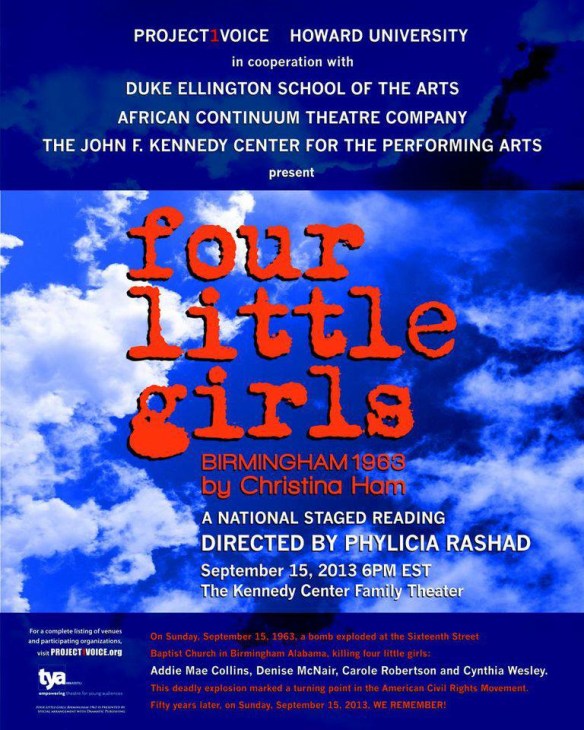
A staged reading of the play "Four Little Girls" streaming live online from the Kennedy Center on September 15, 2013 at 6:00 PM EST.

A staged reading of the play “Four Little Girls” streaming live online from the Kennedy Center on September 15, 2013 at 6:00 PM EST.

…FOUR LITTLE GIRLS

By Leslye Joy Allen

Historian, Educator, Theatre and Jazz Advocate & Consultant, and Doctoral Student

Copyright © 2013 by Leslye Joy Allen.  All Rights Reserved.

There were four little Black girls whose lives were snuffed out on Sunday morning, September 15, 1963 when a bomb planted by racist White terrorists exploded in the Sixteenth Street Baptist Church in Birmingham, Alabama.  They were, Denise McNair who was the youngest at age 11, Carol Robertson aged 14, Cynthia Wesley** aged 14 (**Real and Birth name is “CYNTHIA MORRIS”), and Addie Mae Collins was aged 14.  When that bomb went off, most Black Birmingham citizens and most Black Americans forgot about the “March on Washington,” held a mere eighteen days earlier on August 28.  Not long after the blast, all hell broke loose.  The New York Times headline on the following day read (click here for article): “Birmingham Bomb Kills 4 Negro Girls in Church; Riots Flare; 2 Boys Slain.

Birmingham, then nicknamed “Bombingham,” had an ugly history it would take decades to live down.  A middle class neighborhood in the city had suffered so many bombings that it was nicknamed “Dynamite Hill,” because angry Whites bombed homes to stop Black people from moving into the area.  Dynamite Hill was the neighborhood that honed and developed future Phi Beta Kappa scholar, radical activist, and author Angela Davis.  Yet, that is a story for another essay.  There are those of us, however, who think the story of what and who we lost on that fateful Sunday morning deserves its place in all the national narratives of American history.  I am one of those people; so is actor and activist Erich McMillan-McCall.

My friend, Erich is the founder of Project1Voice, an organization devoted to preserving Black theatre companies and our important historical legacies.  I should add that not only is he a multitalented performance artist with credits on Broadway, national stages, and television, he is also a visionary.  I say he is a visionary, however, with a very important acknowledgement of the type of communities that both of us grew up in as children.  Black women, he emphasizes, were at the center of these communities.  Yet, in several of our usual marathon-long telephone conversations, he has lamented that he is bothered by how Black women’s voices are not only muted or unacknowledged in the historical narratives, but also on the stage, and in the arts.

Erich and I are products of a time when to be young and Black and living in the American South did not necessarily mean that everywhere you went there was danger; what it tended to mean was the Black community in which you grew up was supportive, filled with a great deal of love and encouragement.  There were threats to our wellbeing, to be sure.  Yet, those threats largely came from outside the neighborhoods where we lived.  As much as some very sympathetic White liberal folks and some younger Black Americans have erroneously assumed otherwise, our Black parents and elders made sure we had normal childhoods with school, church, piano lessons, baseball games, concerts, plays, parties, and family picnics.  They did all of this for us in spite of the racism and the perpetual threat of (and often real) racial violence that characterized much of life for us during the 1960s and 1970s.  Erich understands this type of upbringing.

His proactive approach, that provides greater visibility to financially struggling Black theatre companies while engaging educational, civic, and political organizations in this collective struggle for artistic, political, educational, economic, and historical viability is not exactly a new way of doing things.  The Black community that I grew up in was filled with folks who could sing, dance, act, organize, who taught school, practiced medicine, ran businesses, and helped elect Black people to political office—This is what we were/are.  I loved this Black community, and the activism and the theatre it produced.  I still live in the neighborhood my family moved to when I was around the age of eleven.  It has not entirely lost those same qualities that it had during my childhood.  However, I fear that these types of communities become more rare with each passing decade.  At the same time, I am gratified and encouraged by Erich’s embrace of the old collaborative efforts of our neighborhoods and organizations that we remember about our childhoods; and his insistence that those qualities can be modified and used to great affect in the information age.  I hope this is the beginning of a new trend.

Sunday, September 15, 2013, is the 50th anniversary of one of our worst tragedies.  On this date, Project1Voice, in collaboration with Howard University, African Continuum Theatre Company, the Duke Ellington School of the Arts, and the John F. Kennedy Center for the Performing Arts will present a reading of the play “Four Little Girls,” written by Christina Ham, directed by Phylicia Rashad.  It will stream live online at 6:00 PM EST via the Kennedy Center’s website.

Targeted toward young audiences, this will be one of those wonderful opportunities to sit down in front of your computer screens with your children and your friends to watch this important piece of theatre and history—Free of Charge.  You should also check for viewing parties around the country.  Additionally, over thirty Black theatre companies around this nation will be presenting “Four Little Girls” simultaneously on the fiftieth anniversary of this national tragedy.

Erich and I both remember neighborhoods where middle class and working class Black families looked out for each other and each other’s children.  These facts, however, are precisely why the slaughter of Denise McNair, Carol Robertson, Cynthia Wesley** (**born as “Cynthia Morris,” but cited in the historiography and in most news reports as “Cynthia Wesley“) and Addie Mae Collins was so devastating to Birmingham’s Black community and other Black communities throughout the nation.  The reading of this play is not only a way to honor these dead children, but to also recall and remember the kind of stable and warm neighborhoods where all of them and us grew up.  Let us honor these little girls by going home again.  Peace.

Please visit: Project1Voice and the Kennedy Center for the Performing Arts for more information about this play; how to access the play via the internet on Sept. 15, 2013 at 6 PM EST; and for information about other great performances and programs.

Leslye Joy Allen is also a perpetual  and proud supporter of the good work of Clean Green Nation.  Visit the website to learn more about it: Gregory at Clean Green Nation!

Copyright © 2013 by Leslye Joy Allen.  All Rights Reserved.

Creative Commons License This Blog was written by Leslye Joy Allen and is protected by U. S. Copyright Law and licensed under a Creative Commons Attribution-NonCommercial-NoDerivs 3.0 Unported License.  Any partial or total reference to this blog, or any total or partial excerpt of this blog must contain a direct reference to this hyperlink: http://leslyejoyallen.com with Leslye Joy Allen clearly stated as the author.

** Shortly after this blog was published, I, Leslye Joy Allen, was contacted by Fate Morris, the brother of the young girl commonly known in historical and news records as “Cynthia Wesley.”  Fate Morris insisted that his sister’s real name is “CYNTHIA DIANE MORRIS,” and that authorities recorded her name incorrectly the day of the explosion.  Mr. Morris also informed me that he has decided to accept the Congressional Medal for his sister.  Originally he and Sarah Collins Rudolph (sister of Addie Mae Collins) had declined this medal.  Please read the following article about the survivors of this tragedy: “Survivor of ’63 Bombing Seeks Funds”** 

Please join Project1Voice‘s commemoration of the lives of these four little girls: