Democratic Socialists Rising: A View from My Atlanta

by©️Leslye Joy Allen
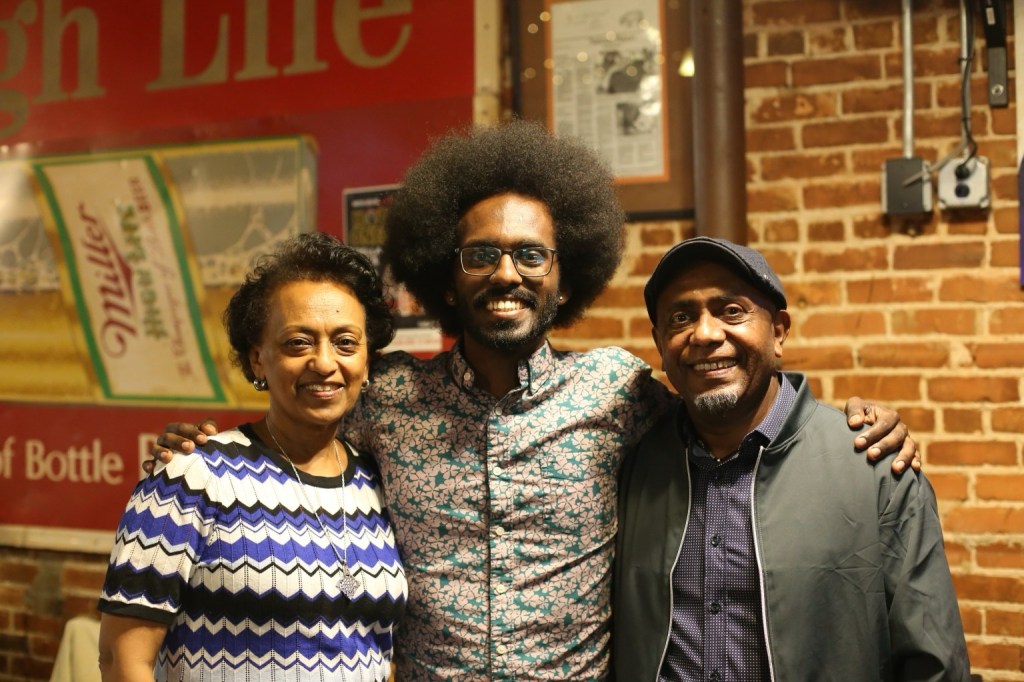
(Mathewos Samson, Georgia House District 58 Representative-elect with his parents.)

Before I do another happy dance over the victory of Democratic Socialist Mathewos Samson who, as of this writing, is the state of Georgia’s House Representative-elect of District 58, let me quickly share a few things about Democratic Socialism’s growing appeal. 

The Democratic Socialist Association’s membership is now roughly and only 100,000 members give or take a few. There are now over 250 Democratic Socialists currently holding public office. And roughly 60% of Americans under the age of 30 view socialism favorably. The uptick in interest in Democratic Socialists began in 2016, with over 90% of them elected after 2019.

Just last year in 2025 after my euphoria over Zohran Mamdani’s win as the newly elected Mayor of New York city, the Washington Examiner published an article titled “Democratic Socialists quietly capture city councils across America” giving credence to the old adage that “All Politics is Local.” It is. And you should pay attention to it.

Yet the point of and the work of the United States’ Democratic Socialists is to build from the ground up—local politics and local accountability are where the people can see the work and the attempts to get the work done. 

I would be remiss if I didn’t acknowledge Atlanta’s first elected Democratic Socialist Liliana Bakhtiari, a native Atlantan elected to the Atlanta City Council in 2022. A native Atlantan of Iranian descent who was raised in Southeast Atlanta, who was also the first Queer and nonbinary Muslim elected. “She/They” was followed by Kelsea Bond as the second nonbinary Democratic Socialist elected to the Atlanta City Council in November 2025. What does this mean? It means that grassroots activism is back. Mathewos Samson campaigned for her (or I should say “they/them”) back in November 2025 and Bond won.

My first introduction to the concept of Democratic Socialism came when I was in my early teens. Salvador Allende of Chile won the presidency as a socialist devoted to democracy. When he was assassinated the talk ranged from him committing suicide (not at all likely) to his being eliminated in a U.S.-backed military coup (completely likely). 

Salvador Allende’s nephew Dr. Juan Allende was my Political Science professor at Agnes Scott College. He never flinched in his moral and ethical convictions. Dr. Allende (who had a Master’s degree in theology) often called himself a “failed preacher.” It was Dr. Allende who not only introduced me to the many African syncretic religions of the Caribbean and Latin America brought here via the Trans-Atlantic Slave Trade, but also to the philosophy and ethics of Afro-American theologian James Cone. Dr. Allende stood firm in his belief in the sanctity of every human being having the right to live the life they saw fit.

As for the old cynics: You have every right to be cynical and to be discouraged. We are living in some very troubling times. Yet, let me remind you what young people are for. They are here to remind you that when we elders put down our batons for the last time that someone else will pick it up. 

If you are Afro-American, Afro-Latin, Afro-Caribbean and all others in the great Afro dispersion you have a duty to your ancestors to place your efforts and your faith in the young, to sit down and let them do the work, and to answer the damned telephone when they call and say “I hit a brick wall, what do you think I should do?” Your wisdom, as well as your restraint, should kick in if you have not indulged yourself in your ego and your own victimization to the point where you no longer understand that you were never intended to finish the race, only to hand over the baton. 

©️Leslye Joy Allen

I am an Independent Historian, Oral Historian and Dramaturge. Please consider supporting my work and research with a few bucks for Coffee and Eggs via my CashApp or PayPal; or become a paid subscriber to me on Substack to help me sustain my research and commentary.

All blogs written by Leslye Joy Allen are protected by U. S. Copyright Law and licensed under a Creative Commons Attribution-NonCommercial-NoDerivs 3.0 Unported License. Any partial or total reference to any blog authored by Leslye Joy Allen, or any total or partial excerpt of any blog authored by Leslye Joy Allen must contain a direct reference to this hyperlink: https://leslyejoyallen.com with Leslye Joy Allen clearly stated as the author.  Postings or blogs placed here by other writers should clearly reference those writers.  All Rights Reserved.

Kill the Snake

by ©️Leslye Joy Allen

Harriet Tubman was a nurse, a scout, and a spy for the Union Army during the Civil War. She is best known, however, as a leader of the Underground Railroad where she led many African American enslaved people from the state of Maryland to head north to Canada.

A majority of Black American runaway slaves never made it to Canada, which was the intended destination. Most of them landed somewhere in the Northeast where American chattel slavery was abolished during the 18th through the early 19th centuries.

I want to point out two things about Tubman and about Black American women during the late 19th century.

First, Tubman always kept a rifle or gun under her dress just in case one of her runaway slaves decided to run back to their plantation. After all, these journeys required hundreds of miles on foot while they worried about bounty hunters who searched for runaways in order to reap financial rewards. Slave patrols roamed all night looking for slaves out after dark without permission. If a slave was caught, punishment was severe, and occasionally fatal.

Tubman let her fellow Black freedom-seekers know that she would shoot them dead before she allowed any one of them to run back to their former owners who would inevitably beat them until they confessed about her mission, which would jeopardize the safety of everyone involved. All of the slaves who headed North with Tubman believed her. She never once had to use her gun.

Second, Tubman was clear about her mission to free and save her people. Her demand to, “Kill the Snake before it Kills you,” was her reference to the slave-holding Confederacy and its Army in the American South.

She did not necessarily want anyone to be killed, but she underscored that the Confederate Army was the Snake; and the Snake had to be stopped no matter the casualties it suffered.

During Reconstruction (1863 to 1877) after the Civil War ended, the Republican Party of the North sought to solidify its political dominance and economic control over the South. So, by 1870 it gave Black men who were former slaves the right to vote.

In spite of the fact that no women were granted the franchise, Black families sat down together and decided together how to cast that one vote afforded to male adults in their households. Many Black men were escorted to the polls by their wives, sisters, and mothers who also hid guns and rifles under their dresses just in case some white southerner/s, aka snake/s, decided to harm these Black male voters.

In this new year of 2025, we are again at a moment in our history where our capacity to protect ourselves and those we love, and our capacity to survive economically and to be free is at stake.

We must face the reality that we may have to do things we never thought we would ever have to do in our lifetimes. We must do more than complain about our representatives who are complacent, thereby complicit, about the objectives of the incoming administration.

We do not yet know what we may have to do. But I think about all of those Black women in the late nineteenth century prepared to protect Black men who were going to vote for the first time in their lives.

I also think about some of my sheroes like Congresswoman and former presidential candidate Shirley Chisholm. I think about her mentee, Congresswoman Barbara Lee. I think about the fact that Black Panther Party membership was 70 percent Black women. Then I think of Vice-President Kamala Harris and former First Lady Michelle Obama.

After I remember all of these sisters I admire, I then think of my late maternal grandmother who was a coed at then Clark College during the Atlanta Race Riot of 1906 with her gun under her dress for her protection. I then remember my paternal aunt who had molotov cocktails thrown at her during protest marches in the 1960s, and one thrown in her home because she dared to register Black folks to vote.

Then I remember Tubman’s order to “Kill the Snake before it Kills you.” Then I prepare myself in the event I have to carry out this order, figuratively and literally.

©️Leslye Joy Allen

(Photo of Harriet Tubman by Harvey B. Lindsley, ca. 1871-1876, courtesy of the Library of Congress)

All blogs written by Leslye Joy Allen are protected by U. S. Copyright Law and licensed under a Creative Commons Attribution-NonCommercial-NoDerivs 3.0 Unported License. Any partial or total reference to any blog authored by Leslye Joy Allen, or any total or partial excerpt of any blog authored by Leslye Joy Allen must contain a direct reference to this hyperlink: https://leslyejoyallen.com with Leslye Joy Allen clearly stated as the author.  Postings or blogs placed here by other writers should clearly reference those writers.  All Rights Reserved.

Guide My Feet…

by Leslye Joy Allen

“Guide My Feet”
(Traditional Negro Spiritual)


Copyright © 2015 by Leslye Joy Allen. All Rights Reserved.

I am grateful that my late Mama and Daddy taught me our old African tradition of ancestor worship.   That worship was as much a part of my childhood as was the old Western Judeo-Christian tradition…Now, for those who know me well, you know that I can be the most severe critic of ministers and organized religion(s) that too often fail to act in the best interests of the flocks they claim to serve, lead and protect.  Yet, that is another blog.  Save your breath.  I am only responding to the message(s) sent to me…

I occasionally re-read the poem that my friend actor-poet-writer Charles Reese wrote immediately following the death of my nearly 92-year-old mother in early 2013.  In homage to her, he referred to my Mama as “a Queen,” but he also referred to her as “our newest ancestor.” — Nothing in “Syble’s Poem” struck me as much as that line about her becoming an ancestor.  For people who know my late Mama, they know that certain songs remained in her repertoire right up to the very end of her days here on earth.

I do not need to recount the tragedies that have happened to Black folk in the last few weeks or even over the last year.  Yet, for the last couple of days I have been unable to get the old Negro Spiritual “Guide My Feet” out of my head.  Composed and sung in the caldron of American chattel slavery and passed down from generation-to-generation by my people, I have been singing it and humming it off-and-on for the last couple of months.  At first, I thought I was going crazy.  I must confess that I had a similar experience with “You Gotta to Move,” a Gospel/Blues song composed by Mississippi Fred McDowell.  A few months earlier in the year, I was singing “You Gotta Move” in an impromptu singing session that followed a gathering of my Sistahs that was a combination of good coffee, prayer, testimony, and truth-talking with each other at Dream Café…A few days after that meeting, I ran into a brother in a wheelchair who was singing the same song on a corner in downtown Atlanta.  That had to mean something, I thought…

When I went to my cousin Dexter’s graduation from Morehouse College this past May 2015, the class Valedictorian and Summa Cum Laude graduate Jerek Sharrod Brown burst into “Guide My Feet” before he began his inspirational and spellbinding Valedictory address.   His voice in song was an unexpected, but welcome and perfectly poetic pleasure.  I felt something inside of me shift and move when Brown sang and when he spoke.  I felt something shift again when my cousin Dexter’s name was called as a new graduate of Morehouse College. After all, I remembered when I first held him in my arms when he was still an infant…

Today I decided to see whether the lyrics to “Guide My Feet” would come up in a general search on Google.  It did.  Now, usually when something comes up in an internet search, I typically download it and then email it to myself just to make sure that I have a couple of copies of my research findings in two different places.  Yet, something strange and beautiful happened after I performed my usual ritual…

When I clicked the email button to send my Google search findings to myself, the email did not pull up my personal email address.  Instead, it opened my late Mama’s email address which was and remains a secondary email account affiliated with my own primary account…Sometimes the Creator knows that you need a little help.  Sometimes the ancestors are talking to you…

There are moments when no matter how bad things are or may seem, you simply do not worry and you no longer expend energy on people who do not work in your and your own people’s best interests.   I have reached that moment. More than we know or acknowledge, the ancestors speak to us in small but important ways if WE only listen, if WE only listen…So, Thank You Mama and Daddy and all the known and unknown ancestors and saints…Thank You Goddess…Thank You God…Peace and Blessings.  Àṣé…

Guide my Feet,

while I run this race.

Guide my Feet,

while I run this race.

Guide my feet,

while I run this race,

For I don’t want to run this race in vain.


Copyright © 2015 by Leslye Joy Allen. All Rights Reserved.

This Blog was written by Leslye Joy Allen and is protected by U. S. Copyright Law and licensed under a Creative Commons Attribution-NonCommercial-NoDerivs 3.0 Unported License. Any partial or total reference to this blog or any total or partial excerpt of this blog must contain a direct reference to this hyperlink: http://leslyejoyallen.com with Leslye Joy Allen clearly and visibly stated as the author. All Rights Reserved.


Why We Fail: Forgetting Malcolm and Martin’s Internationalism

Weary Self-Portrait 2 “Weary Self-Portrait 2” (Copyright © 2014 by Leslye Joy Allen. All Rights Reserved.)

by Leslye Joy Allen

Copyright © 2014 by Leslye Joy Allen. All Rights Reserved.


As bad as things are in the USA—in particular, the killing of a young Black man named Michael Brown in Ferguson, Missouri—what we Black Americans are enduring is “a cakewalk” by comparison to some of the tragedies that are currently taking place in India, parts of Africa, Iraq, Israel, and so many other places around the world.  Yet, our current Black leadership has been conspicuously silent on so many of these international matters, including the excessive policies of Israel against an already displaced Palestinian people.  Yet, Arab, Jewish, African, and African American women found enough of a unified voice to write a statement of solidarity with the Palestinian people.  I wonder why they could do it, but not our elected officials.  These women understand an important component of previous human rights struggles—including the Civil Rights and Freedom struggles that took place during the 1950s well into the 1970s in the United States—the international component.

Martin Luther King, Jr. and Malcolm X always placed Black American freedom struggles in an international context.  If you do not believe me, then read or listen to Malcolm X’s “Message to the Grass Roots” and listen to him rattle off the names of those nations and peoples that too many of us frequently ignore.  Listen to King speak poetically and prophetically against the Vietnam War.  These are only a few examples, often scary examples.  Yet, there are many others.

What happened to Michael Brown in Ferguson, Missouri is going to resonate with other people in other parts of the world.  When we lost Trayvon Martin, you found people across the globe putting on “hoodies” in solidarity.  And, if it were not for the women of Nigeria taking full advantage of social media, most of us would never have known anything about the kidnapping of the Nigerian girls, who have still not been returned to their families.  Yet, when was the last time you saw a massive movement of Black Americans speaking out against and lending assistance to anyone outside of the USA.  Arguably, there has been no massive international activity on OUR part, at least not since the zenith of an internationally led movement that demanded that colleges and businesses divest from South Africa in protest of the country’s brutal and virulent social system known as apartheid, and that was in the late 1970s into the 1980s.

The question is when are we going to get our international legs back, and stop looking at what and who we are as if we are isolated in one country called the United States.  Does it not matter that two teenage Indian girls were gang-raped, and then lynched just a few months ago in Bengal, India?  Does it not matter that several hundred Nigerian girls were kidnapped and—sorry to say this—will probably never return to their families?  Does it not matter that former UK Prime Minister Gordon Brown has stayed on top of the problem in Nigeria and spoken out about this problem of female trafficking in Nigeria and elsewhere, and more often than many Black American politicians and self-appointed pundits?  You are damned right it matters.

I can count on one of my former English professors to regularly post articles and his own occasional eloquent outbursts on his page on Facebook about many of the atrocities that happen to women worldwide and, also what happens to Black Americans—He, however, was born in Pakistan.  The Executive Director of Greenpeace International was born and raised in South Africa, and spent his teenage years in the anti-Apartheid movement.  He regularly articulates how women’s oppression, the problems with the environment and human rights struggles are tied together.  I knew something had become completely out-of-whack when the only men I could count on—with any real regularity—to lend their voices and support against sexism were men of color who were also NON-American.  The difference is, they can and do connect the dots and see environmental problems, discrimination and the persecution of women, and battles to end racism and/or ethnic violence as connected problems in ways that so many Americans simply do not.  Yet, a few Black Americans do connect the dots, but they are not part of what is traditional Black leadership, which is a good thing.

Ron Davis, the father of Jordan Davis—the Black teenage boy that was killed in Florida when a man shot into his vehicle over a quarrel about loud music—took his complaint about the senseless murders and expendability of young Black men to Geneva, Switzerland at the 85th annual meeting of the Committee on the Elimination of Racial Discrimination.  The talks in Geneva run from August 11 through August 29, 2014. This was a bold move by Mr. Davis, but proof positive that he was paying attention in the sixties and seventies when international opinion about the United States government’s slow response to discrimination and racial virulence damaged the USA’s image abroad.  Both Mr. Davis and the women of all colors and nations who signed that Solidarity Pledge fully understand what Malcolm X and Martin Luther King, Jr. tried to teach.  We can hope that some citizens in Ferguson, Missouri are paying attention.

Now, thinking internationally or being concerned with tragedies or the well-being of people outside of the United States will not stop police officers from killing unarmed Black male teenagers.  My interest and sadness over the senseless gang rape and lynching of two teenage girls in India several months ago will not stop the rape and abuse of women anywhere, neither will my continued anguish over the kidnapping of girls in Nigeria.  Yet, to be a Black woman born and raised in the American South is to understand that racism and sexism come from all quarters of the country of my birth, and indeed all quarters of the world itself.

To fail to see the connections I have with peoples who may or may not speak my language or belong to the same racial and/or ethnic and/or gender group is to forget the real lessons of the Civil Rights Movement—that WE are not alone if WE will simply acknowledge that WE need allies, and international allies at that.  Yet, WE will be alone if WE operate from the position that people in other parts of the world do not have anything to teach us.  WE cannot afford to function from the position that because WE dwell in the United States that no one else’s problems or persecution matters as much as ours matter.  If WE do, WE will have missed Martin and Malcolm’s most important lesson, namely that if WE labor alone, WE, and everybody else, will lose.

Copyright © 2014 by Leslye Joy Allen. All Rights Reserved.

CCThis Blog was written by Leslye Joy Allen & is protected by U. S. Copyright Law and licensed under a Creative Commons Attribution-NonCommercial-NoDerivs 3.0 Unported License. Any partial or total reference to this blog, or any total or partial excerpt of this blog must contain a direct reference to this hyperlink: http://leslyejoyallen.com with Leslye Joy Allen clearly and visibly stated as the author. All Rights Reserved.

The Change Agents: A Thought for February

By Leslye Joy Allen                                                                                                     Historian, Educator, Theatre and Jazz Advocate & Consultant, Ph.D. Candidate

Copyright © 2014 by Leslye Joy Allen.  All Rights Reserved.

Leslye Joy Allen, Copyright © 2013.  All Rights Reserved.  Self-Portrait.

Leslye Joy Allen, Copyright © 2013. All Rights Reserved. Self-Portrait.

Several months ago I heard Black British film director Steve McQueen (not the now-deceased White actor), say that art did not change anything.  I clutched my chest as if I was surely having a massive heart attack at what must be blasphemy.  Later, I figured out what McQueen meant.  Art alters and suspends that space in your head where your creativity and out-of-the-box thinking is located, and then YOU might be able to change yourself or your situation or your mind.  Art is the match or spark, which lights the fire in the potential change agent—YOU!

Now, history has taught us that my brothers and sisters, Black Americans, have, at least since the early twentieth century worked diligently to create art—paintings and sculpture, music and dance, or theatre—that they imbued with the herculean task of changing the way the rest of the world looks at us, and how we look at ourselves.  Too often, the belief is that an artistic representation of us, once seen or experienced, will alter the way others think of us.  This is why so many of my brothers and sisters can hyperventilate until they burst into a sweat (or burst a blood vessel) about a film or television characterization of us that is a pathetic and insulting stereotype or caricature of us that strays far from the truth. Typically, what happens next is a mad search for the most exceptional among us.

This February, 2014, I have been guilty of what WE historians call “chronicling.”  Chronicling is posting basic information about a person or event, often in date order, which we think, or believe to be of “historical significance,” whatever that means.  For Black folks, Black History Month reeks of an unsavory type of history that I, and others, also call “Great Man/Great Woman” history, or “Unsung Man/Unsung Woman” history.  I call it unsavory because it never really satisfies—It is the history of our people whom we see (or have been taught to see), as exceptional, or the exception to the rule.  I am also as guilty of it as anybody else.  Yet, this month, February 2014, in many of my Facebook and Twitter posts, I deliberately focused on Black people that have contributed to or participated in theatre.  I did not do this to simply cast a light on Black folks in the theatre that I think everyone should know about.  It was also designed to cast a light on Black theatre itself, something Black folks, those who were theatre professionals and those who were not, used to participate in on a regular basis as a matter of ritual, as a matter of teaching and learning, as a matter of lifting the spirit.

It did not matter whether the person(s) had talent or not, theatre was what WE did for each other and for ourselves.  In the early days of the twentieth century, theatre had not yet become the rather parochial profession as some folks think of it today, but rather it remained an essential exercise in the communal rituals we always participated in as a people.  After all, nobody said you needed talent to recite an Easter Speech or to memorize and recite a poem, did they?  Mama, Daddy, Grandma and Grandpa all thought you “did good” up there on that stage even if you would never, ever be able to act or sing your way out of a jar, to say nothing of survive an audition.  I say all of this to make a few simple points…

Take one moment and forget about “Great Man/Great Woman History.”  Forget about “Unsung Man/Unsung Woman History,” and begin to look at your mothers, fathers, grandparents and others who belong to so many generations before you as the “multi-talented,” “multi-hat-wearing,” “multi-title-holding,” “multi-I’m-going-to-get-this-done-if-it-kills-me” people that they were.  When you do this, you will begin to measure greatness not by accolades and plaques, but by how well something they did served them, saved them and you, and whether it is or is not possible for you to emulate them.  Then you will find out everything you ever needed to know that never went into a History Book or on the cover of a magazine or in a documentary about our/your people.  You will then find that match or spark that ignites you—the change agent!  Ashé!

Leslye Joy Allen is a perpetual and proud supporter of the good work of Clean Green Nation.  Visit the website to learn more about it: Gregory at Clean Green Nation!

Copyright © 2014 by Leslye Joy Allen.  All Rights Reserved.
Creative Commons License This Blog was written by Leslye Joy Allen and is protected by U. S. Copyright Law and licensed under a Creative Commons Attribution-NonCommercial-NoDerivs 3.0 Unported License.  Any partial or total reference to this blog, or any total or partial excerpt of this blog must contain a direct reference to this hyperlink: http://leslyejoyallen.com with Leslye Joy Allen clearly and visibly stated as the author.