The Souls of Poets

What a Hiatus From Social Media Can Do

by©️Leslye Joy Allen

I have taken brief three to four-day hiatuses from all forms of social and electronic media before and been rejuvenated and recalibrated. I still remember a psychiatrist who openly questioned whether 24 hour news or 24 hour headlines and blurbs online were healthy or whether they really got a message out. That was about 20 years ago.

I have watched stories that trend for days and even weeks. Anything repeated long and often enough can usually be memorized or even absorbed, but whether you understand it intricately or not remains to be seen. Whether you feel anything after a certain point also remains to be seen. 

I need not be told that our current sitting president is a racist and a sexist and a sexual predator and a crazy man for the got-damned 10,000th time when slightly over half the population that voted in this country voted for him. He is an easy topic because he’s a shock show designed to distract. You may learn something new that just happened, but I never learn anything new about him. He was an abomination beneath being classified as human when I first learned anything about him back in 1989.  He was then, and remains, like so many of the soulless, including those who never knew and still don’t know that they never had a soul.

When someone decided to try to be a copycat of my Substack account on Monday, September 14, 2026, several wonderful people on Substack jumped into gear to report the imposter; and soon the duplicate was gone. Yet, after taking some days away from all social media my brain processed the offense differently. 

Some people hack, copy, falsify, pretend and troll much of the time for kicks; and to get jobs (hackers get hired); and to breach people’s bank accounts; and also because they have little else to do. They duplicate pages and names and images, but my gray matter—my brain belongs to me. 

I spoke with an old boyfriend from high school a few days after the incident who said, “If I put on a blindfold and someone read me two paragraphs of yours, I would know it was you.” We laughed and reminisced about when we were both young and inquisitive and now we are much older and inquisitive.  Aging is a blessing denied to many people. Good memories are also denied, as so many folks never have any because they never go offline long enough to make any.
When I hung up the phone it occurred to me that I never liked, loved or befriended any boy or man that didn’t have the soul of a poet whether he could write poetry or not. To be able to or just to want to be able to take a phrase that, on the surface, seems abstract and make it mean something else or several something else’s is a gift, a gift that requires that you not just look at the world and your circumstances, but that you have the capacity to see the beauty or joy or even the sadness or terror in those circumstances. 

My quartet of college English professors: Dr. Waqas Ahmad Khwaja, Dr. Willie Tolliver, Dr. Christine Cozzens and Dr. Steven Guthrie taught me that a historian was a much better historian if that historian loved or could write poetry or fiction. The idiosyncrasies of being a human being are detailed, clothed and disrobed in haiku, sonnets, odes, elegies, cinquain, and free verse the way a couple whose marriage is over, but who cannot completely let go, so they create an ongoing argument, a conflict that lasts their lifetimes just so they can hold on to a piece of what can no longer be.

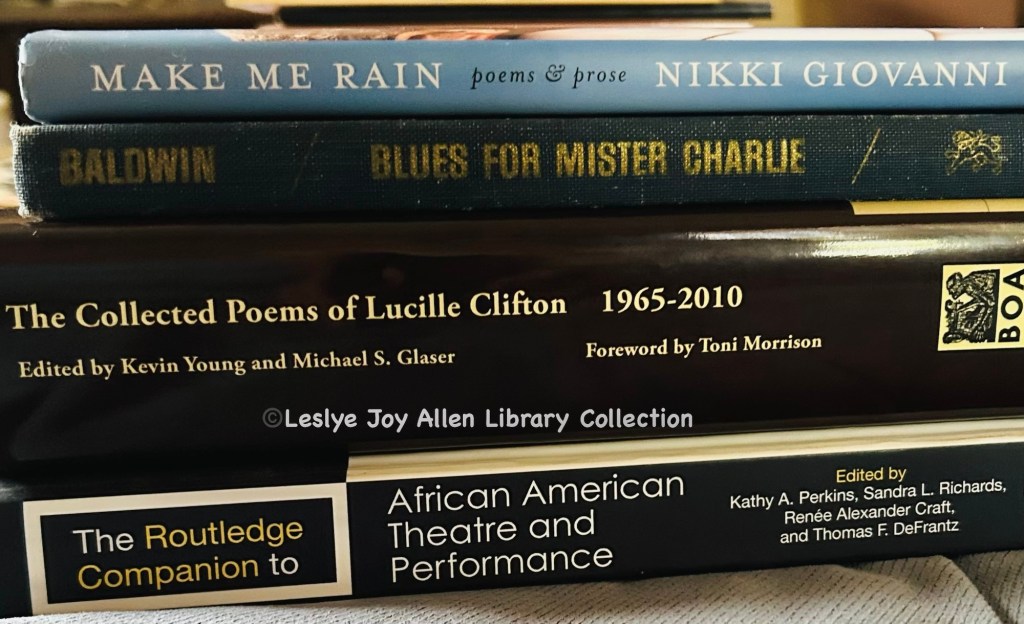
While away from the grind of scrolling on social media I finished reading three books and one stage play that was so good I couldn’t put it down. I peeked out my window long enough to watch my neighbors’ two small children giggling and playing with their two dogs in their front yard. A father and daughter passed by on their bicycles.

Then when I returned to the internet I saw a headline from a three-day-old news story where the U. S. Military used A. I. to write a report that, in error caused the United States military to begin preparations to militarily strike China and/or to prepare itself to be struck by China. Whatever. The cataclysm was averted. For a nanosecond I felt fear.

Then my fear completely disappeared because the job was done. I have written this before, but this oxymoron bears repeating: Anything intelligent cannot be artificial; and anything artificial cannot be intelligent. The underlying purpose of A. I. is confusion and fear, to convince citizens that machines and algorithms can wreak havoc in a split second. The constructors of A. I. are in testing mode—one week it may pose a threat to a forest, a water supply, a military base, a foreign enemy, or to a specific group of people. 

Then after enough non-thinking humans are reasonably subdued to the whims of A.I., the plans to make it safer, less invasive will come along. Jobs will be offered where those who are employed can deliver well-crafted messages about how it is now under control with dozens of benefits to humans that no one realized in its infancy. 

The only problem is that the ones who crafted A.I., who designed it, who will propagate it and implant its alleged benefits and its alleged problems in susceptible brains will not be creators who are able to write a poem or even murmur a few words and phrases that come from the heart or the gut. Emotions, perhaps even love itself, could be rendered suspect because love has never followed a formula. 

If there are any deaths that could come from the whims and malfunctions of machines, the deaths on fields of battle or the obliteration of entire towns will come much, much later, if they come at all. The first deaths will be slow, caused by the absence of the souls of poets, those that can still find their way in the dark; those that know when to refrain from saying something; those that can say it another way to make people feel better without telling a lie instead; those that can remember childhood games and youthful romances and mischief well enough to care about the young ones who will outlive them, not just care about themselves or the here and now.

©️Leslye Joy Allen

I am an Independent Historian, Oral Historian and Dramaturge. Please consider supporting my work and research with a few bucks for Coffee and Eggs via my CashApp or PayPal; or become a paid subscriber to me on Substack to help me sustain my research and commentary.

All blogs written by Leslye Joy Allen are protected by U. S. Copyright Law and licensed under a Creative Commons Attribution-NonCommercial-NoDerivs 3.0 Unported License. Any partial or total reference to any blog authored by Leslye Joy Allen, or any total or partial excerpt of any blog authored by Leslye Joy Allen must contain a direct reference to this hyperlink: https://leslyejoyallen.com with Leslye Joy Allen clearly stated as the author.  Postings or blogs placed here by other writers should clearly reference those writers.  All Rights Reserved.
Democratic Socialists Rising: A View from My Atlanta

by©️Leslye Joy Allen

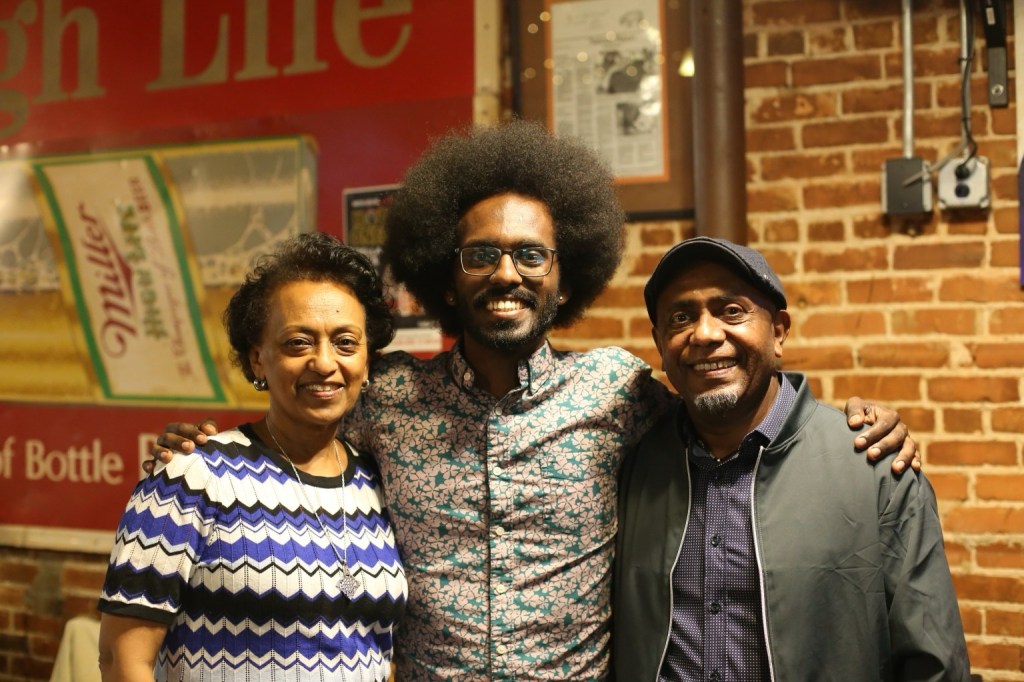
(Mathewos Samson, Georgia House District 58 Representative-elect with his parents.)

Before I do another happy dance over the victory of Democratic Socialist Mathewos Samson who, as of this writing, is the state of Georgia’s House Representative-elect of District 58, let me quickly share a few things about Democratic Socialism’s growing appeal. 

The Democratic Socialist Association’s membership is now roughly and only 100,000 members give or take a few. There are now over 250 Democratic Socialists currently holding public office. And roughly 60% of Americans under the age of 30 view socialism favorably. The uptick in interest in Democratic Socialists began in 2016, with over 90% of them elected after 2019.

Just last year in 2025 after my euphoria over Zohran Mamdani’s win as the newly elected Mayor of New York city, the Washington Examiner published an article titled “Democratic Socialists quietly capture city councils across America” giving credence to the old adage that “All Politics is Local.” It is. And you should pay attention to it.

Yet the point of and the work of the United States’ Democratic Socialists is to build from the ground up—local politics and local accountability are where the people can see the work and the attempts to get the work done. 

I would be remiss if I didn’t acknowledge Atlanta’s first elected Democratic Socialist Liliana Bakhtiari, a native Atlantan elected to the Atlanta City Council in 2022. A native Atlantan of Iranian descent who was raised in Southeast Atlanta, who was also the first Queer and nonbinary Muslim elected. “She/They” was followed by Kelsea Bond as the second nonbinary Democratic Socialist elected to the Atlanta City Council in November 2025. What does this mean? It means that grassroots activism is back. Mathewos Samson campaigned for her (or I should say “they/them”) back in November 2025 and Bond won.

My first introduction to the concept of Democratic Socialism came when I was in my early teens. Salvador Allende of Chile won the presidency as a socialist devoted to democracy. When he was assassinated the talk ranged from him committing suicide (not at all likely) to his being eliminated in a U.S.-backed military coup (completely likely). 

Salvador Allende’s nephew Dr. Juan Allende was my Political Science professor at Agnes Scott College. He never flinched in his moral and ethical convictions. Dr. Allende (who had a Master’s degree in theology) often called himself a “failed preacher.” It was Dr. Allende who not only introduced me to the many African syncretic religions of the Caribbean and Latin America brought here via the Trans-Atlantic Slave Trade, but also to the philosophy and ethics of Afro-American theologian James Cone. Dr. Allende stood firm in his belief in the sanctity of every human being having the right to live the life they saw fit.

As for the old cynics: You have every right to be cynical and to be discouraged. We are living in some very troubling times. Yet, let me remind you what young people are for. They are here to remind you that when we elders put down our batons for the last time that someone else will pick it up. 

If you are Afro-American, Afro-Latin, Afro-Caribbean and all others in the great Afro dispersion you have a duty to your ancestors to place your efforts and your faith in the young, to sit down and let them do the work, and to answer the damned telephone when they call and say “I hit a brick wall, what do you think I should do?” Your wisdom, as well as your restraint, should kick in if you have not indulged yourself in your ego and your own victimization to the point where you no longer understand that you were never intended to finish the race, only to hand over the baton. 

©️Leslye Joy Allen

I am an Independent Historian, Oral Historian and Dramaturge. Please consider supporting my work and research with a few bucks for Coffee and Eggs via my CashApp or PayPal; or become a paid subscriber to me on Substack to help me sustain my research and commentary.

All blogs written by Leslye Joy Allen are protected by U. S. Copyright Law and licensed under a Creative Commons Attribution-NonCommercial-NoDerivs 3.0 Unported License. Any partial or total reference to any blog authored by Leslye Joy Allen, or any total or partial excerpt of any blog authored by Leslye Joy Allen must contain a direct reference to this hyperlink: https://leslyejoyallen.com with Leslye Joy Allen clearly stated as the author.  Postings or blogs placed here by other writers should clearly reference those writers.  All Rights Reserved.
A Personal Prayer of Cuba

by ©️Leslye Joy Allen

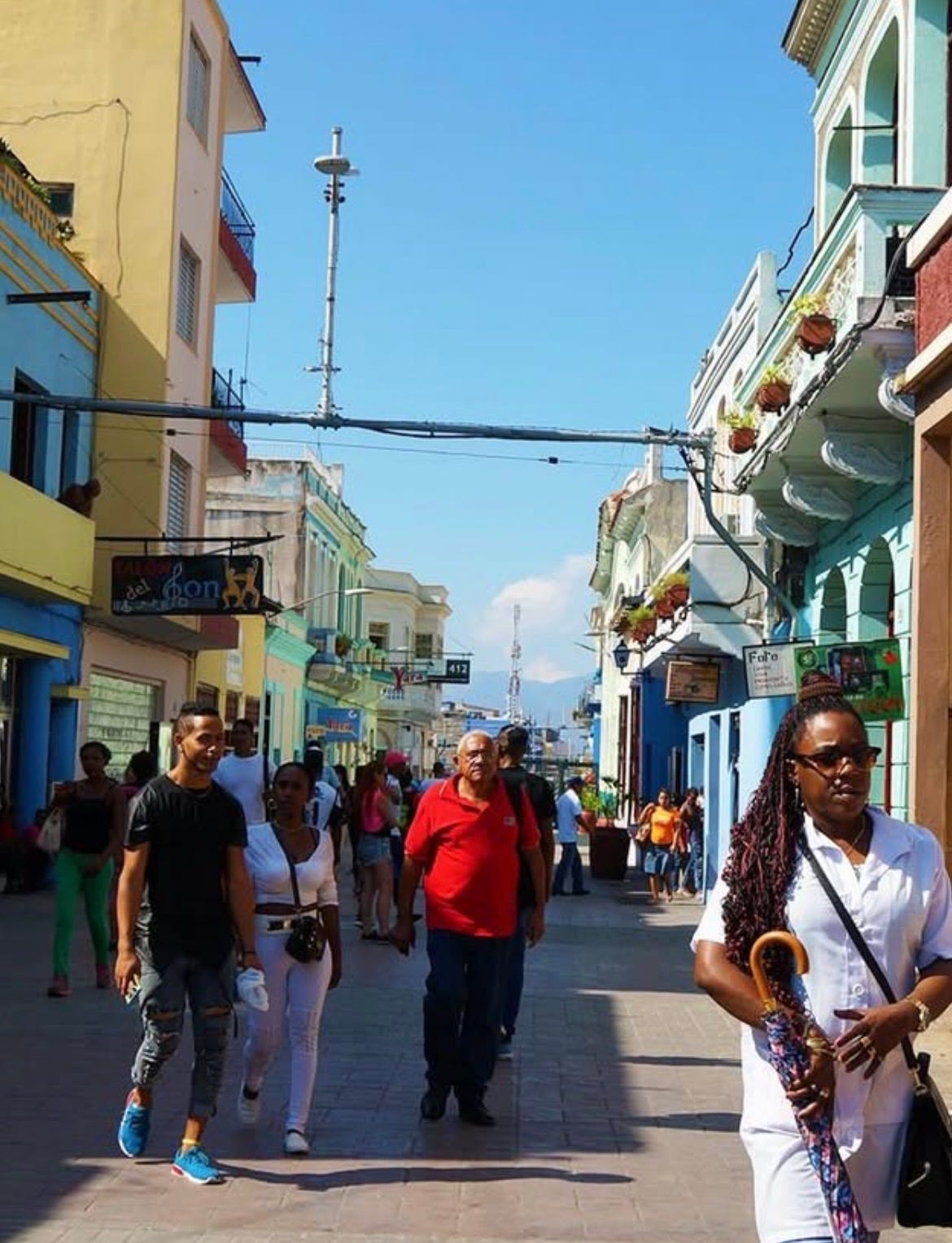
The following below that is written in italics is partially a meditation on Cuba. It is a response I wrote to a piece about Cuba’s current crisis exacerbated by American neglect and cruelty that was written by Arturo Dominguez. A link to his exceptional article is at the very end of this essay. What’s in italics is a rumination I wrote to Arturo:

“I still remember reading that when Afro-Cuban musical artists came to perform in the United States that they had to perform in the U.S. for free. When asked why they were willing to perform for nothing, the answer was always the same: “We want to see where Dizzy Gillespie was born.”

Thanks for this report Arturo Dominguez because every time there is a sanction, a deprivation, I am reminded that no one suffers in Cuba but the people themselves. I still remember the heinous and wretched Helms-Burton Act which banned ships who docked in Cuba’s ports from docking in the United States for several months.

I remember my professors having to fly out of Atlanta to Canada and then taking a flight from some airport in Canada to Havana to do whatever research they were performing on their visits.

The United States has done nothing but made an example of Cuba as a message to other countries in Latin America and the Caribbean that says “This is how far we’ll go; this is how bad we’ll treat you, if you don’t fall in line.”

I might just turn this comment into a meditation.”

A few moments after reading Arturo’s essay I stumbled on one of my favorite thinkers Vijay Prashad who also was offering his thoughts on the viciousness of the United States government against the Cuban people because it is the people that suffer—No one else. (A link to Vijay’s essay is at the end.)

I don’t have the strength to comment on Prashad’s piece right now except that it is brilliant and accurate. I will leave it to you dear reader to examine both his and Arturo’s essays at your leisure. I have only one thing to say.

One line of my paternal family was sold as slaves from Santiago de Cuba to the mainland United States during the period of slavery in this Western hemisphere. My paternal great grandmother was born a slave named Mollie Laws. Her previous family surname was Layende. 

Like most people during the 1700s and 1800s, when one moved (or was sold) some place else the last name was changed to adapt to the new culture one was inhabiting. In the United States, it was typically expected that you Anglicize your name to something that English speakers could pronounce. So “Layende” became “Laws.”

Anyhow I used to relay my personal history to my History students in an effort to make sure that they understood that Chattel slavery took place throughout the Western world. Importantly, what we now call the United States received less than 6 percent of all the Africans transported to this hemisphere during the trans-Atlantic slave trade. The majority of Africans (around 95 percent) landed in what is now named Latin America and the Caribbean. 

I don’t have any deep analysis here about how difficult Afro-American genealogy can be. I don’t have any deep commentary about the many cultures and cultural differences that exist between all of the descendants of Africa who occupy this hemisphere except I have always known that for better or worse I belong to them.

Right after I read Arturo’s essay and then Vijay’s essay, I recalled a favorite memory from the classroom. A student whose name escapes me now came to class after Spring Break with a faded photograph he took while out on the Atlantic ocean. 

He learned that I had roots in Cuba and so did he. He pulled out this faded photo taken on the water. Far off in the distance I saw something that looked like a line stretched across the water. 

“What is that long line in the water that I see in the distance?,” I asked. 

That line across the water in the distance is Cuba, Ms. Allen. I hope you get there someday.” 

©️Leslye Joy Allen

I am an Independent Historian, Oral Historian and Dramaturge. Please consider supporting my work and research with a few bucks for Coffee and Eggs via my CashApp or become a paid subscriber to me on Substack to help me sustain my research.

All blogs written by Leslye Joy Allen are protected by U. S. Copyright Law and licensed under a Creative Commons Attribution-NonCommercial-NoDerivs 3.0 Unported License. Any partial or total reference to any blog authored by Leslye Joy Allen, or any total or partial excerpt of any blog authored by Leslye Joy Allen must contain a direct reference to this hyperlink: https://leslyejoyallen.com with Leslye Joy Allen clearly stated as the author.  Postings or blogs placed here by other writers should clearly reference those writers.  All Rights Reserved.
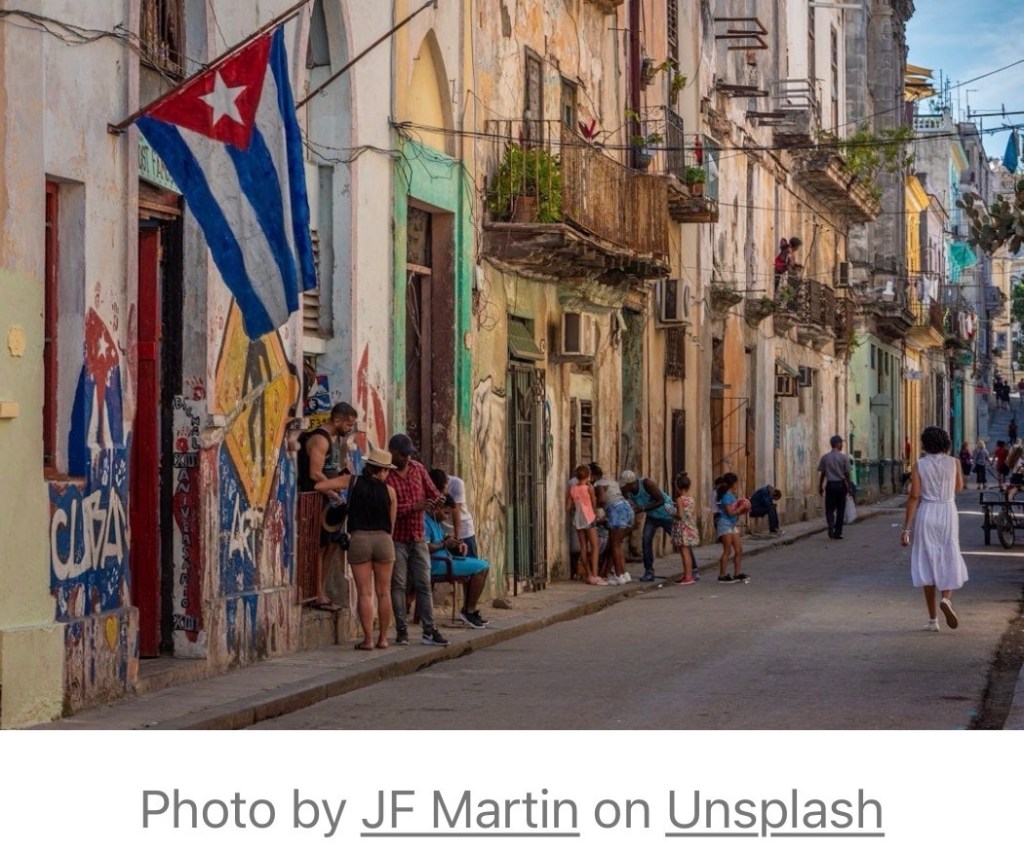
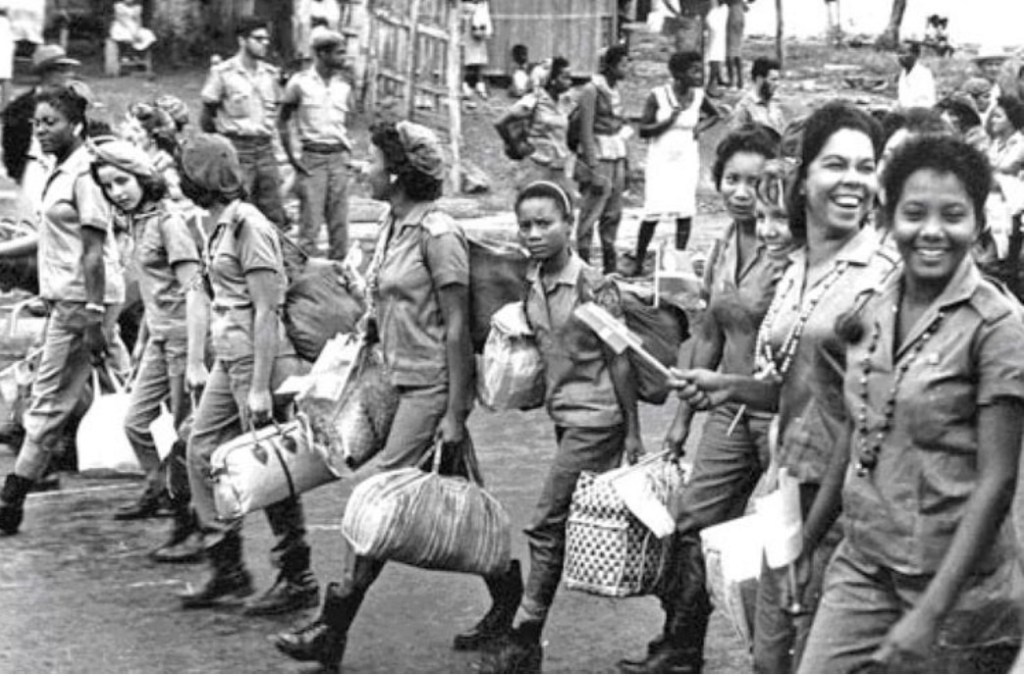
Hyperlinks to additional articles are below photos.

(from Analysis: Cuba on the Brink)

(from Why is the United States Afraid of Cuba?)

The Black Study Group That Transformed a Generation: The Afro-American Association

by © Leslye Joy Allen

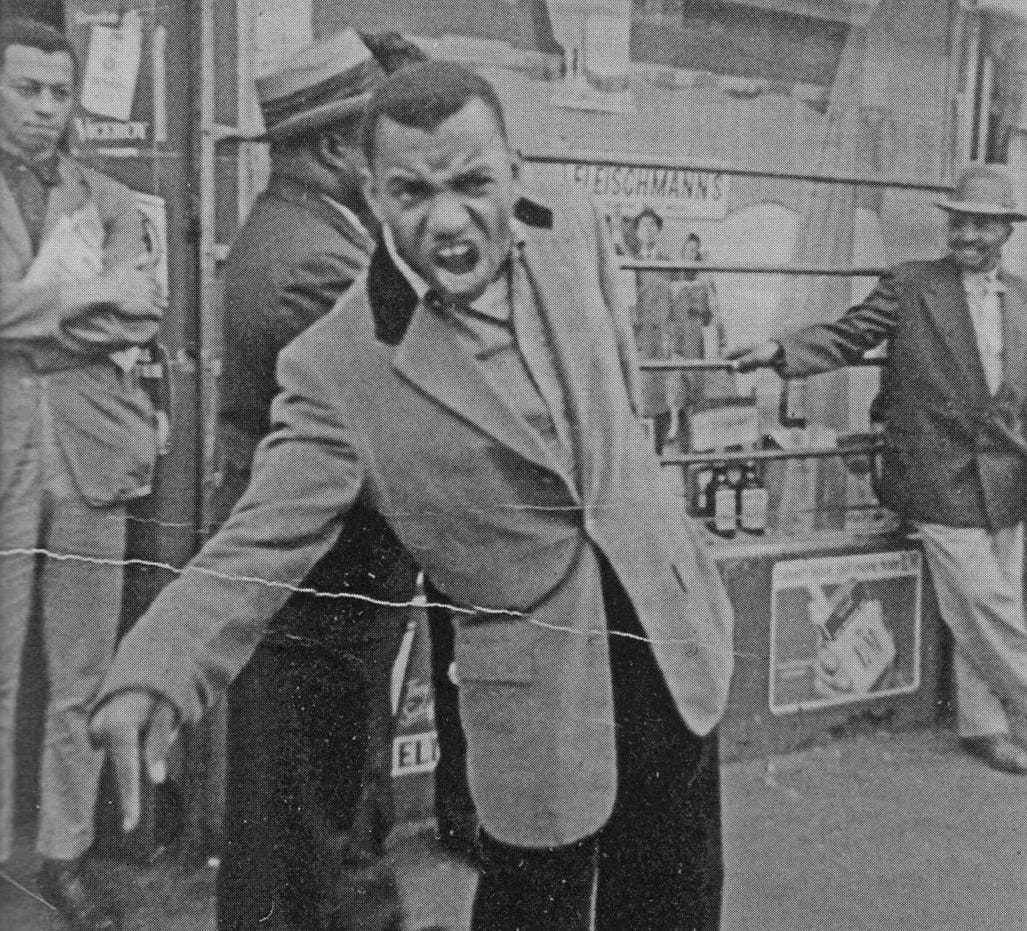
The photo below of Don Warden is from the archives of Khalid and Jamila al Mansour. Don Warden was one of the founders of the Afro-American Association at the University of California at Berkeley. The other founding members were Donald Hopkins, Otho Green, and Henry Ramsey. 

This organization formed in late 1961 and began as a student study group in 1962 at the University of California at Berkeley when there were literally no identifiable Afro-American and African Studies programs on any U. S. college and university campus. The group devoured works by Ralph Ellison, W.E.B. DuBois and other Black scholars that were left out of many colleges curricula. Study meetings of its members initially began at the off-campus home of a UC Berkeley student, and grew from there. In fact, chapters of this organization appeared on hundreds of college campuses in the United States with members numbering in the thousands by the mid-1960s.

The objective of the group was to read and study about the Afro-American, African, and Afro-Diasporic past in order to confront the institutional racism, colonialism and bigotry found in the United States and throughout the world. 

Warden, a UC Berkeley law student, regularly went into Black neighborhoods and literally spoke to young Black citizens directly on street corners or wherever they were. He encouraged them to study about Afro-American and African history in order to fight against their feelings of worthlessness that often accompanied experiencing chronic racism. 

He listened to them tell him about their problems of unemployment, poor housing, you name it. He, like most of his members, espoused that in order to change all systems of oppression, one needed to study about the past in order to do so. Warden eventually became a lawyer for the Black Panther Party of Self-Defense as well as granting legal assistance to the Nation of Islam when Malcolm X was still a member of the group.

The Afro-American Association was heavily influenced by the ideologies of Black American activists Robert F. Williams and Malcolm X. The AAA understood that only sustained study of Black people/s would foster the kind of thinking and strategies for combating systems that sought to suppress and control Black and Brown communities all over the world. Only deep research would correct the far-too-often feelings of inadequacy that came with being Black and oppressed. 

In 1962 when this study group, that was soon named the Afro-American Association, began its study group meetings at UC Berkeley there were roughly only about 100 Black students out of 20,000 white students. And in 1962 there were only two members of the group that were not born in the United States. One was from Jamaica; the other was from India.

In 1962 this tall, skinny, young Black man from Orange Hill, Jamaica and this petite and short, very brown young woman from Chennai, Tamil Nadu (in Southern India) dressed in her Sari and sandals met in an AAA group meeting.

The young man from Jamaica gave a pristine evaluation of how Great Britain had created a rather stiff and proper group of elite Black Jamaicans that often mimicked the mores and habits of British society. It was done, he said, to shield the world from knowing how racist the British empire actually was. The young man was calm, studious with very edgy ideas about the colonization of Black people/s around the world. 

The young brown woman in her Sari and sandals was intrigued. She too had been a British subject in her native state of Tamil Nadu in southern India. She knew something about what this young man spoke of, but not all of it. Back then, the typical path for academically talented Indian and Jamaican students was to study in England, that is if they could secure a path to graduate school. 

She rejected that path because there was no major in Biochemistry in India or in the UK that would have been available to a female. The skinny guy from Jamaica also rejected the educational path to the UK. His decision was so unusual that the approval for his exit from Jamaica took so long that he arrived at UC Berkeley two weeks after the Fall 1961 semester begun.

He, Dr. Donald Harris became a leading economist and she, Dr. Shyamala Gopalan-Harris became a leading biomedical scientist, a contributor to the identification of the function of rMNA, which greatly improved treatments for breast cancer. 

The early members of the Afro-American Association described her as warm, funny, “down for the cause” of Civil Rights and an end to colonialism, and also a fiery debater. At first one member of the AAA noted that some of them thought she was royalty because of the way she carried herself. Yet, she fit right in, several members noted. He was described as professorial even though he was in his early 20s. While their eventual marriage didn’t last (they married roughly 10 months after meeting), their firstborn daughter Kamala noted that she knew they loved each other and felt that if they had been a bit older and a bit more emotionally mature they might have made it. 

She cited them both as activists, and remembers going to protest marches with her parents in a stroller. The blueprint for their activism and for the creation of Afro-American and African Studies as disciplines were rooted in the activities in the Afro-American Association. While at UC Berkeley, Shyamala met and influenced arguably, one of Afro-America’s most important philosophers, Cedric Robinson.

Robinson’s book Black Marxism, first published in 1983, remains one of the most brilliant critiques and reassessments of the Eurocentric theories of Marxism. It has become a must-read in the literary canons of both Afro-American and African Studies.

It was Robinson who coined the phrase “Racial Capitalism.” He argued that capitalism was always based on race and race came before capitalism. Importantly there never was a clean break from European feudalism. He was one of the first Black scholars to identify “race,” as a component that European empires used when feudalism morphed into capitalism. 

Any study he maintained had to be central to Black people/s’ lived experiences wherever they were in the world. When I first read him, it became apparent that European Marxist scholars either forgot or tried to ignore that the peoples of Europe were once considered “races,” races and national identities that were eventually erased in exchange for their being identified as “white” which served the interests of European countries in their quest to colonize and dominate large portions of the world.

In 1959, Shyamala Gopalan was standing in line behind Cedric Robinson while they were both registering for classes. Both became members of the Afro-American Association. In the first edition of Black Marxism, there was only one person who was not a Black American listed in his group of early friends that Robinson acknowledged as influential on the development of his ideas. That person was Dr. Shyamala Gopalan-Harris.

So here’s a brief mini-history of the continuing of the Afro-American Association of University of California at Berkeley. Huey Newton and Bobby Seale who founded the Black Panther Party became members. Huey dared to show up at a meeting of AAA without having read the book assigned for that session. The members sent him home. He never showed up again unprepared. 

Future Congressman Ron Dellums was a member of the AAA at one time as was Kenny Freeman, a contributor to the Black Panthers 10-Point Plan. The AAA literally laid the academic groundwork for Afro-American and African Studies programs throughout the nation as underscored by historian and author Donna Jean Murch who traced the evolution and development of the Black Panther Party from its roots in the Afro-American Association. None of it began without the required reading and research and the on-the-ground grassroots activism that met Black communities in the Oakland area where they were.

I could go on about how police monitored the group’s members particularly when they spoke on street corners, or visited high schools to encourage reading and research among members of the Black community. Yet, I will not do that mainly because well-meaning, good people have started to use the internet like an online set of Cliffnotes

If you’re old enough to remember Cliffnotes you also remember that occasionally they were used instead of reading the actual book or doing the actual research. Yet, your ass was grass when a teacher or professor asked you a highly specific question that Cliffnotes did not cover and you hadn’t bothered to read the whole book.

So there’s a small bibliography below with a list of books that are worth your time. The message is clear: Either you put in the time and read or you remain a dilettante on matters that you need to know both for your safety and your sanity.

© Leslye Joy Allen

This essay was previously posted on Substack on January 22, 2026.

I am an Independent Historian, Oral Historian and Dramaturge. Please consider supporting my work and research with a few bucks for Coffee and Eggs via my CashApp or become a paid subscriber to me on Substack to help me sustain my research.

Recommended Readings:

Living For the City: Migration, Education, and the Rise of the Black Panther Party in Oakland, California by Donna Jean Murch

Fanon for Beginners by Deborah Baker Wyrick

Remaking Black Power: How Black Women Transformed an Era by Ashley D. Farmer

Black Marxism: The Making of the Black Radical Tradition by Cedric Robinson

Oregon Police Department Surveillance Files on Donald Warden and the Afro-American Association which kept surveillance documents on Donald Warden when he visited Oregon to encourage students to read and research.

The Afro-American Association: Forerunner to the Panthers

“How Kamala Harris’ Immigrant Parents Found a Home, and Each Other, in a Black Study Group” by Ellen Barry, September 13, 2020, New York Times.

The Truths We Hold: An American Journey by Kamala Harris

Remembering Cedric Robinson: Humanistic Imaginaries and the Black Radical Tradition

All blogs written by Leslye Joy Allen are protected by U. S. Copyright Law and licensed under a Creative Commons Attribution-NonCommercial-NoDerivs 3.0 Unported License. Any partial or total reference to any blog authored by Leslye Joy Allen, or any total or partial excerpt of any blog authored by Leslye Joy Allen must contain a direct reference to this hyperlink: https://leslyejoyallen.com with Leslye Joy Allen clearly stated as the author.  Postings or blogs placed here by other writers should clearly reference those writers.  All Rights Reserved.
Baldwin, Gaza, and Venezuela: “Open Letter to the Born Again,” 1979

by © Leslye Joy Allen

“The people who call themselves “born again” today have simply become members of the richest, most exclusive private club in the world, a club that the man from Galilee could not possibly hope—or wish—to enter.” — James Baldwin, 1979

The passage above is from “Open Letter to the Born Again” by writer, philosopher, and activist James Baldwin. It was written in September of 1979 and first published in The Nation.

Here’s another quote from the same letter:

“But the state of Israel was not created for the salvation of the Jews; it was created for the salvation of the Western interests…Finally: there is absolutely—repeat: absolutely—no hope of establishing peace in what Europe so arrogantly calls the Middle East (how in the world would Europe know? having so dismally failed to find a passage to India) without dealing with the Palestinians.”—James Baldwin

His words are 46 years old as of September 2025. And for your edification, the terms “Middle East” and “Far East” were/are geographic names created by and assigned to these areas by Great Britain based on these areas’ geographic proximity to Great Britain. I bring this up for two reasons. 

First, there are people out there that think what is happening in Gaza is relatively new. While the genocide happening in Gaza now is far more horrific than in the past, Palestinians have been battling abuse and state-sponsored murder for decades.

The second reason I quoted Baldwin is because I met a 50-year-old white man some weeks ago who was a college graduate but who said he had not heard of James Baldwin until a couple of years ago. He was embarrassed by that. He told me so. He could not, for the life of him, explain why he had never heard of Baldwin. I knew why. 

His identity as a white man did not require him to look any further than his whiteness for validation. It is one thing to have never read a particular author; after all, we cannot read everything. Yet, it is quite another thing to not even be able to identify an author that was an activist who was so public with his opinions for decades.

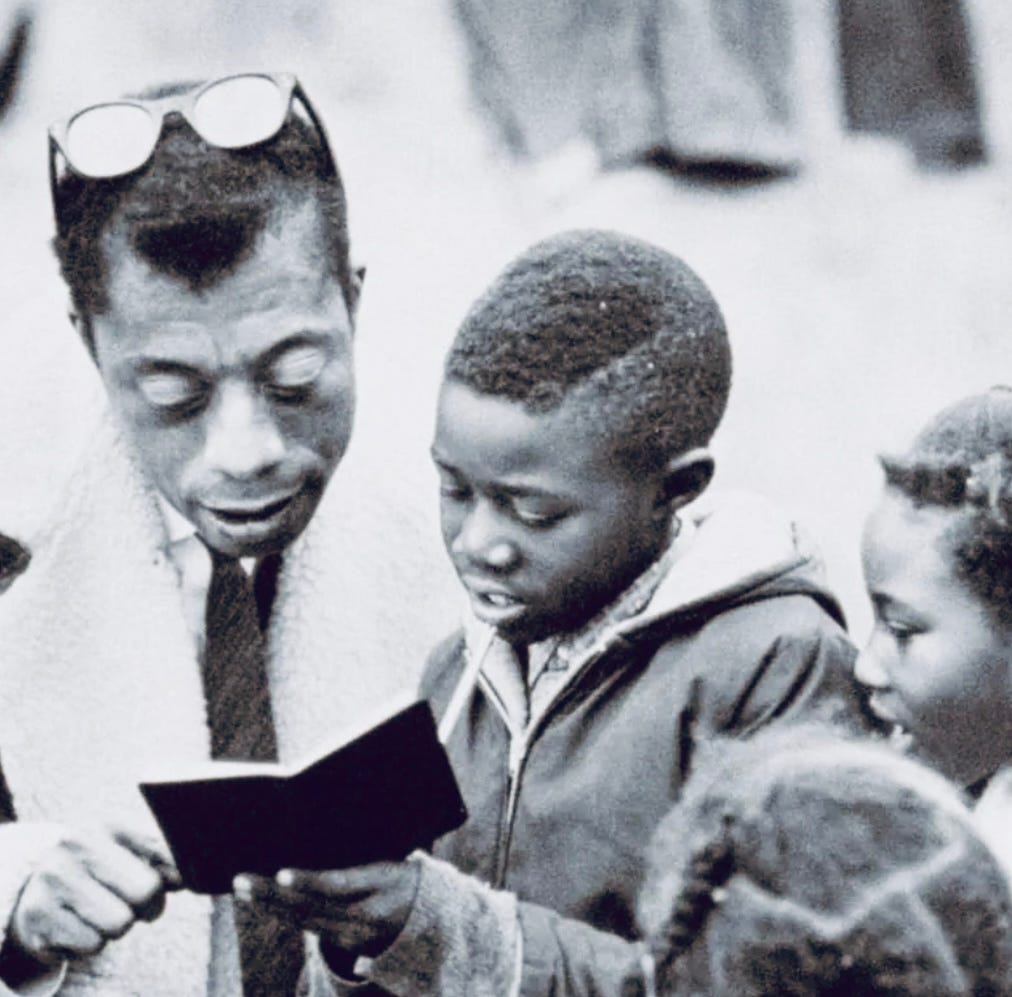
(James Baldwin (1924 – 1987) reads a book with a group of children, Durham, North Carolina, 1963. Photo by Steve Schapiro/Corbis via Getty Images)

I have listened to so many white co-workers who describe their families as in complete disarray and disagreement about Felon 47 and his many renewed atrocities. It is not that every white American wishes harm and abuse on peoples of color, but rather, as Christopher Ortiz so brilliantly noted in his essay The Empty Trauma of Whiteness: How Colonialism Stole Europe’s Soul, that, “People racialized as white aren’t the colonizer. They too have been colonized, and we’ve got to talk about it.” stronglystrongly urge you to read Ortiz’s analysis. 

People classifiable as “white” rarely identify themselves collectively as victims unless they can rationalize that their victimization is coming from or due to a person or a group of people that are not typically categorized as “white.” And if their victimizers are indeed classifiable as “white,” then the victimizers are defined by something other than race. If said victimizer has a different religion, then that difference often works in these instances.

Every white person, from the Neo-Nazi to the bleeding-hearted white liberal, to all those folks in between, know one fact that they typically cannot say out loud: The hatred and virulence of white racists and the white liberal guilt (and embarrassment) about those white racists are all rooted in a single foundation, a foundation that is no more than a sand castle on a beach. Any forceful wave will destroy it.

Many white folks are stumbling in the dark because they cannot (or will not) pinpoint the source of their betrayal. They and their ancestors have spent generations and entire lifetimes believing several sets of assumptions that were never true, and in this current political climate, those assumptions are now on life support.

The “colored” peoples of this world that whites see as “other,” never entirely believed in these same assumptions even when we pretended to believe. For peoples of color, the requirement of our assimilation into the “mainstream” (code for “white”) is/was, to mimic, at least on the surface, the ideas and values of whatever dominant group that is/was oppressing us in order to be accepted by the dominant group. Assimilation never works because inequity is built into the entire process.

Baldwin told everyone back in the mid-1980s that “the world is not white.”  It never has been.  Not unlike the character “Dorothy” in the film “The Wizard of Oz,” the captains of industry never told white folks that they could go home and join the rest of humanity if they clicked those Ruby slippers together. 

The oligarchs have counted on you white folks to believe (and you have believed) in the Wizard of Oz who hides behind a curtain and who is no more than a snake oil salesman whose purpose is to sell you his wares, empty your pockets, and convince you of his omnipotence (that he never had) rather than of your shared humanity with the rest of the world.

Baldwin’s critique of white Christians in 1979 is no different than current critiques of white evangelicals who believe/d they are chosen by the Creator to plunder and control land and resources and people wherever they see fit. 

If still alive, Baldwin would know that Western interests are after that 1 trillion cubic feet of natural gas reserves in Gaza that would make Palestine energy independent. That road to energy independence for Palestine was interrupted when Hamas struck Israel in a surprise attack in October of 2023; an attack that Israel uses to justify its deliberate and coordinated genocide of the people of Gaza. 

When Baldwin wrote his Open Letter to the Born Again, Israel was then selling oil to Apartheid white-controlled South Africa; Nelson Mandela was still in prison and would remain there for another 11 years. And none of the above kept Jews safe anywhere in the world.

Now we have the savage-in-chief ordering the strike of a Venezuelan ship that was allegedly carrying narcotics when what Felon 47 and his empire-addicted crew wants is access to and control of Venezuela’s oil. Venezuela’s fighter jets flew over America’s Naval ships as a show of military strength. The stoking of fear is deliberate, the villainizing and “othering” of people who are not white is deliberate. 

So, consider this. Latin America is mineral and resource rich. Gaza is mineral and resource rich. Venezuela’s allies are China, Russia, Cuba, Iran, Turkey, with additional allies on islands in the Caribbean that receive Venezuela’s subsidized oil. What you have been taught to assume/believe about being classified as “white” will lead you down a dark alley that neither you nor the entire nation of America will walk out of. You and many soldiers, however, might exit in body bags. 

What so many white people fear is that other people they have never fully trusted might be correct in their analyses; the “others” might know something that they don’t know after having lived their entire lives believing that there was nothing they could not know or access. The captains of industry have always used you and made you their accomplices. This did not start with Elon Musk or Jeff Bezos. It started well before the pilgrims on the ship called the Mayflower landed at Plymouth Rock. 

Baldwin once wrote that, “You must embrace what you fear.” I will add that you cannot embrace what you fear if you are unwilling to name it. Without claiming it or acknowledging it, you remain bound to a script that you believe you wrote knowing in your subconscious that something or someone else wrote it for you. 

©️ Leslye Joy Allen

Suggested Readings:

James Baldwin, James Baldwin: Collected Essays, (New York, NY: The Library of America, 1998).

Vine Deloria, Jr., God Is Red: A Native View of Religion, 2nd Edition, (Golden, CO: North American Press, 1992).

(Dr. Deloria was a member of the Lakota Nation and his first name is pronounced “Vee-nay.”)

I am an Independent Historian, Oral Historian and Dramaturge. Please consider supporting my work with a few bucks for Coffee and Eggs via my CashApp.

You can also subscribe to my writings on Substack and stay in the loop with the best new research, history, journalism, prose, poetry, and etcetera.

All blogs written by Leslye Joy Allen are protected by U. S. Copyright Law and licensed under a Creative Commons Attribution-NonCommercial-NoDerivs 3.0 Unported License. Any partial or total reference to any blog authored by Leslye Joy Allen, or any total or partial excerpt of any blog authored by Leslye Joy Allen must contain a direct reference to this hyperlink: https://leslyejoyallen.com with Leslye Joy Allen clearly stated as the author.  Postings or blogs placed here by other writers should clearly reference those writers.  All Rights Reserved.