The Souls of Poets

What a Hiatus From Social Media Can Do

by©️Leslye Joy Allen

I have taken brief three to four-day hiatuses from all forms of social and electronic media before and been rejuvenated and recalibrated. I still remember a psychiatrist who openly questioned whether 24 hour news or 24 hour headlines and blurbs online were healthy or whether they really got a message out. That was about 20 years ago.

I have watched stories that trend for days and even weeks. Anything repeated long and often enough can usually be memorized or even absorbed, but whether you understand it intricately or not remains to be seen. Whether you feel anything after a certain point also remains to be seen. 

I need not be told that our current sitting president is a racist and a sexist and a sexual predator and a crazy man for the got-damned 10,000th time when slightly over half the population that voted in this country voted for him. He is an easy topic because he’s a shock show designed to distract. You may learn something new that just happened, but I never learn anything new about him. He was an abomination beneath being classified as human when I first learned anything about him back in 1989.  He was then, and remains, like so many of the soulless, including those who never knew and still don’t know that they never had a soul.

When someone decided to try to be a copycat of my Substack account on Monday, September 14, 2026, several wonderful people on Substack jumped into gear to report the imposter; and soon the duplicate was gone. Yet, after taking some days away from all social media my brain processed the offense differently. 

Some people hack, copy, falsify, pretend and troll much of the time for kicks; and to get jobs (hackers get hired); and to breach people’s bank accounts; and also because they have little else to do. They duplicate pages and names and images, but my gray matter—my brain belongs to me. 

I spoke with an old boyfriend from high school a few days after the incident who said, “If I put on a blindfold and someone read me two paragraphs of yours, I would know it was you.” We laughed and reminisced about when we were both young and inquisitive and now we are much older and inquisitive.  Aging is a blessing denied to many people. Good memories are also denied, as so many folks never have any because they never go offline long enough to make any.
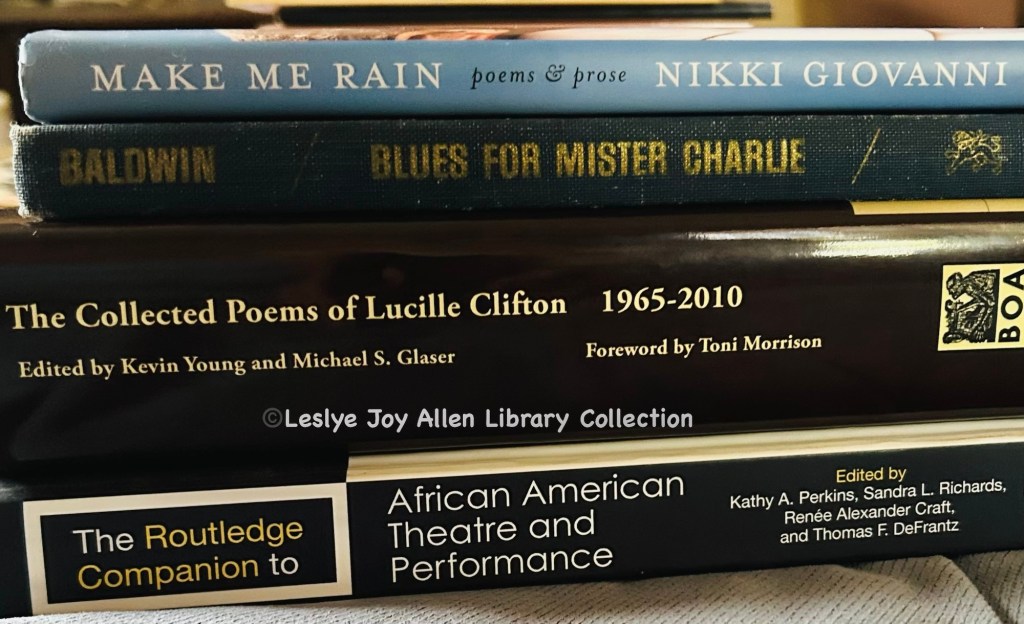
When I hung up the phone it occurred to me that I never liked, loved or befriended any boy or man that didn’t have the soul of a poet whether he could write poetry or not. To be able to or just to want to be able to take a phrase that, on the surface, seems abstract and make it mean something else or several something else’s is a gift, a gift that requires that you not just look at the world and your circumstances, but that you have the capacity to see the beauty or joy or even the sadness or terror in those circumstances. 

My quartet of college English professors: Dr. Waqas Ahmad Khwaja, Dr. Willie Tolliver, Dr. Christine Cozzens and Dr. Steven Guthrie taught me that a historian was a much better historian if that historian loved or could write poetry or fiction. The idiosyncrasies of being a human being are detailed, clothed and disrobed in haiku, sonnets, odes, elegies, cinquain, and free verse the way a couple whose marriage is over, but who cannot completely let go, so they create an ongoing argument, a conflict that lasts their lifetimes just so they can hold on to a piece of what can no longer be.

While away from the grind of scrolling on social media I finished reading three books and one stage play that was so good I couldn’t put it down. I peeked out my window long enough to watch my neighbors’ two small children giggling and playing with their two dogs in their front yard. A father and daughter passed by on their bicycles.

Then when I returned to the internet I saw a headline from a three-day-old news story where the U. S. Military used A. I. to write a report that, in error caused the United States military to begin preparations to militarily strike China and/or to prepare itself to be struck by China. Whatever. The cataclysm was averted. For a nanosecond I felt fear.

Then my fear completely disappeared because the job was done. I have written this before, but this oxymoron bears repeating: Anything intelligent cannot be artificial; and anything artificial cannot be intelligent. The underlying purpose of A. I. is confusion and fear, to convince citizens that machines and algorithms can wreak havoc in a split second. The constructors of A. I. are in testing mode—one week it may pose a threat to a forest, a water supply, a military base, a foreign enemy, or to a specific group of people. 

Then after enough non-thinking humans are reasonably subdued to the whims of A.I., the plans to make it safer, less invasive will come along. Jobs will be offered where those who are employed can deliver well-crafted messages about how it is now under control with dozens of benefits to humans that no one realized in its infancy. 

The only problem is that the ones who crafted A.I., who designed it, who will propagate it and implant its alleged benefits and its alleged problems in susceptible brains will not be creators who are able to write a poem or even murmur a few words and phrases that come from the heart or the gut. Emotions, perhaps even love itself, could be rendered suspect because love has never followed a formula. 

If there are any deaths that could come from the whims and malfunctions of machines, the deaths on fields of battle or the obliteration of entire towns will come much, much later, if they come at all. The first deaths will be slow, caused by the absence of the souls of poets, those that can still find their way in the dark; those that know when to refrain from saying something; those that can say it another way to make people feel better without telling a lie instead; those that can remember childhood games and youthful romances and mischief well enough to care about the young ones who will outlive them, not just care about themselves or the here and now.

©️Leslye Joy Allen

I am an Independent Historian, Oral Historian and Dramaturge. Please consider supporting my work and research with a few bucks for Coffee and Eggs via my CashApp or PayPal; or become a paid subscriber to me on Substack to help me sustain my research and commentary.

All blogs written by Leslye Joy Allen are protected by U. S. Copyright Law and licensed under a Creative Commons Attribution-NonCommercial-NoDerivs 3.0 Unported License. Any partial or total reference to any blog authored by Leslye Joy Allen, or any total or partial excerpt of any blog authored by Leslye Joy Allen must contain a direct reference to this hyperlink: https://leslyejoyallen.com with Leslye Joy Allen clearly stated as the author.  Postings or blogs placed here by other writers should clearly reference those writers.  All Rights Reserved.
The Black Study Group That Transformed a Generation: The Afro-American Association

by © Leslye Joy Allen

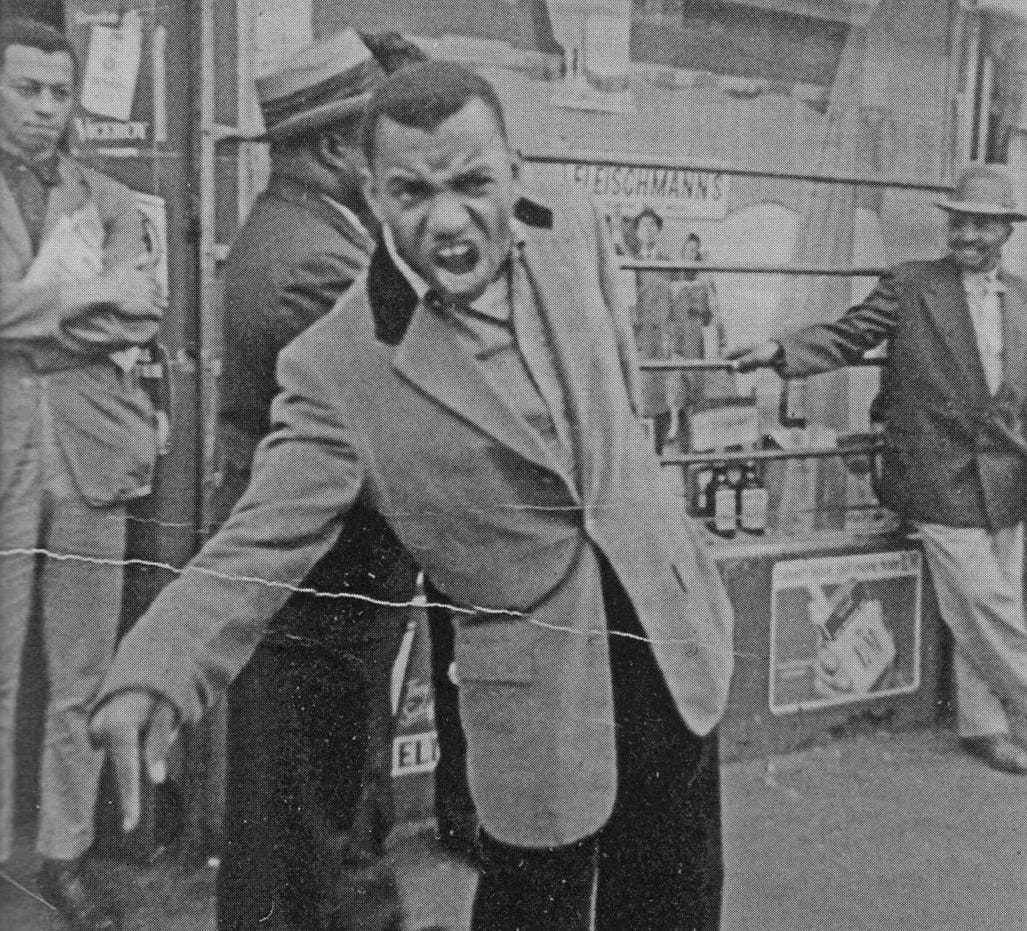
The photo below of Don Warden is from the archives of Khalid and Jamila al Mansour. Don Warden was one of the founders of the Afro-American Association at the University of California at Berkeley. The other founding members were Donald Hopkins, Otho Green, and Henry Ramsey. 

This organization formed in late 1961 and began as a student study group in 1962 at the University of California at Berkeley when there were literally no identifiable Afro-American and African Studies programs on any U. S. college and university campus. The group devoured works by Ralph Ellison, W.E.B. DuBois and other Black scholars that were left out of many colleges curricula. Study meetings of its members initially began at the off-campus home of a UC Berkeley student, and grew from there. In fact, chapters of this organization appeared on hundreds of college campuses in the United States with members numbering in the thousands by the mid-1960s.

The objective of the group was to read and study about the Afro-American, African, and Afro-Diasporic past in order to confront the institutional racism, colonialism and bigotry found in the United States and throughout the world. 

Warden, a UC Berkeley law student, regularly went into Black neighborhoods and literally spoke to young Black citizens directly on street corners or wherever they were. He encouraged them to study about Afro-American and African history in order to fight against their feelings of worthlessness that often accompanied experiencing chronic racism. 

He listened to them tell him about their problems of unemployment, poor housing, you name it. He, like most of his members, espoused that in order to change all systems of oppression, one needed to study about the past in order to do so. Warden eventually became a lawyer for the Black Panther Party of Self-Defense as well as granting legal assistance to the Nation of Islam when Malcolm X was still a member of the group.

The Afro-American Association was heavily influenced by the ideologies of Black American activists Robert F. Williams and Malcolm X. The AAA understood that only sustained study of Black people/s would foster the kind of thinking and strategies for combating systems that sought to suppress and control Black and Brown communities all over the world. Only deep research would correct the far-too-often feelings of inadequacy that came with being Black and oppressed. 

In 1962 when this study group, that was soon named the Afro-American Association, began its study group meetings at UC Berkeley there were roughly only about 100 Black students out of 20,000 white students. And in 1962 there were only two members of the group that were not born in the United States. One was from Jamaica; the other was from India.

In 1962 this tall, skinny, young Black man from Orange Hill, Jamaica and this petite and short, very brown young woman from Chennai, Tamil Nadu (in Southern India) dressed in her Sari and sandals met in an AAA group meeting.

The young man from Jamaica gave a pristine evaluation of how Great Britain had created a rather stiff and proper group of elite Black Jamaicans that often mimicked the mores and habits of British society. It was done, he said, to shield the world from knowing how racist the British empire actually was. The young man was calm, studious with very edgy ideas about the colonization of Black people/s around the world. 

The young brown woman in her Sari and sandals was intrigued. She too had been a British subject in her native state of Tamil Nadu in southern India. She knew something about what this young man spoke of, but not all of it. Back then, the typical path for academically talented Indian and Jamaican students was to study in England, that is if they could secure a path to graduate school. 

She rejected that path because there was no major in Biochemistry in India or in the UK that would have been available to a female. The skinny guy from Jamaica also rejected the educational path to the UK. His decision was so unusual that the approval for his exit from Jamaica took so long that he arrived at UC Berkeley two weeks after the Fall 1961 semester begun.

He, Dr. Donald Harris became a leading economist and she, Dr. Shyamala Gopalan-Harris became a leading biomedical scientist, a contributor to the identification of the function of rMNA, which greatly improved treatments for breast cancer. 

The early members of the Afro-American Association described her as warm, funny, “down for the cause” of Civil Rights and an end to colonialism, and also a fiery debater. At first one member of the AAA noted that some of them thought she was royalty because of the way she carried herself. Yet, she fit right in, several members noted. He was described as professorial even though he was in his early 20s. While their eventual marriage didn’t last (they married roughly 10 months after meeting), their firstborn daughter Kamala noted that she knew they loved each other and felt that if they had been a bit older and a bit more emotionally mature they might have made it. 

She cited them both as activists, and remembers going to protest marches with her parents in a stroller. The blueprint for their activism and for the creation of Afro-American and African Studies as disciplines were rooted in the activities in the Afro-American Association. While at UC Berkeley, Shyamala met and influenced arguably, one of Afro-America’s most important philosophers, Cedric Robinson.

Robinson’s book Black Marxism, first published in 1983, remains one of the most brilliant critiques and reassessments of the Eurocentric theories of Marxism. It has become a must-read in the literary canons of both Afro-American and African Studies.

It was Robinson who coined the phrase “Racial Capitalism.” He argued that capitalism was always based on race and race came before capitalism. Importantly there never was a clean break from European feudalism. He was one of the first Black scholars to identify “race,” as a component that European empires used when feudalism morphed into capitalism. 

Any study he maintained had to be central to Black people/s’ lived experiences wherever they were in the world. When I first read him, it became apparent that European Marxist scholars either forgot or tried to ignore that the peoples of Europe were once considered “races,” races and national identities that were eventually erased in exchange for their being identified as “white” which served the interests of European countries in their quest to colonize and dominate large portions of the world.

In 1959, Shyamala Gopalan was standing in line behind Cedric Robinson while they were both registering for classes. Both became members of the Afro-American Association. In the first edition of Black Marxism, there was only one person who was not a Black American listed in his group of early friends that Robinson acknowledged as influential on the development of his ideas. That person was Dr. Shyamala Gopalan-Harris.

So here’s a brief mini-history of the continuing of the Afro-American Association of University of California at Berkeley. Huey Newton and Bobby Seale who founded the Black Panther Party became members. Huey dared to show up at a meeting of AAA without having read the book assigned for that session. The members sent him home. He never showed up again unprepared. 

Future Congressman Ron Dellums was a member of the AAA at one time as was Kenny Freeman, a contributor to the Black Panthers 10-Point Plan. The AAA literally laid the academic groundwork for Afro-American and African Studies programs throughout the nation as underscored by historian and author Donna Jean Murch who traced the evolution and development of the Black Panther Party from its roots in the Afro-American Association. None of it began without the required reading and research and the on-the-ground grassroots activism that met Black communities in the Oakland area where they were.

I could go on about how police monitored the group’s members particularly when they spoke on street corners, or visited high schools to encourage reading and research among members of the Black community. Yet, I will not do that mainly because well-meaning, good people have started to use the internet like an online set of Cliffnotes. 

If you’re old enough to remember Cliffnotes you also remember that occasionally they were used instead of reading the actual book or doing the actual research. Yet, your ass was grass when a teacher or professor asked you a highly specific question that Cliffnotes did not cover and you hadn’t bothered to read the whole book.

So there’s a small bibliography below with a list of books that are worth your time. The message is clear: Either you put in the time and read or you remain a dilettante on matters that you need to know both for your safety and your sanity.

© Leslye Joy Allen

This essay was previously posted on Substack on January 22, 2026.

I am an Independent Historian, Oral Historian and Dramaturge. Please consider supporting my work and research with a few bucks for Coffee and Eggs via my CashApp or become a paid subscriber to me on Substack to help me sustain my research.

Recommended Readings:

Living For the City: Migration, Education, and the Rise of the Black Panther Party in Oakland, California by Donna Jean Murch

Fanon for Beginners by Deborah Baker Wyrick

Remaking Black Power: How Black Women Transformed an Era by Ashley D. Farmer

Black Marxism: The Making of the Black Radical Tradition by Cedric Robinson

Oregon Police Department Surveillance Files on Donald Warden and the Afro-American Association which kept surveillance documents on Donald Warden when he visited Oregon to encourage students to read and research.

The Afro-American Association: Forerunner to the Panthers

“How Kamala Harris’ Immigrant Parents Found a Home, and Each Other, in a Black Study Group” by Ellen Barry, September 13, 2020, New York Times.

The Truths We Hold: An American Journey by Kamala Harris

Remembering Cedric Robinson: Humanistic Imaginaries and the Black Radical Tradition

All blogs written by Leslye Joy Allen are protected by U. S. Copyright Law and licensed under a Creative Commons Attribution-NonCommercial-NoDerivs 3.0 Unported License. Any partial or total reference to any blog authored by Leslye Joy Allen, or any total or partial excerpt of any blog authored by Leslye Joy Allen must contain a direct reference to this hyperlink: https://leslyejoyallen.com with Leslye Joy Allen clearly stated as the author.  Postings or blogs placed here by other writers should clearly reference those writers.  All Rights Reserved.

The Steps Called Books

by ©️Leslye Joy Allen

For people who have been reading my posts, you may have noticed that I have written about the United States’ severe literacy crisis twice on this platform. If not, you can read them here: The USA Literacy Crisis & This Election and Literacy Crisis, Part II.

This essay is Part III. Let me point out a few things first. Some 65 years ago in 1960, the United States was one of the most literate nations in the world. In 1960, only a handful of states in this country had an illiteracy rate of 10% for people aged 14 and over. The rest of the states registered only about 3% illiteracy. Now we rank 36th in the world for literacy among industrialized nations. There are other sources that place the USA at a literacy rate much lower.

In 2025, 21% of American adults are completely illiterate while 54% of adults read below the 6th grade level. I want to share with you in this essay, however, what poor reading and writing skills look like when these circumstances are also combined with educational red tape. 

I taught College History courses for roughly 7+ years, from 2007 to early 2015. My first 2 years, I taught at a Junior College that had several campuses outside the city limits of Atlanta in the outlying metropolitan areas. My last 5 years I taught at large state universities. Junior Colleges are structured for students who have some academic deficits. Students often attend Junior Colleges to fix a deficit in some academic discipline so that they can eventually qualify to attend a four-year institution to earn a Bachelor’s degree.

When I started teaching, I taught year round. After I taught on this particular campus for about two semesters, I noticed that this campus was slowly being converted into a cash cow. The school started accepting anyone who could pay tuition and occasionally referred to students as “customers.” That did not go down well with me and a lot of other Instructors and Professors. 

Most of my History students had some problems with reading, writing, and critical thinking skills. I usually spent the first 3 weeks of every semester correcting grammar and insisting that they trust their answers and their own instincts. 

When I asked a simple question, initially none of them could state the obvious answer. I demanded that my students give complete and well-thought out answers and opinions in class discussions instead of the abbreviated and one-word answers that chronic text messaging had fostered. 

The majority of my students rose to the occasion. They did the work, read my comments, listened to my instructions and suggestions, and put in the extra time needed to get up to speed in writing and having in-depth discussions about History. I did have one student, whose identity I never knew, who complained about having to write 3 five-page long History papers. Imagine having to write 3 papers in a 16-week long semester in college.

I learned later through the grapevine that this student allegedly had an inappropriate relationship with some man in the Junior College’s administration to who that student complained. One day I was informed that I would have to attend a meeting with my Department Chair and the Ombudsman of the School. 

During the meeting, both my Department Chair and the Ombudsman kept telling me things like “Many of these students might not know how to interpret what you tell them. They might not understand what you say to them or write on their papers. One student said you told him or her that they could not write!”

I was confused and raised these points: “I have NEVER told a student that they cannot write. I have told or wrote to many of them, however, that they needed to take a good writing course so that they can improve their writing skills and get more practice writing cogent papers. Also, I speak grammatically correct English in the classroom. How can I know when a student cannot understand grammatically correct English? What type of language or techniques are you asking me to use?”

They both stopped talking for about 30 seconds. I interrupted their silence. “Are you asking me to water down my curriculum?!”  No one answered my question. They both began to reiterate how much the students might not understand what I asked students to do. I repeated the question FOUR more times. They NEVER answered my question.

When they suggested that I attend a seminar on Customer Service Skills, it was all I could do to hold my tongue. Then my Department Chair finally ruptured this charade of a meeting and asked me, “Do you want this job?”

I swallowed hard and paused for a good 20 seconds and responded, “That’s a rather loaded question, don’t you think? Obviously, when I applied for this job, I wanted and needed a job. I still do. However, anyone who might be offered a better job somewhere else would probably take the better job. That includes me too.”

When I walked out of that office, I was so angry I couldn’t see straight. The Department Chair’s secretary looked at me as I exited and said “Leslye, what did they do to you in there?! Please, please don’t look like that.” I told her I would come back later and fill her in on the details after the Department Chair went to lunch.

So, here was the dilemma. That handful of students that never had any intention of studying and improving their literacy and writing abilities were now expecting to receive passing grades when they were just as inept at the end of the semester as they were at the beginning of it. That meeting, however, was not my worst moment on that campus.

A young Black woman student emailed me and asked me, when the time came, to write her recommendation letter to Spelman College. She had sent in an application to Spelman and assumed that she would be accepted. When I checked her records, she only had a GPA of about 2.0.

Spelman College is a Historically Black College for women that has always teemed with academic brilliance. No girl graduating high school will even be considered for admission with a GPA less than a 3.5. The average GPA of students who are admitted is a 3.8. It is a highly competitive school with an admission rate of only about 34% of applicants.

I very delicately wrote to this young woman that she would need to pull her grades up in order to get into Spelman. I wrote that she should not be discouraged because, “I know you can do it if you work hard and apply yourself by taking some additional classes.” This was my attempt to tell her the hard truth without crushing her dreams or suggesting that she give up. I signed my name to the email, pressed the “Send” button, and sat and cried for about 15 minutes.

It took me years to understand that people who don’t read well or who rarely read at all constantly misinterpret the meanings in spoken and written language. They also assign their own meanings to what people say and write with little to no comprehension. They make decisions based on what they think or feel about something a person said or wrote.

That is where we are in the United States right now. We have a majority adult population that responds to most political propaganda with their emotions and assumptions, never exactly or entirely based on actual facts. Moreover, many don’t even know where or how to look for the facts. 

If the Democrats do not figure out how to reach out to semi-literate people stumbling in the dark with information they can barely decipher, then the Democrats are in danger of losing elections for the next several decades. The Political Left is also doomed to be reduced to little more than a group of well-read, but also self-righteous, ideologues that do not know how to reach the people they need to reach who don’t fit the definition of “well-read.” 

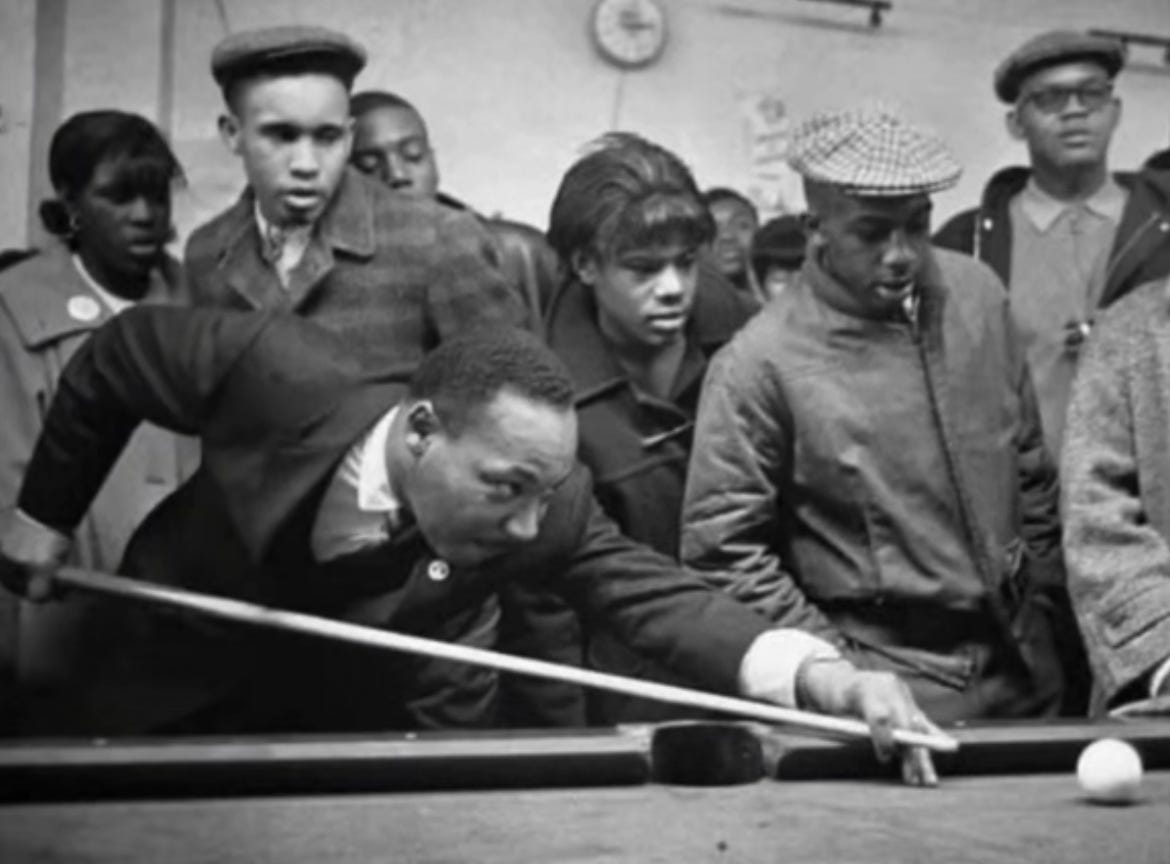
One of the things that made my home boy Dr. Martin Luther King, Jr. so effective was that he was a young man with a doctorate degree who could go hang out in a pool room and shoot pool and talk trash with the men who hung out there as easily as he could address heads-of-state. He could render presidents and prime ministers speechless because he was better educated and more in-tune with what people needed than the vast majority of them. 

He could talk with ease to the poorly educated and to the best educated. For those who don’t know, Martin Luther King Jr. was an exceptional scholar who entered college at age 14 and who graduated Morehouse College at the age of 18 and had earned his doctorate by the time he was 25 years old. Kamala Harris’ Mama also had her doctorate degree by the age of 25. She was working in a laboratory when her water broke with her then soon-to-be-born first child that she named “Kamala.” 

(Photo of M.L. shooting pool in Atlanta in 1966. The tall guy on the far right in the cap and glasses was then a Morehouse College Freshman named Samuel Leroy Jackson.)

What is my point? Education and literacy matters; and its singular purpose is to help people focus on what they need to be focused on. In 1960, a man or woman in the United States with little resources knew that the public library was still free and they made good use of it. Today, our semi-literate majority adult population that cannot stay still long enough to read a 5-minute article because they are always ready to look at something that is “trending,” is what we are confronted with now. 

Long after I left the classroom, I ran into one of my former students from the Junior College where I once taught. He was attending Georgia State University and was about to graduate. Excited to run into me, he said, “I hated you back then. But you pushed me and demanded that I get the work done. Now, I can’t stop reading and doing research. I cannot read enough BOOKS!”

Hugging his neck I said, “Don’t ever stop. The more you dig the more you will know.

So, in the names of your favorite teachers, instructors and professors, please keep talking about the truths and the dangers of a largely illiterate and poor reading nation. Our welfare as a nation and as human beings depend on it.

©️Leslye Joy Allen

I was am an Independent Historian, Oral Historian and Dramaturge. Please consider supporting my work with a few bucks for Coffee and Eggs via my CashApp.

You can also subscribe to my writings on Substack and stay in the loop with the best new research, history, journalism, prose, poetry, and etcetera.

All blogs written by Leslye Joy Allen are protected by U. S. Copyright Law and licensed under a Creative Commons Attribution-NonCommercial-NoDerivs 3.0 Unported License. Any partial or total reference to any blog authored by Leslye Joy Allen, or any total or partial excerpt of any blog authored by Leslye Joy Allen must contain a direct reference to this hyperlink: https://leslyejoyallen.com with Leslye Joy Allen clearly stated as the author.  Postings or blogs placed here by other writers should clearly reference those writers.  All Rights Reserved.
Literacy Crisis, Part II

by ©️Leslye Joy Allen

Back in November of 2024, I wrote a blog titled The USA Literacy Crisis & This Election where I bemoaned the fact that only 25 percent of American adults were currently reading above the 6th grade level. Don’t flatline, but that’s a fact we must face if we want to fight Felon 47.

I have also posted frequent videos of The Library Dads, founded in Atlanta, where young Black fathers take their small children to the library to read and to have a playtime session on a weekly and/or monthly basis. It is one of the most encouraging sights to see all these young Dads headed to the library for the sake of their children’s literacy and to spend time bonding with their kids and each other.

People who read always think deeper than people who rarely read. Critical thinking skills are virtually non-existent in people who do not read. Stimulating thought and critical thinking is essential to fighting Felon 47.

I looked at the percentages of voting eligible Americans, tabulated by the Cook Political Report Popular Vote Tracker in the University of Florida’s Election Lab General Election Turnout data, and saw that 36.70 percent of voters did not bother to vote at all. I don’t have any evidence, but I bet these non-voters don’t read much. 

Our political system was flawed even before Felon 47 won the Whitehouse a second time. Yet, thinking people, including some racists and sexists, know that going to vote is essential to the maintenance of our democracy. When over a third of voters stayed home, it spoke to a lack of depth and a lack of civic responsibility that is not easy to fix. 

So let me share this. I taught college History courses for 7 years. I would have to say that I enjoyed all of my students, except for a couple of them. One day in class a young white male student complained that he had to take History and English to fulfill the general requirements to earn a Bachelor’s degree. He was a Math Major so he felt like subjects like History and English were of no use to him. I let him talk and then reminded him that subjects like History and English inspire ideas, and would cause him to think more. “You will be a better mathematician,” I said.

The following week my class had a discussion about police brutality. This same student stated that he was unlikely to be the victim of police brutality simply because he was white. All of his classmates that represented all colors, races, and ethnicities looked at him like he was crazy. Two days later he was jaywalking. A police officer stopped him and this student decided to mouth off at the police officer who then promptly hauled him to jail.

When this student returned to class, his classmates were ready to poke fun at him. I stopped them, but I reminded this student that what he did not know could, would, and did hurt him. I reminded him that making assumptions without any proof or knowledge could cripple him. He then decided that maybe reading was essential. He turned out to be a pretty good student. 

So, if you have a friend, a kid, a relative, or a neighbor that never reads, take them to the library yourself. Encourage them to read. Give them book suggestions because whatever fight we put up against Felon 47 will require the most erudite fighters among us. We won’t win if we cannot outthink the enemies of democracy and fairplay.

©️Leslye Joy Allen

I am an Independent Historian, Oral Historian and Dramaturge. Please consider supporting my work with a few bucks for Coffee and Eggs via my CashApp.

All blogs written by Leslye Joy Allen are protected by U. S. Copyright Law and licensed under a Creative Commons Attribution-NonCommercial-NoDerivs 3.0 Unported License. Any partial or total reference to any blog authored by Leslye Joy Allen, or any total or partial excerpt of any blog authored by Leslye Joy Allen must contain a direct reference to this hyperlink: https://leslyejoyallen.com with Leslye Joy Allen clearly stated as the author.  Postings or blogs placed here by other writers should clearly reference those writers.  All Rights Reserved.

Walk With a Book

by ©️Leslye Joy Allen

I remember the first time I heard someone say, “If you want to hide something, hide it in a book.” The comment depressed me.

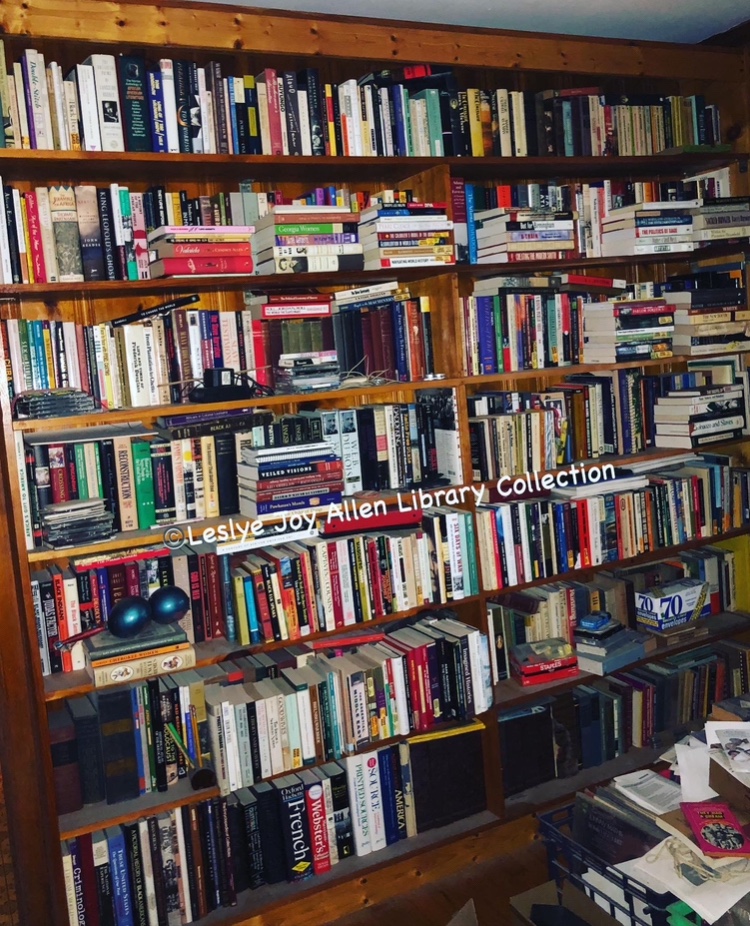
When you are a historian, you have books everywhere. You have to read all the time. I have not seen the top of my dining room table in nearly 15 years as it is covered with stacks of books. Books occupy every nook and cranny of my home.

With the United States ranking 36th in the world for literacy, with a 79% literacy rate, with only 25% of literate adults reading above the 6th grade level, we are already dumb. We can expect to see more decline in literacy with Felon 47 living on Pennsylvania Avenue.

So, I have a proposal. It might not change anything, but it is worth a try. Walk out of your door with a book in your hand or tucked under your arm everyday for at least a month.

Let kids and other adults see you walk with that book. And don’t say you can’t do this. You have carried books before when you were in grade school.

Make your book/s visible at your job, on a trip to a store. Hell, go for a walk with your book until someone asks you why you always have a book in your hand or under your arm. And then have the audacity to tell them why.

©️Leslye Joy Allen

All blogs written by Leslye Joy Allen are protected by U. S. Copyright Law and licensed under a Creative Commons Attribution-NonCommercial-NoDerivs 3.0 Unported License. Any partial or total reference to any blog authored by Leslye Joy Allen, or any total or partial excerpt of any blog authored by Leslye Joy Allen must contain a direct reference to this hyperlink: https://leslyejoyallen.com with Leslye Joy Allen clearly stated as the author.  Postings or blogs placed here by other writers should clearly reference those writers.  All Rights Reserved.