Parable of the Sower

by ©️Leslye Joy Allen

“…the plant of freedom has grown only a bud and not yet a flower.” — Martin Luther King, Jr.

“God is your first and your last teacher. God is your harshest teacher: subtle, demanding. Learn or die.” — Octavia Butler, (from “The Parable of the Sower, 1993)

I woke up before dawn annoyed that January 20, 2025 is inauguration day for Felon 47 and it is also the federal holiday celebrating the birth and life of Martin Luther King, Jr. I also could not help thinking about how our abuse of the earth has contributed to the fires in California.

A week ago, I re-read Octavia Spencer’s prescient novel “Parable of the Sower.” Butler’s protagonist Lauren, the daughter of a preacher, lives in a safe and comfortable, walled-up cul-de-sac. Outside those walls are desperately poor people, racial and economic inequality, and drug addicts that use a drug called “pyro” that makes its users want to set fires.

Lauren tries to convince others to accept that the world has changed and will continue to change. The others prefer to pretend nothing has happened to the earth and its inhabitants.

Butler predicted ecological disaster by fire coming over 30 years ago, and named her novel after a biblical parable. Right after I finished reading the book again, I thought about how M. L. got his name.

Many people do not know that M. L. (what we called him here in Atlanta) was born Michael King, Jr. I knew many elderly Black Atlanta citizens who called him “Mike” their entire lives.

His father, best known as “Daddy King,” attended a World Baptist Conference in Germany in 1934. Reborn and rejuvenated after he learned more about the philosophies of Protestant reformer Martin Luther, Daddy King soon renamed himself and his son “Martin Luther King, Sr. and Jr.

In 1957, “Michael King, Jr.” was officially changed to “Martin Luther King, Jr.” on his birth certificate. There are other stories about why and when Daddy King changed their names, but I like this story the best.

I bring this up because another story goes that when the German Protestant leader Martin Luther was asked what he would do if he knew the world was going to end tomorrow, he allegedly answered, “I would plant an apple tree today.”

While I am a believer in Goddess/God, I am not particularly religious. I know too well how organized religion has failed us in so many ways. I am, however, a historian who finds truth and sustenance in some parts of the Christian Bible that the incoming administration and so many preachers and billionaires have totally corrupted.

In the Bible’s Parable of the Sower, Yeshu’a ben Yosef (bka Jesus) tells a story about a farmer who sows seeds in four different types of soil. It is not until the farmer’s seeds are sowed in good soil that he yields a good crop. In this parable, which has many lessons, Yeshu’a emphasized that we must pay attention to where we plant our seeds if we expect anything to grow. We yield a good harvest when we take responsibility for how and where we do our planting.

To place seeds in the ground is an act of faith. When you plant, you do so with the faith that you will yield something. You do it with the belief that you, or your loved ones, will live long enough to reap the reward, be it vegetables or fruits or flowers or justice or equality.

On this Martin Luther King, Jr. holiday, may we go forward intentionally, reminded that we are obligated to be good stewards of the earth that we do not own. California’s fires are the result of our excess and failure to clean up the earth which is the only home we have.

May we plant in the best soil, in the best social and educational policies, in the best radicalism, in the truth. May we sow our seeds in our gardens and farms and tend them with a faith that tells us we will reap a good harvest and that we will have enough to sustain us in order to stave off the worst excesses of the incoming administration. May we humble ourselves, unlike Felon 47 and his underlings, and remember that we live on this earth that we did not create and will die whether we are paupers or billionaires. May we learn the life lessons of one of the best sowers, namely Martin Luther King, Jr.

©️Leslye Joy Allen

King’s Papers are located at the King Institute at Stanford University. I urge you to visit and explore: https://kinginstitute.stanford.edu/message-director

(Martin Luther King, Jr. photographed in 1964 by Dick DeMarsico for World Telegraph and Sun. Courtesy of the Library of Congress)

All blogs written by Leslye Joy Allen are protected by U. S. Copyright Law and licensed under a Creative Commons Attribution-NonCommercial-NoDerivs 3.0 Unported License. Any partial or total reference to any blog authored by Leslye Joy Allen, or any total or partial excerpt of any blog authored by Leslye Joy Allen must contain a direct reference to this hyperlink: https://leslyejoyallen.com with Leslye Joy Allen clearly stated as the author.  Postings or blogs placed here by other writers should clearly reference those writers.  All Rights Reserved.
No Contradictions

by ©️Leslye Joy Allen

When I started to hear negative commentary about Kamala Harris’ racial and ethnic background, I started reevaluating how “White Supremacy” works again.

Many people are completely unaware that when the Greek explorer Herodotus named the continent “Αἰθιοπία” (romanized as Aithiopía”), his definition included the continents of Africa, India, and Southeast Asia. Herodotus’ term literally means “Land of Burnt Faces.”

Those kinds of cross-cultural connections and collaborations do not help white supremacy to flourish which is why you rarely hear anything about them. The objective of white supremacy is to make certain that peoples of color look to white folk, and white men specifically, for acceptance, guidance, deliverance, and redemption, but not to each other. Sexism works exactly the same way. A man, not a woman, may rule you and grant you favor in some screwed up patriarchal world as sexists imagine it.

African-American scholar W. E. B. DuBois’ heir apparent Vijay Prashad noted that many Indian men arrived in the USA in the late 18th and 19th centuries, married Black American women and disappeared from most histories. Suraj Yengde, both in his books and in his portrayal of himself in Ava DuVernay’s masterpiece film “ORIGIN,” noted that we must find reconnections with each other. His research on Dr. Bhimrao Ambedkar is fascinating.

Ambedkar was a Dalit, or as he was once called, an “Untouchable.” He wrote India’s constitution. He earned two doctorate degrees and when he came to the United States he wanted to meet his fellow American untouchables. So, he visited Harlem where the Black folks lived. (FYI: Martin Luther King, Jr. was introduced as a fellow “untouchable” when he visited India.)

This is exactly what Shyamala Gopolan-Harris did when she left India to go to school in the United States. She gravitated toward communities where she was less likely to be mistreated. So, she headed to Berkeley, California which was a hotbed of activism—there were Civil Rights protests, anti-Vietnam protests, the Free Speech Movement and the work of the Black Panther Party in nearby Oakland was the world that her daughter Kamala Harris grew up in.

I bring this up because we know so little about our early histories and connections. I don’t bring this up with any foolish idea that everyone is going to suddenly start singing “Kumbaya” and start getting along all the time. Yet, we know more about what Prashad accurately identified as white power structures that, during the late 20th century, deliberately created the myth that “Southeast Asians” were a model minority, a minority he emphasized that was designed as a weapon against Black Americans.

Felon 47 and his minions have lined up a small cadre of Southeast Asians to serve in his administration to do two things: 1) make the administration look less racist than it is and, 2) to also entice India, which now has a larger population than China, that its population is seen somehow as superior. South Africa did damned near the same thing during apartheid.

When Black Americans visited South Africa during its apartheid era, Black American visitors were given passes written in Afrikaans that translated into English as “Honorary White Person.”

Now, the fact that I personally know at least seven Southeast Asians who identify quite accurately as “Black,” does not matter. The fact that so many folks on the continents of Africa and Southeast Asia have near identical DNA doesn’t matter either. When I read the book “A Passage to India,” I noted that an Indian character in the book was described as a “little Black man.” It was the first time I ever saw such a description of anyone outside of a specifically African or African American context. My point, however, is much simpler.

We Black Americans can continue to roll our eyes at the brown guy wearing the turban at the local gas station and vice-versa OR we can recognize and identify our participation in upholding white supremacy while its foot remains situated on both our necks. Before you bother to tell me about the guy at the gas station that you don’t like, remember that he is an employee and all you are is someone pumping gas. White supremacy makes all of us its pawns.

If you are honest, you also remember that moment when you got bad service at a Black-owned business and thought to yourself that you got bad service because the business was Black-owned. The fact that there are, were, and will be folks who simply are not good at customer service regardless of their race or ethnicity or nationality did not enter your mind. That kind of thinking is white supremacy in action too.

Kamala Harris knows this better than anyone. She knows who she is and she didn’t need anyone to tell her who she is. The fact that anyone dared define her speaks not only to their arrogance, but also to their presumptions that they actually have such a right to do so.

She was perceived by some folks as a contradiction and by some folks as having split loyalties. The only thing that actually requires split loyalties is white supremacy. It cannot thrive or survive without its clear contradictions. Let me write that again—It cannot survive or thrive without its clear contradictions. It functions with the assistance of the people who it is designed to either oppress and/or control and/or regulate. Repeat that until you get it. So, no contradictions.

©️Leslye Joy Allen

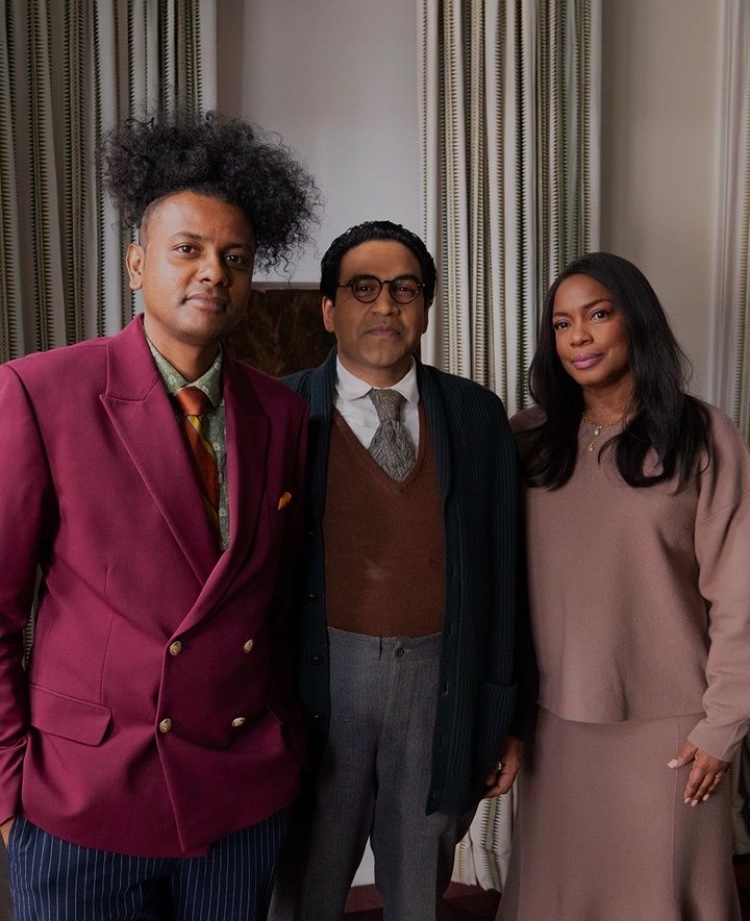
Dr. Suraj Yengde (as “himself”), Dr. Gaurav J. Pathania (as “Dr. Bhimrao Ambedkar”) and Aunjanue Ellis-Taylor (as “Isabel Wilkerson”) in Ava DuVernay’s film “ORIGIN.”

All blogs written by Leslye Joy Allen are protected by U. S. Copyright Law and licensed under a Creative Commons Attribution-NonCommercial-NoDerivs 3.0 Unported License. Any partial or total reference to any blog authored by Leslye Joy Allen, or any total or partial excerpt of any blog authored by Leslye Joy Allen must contain a direct reference to this hyperlink: https://leslyejoyallen.com with Leslye Joy Allen clearly stated as the author.  Postings or blogs placed here by other writers should clearly reference those writers.  All Rights Reserved.

Bookstores & Librarians & Libraries Rock: Writers & Readers, Pay Attention

by ©️Leslye Joy Allen

I love bookstores & libraries and librarians, but particularly librarians. They are natural allies to historians or anyone doing research. When you tell them what you are looking for they can point you right to it. I love archivists for the same reason, but archivists deal with materials that are older, and rarer than the books you see on the shelves in bookstores and in public, school and university libraries. This blog, however, is more than a shout out to the folks who handle books, it is for anyone who has written or who plans to write a book.

Here’s a tip. Do your best to get your book reviewed by a librarian. Here’s why.

While most scholarly articles and many scholarly books are peer-reviewed (which means exactly what it says: reviewed by one’s academic peers), the majority of novels, memoirs, some scholarly works, and popular authors’ books are not reviewed by their peers or by librarians.

There is one advantage that a librarian-reviewed book has: If the librarians responsible for purchasing books like the book and recommend the book, they will buy it and other libraries will buy it too! Library sales are not like other purchases. Let me explain.

Let’s say you are a new author. You and/or your publisher (if you have one) get a local bookstore to buy 100 copies of your book for 50 percent off of the retail price of each book. The typical timeline to return copies of books that did not sell is around 6 months. Let’s say, all but 20 copies of your book sold, so the bookstore returns the unsold books for a refund. Now, you certainly sold more books to the local bookstore than to a public or university library, BUT libraries’ sales are final and books are never returned unless there’s some physical damage to the actual book.

So, here’s a suggestion. Scholars and Librarians rarely review books that do not appear to have some scholarly value. Yet, you can always send your manuscript—whether it is a Science Fiction Thriller, a Memoir, or a Book of Poetry—along with a Cover Letter, requesting a review of your book.

Library Journals like Kirkus Reviews (librarians read this one all the time), Library Journal, Booklist, School Library Journal are some of the journals that librarians read and publish in. If you get a positive review in any one of these, you are bound to sell a few books and potentially earn another audience of readers because Bookstores and Libraries and Librarians Rock!

“If libraries order your book, you’re golden, because those sales are non-returnable—an author and publisher’s dream.” — from Returns 101: What New Authors Need to Know

©️Leslye Joy Allen

Vice-President Kamala Harris at Bold Fork Books, on Small Business Saturday, November 30, 2024. Bold Fork Books is a Culinary Bookstore located in Washington, D. C.

#MakeAmericaLiterateAgain

Blogs written by Leslye Joy Allen are protected by U. S. Copyright Law and licensed under a Creative Commons Attribution-NonCommercial-NoDerivs 3.0 Unported License. Any partial or total reference to any blog authored by Leslye Joy Allen, or any total or partial excerpt of any blog authored by Leslye Joy Allen must contain a reference to this hyperlink: https:/leslyejoyallen.com with Leslye Joy Allen clearly stated as the author. Postings or blogs placed here by other writers should clearly reference those writers.  All Rights Reserved.

How I Maintain Peace and Equilibrium

by Leslye Joy Allen

Copyright © 2017 by Leslye Joy Allen. All Rights Reserved.

Adire Eleko cloth (Yorùbá, circa 1960)

The following is simply a few of my methods for maintaining a sense of balance and a sense of peace.  This is not for everyone, nor should it be.  Each individual must find where their sense of balance is…The following I learned from my late mother and father, a few late cousins, several former professors, some friends, and from my students and the young people I mentor:

I believe in spending time with and listening to young people. Children, adolescents and young adults not only need guidance but I also need their guidance. Only they can tell me how they feel or how they arrived at a particular opinion. I ask them to teach me something and they always do; and just as I learn something new, they also feel empowered because an older person needed their assistance and advice and respected their capacity to give it.

I avoid negative people. That person (or people) who never has anything nice to say about anything or anyone can ruin an otherwise great day. I avoid them as much as possible or altogether.  (Included in this group are whiners, complainers, moochers, and those who are chronically lazy.)

I expect good treatment and greet almost everyone with a smile; and 99 times out of 100 I get that good treatment and friendliness back. Most people will smile back and speak, but even if they do not smile back, I do not lose anything by smiling and being friendly.  A kind word to a waiter or customer service representative has often gotten me a few perks.

I stop from time-to-time to take a snapshot of a flower, a sunset or a view that catches my attention. Occasionally, I have pulled over on the side of the road to do this. When I look for beauty I often find it.

I turn off the news. I have purged myself of the affliction of addiction to bad news, to horrifying news, to doom and gloom.  Yes, there are plenty of problems that need and should have my attention and my activism. Yet, a combination of activism and cynicism does not work for me; neither does feeding off of the gore and bad policies that have overtaken most news outlets.

I pick my battles. Not every battle is worth the tension and heat it generates. If the battle only allows me to blow off steam, if it resolves nothing nor makes me any income nor pushes me any closer to my goals, then I do not need to participate in that battle. When the battle helps me or someone else, then I might fight it.

I maintain an inquisitiveness about spirituality, the arts, about my ancestors, and I do the research.  For example, I love the idea that the Yorùbá people (along with their many Afro-American descendants in the Americas) believe that procreation is also a form of art.  A sense of wonder about creation and creativity (artistic and otherwise) without the rigid dogmas of organized religions is a better path for me to stay connected to my Creator, and all of creation.

I hope anyone who reads this finds (or has found) his or her own path to peace.

Àṣé!

Copyright © 2017 by Leslye Joy Allen.  All Rights Reserved.

This blog was written by Leslye Joy Allen and is protected by U. S. Copyright Law and licensed under a Creative Commons Attribution-NonCommercial-NoDerivs 3.0 Unported License. Any partial or total reference to this or any blog authored by Leslye Joy Allen, or any total or partial excerpt of this or any blog by Leslye Joy Allen must contain a direct reference to this hyperlink: https://leslyejoyallen.com with Leslye Joy Allen clearly stated as the author. All Rights Reserved.


Black and Latino Playwrights Conference…

A quick conversation between Artistic Director and Actor Eugene Lee and Leslye Joy Allen

Copyright © 2016 by Leslye Joy Allen. All Rights Reserved.

Joy:  Hello Eugene.  Tell me how and why you became an actor; and when did you start writing plays?

Eugene:  I chose Theatre and Political Science as my majors in college and began my studies of the craft of acting there.  I started writing plays while in New York in between gigs.

Joy:  Who trained you as an actor, writer, etc.?  Who among your teachers remains the most important and influential to you and why?

Eugene:  My professors at Southwest Texas State.  I’ve studied in professional classes and workshops on both coasts as well.  I’ve learned from a broad spectrum of theatre artists along the way and could never lessen anyone’s impact or contribution to my smorgasbord education.

Joy:  How did you become involved in the Black and Latino Playwrights Conference?  Why is this conference important?

Eugene:  I was approached by my alma mater about taking the helm of this phenomenon.  It’s sort of patterned after the Eugene O’Neill playwrights conference at Yale University for development of new plays.  This conference fills a void in that it provides some much needed resources to help writers find their play and their voice as a writer.  The mission statement for the conference is “To study the Craft.  To nurture the Writer.  To celebrate the work.” Simple.  There is a need to nourish our storytellers, else we end up with more revisionist history.  WE have to tell our stories and to do so we much develop the skill set.  The collaborative aspect of finding a play involves bringing together resources like director, actor, dramaturgical support, stage management, etc.

Joy:  What has changed about writing plays from when you began writing until today?

Eugene:  I don’t know.  All the basic fundamental elements of playwriting are pretty much the same, though some writers find creative ways to tweak and turn those to fit the needs of their storytelling and style etc.

Joy:  What advice would you give to young playwrights of color?

Eugene:  Learn the craft.  Dare to care.  Write.  That’s the secret to writing.  Write.  Writers write.  Great stories in your head don’t have export until they’re on a page. Writers read probably more than they write. These are short responses.  I’m in the throes of tech rehearsals here in Boston.  I can probably elaborate more after my plate empties a bit. Thank you Joy, for all you do.

Joy:  Thanks Eu-genius!  Looking forward to a more extensive conversation, once you have a bit more time, my friend.


Copyright © 2016 by Leslye Joy Allen. All Rights Reserved.

This interview was conducted by Leslye Joy Allen and is protected by U. S. Copyright Law and licensed under a Creative Commons Attribution-NonCommercial-NoDerivs 3.0 Unported License.   Any partial or total reference to this or any interview or blog authored by Leslye Joy Allen, or any total or partial excerpt of this or any interview or blog by Leslye Joy Allen must contain a direct reference to this hyperlink: http://leslyejoyallen.com with Leslye Joy Allen clearly stated as the author.  Postings, interviews, or blogs placed here by other writers should clearly reference those writers. All Rights Reserved.