The Black Study Group That Transformed a Generation: The Afro-American Association

by © Leslye Joy Allen

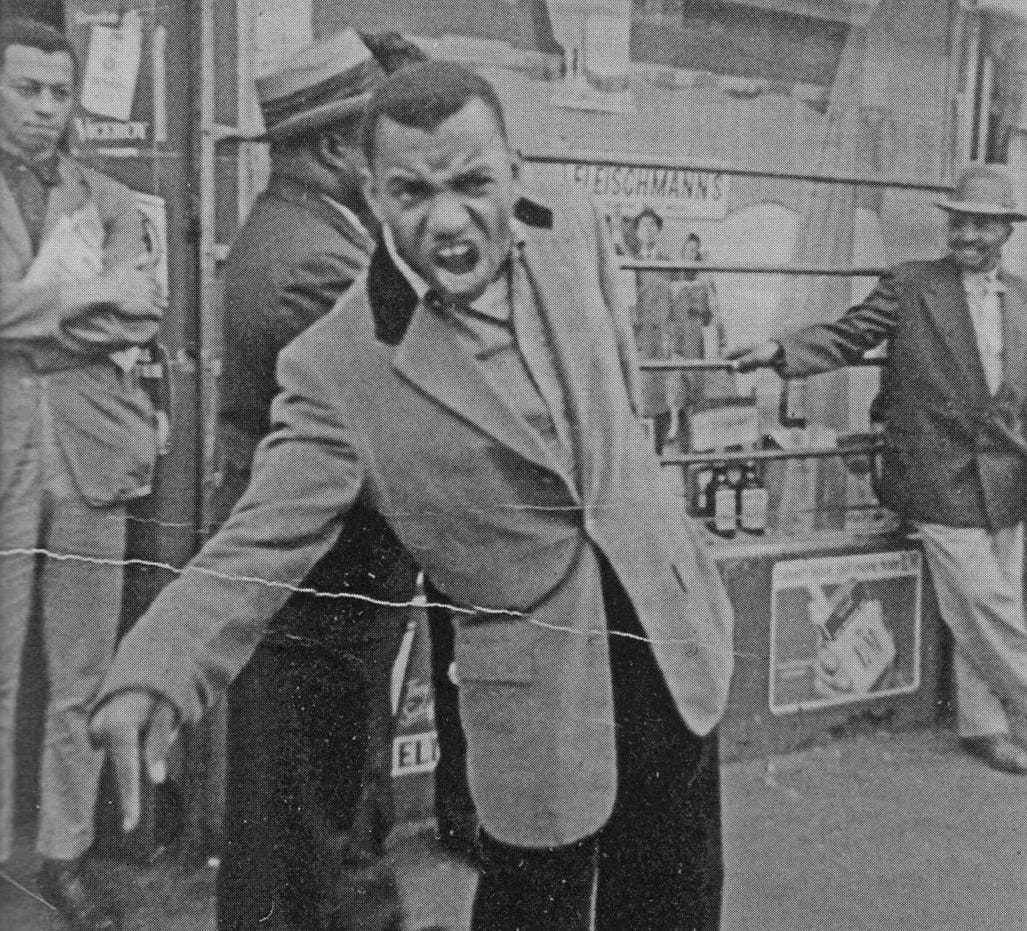
The photo below of Don Warden is from the archives of Khalid and Jamila al Mansour. Don Warden was one of the founders of the Afro-American Association at the University of California at Berkeley. The other founding members were Donald Hopkins, Otho Green, and Henry Ramsey. 

This organization formed in late 1961 and began as a student study group in 1962 at the University of California at Berkeley when there were literally no identifiable Afro-American and African Studies programs on any U. S. college and university campus. The group devoured works by Ralph Ellison, W.E.B. DuBois and other Black scholars that were left out of many colleges curricula. Study meetings of its members initially began at the off-campus home of a UC Berkeley student, and grew from there. In fact, chapters of this organization appeared on hundreds of college campuses in the United States with members numbering in the thousands by the mid-1960s.
The objective of the group was to read and study about the Afro-American, African, and Afro-Diasporic past in order to confront the institutional racism, colonialism and bigotry found in the United States and throughout the world. 

Warden, a UC Berkeley law student, regularly went into Black neighborhoods and literally spoke to young Black citizens directly on street corners or wherever they were. He encouraged them to study about Afro-American and African history in order to fight against their feelings of worthlessness that often accompanied experiencing chronic racism. 

He listened to them tell him about their problems of unemployment, poor housing, you name it. He, like most of his members, espoused that in order to change all systems of oppression, one needed to study about the past in order to do so. Warden eventually became a lawyer for the Black Panther Party of Self-Defense as well as granting legal assistance to the Nation of Islam when Malcolm X was still a member of the group.

The Afro-American Association was heavily influenced by the ideologies of Black American activists Robert F. Williams and Malcolm X. The AAA understood that only sustained study of Black people/s would foster the kind of thinking and strategies for combating systems that sought to suppress and control Black and Brown communities all over the world. Only deep research would correct the far-too-often feelings of inadequacy that came with being Black and oppressed. 

In 1962 when this study group, that was soon named the Afro-American Association, began its study group meetings at UC Berkeley there were roughly only about 100 Black students out of 20,000 white students. And in 1962 there were only two members of the group that were not born in the United States. One was from Jamaica; the other was from India.

In 1962 this tall, skinny, young Black man from Orange Hill, Jamaica and this petite and short, very brown young woman from Chennai, Tamil Nadu (in Southern India) dressed in her Sari and sandals met in an AAA group meeting.

The young man from Jamaica gave a pristine evaluation of how Great Britain had created a rather stiff and proper group of elite Black Jamaicans that often mimicked the mores and habits of British society. It was done, he said, to shield the world from knowing how racist the British empire actually was. The young man was calm, studious with very edgy ideas about the colonization of Black people/s around the world. 

The young brown woman in her Sari and sandals was intrigued. She too had been a British subject in her native state of Tamil Nadu in southern India. She knew something about what this young man spoke of, but not all of it. Back then, the typical path for academically talented Indian and Jamaican students was to study in England, that is if they could secure a path to graduate school. 

She rejected that path because there was no major in Biochemistry in India or in the UK that would have been available to a female. The skinny guy from Jamaica also rejected the educational path to the UK. His decision was so unusual that the approval for his exit from Jamaica took so long that he arrived at UC Berkeley two weeks after the Fall 1961 semester begun.

He, Dr. Donald Harris became a leading economist and she, Dr. Shyamala Gopalan-Harris became a leading biomedical scientist, a contributor to the identification of the function of rMNA, which greatly improved treatments for breast cancer. 

The early members of the Afro-American Association described her as warm, funny, “down for the cause” of Civil Rights and an end to colonialism, and also a fiery debater. At first one member of the AAA noted that some of them thought she was royalty because of the way she carried herself. Yet, she fit right in, several members noted. He was described as professorial even though he was in his early 20s. While their eventual marriage didn’t last (they married roughly 10 months after meeting), their firstborn daughter Kamala noted that she knew they loved each other and felt that if they had been a bit older and a bit more emotionally mature they might have made it. 

She cited them both as activists, and remembers going to protest marches with her parents in a stroller. The blueprint for their activism and for the creation of Afro-American and African Studies as disciplines were rooted in the activities in the Afro-American Association. While at UC Berkeley, Shyamala met and influenced arguably, one of Afro-America’s most important philosophers, Cedric Robinson.

Robinson’s book Black Marxism, first published in 1983, remains one of the most brilliant critiques and reassessments of the Eurocentric theories of Marxism. It has become a must-read in the literary canons of both Afro-American and African Studies.

It was Robinson who coined the phrase “Racial Capitalism.” He argued that capitalism was always based on race and race came before capitalism. Importantly there never was a clean break from European feudalism. He was one of the first Black scholars to identify “race,” as a component that European empires used when feudalism morphed into capitalism. 

Any study he maintained had to be central to Black people/s’ lived experiences wherever they were in the world. When I first read him, it became apparent that European Marxist scholars either forgot or tried to ignore that the peoples of Europe were once considered “races,” races and national identities that were eventually erased in exchange for their being identified as “white” which served the interests of European countries in their quest to colonize and dominate large portions of the world.

In 1959, Shyamala Gopalan was standing in line behind Cedric Robinson while they were both registering for classes. Both became members of the Afro-American Association. In the first edition of Black Marxism, there was only one person who was not a Black American listed in his group of early friends that Robinson acknowledged as influential on the development of his ideas. That person was Dr. Shyamala Gopalan-Harris.

So here’s a brief mini-history of the continuing of the Afro-American Association of University of California at Berkeley. Huey Newton and Bobby Seale who founded the Black Panther Party became members. Huey dared to show up at a meeting of AAA without having read the book assigned for that session. The members sent him home. He never showed up again unprepared. 

Future Congressman Ron Dellums was a member of the AAA at one time as was Kenny Freeman, a contributor to the Black Panthers 10-Point Plan. The AAA literally laid the academic groundwork for Afro-American and African Studies programs throughout the nation as underscored by historian and author Donna Jean Murch who traced the evolution and development of the Black Panther Party from its roots in the Afro-American Association. None of it began without the required reading and research and the on-the-ground grassroots activism that met Black communities in the Oakland area where they were.

I could go on about how police monitored the group’s members particularly when they spoke on street corners, or visited high schools to encourage reading and research among members of the Black community. Yet, I will not do that mainly because well-meaning, good people have started to use the internet like an online set of Cliffnotes

If you’re old enough to remember Cliffnotes you also remember that occasionally they were used instead of reading the actual book or doing the actual research. Yet, your ass was grass when a teacher or professor asked you a highly specific question that Cliffnotes did not cover and you hadn’t bothered to read the whole book.

So there’s a small bibliography below with a list of books that are worth your time. The message is clear: Either you put in the time and read or you remain a dilettante on matters that you need to know both for your safety and your sanity.

© Leslye Joy Allen

This essay was previously posted on Substack on January 22, 2026.

I am an Independent Historian, Oral Historian and Dramaturge. Please consider supporting my work and research with a few bucks for Coffee and Eggs via my CashApp or become a paid subscriber to me on Substack to help me sustain my research.

Recommended Readings:

Living For the City: Migration, Education, and the Rise of the Black Panther Party in Oakland, California by Donna Jean Murch

Fanon for Beginners by Deborah Baker Wyrick

Remaking Black Power: How Black Women Transformed an Era by Ashley D. Farmer

Black Marxism: The Making of the Black Radical Tradition by Cedric Robinson

Oregon Police Department Surveillance Files on Donald Warden and the Afro-American Association which kept surveillance documents on Donald Warden when he visited Oregon to encourage students to read and research.

The Afro-American Association: Forerunner to the Panthers

“How Kamala Harris’ Immigrant Parents Found a Home, and Each Other, in a Black Study Group” by Ellen Barry, September 13, 2020, New York Times.

The Truths We Hold: An American Journey by Kamala Harris

Remembering Cedric Robinson: Humanistic Imaginaries and the Black Radical Tradition

All blogs written by Leslye Joy Allen are protected by U. S. Copyright Law and licensed under a Creative Commons Attribution-NonCommercial-NoDerivs 3.0 Unported License. Any partial or total reference to any blog authored by Leslye Joy Allen, or any total or partial excerpt of any blog authored by Leslye Joy Allen must contain a direct reference to this hyperlink: https://leslyejoyallen.com with Leslye Joy Allen clearly stated as the author.  Postings or blogs placed here by other writers should clearly reference those writers.  All Rights Reserved.
Enough Is Enough

by ©️Leslye Joy Allen

I have more than a few favorite writers, journalists, and/or activists on Substack. One of them is Lorissa Rinehart. When she wrote that too many children are addicted to social media, I got the impression that she drew on scientific studies and her own observations.

She delivered a good hard punch to catch our attention. She wrote:

“If religion is the opium of the masses, then social media is the meth.” —©️Lorissa Rinehart

You should be aware that an addiction to substances like Crystal Meth are among the most difficult of all habits to kick. Rinehart waxed poetic about how the Zuckerbergs and the Musks of this world prey on the minds of our children in much the same way drug dealers pounce on entire communities.

Her statement reminded me that addiction to social media is one thing that aided and abetted our current political climate. She reminded me that our children are particularly vulnerable to social media propaganda pushed by the Far Right.

So, here are some family practices I suggest that I learned from a friend of mine over 15 years ago. My friend limited TV viewing to one night a week with the whole family watching together. Her kids were only allowed 3 days per week to surf the web at home for 1 hour each day with parental controls on.

The rest of the week she and her offspring discussed Art, Music, Current Events, School and Books at the dinner table. After dinner there was homework. After homework they would pick a topic to discuss or a book to read together over the coming week. I must say she now has some of the smartest young adults I have met in quite a while.

Now, before you say that all of this is too difficult to do; that your work schedule is too difficult to navigate around in order to do any of this; or that you are not sure if you can get your kids to participate in anything like this, answer a few questions for yourself.

When is the last time you read a book or visited a library? How often do you have face-to-face conversations with friends and family, with everyone’s cellphone silenced or turned off and put away out of sight?

If you have not done any of the above in quite some time or you have stopped doing most of it regularly, consider how social media has altered how you communicate with others. Come to think of it, social media has altered nearly everybody’s way of communicating.

Social media is not inherently evil nor inherently good. Social media’s information, however, is the easiest information to manipulate and the fastest to spread. Now think of how easy it can manipulate your children’s ideas about the world and themselves, often before you know anything about the ideas that have formed in their heads. Before I say anything else about Meth addiction, think about social drinking.

If you are a social drinker who is not an alcoholic, you tend to know your limit. You might feel a mild buzz, feel a bit relaxed, but not drunk. In your youth you probably learned the hard way when to say “I have had enough.” Long term Meth addicts don’t have any moments of “I have had enough.” They often suffer from everything from depression, psychotic episodes, an inability to sleep, and tooth decay.

Unlike addictions to controlled substances—legal and illegal—social media addiction has no noticeable physical symptoms. So, when it comes to social media, do you know when enough is enough for yourself? More importantly, do you know when enough is enough for your kids? Think about that for a while.

©️Leslye Joy Allen

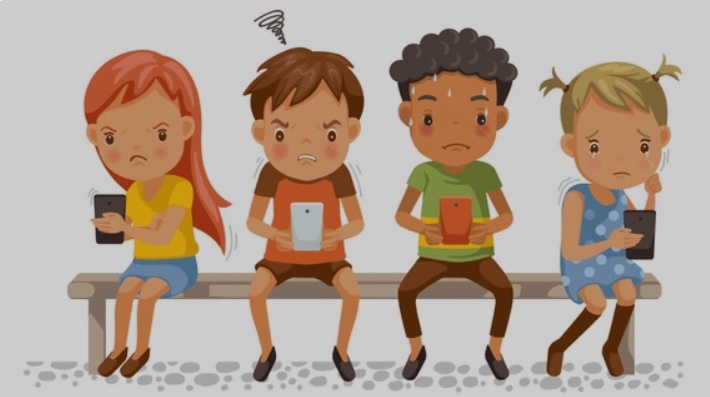
(Stock drawing of kids on their cellphones)

All blogs written by Leslye Joy Allen are protected by U. S. Copyright Law and licensed under a Creative Commons Attribution-NonCommercial-NoDerivs 3.0 Unported License. Any partial or total reference to any blog authored by Leslye Joy Allen, or any total or partial excerpt of any blog authored by Leslye Joy Allen must contain a direct reference to this hyperlink: https://leslyejoyallen.com with Leslye Joy Allen clearly stated as the author.  Postings or blogs placed here by other writers should clearly reference those writers.  All Rights Reserved.
Social Media Overload

by Leslye Joy Allen

Copyright © by Leslye Joy Allen

I freely admit I enjoy social media.  We social media denizens trade ideas, photos, debate politics, say prayers for people in need, raise money, promote good causes, advertise our own enterprises, post recipes and witty sayings, talk about art, film, theatre, and occasionally go on rants.  I try to keep rants to a bare minimum. But hey, if ranting on social media is what keeps you from going out and shooting people at the mall, then rant away.  Now with all that’s good about social media, I’ve also experienced what I now call “social media overload.” I thought I would share some of my opinions because occasionally I get messages from people asking me why I don’t comment on posts as much as I used to.  Well, I know I’ve lost time in the past by spending too much time posting, commenting, clicking and tweeting.

I primarily use my laptop much more than I use my smartphone for any form of social media; and I always log out when I’m done, so I don’t hear those dings you hear on a smartphone when someone posts or tweets something new. Plus, with a sporadic and highly irregular work schedule while I also try to write and edit and finish a dissertation is hard enough.  I can typically write a blog in less than 30 minutes, but writing and editing a dissertation in squirts is a slow and agonizing process, so staying online isn’t possible anyway.  I now deliberately and regularly go a minimum of 24 to 48 hours (often longer) without checking in on social media. The first time I did this several months ago, I discovered something about these 24 to 48 hour cycles.  My first full day away, I found myself severely missing posting and commenting on other people’s posts.

If you stay away from all social media for roughly 24 to 48 hours and then return, you will probably notice one or two (or maybe three) subjects trending.  There will be one post after another about essentially the same thing.  Let’s say it’s something that everyone seems to like; so everyone is super happy about an event, a film, you name it.  When that happens I can almost guarantee that if you sign off again and then revisit after the next 24 to 48 hours, whatever was trending that everyone liked a few days ago will now have its critics.  So then there will be a series of comments or a few articles telling you that what you initially liked 24 to 48 hours ago is no longer something that you should like, but something you should question or at least greet with some suspicion.  Some of these fresh critiques often have some value and tend to make good reading.  Yet, I noticed that a lot of these articles and comments read like the pseudo-intellectual hogwash they are; and often the real tragedy is that these articles are penned by perfectly good writers who seem to be having a hard time finding something to write about and have simply jumped on the bandwagon with the rest of the cynics.  Then if you sign off and stay gone for yet another couple of days, something even more curious will have probably happened.  Within that next 24 to 48-hour cycle—this is our third cycle, now—you will have another set of reverse critics who will critique those initial critics who dared criticize what you and everyone else liked in the first place. If you have a headache reading this, don’t feel bad.  I have one too!  However, I didn’t see these patterns until I let a few days go by without visiting social media.

I had an interesting conversation recently with a Personal Development Counselor. He was a charismatic young man who looked to be in his late twenties to early thirties.  He told me something that I found quite troubling.  Most of his work, he said, was with young male Internet Technology professionals, commonly called ITs.  He stated that almost all of the young male ITs he meets have problems talking to women because they spend all day staring at a computer screen.  He bluntly told me that most of them don’t know how to make small talk.  Almost all of the questions they ask him are about how they might best find the right words to approach a woman to date via some online service.  Simple things like having a conversation with a woman and then asking her out for a simple cup of coffee is totally foreign to many of these guys.  His job as a Personal Development Counselor is to give these young men some kind of road map to use to help them create a satisfying personal life because they do not know how to do it by themselves.

Now, before every Internet Technology professional sends me personal denials of such behavior and/or hate comments, hold your horses and slow your roll.  I know plenty of well-rounded IT professionals and I know that the majority of folks in this profession do not have the problems identified by this Personal Development Counselor.  I do suspect that  youth plays a factor in these problems. Those of us who are now in our AARP years remember a time when you didn’t need a computer or a smartphone to do anything and everything.  You had to go out and meet people, make eye contact, have conversations, and you did not have a smartphone as a constant distraction.  Younger men and women have no such memories.  What this young Personal Development Councilor shared with me made me take a good hard look at how much, how long and what content I place on social media and why I do it.

A while back I made a personal commitment to not post the news on my Facebook, Twitter or Instagram accounts.  What appears on MSNBC or CNN or FOX is almost always bad news anyway. I’ve managed to stick with this formula about 98 percent of the time.  On those days when something tragic has happened yet again to another Black person, to another woman, another LGBTQ person, another child, and etcetera, you can expect the threads on most social media to be filled to the brim with this bad news, tragic news, and horrible news, along with their shock and hurt about these tragedies.  All of it would be easier to stomach if there wasn’t so much of it.  It’s not that racists and sexists and misogynists and homophobes and rapists and murderers don’t do ugly, horrible mess to people with great regularity; it’s that this ugliness is not happening to me or you every single minute of the day because if it were happening to all of us 24/7, none of us would have the time or the luxury to post about it and debate about it on social media.  It is not that bad things don’t happen, but rather that good things happen as well. Now before you say that we all need to talk about these problems and vent about these tragedies, consider this:  If you do not post or comment about some major issue or problem, what exactly is going to happen or not happen if you don’t post or if you are absent for a few days?  What exactly would you be doing if you were not posting and commenting on your own or someone else’s posts?  This leads me to what I call the “Instant Gratification Trap.”  I’m as guilty of being caught by it and in it as anyone.

The “Instant Gratification Trap” is when you discover that your posts are rather popular and/or make people feel better and/or make people think deeply. Suddenly you feel important and admired. When I simply stopped posting anything negative and made it a point to post something positive, I found nothing wrong with basking in the warmth of compliments generated by folks who pressed the “Like” button and “Share” button and those who “Re-Tweeted” my posts.  All of this makes for good feelings all around.  However, the next thing I felt was obligated to continue making these kinds of intellectually stimulating posts.  “Obligated” is actually the wrong word here.  I felt compelled to post more positive posts because I ENJOYED and DESIRED the affirmative reactions of my real friends and my “cyberspace associates.”  Even further, I started to believe that what I had to say was so very important that I better hurry up and post something else that was wise and wonderful because, hey, what’s going to happen to all of those people who rely on my posts and my comments if I’m not there to post or comment?!  Let me say this as plainly as possible:  This is some ego tripping of the highest order.  All of us, hopefully, get to help people out, give some good advice and feel a little extra special, which is healthy.  We should feel confident about our work and our words and our contributions.  But exactly where do we draw the line?

Now, I read a lot of writing by my own real personal friends and many of my cyberspace associates; and there are some seriously talented writers and thinkers among them. Many of us are quite bright and we might say a lot of things that need to be said, but we’re not the only crayons in the box.  The problem with Instant Gratification is that it is short-lived because you haven’t worked that hard for it; it’s fleeting.  So, like a drug addict in search of another high, you post more and more to get more and more validation.  That validation strokes the ego; at least I know it stroked mine.  However, here’s how I’ve decided to use my ego.  I have enough of an ego to not want my very best writing to be on some social media site because once it’s posted there, it belongs to the site.  You can always lay claim to what you wrote, but the jury is still out as to whether any social media site needs your permission to reproduce what you’ve written somewhere else for the site’s own purposes.  When I feel the need to say something really serious, I put it in my blog or in my notes for some future essay.

Now, here’s an aspect of social media that is more delicate.  On most social media sites you can “unfollow” or “block” people. On Facebook you can “unfriend and block” people.  Every person I know has had that moment when they suddenly discover that “friend” or what I call a “cyberspace associate” who disagrees with them on every moral or ethical question out there.  Their contradictory opinions seem to come out of nowhere, but they really don’t come out of nowhere.  Remember, you don’t actually personally know a lot of these people who make it to your friend list; and they typically made it to your list because they know about thirty people that you actually know or they seem to be natural allies due to their posts and comments. Then one day they comment on some thread of yours and manage to annoy everyone with their narrowmindedness or their determination to ram their opinions down everyone’s throat and by their unwillingness to respect the opinions of others.  So after a few acrimonious comments and a variety of pithy rebuttals to their opinion, you get angry as hell and you click that “Unfriend” button so you don’t have to hear from them again.  Now, there are some good reasons for unfriending these creeps.  I got rid of one that was running for public office and who also turned out to be damned near a stalker.  (I also blocked him and thank God he lost his election.)

Now, I don’t blame folks for not wanting to be bothered with internet trolls or real life ass holes who spend the better part of their days trying to start arguments and foment dissension among groups of people who might be having a stimulating and insightful discussion. Yet, the problem with unfriending people with opposing views is that’s not how it works in the real world. As I have encouraged healthy debates among my former History students, they know like I do that you don’t learn as much from the people with whom you agree, but from those people with whom you disagree.  It might make you feel better to “unfriend” someone. I know it made me feel better. Yet, when met with opposition face-to-face instead of in cyberspace, you have to monitor your anger to prevent a debate from turning into a full-fledged argument or worse.  You have to think with more precision because you are in the physical presence of someone who disagrees with you and who has also pushed your buttons. I often think we argue on social media because it’s physically safer to do so; and there is nothing wrong with that. However, you might discover in face-to-face communications that your adversary has a point worth listening to.  And the key word here is “listen.”  Unless you’re communicating via FaceTime, most communication on social media is written. I have read (and learned to stay the hell off of) some threads where someone’s words were misconstrued precisely because no one on the thread could see that person’s body language or hear the natural inflections in that person’s voice that give additional meanings and depth to the point they were trying to make. And this leads me to something the Personal Development Counselor said about empathy.

The last thing he told me was that he thought too much consumption of social media led a lot of folks to believe that they were highly informed and highly sympathetic to people with problems when they were not.  Reading a book or a story, he said, created empathy.  He’s right.  You identify with the protagonist or some character in the book.  After you’ve finished reading the book, you continue thinking about the characters, the themes, what did it all mean, and why you enjoyed it, etcetera.  The brevity of posts on social media, he said, doesn’t require this kind of investment. You read a few lines of a post, and think about it for a few minutes, and then you move on to the next post or the next thread.  There isn’t much time to ponder and process what you just read if you’re suddenly distracted by something else that is more provocative.

I met a couple of young people recently who have deleted several of their social media accounts, including this Personal Development Counselor.  I probably will continue to enjoy social media for all the reasons I listed at the beginning of this blog.  I personally know plenty of people on social media who are caring, thoughtful people who genuinely want everyone they know to be informed about some serious problems going on in the world or about the good that’s out there; but there’s a creeping shallowness on social media that I’ve noticed in recent years.  It is no accident that the rapper Kanye West thinks “slavery was a choice,” if we consider that his exposure to the subject and its history has obviously been through imbibing short blurbs, 30 second soundbites, memes and slogans designed more to catch the ear and eye than to honestly analyze and inform anyone about what was a highly complex and brutally oppressive institution.

The fact that West and others think you can explain and reduce Chattel Slavery in the Americas—a 400-plus year old institution—to something as simple and singular as “choice” not only speaks volumes about what books they haven’t read, but also how their brains are now wired to believe that their ability to understand complex subjects can be accomplished via tweets, short articles, and a few posts.  West is not unusual nor is he an anomaly.  Kanye West is the results.  It’s hard to invest in people and consider their feelings when empathy with other people and their history is short term because the next post or thread about someone or something else is so much more exciting.  It’s easy to dismiss what is not provocative or catchy; after all, most of these posts are designed to draw people to them.  I don’t know what the long term repercussions of this type of media saturation will mean to everyone, but for me it means I’m going to be taking regular breaks from all forms of it from now on. Peace.

Copyright © by Leslye Joy Allen.

This blog was written by Leslye Joy Allen and is protected by U. S. Copyright Law and licensed under a Creative Commons Attribution-NonCommercial-NoDerivs 3.0 Unported License. Any partial or total reference to this or any blog authored by Leslye Joy Allen, or any total or partial excerpt of this or any blog by Leslye Joy Allen must contain a direct reference to this hyperlink: https://leslyejoyallen.com with Leslye Joy Allen clearly stated as the author. All Rights Reserved.

I AM…


(for Billie, who insisted that I boldly say, “I AM,” and for Nevaina (nih-von-yah)—one of many actors who were once under Billie’s direction—who reminded me to say it even louder)

Copyright © 2016 by Leslye Joy Allen. All Rights Reserved.

“Self Portrait” by Copyright © 2015 Leslye Joy Allen.  All Rights Reserved.

“Self Portrait” by Copyright © 2015 Leslye Joy Allen. All Rights Reserved.

I am Thomas and Syble’s daughter.

I am the granddaughter of Lorena and George and Minnie and Will.

I am a historian.

I am an intellectual.

I am a dramaturge and patron of theatre and the arts.

I am a Jazz fan.

I am a Johnny Mathis fanatic.

I am eloquent.

I am also a great procrastinator.

I am one who is often impatient.

I am one who does not like braggarts or pretenders.

I am a good and loyal friend.

I am also one who, some times, does not listen.

I am a woman who will drop you like a bad habit if you lack empathy or fidelity.

I am an environmentalist.

I am a lover of animals and nature.

I am a lover of children.

I am a Black Nationalist because it makes sense to take care of your home and your people first.

I am a woman that does not deal easily with shallow people.

I am a woman that prefers simplicity.

I am a woman who is fond of the exotic.

I am a woman who has learned how to say, “No” the hard way.

I am a woman who does not like playing small.

I am a woman who never discounts what other people have to go through to do whatever it is that they need or have to do…which is why I am deeply offended when other people discount what I go through.

I am a woman that dislikes men and women who try to prove their worth with things rather than demonstrate who they are by what they believe in and what they put into practice.

I am a woman who would prefer the company of a poet over that of a stockbroker or the company of a musician over that of an accountant or the company of a college professor over that of a CEO of a Fortune 500 company…

I am my mother and father’s daughter.

— Leslye Joy Allen 

Copyright © 2016 by Leslye Joy Allen. All Rights Reserved.

This Blog was written by Leslye Joy Allen and is protected by U. S. Copyright Law and licensed under a Creative Commons Attribution-NonCommercial-NoDerivs 3.0 Unported License. Any partial or total reference to this blog or any total or partial excerpt of this blog must contain a direct reference to this hyperlink: http://leslyejoyallen.com with Leslye Joy Allen clearly and visibly stated as the author. All Rights Reserved.

Frank Wittow’s Legacy…Nevaina’s Dream

by Leslye Joy Allen

Copyright © 2015 by Leslye Joy Allen.  All Rights Reserved.

The late great actor-director-educator Frank Wittow remains one of my favorite figures in Atlanta’s rich theatre history.  His work with the late, great Georgia Allen was second to none—He placed this multi-talented Black woman in a non-servant role on an Atlanta stage in the early 1960s when the city and indeed the nation were still grappling with the idea that maybe Black folk were more than just the servants of White folk. Georgia Allen had appeared in numerous films and theatre productions throughout the nation and on the campuses of Spelman and Clark Colleges, and Wittow was wise enough to recognize Allen’s superior gifts.  He was simply a different kind of White man. There were no syrupy and useless White liberal platitudes about race relations spewing out of his mouth—he just did what he wanted to do.

Now, Allen predated Wittow’s arrival in Atlanta and she had a much longer career, and to fully honor her contributions to all of the arts and to education would require writing a tome. So, I will save that project for a later date.  Much like Allen, however, Wittow directed, trained, and mentored some of the best performers on the planet and took theatre performances into Atlanta Public Schools throughout much of his life.  He did this almost to the day he died in 2006.  One of his younger protégées had the benefit of his training…

Her name is Nevaina Rhodes—her first name is pronounced “Nih-Von-yah” like “lasagna.”  The first time I saw her perform, I did not know she had any affiliation with Wittow.  When she told me her basic philosophy about acting there was something refreshingly new about her approach to her craft, but also something rather familiar…Let me explain…

You see, when I was growing up in Atlanta, an actor, a musician, a poet, an academic, an intellectual, was simply part of the community in which we all lived.  Importantly, you had to participate in the arts and the humanities, and it did not matter if you had talent or an exceptional intellect or not.  While I adore and admire many younger performers and scholars—and by younger, I mean anyone born after the Baby Boom—I find an increasing number of them who are quite insular; they have fewer connections to each other or with the folk in the communities where they live.  Unlike the Atlanta of my childhood, in recent years I have attended far too many functions filled with musicians, actors, poets, filmmakers, and historians and I end up being the only person in the room who actually knows everybody in that room…

Well, to make a long story short, Nevaina’s conceptualization of Real Actors Workshop (RAW) makes it open to amateur and professional alike.  Her basic theory is that whether you are a professional actor or not, all of us humans act and perform in certain ways depending on the circumstances.  In other words, she insists that, we all are actors. Although she is a North Carolinian by birth, her approach feels much like the Atlanta of my youth, where the long theatre traditions on the campuses of our Historically Black Colleges and Universities, and people like Georgia Allen and Frank Wittow made certain that theatre reached who it was supposed to reach—the people. We were not a community of strangers…everybody knew everybody, which is the way it should be.

I should add that I am writing this to inform you that Nevaina is not only a dazzling performer and an amazing drama coach, but she is also a real survivor. Native Atlantans, in particular, love people with a strong work ethic and those who bounce back when things do not always go as planned.  Less than five years ago, Nevaina miraculously and fully recovered from a stroke that could have easily killed her; and she remained positive while she also endured some personal losses that probably would have destroyed some weaker souls.

Today her Real Actors Workshop (RAW) is headquartered at Dream Café, Atlanta’s first cafe and empowerment lounge, which is owned by Nevaina and her partners, Jay White and Stevie Baggs.  Dream Café‘s premise is simple.  It is designed to be a place where artists, intellectuals, young and old folk can meet and greet and talk and achieve their dreams, over coffee and healthy food.  This concept and these young owners have my support not only because it feels familiar to me, but because it feels right…and it also feels rather cyclical…

Now, I am aware that my hometown has changed.  Nothing stays the same, nor should it stay the same.  Yet, there are some core elements that we must never lose—namely, the ability to connect with each other and exchange ideas.  Not even a semblance of community can survive if we lose this ability.  So, I am proud to call Nevaina a friend. It has been a great privilege to watch her perform; and I have been encouraged by her intellect, her big smile, and her big spirit…I am also certain that Wittow (and Allen) are watching her from that place where great souls go when they leave this earth…So, in honor of them and in honor of future generations, go visit the Dream Café, and write your dream on the wall. Àṣé!

To learn more about Real Actors Workshop (RAW), and Nevaina’s distinguished career as an actor, drama coach, and public speaker, click here: Nevaina Rhodes Inspirational Speaker and Drama Therapy Specialist.

Copyright © 2015 by Leslye Joy Allen.  All Rights Reserved.

This Blog was written by Leslye Joy Allen and is protected by U. S. Copyright Law and licensed under a Creative Commons Attribution-NonCommercial-NoDerivs 3.0 Unported License. Any partial or total reference to this blog or any total or partial excerpt of this blog must contain a direct reference to this hyperlink: http://leslyejoyallen.com with Leslye Joy Allen clearly and visibly stated as the author. All Rights Reserved.