The Intersectionality of Suffragist & Abolitionist Lucy Stone

by ©️Leslye Joy Allen

“Intersectionality is a metaphor for understanding the ways that multiple forms of inequality or disadvantage sometimes compound themselves and create obstacles that often are not understood among conventional ways of thinking.” — Kimberlé Crenshaw

Recently, I responded to a question about the factors that stymied women’s quest for suffrage during the mid-to-late 19th century. I brought up the pragmatism and egalitarianism of suffragist and abolitionist Lucy Stone whose legacy remains largely overlooked. And therein lies the problem.

Susan B. Anthony and Elizabeth Cady Stanton have rightfully earned their place in Women’s history. They battled for the vote in ways almost unimaginable. Yet, they both held racist and classist views. Now before you start yelling about how both of them worked in the abolitionist movement, spare me. You can be anti-slavery and still not think the slave is your social or political equal. The inability to shake off one’s sense of entitlement has extreme consequences for everyone.

When lawmakers decided to include Black men as voters in the 15th Amendment without including the franchise for white women, both Stanton and Anthony were rightfully livid, but livid to the point where they then fought against the passage of the 15th Amendment altogether. It passed, however, in 1869 and was ratified in 1870.

Stanton wrote that it was unconscionable and dangerous to give the vote to Black, Chinese or Irish men because they were inferior. Anyone that did not fit a strict Anglo-Saxon and native-born status was considered inferior. Additionally, neither Stanton nor Anthony had thought about Black women voting at all. 
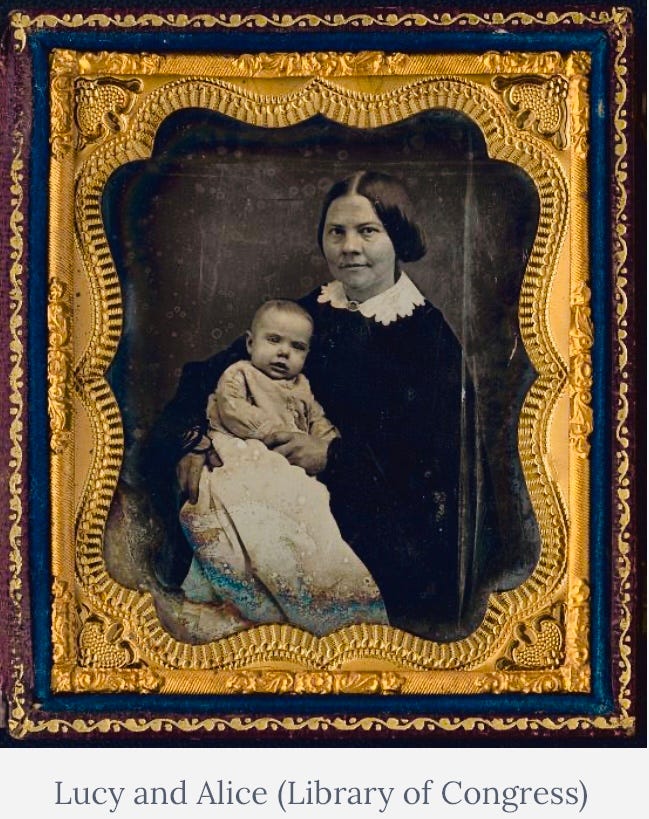
Stone broke with Anthony and Stanton over their racism. Orator, writer, abolitionist and former slave Frederick Douglass cut his ties to Anthony and Stanton as well. The tragedy was that Douglass had attended the Women’s Conference at Seneca Falls in 1848 and had been a huge and early advocate for women’s rights. Moreover, it was Lucy Stone’s brilliant oratory that had inspired Susan B. Anthony to join the suffrage movement.

Stone read the political winds correctly. She formed the American Woman Suffrage Association which concentrated on gaining women the right to vote on a state-by-state basis. She knew that Congress was not going to grant the franchise to everyone. 

Stone believed that the enfranchisement of Black men was progress. Although she was disappointed that the 15th Amendment did not include women’s suffrage, she did not believe that denying the franchise to others would help women in the long run.

Black men, rather than white women, were granted the right to vote first for a variety of reasons. As a historian, I know that the Republican Party in the 1860s was the party of Lincoln (not the sh*t show it is now) that freed Black American slaves. They controlled both the House and the Senate in 1867 to 1869. They knew that recently freed and enfranchised Black men would inevitably vote Republican and increase the party’s political dominance.

Granting the franchise to white women would have mixed political results as many white women still believed in the lost cause of the South in spite of its loss during the Civil War. They would have voted Democrat which was then the favored party of the former slave-holding South.

Some of Stone’s ideas were tied to her upbringing. She came from a hardworking farming family in Massachusetts. Both of her parents were abolitionists. While quite young, she, along with Lucretia Mott and Abby Kelly Foster helped William Lloyd Garrison establish the American Anti-slavery Society which was founded in 1833.

All of her brothers attended college. Yet, Stone had to postpone her education. She taught school for several years and was able to scrape up enough money to attend Oberlin College, the first college in the nation to accept Black people and women. When she graduated in 1847, she became the first woman in Massachusetts to earn a college degree.

Stone had planned to remain a single woman because she feared losing her independence to a husband. She finally yielded to Henry Browne Blackwell’s persistence. Blackwell was also an abolitionist and women’s rights advocate. Blackwell would learn years later that Stone finally decided to marry him after he met and aided a young slave with her owners while traveling on a train.

When Blackwell asked the girl would she rather be free, she answered “yes.” Blackwell and an accomplice helped get the young girl off of the train and away from her owners. It was that act of liberation that won Stone over.

When Blackwell and Stone married their written protest against laws that denied women equal rights was read before the ceremony. The promise “to obey” was removed from their wedding vows. Stone retained her maiden name and refused to pay taxes as long as she was denied her equal rights.

While neither Stone nor her contemporaries Anthony and Stanton lived long enough to see women receive the right to vote, their different approaches and beliefs underscored a perpetual problem in the quest for women’s equality and the right to vote.

Stone never stopped fighting for the rights of Black people as she continued her fight to get the vote for women. She believed that both causes were interrelated. The same cannot be said of Anthony and Stanton. 

The fight for the right to vote for women was often fractured by racism well into the 20th century. Stone’s stances on racial equality and equal rights for women cost her some popularity among some white women. Anthony and Stanton emerged as the face of white women’s suffrage. Yet, Anthony and Stanton also emerged as suspect to Black men and women. 

After Lucy Stone died of stomach cancer in 1893, her only child, Alice Stone Blackwell reached out to the daughter of Elizabeth Cady Stanton and began the process of repairing the divided women’s suffrage movement. They created a new coalition. Alice Stone Blackwell followed her mother’s mantra to make the world better.

Lucy Stone deserves more historical attention than she receives. Her example should be emulated precisely because she understood the “intersectionality” of gender and race (and the political implications that go along with it) long before Black scholar and lawyer Kimberlé Crenshaw coined the term and defined the theory in the late 20th century. Stone recognized that, no matter how different gender and race may appear, women’s equality was inextricably linked to racial equality. You must fight for both, not just one or the other.

©️Leslye Joy Allen

I am an Independent Historian, Oral Historian and Dramaturge. Please consider supporting my work with a few bucks for Coffee and Eggs via my CashApp.

All blogs written by Leslye Joy Allen are protected by U. S. Copyright Law and licensed under a Creative Commons Attribution-NonCommercial-NoDerivs 3.0 Unported License. Any partial or total reference to any blog authored by Leslye Joy Allen, or any total or partial excerpt of any blog authored by Leslye Joy Allen must contain a direct reference to this hyperlink: https://leslyejoyallen.com with Leslye Joy Allen clearly stated as the author.  Postings or blogs placed here by other writers should clearly reference those writers.  All Rights Reserved.

To End Crucifixion

by ©️Leslye Joy Allen

The first time I heard of crucifixion outside of a biblical context I was watching the film Spartacus, released in 1960 that starred Kirk Douglas. I was in high school in the 1970s when I first saw the film on television.

Crucifixion was one of the most excruciating and barbaric of all forms of execution. The person on the cross, slowly and agonizingly, died from suffocation as their rib cage was forced upwards. They could not fully breathe and eventually they died.

No moment in the film Spartacus brought me more tears than the fight scene when the slaves “Spartacus” (Douglas) and “Antoninus” (played by Tony Curtis) were forced by Roman authorities to fight each other to the death.

Spartacus and Antoninus, who loved each other like brothers, were determined to kill one another in order to spare the other the agony of crucifixion. Spartacus eventually kills Antoninus. In grief, Spartacus yells at his tormentors, “He’ll come back. He’ll come back; and he’ll be millions.”

That scene gave me the sense that when the best people die, they will somehow be reincarnated and other people of goodwill will join them. That belief, however, has never brought me much comfort.

MAGA supporters are not likely to understand my interpretation of the themes in the film Spartacus. They follow orders, not facts. They don’t think of people on the Left, or people of peace as anything other than unrealistic and subhuman. They don’t think compromise with people with whom they disagree is anything other than a show of weakness.

MAGA adherents of all races and ethnicities believe in White male supremacy in a world that gets browner by the day. While U. S. Immigration and Customs Enforcement officers round up every undocumented brown worker they can find, Felon 47 wants to annex countries inhabited primarily by people classifiable as white.

White male supremacy only functions when people believe in the stereotype of the “Great White Father” who is considered the only one fit to lead and to appoint others to important positions. This is part of the reason why a lot of voters voted against their own interests and against their own people.

Felon 47 supporters always claim to be Christians. I do not entirely trust the Christianity formulated in the Western World because the people who formulated it cannot even so much as admit that there is virtually no such thing as a person classifiable as “white” that was/is native to any location in the Middle East or North and Eastern Africa.

A sandy blond-haired, white-complexioned, blue-eyed Yeshu’a has always been a lie. So, when you engage with MAGA supporters (and many anti-MAGA folks) you are engaging with people where generations of their families have prescribed to the lie for centuries. Felon 47 stepped into a centuries old illusion, proclaimed himself to be sent by God, then went around autographing Bibles.

I can count on one hand the Christian ministers I respect; most of them are women. They inspire. They pray. They analyze. They talk about justice. They talk to you like you have a brain; and they do so without the big egos and the expectance of deference I have encountered from a few too many clergymen.

At the end of all discussions and analyses, Yeshu’a’s life still ends the same way. No matter how good he was, he was still executed by crucifixion which was the Roman Empire’s method of execution for paupers and other petty criminals.

No matter how popular an itinerant preacher Yeshu’a was, church fathers and the Roman government considered him a threat to their power; and they used every lie, every smear campaign against him until many of his own followers turned against him and called for him to be put to death.

I do wonder when we, particularly those of us in the Western World, will get sick of that perpetual narrative where someone has to die in order to free us?

Must the good man or the good woman always be the sacrifice? Or, have we absorbed a skewed Western Christian Worldview for so long that we cannot even imagine any form of salvation, deliverance or peace without someone being killed?

Is some form of crucifixion inevitable or merely a twisted human habit where we refuse to think our way out and fight our way out of problems we cannot completely face so that we require a martyr to prove we were, at least, thinking in the right manner? That kind of thinking should not ease our consciences.

Maybe I’m a fool, but I still think that if we learned anything—even from an edited and modified form of Christianity—it ought to be that goodness and mercy and fair play may get someone jailed or killed, but it should not have to be that way.

Church services are often filled with sermons that make Yeshu’a seem more like a spirit than a flesh and blood man who once walked the earth. And if it is true that he died for our sins, exactly when do we accept that the point of his crucifixion was for us to do more than just acknowledge the awful habits of human history where we persecute or allow good men and women to continue to be persecuted?

Felon 47 and his underlings corrupt every precedent set by Yeshu’a. They resemble the Roman government and its sycophants while they embrace the Nihilistic principles of a 19th century Russian Party that used terrorism and assassination as part of their reform.

MAGA supporters and Felon 47 let people be detained or die in order to stave off the inevitability of the collapse of the White Western World. But will we, who know Felon 47 is wrong, fight to stop the deaths, persecutions, and detentions of people who only want to work and feed their families?

Will we ever admit that the story of Yeshu’a’s crucifixion means that we are charged with ending the blood-letting, the needless assaults, the threats? Will we ever be brave enough to end needless persecutions; or will we watch these modern-day crucifixions as if we were watching the fight between Spartacus and Antoninus thinking that it is only a movie. So, no one actually died.

©️Leslye Joy Allen

Tony Curtis (left) ; Kirk Douglas (right) in the film SPARTICUS, 1960. Alamy Stock Photo

All blogs written by Leslye Joy Allen are protected by U. S. Copyright Law and licensed under a Creative Commons Attribution-NonCommercial-NoDerivs 3.0 Unported License. Any partial or total reference to any blog authored by Leslye Joy Allen, or any total or partial excerpt of any blog authored by Leslye Joy Allen must contain a direct reference to this hyperlink: https://leslyejoyallen.com with Leslye Joy Allen clearly stated as the author.  Postings or blogs placed here by other writers should clearly reference those writers.  All Rights Reserved.

Walk With a Book

by ©️Leslye Joy Allen

I remember the first time I heard someone say, “If you want to hide something, hide it in a book.” The comment depressed me.

When you are a historian, you have books everywhere. You have to read all the time. I have not seen the top of my dining room table in nearly 15 years as it is covered with stacks of books. Books occupy every nook and cranny of my home.

With the United States ranking 36th in the world for literacy, with a 79% literacy rate, with only 25% of literate adults reading above the 6th grade level, we are already dumb. We can expect to see more decline in literacy with Felon 47 living on Pennsylvania Avenue.

So, I have a proposal. It might not change anything, but it is worth a try. Walk out of your door with a book in your hand or tucked under your arm everyday for at least a month.

Let kids and other adults see you walk with that book. And don’t say you can’t do this. You have carried books before when you were in grade school.

Make your book/s visible at your job, on a trip to a store. Hell, go for a walk with your book until someone asks you why you always have a book in your hand or under your arm. And then have the audacity to tell them why.

©️Leslye Joy Allen

All blogs written by Leslye Joy Allen are protected by U. S. Copyright Law and licensed under a Creative Commons Attribution-NonCommercial-NoDerivs 3.0 Unported License. Any partial or total reference to any blog authored by Leslye Joy Allen, or any total or partial excerpt of any blog authored by Leslye Joy Allen must contain a direct reference to this hyperlink: https://leslyejoyallen.com with Leslye Joy Allen clearly stated as the author.  Postings or blogs placed here by other writers should clearly reference those writers.  All Rights Reserved.

Pawns and Queens: Analogies For a New Era

by ©️Leslye Joy Allen

We historians often find data in some file in an obscure archive, in letters written by someone’s grandmother, in photos, newspaper clippings, legal records. Our discipline demands that we dig, analyze, rethink and revise, constantly. I liken our work to studying the function of each piece in a Chess game. We get different perspectives about the same set of circumstances depending on which Chess piece we examine.

I was a mediocre Chess player. I had a few friends who played like champions. So, I often just watched them play. I remain, however, fascinated by the game’s objectives and, specifically, the roles of Pawns and Queens.

Pawns are the most numerous pieces in Chess; they are the foot soldiers. Each player has eight Pawns. A Pawn can move one or two squares forward if that move is its first move. After the first move, a Pawn can only move one square forward unless the square is blocked by some other piece. A Pawn can capture or attack another piece, however, by moving diagonally to the left or right.

The Pawn is the only piece in a Chess game that can change ranks. Depending on the skill of a Chess player, a Pawn can become a Bishop, a Rook or a Queen. In spite of a Pawn’s ability to advance to a higher rank, it is still considered the lowest ranking piece in the game. It is only worth one point.

The objective of the game is to capture your opponent’s King where that King has no way out, which means Checkmate. While the King is considered the most important piece in the game, it is the Queen that is considered the most powerful piece.

Queens are the only pieces that can move across the board in any manner as long as they are not successfully blocked by other pieces. If you lose, it is highly likely that you lost because your opponent’s Queen checkmated your King. Chess players feel much more confident when they have successfully captured or blocked her.

You can still win the game without capturing the Queen, but you have to be extremely strategic and precise to do so. You can also win without making good moves with your Pawns, but it is highly unlikely.

Chess is now over 1,500 years old. While there is some skepticism about its precise origins, many Chess historians believe that the Indian board game called “Chaturanga” was the earliest predecessor of Chess. There were many other versions that followed, but are too numerous to mention here.

In early versions of Chess, there was a piece called “Vizier” or “Advisor” for centuries. In the 1500s, in the era of great and powerful Queens in Europe, like Spain’s Isabella and England’s Elizabeth, “Viziers” or “Advisors” were redesigned and renamed “Queens.” You can learn an awful lot of world history just by examining Chess.

So here’s the deal: There is no such thing as a Chess game where Queens/Women Heads of State/Women in general are not powerful and flexible while the Kings/Men Heads of State/Men in general are highly important but who have or exercise fewer tactical moves.

There is also no such thing as a Chess game where Pawns/Foot Soldiers/Laborers are not essential to success, even while they are considered less important.

Apply any and all of the above to what you see happening in the United States and the world right now. I refuse to tell you how to analyze and interpret this history because there are so many interpretations and analogies that can be extrapolated from this board game.

All I will say is that nothing is going to change or be corrected without the skill of devoted Pawns, and the power and daring of Queens.

©️Leslye Joy Allen

Shutterstock photo of a Pawn and a Queen on a Chessboard.

All blogs written by Leslye Joy Allen are protected by U. S. Copyright Law and licensed under a Creative Commons Attribution-NonCommercial-NoDerivs 3.0 Unported License. Any partial or total reference to any blog authored by Leslye Joy Allen, or any total or partial excerpt of any blog authored by Leslye Joy Allen must contain a direct reference to this hyperlink: https://leslyejoyallen.com with Leslye Joy Allen clearly stated as the author.  Postings or blogs placed here by other writers should clearly reference those writers.  All Rights Reserved.

Parable of the Sower

by ©️Leslye Joy Allen

“…the plant of freedom has grown only a bud and not yet a flower.” — Martin Luther King, Jr.

“God is your first and your last teacher. God is your harshest teacher: subtle, demanding. Learn or die.” — Octavia Butler, (from “The Parable of the Sower, 1993)

I woke up before dawn annoyed that January 20, 2025 is inauguration day for Felon 47 and it is also the federal holiday celebrating the birth and life of Martin Luther King, Jr. I also could not help thinking about how our abuse of the earth has contributed to the fires in California.

A week ago, I re-read Octavia Spencer’s prescient novel “Parable of the Sower.” Butler’s protagonist Lauren, the daughter of a preacher, lives in a safe and comfortable, walled-up cul-de-sac. Outside those walls are desperately poor people, racial and economic inequality, and drug addicts that use a drug called “pyro” that makes its users want to set fires.

Lauren tries to convince others to accept that the world has changed and will continue to change. The others prefer to pretend nothing has happened to the earth and its inhabitants.

Butler predicted ecological disaster by fire coming over 30 years ago, and named her novel after a biblical parable. Right after I finished reading the book again, I thought about how M. L. got his name.

Many people do not know that M. L. (what we called him here in Atlanta) was born Michael King, Jr. I knew many elderly Black Atlanta citizens who called him “Mike” their entire lives.

His father, best known as “Daddy King,” attended a World Baptist Conference in Germany in 1934. Reborn and rejuvenated after he learned more about the philosophies of Protestant reformer Martin Luther, Daddy King soon renamed himself and his son “Martin Luther King, Sr. and Jr.”

In 1957, “Michael King, Jr.” was officially changed to “Martin Luther King, Jr.” on his birth certificate. There are other stories about why and when Daddy King changed their names, but I like this story the best.

I bring this up because another story goes that when the German Protestant leader Martin Luther was asked what he would do if he knew the world was going to end tomorrow, he allegedly answered, “I would plant an apple tree today.”

While I am a believer in Goddess/God, I am not particularly religious. I know too well how organized religion has failed us in so many ways. I am, however, a historian who finds truth and sustenance in some parts of the Christian Bible that the incoming administration and so many preachers and billionaires have totally corrupted.

In the Bible’s Parable of the Sower, Yeshu’a ben Yosef (bka Jesus) tells a story about a farmer who sows seeds in four different types of soil. It is not until the farmer’s seeds are sowed in good soil that he yields a good crop. In this parable, which has many lessons, Yeshu’a emphasized that we must pay attention to where we plant our seeds if we expect anything to grow. We yield a good harvest when we take responsibility for how and where we do our planting.

To place seeds in the ground is an act of faith. When you plant, you do so with the faith that you will yield something. You do it with the belief that you, or your loved ones, will live long enough to reap the reward, be it vegetables or fruits or flowers or justice or equality.

On this Martin Luther King, Jr. holiday, may we go forward intentionally, reminded that we are obligated to be good stewards of the earth that we do not own. California’s fires are the result of our excess and failure to clean up the earth which is the only home we have.

May we plant in the best soil, in the best social and educational policies, in the best radicalism, in the truth. May we sow our seeds in our gardens and farms and tend them with a faith that tells us we will reap a good harvest and that we will have enough to sustain us in order to stave off the worst excesses of the incoming administration. May we humble ourselves, unlike Felon 47 and his underlings, and remember that we live on this earth that we did not create and will die whether we are paupers or billionaires. May we learn the life lessons of one of the best sowers, namely Martin Luther King, Jr.

©️Leslye Joy Allen

King’s Papers are located at the King Institute at Stanford University. I urge you to visit and explore: https://kinginstitute.stanford.edu/message-director

(Martin Luther King, Jr. photographed in 1964 by Dick DeMarsico for World Telegraph and Sun. Courtesy of the Library of Congress)

All blogs written by Leslye Joy Allen are protected by U. S. Copyright Law and licensed under a Creative Commons Attribution-NonCommercial-NoDerivs 3.0 Unported License. Any partial or total reference to any blog authored by Leslye Joy Allen, or any total or partial excerpt of any blog authored by Leslye Joy Allen must contain a direct reference to this hyperlink: https://leslyejoyallen.com with Leslye Joy Allen clearly stated as the author.  Postings or blogs placed here by other writers should clearly reference those writers.  All Rights Reserved.