The Steps Called Books

by ©️Leslye Joy Allen

For people who have been reading my posts, you may have noticed that I have written about the United States’ severe literacy crisis twice on this platform. If not, you can read them here: The USA Literacy Crisis & This Election and Literacy Crisis, Part II.

This essay is Part III. Let me point out a few things first. Some 65 years ago in 1960, the United States was one of the most literate nations in the world. In 1960, only a handful of states in this country had an illiteracy rate of 10% for people aged 14 and over. The rest of the states registered only about 3% illiteracy. Now we rank 36th in the world for literacy among industrialized nations. There are other sources that place the USA at a literacy rate much lower.

In 2025, 21% of American adults are completely illiterate while 54% of adults read below the 6th grade level. I want to share with you in this essay, however, what poor reading and writing skills look like when these circumstances are also combined with educational red tape. 

I taught College History courses for roughly 7+ years, from 2007 to early 2015. My first 2 years, I taught at a Junior College that had several campuses outside the city limits of Atlanta in the outlying metropolitan areas. My last 5 years I taught at large state universities. Junior Colleges are structured for students who have some academic deficits. Students often attend Junior Colleges to fix a deficit in some academic discipline so that they can eventually qualify to attend a four-year institution to earn a Bachelor’s degree.

When I started teaching, I taught year round. After I taught on this particular campus for about two semesters, I noticed that this campus was slowly being converted into a cash cow. The school started accepting anyone who could pay tuition and occasionally referred to students as “customers.” That did not go down well with me and a lot of other Instructors and Professors. 

Most of my History students had some problems with reading, writing, and critical thinking skills. I usually spent the first 3 weeks of every semester correcting grammar and insisting that they trust their answers and their own instincts. 

When I asked a simple question, initially none of them could state the obvious answer. I demanded that my students give complete and well-thought out answers and opinions in class discussions instead of the abbreviated and one-word answers that chronic text messaging had fostered. 

The majority of my students rose to the occasion. They did the work, read my comments, listened to my instructions and suggestions, and put in the extra time needed to get up to speed in writing and having in-depth discussions about History. I did have one student, whose identity I never knew, who complained about having to write 3 five-page long History papers. Imagine having to write 3 papers in a 16-week long semester in college.

I learned later through the grapevine that this student allegedly had an inappropriate relationship with some man in the Junior College’s administration to who that student complained. One day I was informed that I would have to attend a meeting with my Department Chair and the Ombudsman of the School. 

During the meeting, both my Department Chair and the Ombudsman kept telling me things like “Many of these students might not know how to interpret what you tell them. They might not understand what you say to them or write on their papers. One student said you told him or her that they could not write!”

I was confused and raised these points: “I have NEVER told a student that they cannot write. I have told or wrote to many of them, however, that they needed to take a good writing course so that they can improve their writing skills and get more practice writing cogent papers. Also, I speak grammatically correct English in the classroom. How can I know when a student cannot understand grammatically correct English? What type of language or techniques are you asking me to use?”

They both stopped talking for about 30 seconds. I interrupted their silence. “Are you asking me to water down my curriculum?!”  No one answered my question. They both began to reiterate how much the students might not understand what I asked students to do. I repeated the question FOUR more times. They NEVER answered my question.

When they suggested that I attend a seminar on Customer Service Skills, it was all I could do to hold my tongue. Then my Department Chair finally ruptured this charade of a meeting and asked me, “Do you want this job?”

I swallowed hard and paused for a good 20 seconds and responded, “That’s a rather loaded question, don’t you think? Obviously, when I applied for this job, I wanted and needed a job. I still do. However, anyone who might be offered a better job somewhere else would probably take the better job. That includes me too.”

When I walked out of that office, I was so angry I couldn’t see straight. The Department Chair’s secretary looked at me as I exited and said “Leslye, what did they do to you in there?! Please, please don’t look like that.” I told her I would come back later and fill her in on the details after the Department Chair went to lunch.

So, here was the dilemma. That handful of students that never had any intention of studying and improving their literacy and writing abilities were now expecting to receive passing grades when they were just as inept at the end of the semester as they were at the beginning of it. That meeting, however, was not my worst moment on that campus.

A young Black woman student emailed me and asked me, when the time came, to write her recommendation letter to Spelman College. She had sent in an application to Spelman and assumed that she would be accepted. When I checked her records, she only had a GPA of about 2.0.

Spelman College is a Historically Black College for women that has always teemed with academic brilliance. No girl graduating high school will even be considered for admission with a GPA less than a 3.5. The average GPA of students who are admitted is a 3.8. It is a highly competitive school with an admission rate of only about 34% of applicants.

I very delicately wrote to this young woman that she would need to pull her grades up in order to get into Spelman. I wrote that she should not be discouraged because, “I know you can do it if you work hard and apply yourself by taking some additional classes.” This was my attempt to tell her the hard truth without crushing her dreams or suggesting that she give up. I signed my name to the email, pressed the “Send” button, and sat and cried for about 15 minutes.

It took me years to understand that people who don’t read well or who rarely read at all constantly misinterpret the meanings in spoken and written language. They also assign their own meanings to what people say and write with little to no comprehension. They make decisions based on what they think or feel about something a person said or wrote.

That is where we are in the United States right now. We have a majority adult population that responds to most political propaganda with their emotions and assumptions, never exactly or entirely based on actual facts. Moreover, many don’t even know where or how to look for the facts. 

If the Democrats do not figure out how to reach out to semi-literate people stumbling in the dark with information they can barely decipher, then the Democrats are in danger of losing elections for the next several decades. The Political Left is also doomed to be reduced to little more than a group of well-read, but also self-righteous, ideologues that do not know how to reach the people they need to reach who don’t fit the definition of “well-read.” 

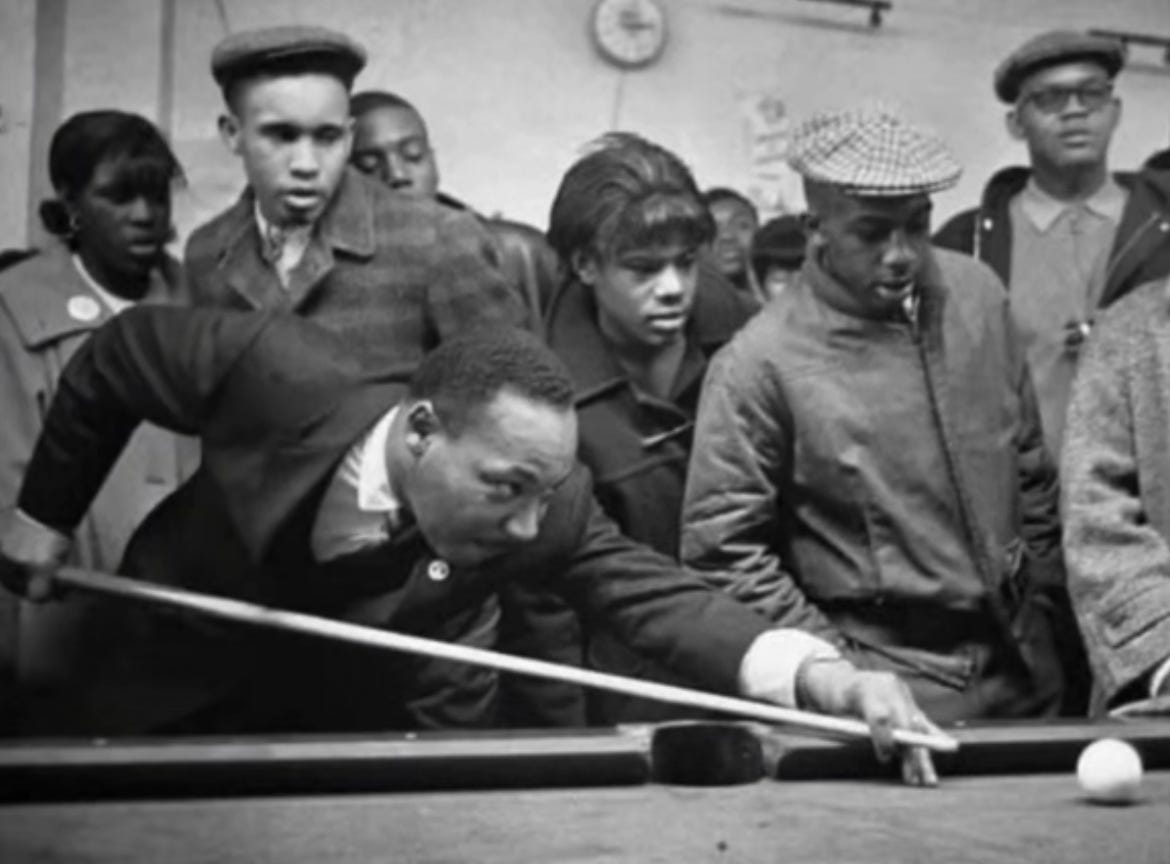
One of the things that made my home boy Dr. Martin Luther King, Jr. so effective was that he was a young man with a doctorate degree who could go hang out in a pool room and shoot pool and talk trash with the men who hung out there as easily as he could address heads-of-state. He could render presidents and prime ministers speechless because he was better educated and more in-tune with what people needed than the vast majority of them. 

He could talk with ease to the poorly educated and to the best educated. For those who don’t know, Martin Luther King Jr. was an exceptional scholar who entered college at age 14 and who graduated Morehouse College at the age of 18 and had earned his doctorate by the time he was 25 years old. Kamala Harris’ Mama also had her doctorate degree by the age of 25. She was working in a laboratory when her water broke with her then soon-to-be-born first child that she named “Kamala.” 

(Photo of M.L. shooting pool in Atlanta in 1966. The tall guy on the far right in the cap and glasses was then a Morehouse College Freshman named Samuel Leroy Jackson.)

What is my point? Education and literacy matters; and its singular purpose is to help people focus on what they need to be focused on. In 1960, a man or woman in the United States with little resources knew that the public library was still free and they made good use of it. Today, our semi-literate majority adult population that cannot stay still long enough to read a 5-minute article because they are always ready to look at something that is “trending,” is what we are confronted with now. 

Long after I left the classroom, I ran into one of my former students from the Junior College where I once taught. He was attending Georgia State University and was about to graduate. Excited to run into me, he said, “I hated you back then. But you pushed me and demanded that I get the work done. Now, I can’t stop reading and doing research. I cannot read enough BOOKS!”

Hugging his neck I said, “Don’t ever stop. The more you dig the more you will know.

So, in the names of your favorite teachers, instructors and professors, please keep talking about the truths and the dangers of a largely illiterate and poor reading nation. Our welfare as a nation and as human beings depend on it.

©️Leslye Joy Allen

I was am an Independent Historian, Oral Historian and Dramaturge. Please consider supporting my work with a few bucks for Coffee and Eggs via my CashApp.

You can also subscribe to my writings on Substack and stay in the loop with the best new research, history, journalism, prose, poetry, and etcetera.

All blogs written by Leslye Joy Allen are protected by U. S. Copyright Law and licensed under a Creative Commons Attribution-NonCommercial-NoDerivs 3.0 Unported License. Any partial or total reference to any blog authored by Leslye Joy Allen, or any total or partial excerpt of any blog authored by Leslye Joy Allen must contain a direct reference to this hyperlink: https://leslyejoyallen.com with Leslye Joy Allen clearly stated as the author.  Postings or blogs placed here by other writers should clearly reference those writers.  All Rights Reserved.

A Word About Nancy Pelosi, and What I Learned From a Person Who Taught Me

by ©️Leslye Joy Allen

When I was an undergraduate History major at Agnes Scott College I took a course in Chinese History from Dr. Penelope Campbell. Dr. Campbell had literally created a program of study in Chinese History a while back to accommodate a student who was then named Mary Brown who later became ASC’s first alumna president as Mary Brown Bullock.

When I took Dr. Campbell’s class it became apparent that she and I were not exactly on the same page politically. We debated often but it was not contentious. It was rather intellectually stimulating.

One day at a reception that I attended with my mother on the Agnes Scott campus, I introduced Dr. Campbell. “Mama, I gave this lady a hard time when I took her class.”

Dr. Campbell stopped me. “No, Leslye you argued your points well. You stood your ground. You know, we professors and teachers live to see the success of our students.”

I thought about Dr. Campbell’s comments and compliment to me when former representative Nancy Pelosi went out of her way to block Alexandria Ocasio Cortez from assuming the position of ranking member of the House Oversight Committee.

All I could think was there are very few people in the House of Representatives and the Senate like the majority of the people who taught me; or like myself.

I taught college History for seven years and it is always an absolute joy to hear about a former student’s success.

Unlike these bought and paid for politicians, the best educators not only want, but expect, their students to do well; and they are delighted when those students outdo them.

I could go on about my disappointment with Pelosi, but I won’t. I will only ask that you talk to educators.

by ©️Leslye Joy Allen

#MakeAmericaLiterateAgain

Agnes Scott College

All blogs written by Leslye Joy Allen are protected by U. S. Copyright Law and licensed under a Creative Commons Attribution-NonCommercial-NoDerivs 3.0 Unported License. Any partial or total reference to any blog authored by Leslye Joy Allen, or any total or partial excerpt of any blog authored by Leslye Joy Allen must contain a direct reference to this hyperlink: https://leslyejoyallen.com with Leslye Joy Allen clearly stated as the author.  Postings or blogs placed here by other writers should clearly reference those writers.  All Rights Reserved.
A Cautionary Blog for Teachers, Directors, and those in Charge of any kind of Team

"Weary - Self Portrait" by Copyright © 2013 by Leslye Joy Allen.  All rights reserved.

“Weary – Self Portrait” by Copyright © 2016 by Leslye Joy Allen. All rights reserved.

Copyright © 2016 by Leslye Joy Allen. All Rights Reserved.

I can never forget one moment in a graduate History class that I took when I was working on my Master’s Degree. (FYI: My former professors at my alma maters need not worry about what I am about to say. I took this class on some other college campus.)

I remember the professor’s instructions. In a small class of no more than ten graduate students, the professor said something to this effect,

“You are to write a five-page review of this book. It must have one-inch margins, be double-spaced, and it must be EXACTLY FIVE pages. I don’t want FOUR and a half pages. I don’t want FIVE and one-fourth pages. It must be EXACTLY FIVE pages. If you do not follow these instructions, I will hand the paper back to you and you will have to do it over. This is an exercise to teach you how to edit with precision.”

Now, in all fairness, it was a good exercise. I edited and rewrote until I got that paper to exactly five pages. I re-read it to make sure that it still made sense and was clear. I turned it in. When the professor returned the papers, I anxiously turned to the last page. There it was, an A+. Now, this story does not exactly have a good ending.

Before I could tuck my paper away into my book bag, the professor stood before the class and said this,

“The only person that DOES NOT have to do her paper over is Leslye Joy Allen.”

I gasped.  Damn, I thought!  I did not mind the “A+.” I earned it. Yet, I did mind being singled-out! All of my classmates stared in my direction. A few of them gave me icy looks, others just looked embarrassed. On the way out, I asked the professor if I could speak with him privately.

When we arrived at his office, I told him “Please don’t ever do that to me again.” “What do you mean?” he said. “Single me out like that,” I answered. “But you’re a good student. Good students deserve praise,” he said.  “But not at the expense of making other students feel small,” I replied. I left his office.

At that moment, I understood what every student labeled a “nerd” felt like. I was ashamed of myself because there had been a few times in high school when, even though I made good grades, I had been guilty of calling a few super-brainiac students “nerds.”

Over the next couple of weeks in this graduate class, a few of my classmates barely spoke back when I said, “Hello,” and those that did respond, responded rather coldly. I cut back for a while on participating in class discussions. Eventually the chill thawed and I resumed my normal relations with my classmates and with the professor. Yet, I share this story to make a point.

While I did not deserve the coldness from some of my classmates, I also did not deserve to be singled-out in front of them as the only person who followed the instructions. It produced an unhealthy atmosphere where I appeared as the “favorite” of the professor. Even worse, it placed me in the unnatural and untenable position of being the “standard” by which all others were judged. I’ve never cared for that kind of attention. 

I hope all of the people who are reading this, those who have some form of direction over any group of individuals, will remember that if there is a high achiever in your group, that you can damage the morale of the whole group by singling out that achiever in a manner that denigrates or undervalues the others. Importantly, you can also dampen the spirits and isolate the high achiever(s), which could destroy the type of unity and the free exchange of ideas that makes for a great class, a great production, or a great team. This is a lesson I have never forgotten.

Copyright © 2016 by Leslye Joy Allen. All Rights Reserved.

This blog was written by Leslye Joy Allen and is protected by U. S. Copyright Law and licensed under a Creative Commons Attribution-NonCommercial-NoDerivs 3.0 Unported License.   Any partial or total reference to this or any blog authored by Leslye Joy Allen, or any total or partial excerpt of this or any blog by Leslye Joy Allen must contain a direct reference to this hyperlink: http://leslyejoyallen.com with Leslye Joy Allen clearly stated as the author. All Rights Reserved.

5 Memorable Comments Made to Me by My Teachers

by Leslye Joy Allen 

Copyright © 2015 by Leslye Joy Allen. All Rights Reserved.

“Archive Joy!,” Copyright © 2014 by Leslye Joy Allen. All Rights Reserved.

Trying to pick five favorite quotes by former teachers and professors is a real chore.  Blessed with some of the greatest teachers on this earth, I have no other choice but to acknowledge their intelligence and their wit.  It is also impossible to remember what so many of them said to me verbatim.  Yet, when I start to count my blessings, I can hear them.  We may not be able to remember who won the World Series in 1990 or what film won the Oscar for Best Picture in 2000, but we remember our teachers.  On so many occasions I hear their wisdom and humor, loud and clear.  So here are my favorite five; at least my “first” favorite five.  This one is short and sweet.  Enjoy.  


1.  “It was a joy to teach you!” – Mrs. Doris Prather, 7th Grade English Teacher

2.  “You are too intelligent for this!!  If I catch you and Louis with Cliffs Notes again, I will call both of your mothers!!” – Sister Barbara Sitko, 12th Grade English teacher

3.  “The only good thesis and the only good dissertation is a finished thesis and a finished dissertation.” – Dr. Jacqueline Howard Matthews, Africana Women’s Studies Professor

4.  “You write very well. But relax, you won’t hit it out of the ballpark every time.” – Dr. Waqas A. Khwaja, English Professor (when I received a grade of “B” instead of an “A” on an English paper)

5.  “Scholars say that there was a heavy concentration of lead in the water back in Ancient Rome. They believe that the reason why so many of those old Roman Emperors went crazy was due to lead poisoning. But just between you and I, I think a lot of them were crazy due to all of that family inbreeding.” – Dr. Sally MacEwen, Latin Professor

Àṣé!!


Copyright © 2015 by Leslye Joy Allen. All Rights Reserved.

This Blog was written by Leslye Joy Allen and is protected by U. S. Copyright Law and licensed under a Creative Commons Attribution-NonCommercial-NoDerivs 3.0 Unported License. Any partial or total reference to this blog or any total or partial excerpt of this blog must contain a direct reference to this hyperlink: http://leslyejoyallen.com with Leslye Joy Allen clearly and visibly stated as the author. All Rights Reserved.


Frank Wittow’s Legacy…Nevaina’s Dream

by Leslye Joy Allen

Copyright © 2015 by Leslye Joy Allen.  All Rights Reserved.

The late great actor-director-educator Frank Wittow remains one of my favorite figures in Atlanta’s rich theatre history.  His work with the late, great Georgia Allen was second to none—He placed this multi-talented Black woman in a non-servant role on an Atlanta stage in the early 1960s when the city and indeed the nation were still grappling with the idea that maybe Black folk were more than just the servants of White folk. Georgia Allen had appeared in numerous films and theatre productions throughout the nation and on the campuses of Spelman and Clark Colleges, and Wittow was wise enough to recognize Allen’s superior gifts.  He was simply a different kind of White man. There were no syrupy and useless White liberal platitudes about race relations spewing out of his mouth—he just did what he wanted to do.

Now, Allen predated Wittow’s arrival in Atlanta and she had a much longer career, and to fully honor her contributions to all of the arts and to education would require writing a tome. So, I will save that project for a later date.  Much like Allen, however, Wittow directed, trained, and mentored some of the best performers on the planet and took theatre performances into Atlanta Public Schools throughout much of his life.  He did this almost to the day he died in 2006.  One of his younger protégées had the benefit of his training…

Her name is Nevaina Rhodes—her first name is pronounced “Nih-Von-yah” like “lasagna.”  The first time I saw her perform, I did not know she had any affiliation with Wittow.  When she told me her basic philosophy about acting there was something refreshingly new about her approach to her craft, but also something rather familiar…Let me explain…

You see, when I was growing up in Atlanta, an actor, a musician, a poet, an academic, an intellectual, was simply part of the community in which we all lived.  Importantly, you had to participate in the arts and the humanities, and it did not matter if you had talent or an exceptional intellect or not.  While I adore and admire many younger performers and scholars—and by younger, I mean anyone born after the Baby Boom—I find an increasing number of them who are quite insular; they have fewer connections to each other or with the folk in the communities where they live.  Unlike the Atlanta of my childhood, in recent years I have attended far too many functions filled with musicians, actors, poets, filmmakers, and historians and I end up being the only person in the room who actually knows everybody in that room…

Well, to make a long story short, Nevaina’s conceptualization of Real Actors Workshop (RAW) makes it open to amateur and professional alike.  Her basic theory is that whether you are a professional actor or not, all of us humans act and perform in certain ways depending on the circumstances.  In other words, she insists that, we all are actors. Although she is a North Carolinian by birth, her approach feels much like the Atlanta of my youth, where the long theatre traditions on the campuses of our Historically Black Colleges and Universities, and people like Georgia Allen and Frank Wittow made certain that theatre reached who it was supposed to reach—the people. We were not a community of strangers…everybody knew everybody, which is the way it should be.

I should add that I am writing this to inform you that Nevaina is not only a dazzling performer and an amazing drama coach, but she is also a real survivor. Native Atlantans, in particular, love people with a strong work ethic and those who bounce back when things do not always go as planned.  Less than five years ago, Nevaina miraculously and fully recovered from a stroke that could have easily killed her; and she remained positive while she also endured some personal losses that probably would have destroyed some weaker souls.

Today her Real Actors Workshop (RAW) is headquartered at Dream Café, Atlanta’s first cafe and empowerment lounge, which is owned by Nevaina and her partners, Jay White and Stevie Baggs.  Dream Café‘s premise is simple.  It is designed to be a place where artists, intellectuals, young and old folk can meet and greet and talk and achieve their dreams, over coffee and healthy food.  This concept and these young owners have my support not only because it feels familiar to me, but because it feels right…and it also feels rather cyclical…

Now, I am aware that my hometown has changed.  Nothing stays the same, nor should it stay the same.  Yet, there are some core elements that we must never lose—namely, the ability to connect with each other and exchange ideas.  Not even a semblance of community can survive if we lose this ability.  So, I am proud to call Nevaina a friend. It has been a great privilege to watch her perform; and I have been encouraged by her intellect, her big smile, and her big spirit…I am also certain that Wittow (and Allen) are watching her from that place where great souls go when they leave this earth…So, in honor of them and in honor of future generations, go visit the Dream Café, and write your dream on the wall. Àṣé!

To learn more about Real Actors Workshop (RAW), and Nevaina’s distinguished career as an actor, drama coach, and public speaker, click here: Nevaina Rhodes Inspirational Speaker and Drama Therapy Specialist.

Copyright © 2015 by Leslye Joy Allen.  All Rights Reserved.

This Blog was written by Leslye Joy Allen and is protected by U. S. Copyright Law and licensed under a Creative Commons Attribution-NonCommercial-NoDerivs 3.0 Unported License. Any partial or total reference to this blog or any total or partial excerpt of this blog must contain a direct reference to this hyperlink: http://leslyejoyallen.com with Leslye Joy Allen clearly and visibly stated as the author. All Rights Reserved.