Tariffs, Borders, & Personal Loss Redux

by ©️Leslye Joy Allen

It can be argued that tariffs helped fuel the US Civil War. By the mid-1800s, the northern economy was based on manufacturing and was in direct competition with an agricultural, slave-based southern economy. Tariffs on imported goods were great for the Northern states as they provided a huge amount of revenue. Tariffs also protected American businesses from foreign competitors and provided revenue for the federal government. In the South, tariffs were a big negative.

In 1828, a tariff that southerners called the Tariff of Abominations became law. This tariff protected Northern manufacturers, but it penalized Southern slaveholders who relied on exporting their agricultural products (cotton) that were produced by Black slave labor. These same Southerners imported goods from Europe.

The Morrill Tariff passed in 1861 around the time several Southern states had seceded from the Union because tariffs placed a heavy economic burden on the South. The big issue was, however, the expansion of slavery. 

The American South sought to transplant slavery in newly acquired western territory due to its own self-produced ecological disaster, namely soil exhaustion. Yet, it was often difficult to transplant slavery in the western portion of what is now the United States due to the fact that laws differed in these newly acquired regions. California became a state in 1850, but it had abolished slavery. The Compromise of 1850 granted statehood to California as a free state with the expectation that California would uphold the Fugitive Slave Act.

Once the Mexican-American War was over in 1848 and the Treaty of Guadalupe was signed, Mexico ceded over 500,000 square miles of its territory to the United States. Those square miles included modern-day Utah, Nevada, Colorado, New Mexico, California, and large portions of Arizona, Wyoming, Oklahoma and Kansas. So, do not think that Felon 47’s desire for extra territory is something new. And for Goddess sake don’t think the USA had or has any respect for actual geographic boundaries.
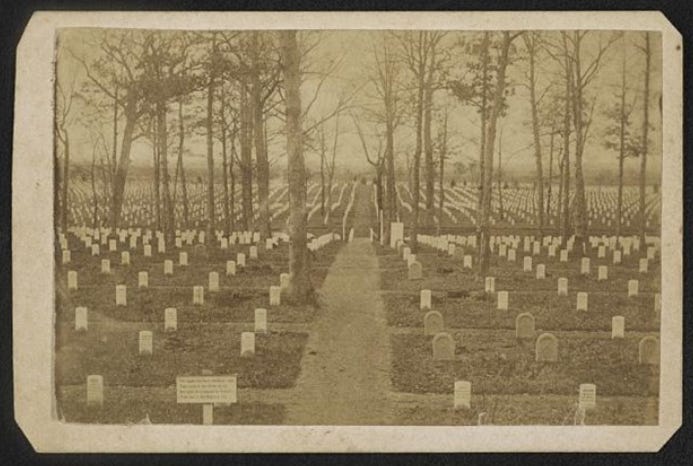
(Arlington Cemetery, c. 1865, Library of Congress)

Tariffs in the United States only waned after this country’s “protectionist” period ended roughly in the early 1930s. By the end of World War II, the United States entered full swing into a period of open markets and greater engagement with markets in other countries. 

But here’s the thing. What Felon 47 is doing is not new. In the mid-1800s while Northern industrialists reminded poorly paid white factory workers that they had privileges and supremacy over Black folks who were slaves, Southern slaveholders were selling the exact same argument to poor whites and middling white yeoman farmers. 

The white oligarchy didn’t fight in the Civil War on either side. They used poor whites to do it for them. And the South lost—Thank You Jesus! Yet, what most folks forget is that Black folks in the South were its property and its wealth. Setting them free WAS NOT the initial aim of the war. It was not until Black abolitionist and former slave Frederick Douglass pushed at President Abraham Lincoln to make ending slavery a war objective.

Douglass made it plain. If Lincoln wanted to end the war, and force the South back into the Union, the simplest way to do it was to free the slaves. After all, Black slaves were one third of the population of the entire South, and Black bodies were the primary source of wealth of a minority of white southern oligarchs. That strategy worked. 

Yet, here’s something to contemplate on a more personal level. After he was around the age of 6, abolitionist and former slave Frederick Douglass never saw his mother again and never learned what happened to her. After he escaped from his owner, he remained a fugitive for years. Eventually his freedom was purchased by Quakers in the UK for $711.66 (around $30K today) in 1846. After the Civil War ended, roughly two generations of white southern women who hoped to marry and have children never did so in certain areas of the South because there simply were not enough men to go around. A majority of the men they might have married were killed during the Civil War. 

As a Black woman historian, nothing that Felon 47 is doing is new to me. Although I must admit he seems to be an old American history lesson on steroids. The American North tore up the Slaveholding South, imposed tariffs that favored their industries and never lost a wink of sleep; and never once worried about the personal costs of doing any of it. 

So, while there are plenty of Black fools out there (trust me, I know many of them), a majority of us Black folks know that there is no limit to how oligarchs will play with our lives, crush economies, steal from us, and attempt to throw our Black asses on the frontlines of military interventions and sacrifice us on an assortment of altars. They have done all of this to us for centuries. What is different now is that white folks are finding out that they too will be placed in these same untenable positions. 

©️Leslye Joy Allen

I am an Independent Historian, Oral Historian and Dramaturge. Please consider supporting my work with a few bucks for Coffee and Eggs via my CashApp.

All blogs written by Leslye Joy Allen are protected by U. S. Copyright Law and licensed under a Creative Commons Attribution-NonCommercial-NoDerivs 3.0 Unported License. Any partial or total reference to any blog authored by Leslye Joy Allen, or any total or partial excerpt of any blog authored by Leslye Joy Allen must contain a direct reference to this hyperlink: https://leslyejoyallen.com with Leslye Joy Allen clearly stated as the author.  Postings or blogs placed here by other writers should clearly reference those writers.  All Rights Reserved.

A Thought for the Old and New Year

By Leslye Joy Allen                                                                                                     Historian, Educator, Theatre and Jazz Advocate & Consultant, Ph.D. Candidate

Copyright © 2014 by Leslye Joy Allen.  All Rights Reserved.

One of the first things that came to mind shortly after Christmas and before the New Year was how much my Mom and Dad would have been thrilled and proud that a great film like 12 Years a Slave received great reviews and had enjoyed large viewing audiences.  I would have heard a litany of what they remembered about their childhoods and how far we Black folks have come.  And if they were still alive they would surely have warned me not to hyperventilate about whether or not Santa Claus was Black or some of the foolish and racist slips of the tongue that seem to dominate our current news cycles on most days.

Strangely, my mind goes back to that one scene in the film 12 Years a Slave where after a slave has literally dropped dead from exhaustion while laboring in the fields, you see the slaves standing around a gravesite that they have prepared for their fallen comrade.  Suddenly, a slave woman begins singing the old Negro spiritual “Roll, Jordan, Roll.”  Then all of the slaves joined in and they sang with a joyous abandon.  At this moment in the movie theater, I completely lost my composure.  I wept so loudly that I had to place my hand over my mouth to muffle the sound.  For days, I wondered why that scene—and not one of the other more horrible scenes where someone was beaten or tortured—caused me to cry like a two-year-old toddler.  Then it came to me.  This was a gift.  The gift was not simply my ancestors’ songs, but their decision that they had a right to sing their songs.

Their gift feels as familiar as a book of black poetry or history or the first time my parents took me to a Jazz concert or to see the Alvin Ailey American Dance Theatre or to a Broadway play.  Afterwards, they would always inform me that I must never forget that it was my people that had created the artistry and creative offerings that I had just witnessed.  The lesson was simple—I could perpetually cry about what white folks had done to my people or I could fight for and celebrate what my people had done for themselves and for me, all of which is a balancing act.  Yes, one must call out and fight against racism.  Yet, one cannot allow it too much space in one’s head, lest one descend into perpetual victimhood.  “How much of your energy are you gonna’ give THEM,” Daddy would ask without blinking?

I wept in the dark of that movie theatre, as the slaves on the screen sang with abandon and rejoicing.  It is difficult to count one’s blessings when the world and everyone in it seems to be your enemy.  Yet, that is exactly what the slaves did.  My slave ancestors did not sing with joy because they were happy and content, but rather because the singing allowed them to reclaim their humanity, to reclaim their right to joy.  No degree of inhumane treatment routinely meted out to them by white slave masters could make them surrender their own humanity, or their very human need for joyousness and a belief in the future even when that future was uncertain.  Their gift is still a gift that keeps on giving if you are willing to claim it.  This is what I hope to remember now, and in the New Year.

Peace.

Leslye Joy Allen is a perpetual and proud supporter of the good work of Clean Green Nation.  Visit the website to learn more about it: Gregory at Clean Green Nation!

Copyright © 2014 by Leslye Joy Allen.  All Rights Reserved.
Creative Commons License This Blog was written by Leslye Joy Allen and is protected by U. S. Copyright Law and licensed under a Creative Commons Attribution-NonCommercial-NoDerivs 3.0 Unported License.  Any partial or total reference to this blog, or any total or partial excerpt of this blog must contain a direct reference to this hyperlink: http://leslyejoyallen.com with Leslye Joy Allen clearly and visibly stated as the author.

Thank You Onesimus of Boston (by Way of Africa)

By Leslye Joy Allen

Historian, Educator, Theatre and Jazz Advocate & Consultant, Doctoral Student

Copyright © 2012 by Leslye Joy Allen. All Rights Reserved.

“The irony and glory of being a person of African descent is that when you study your people’s history, along with their many contradictions and foibles that they possessed like all other human beings, you also learn how much your people contributed to the well-being of the people who abused and mistreated them.” – Leslye Joy Allen, Copyright © 2012 

The year was 1721.  The city of Boston experienced one of the most serious outbreaks of smallpox in its history.  One Puritan minister, the Reverend Cotton Mather—best known for his participation in Salem’s witchcraft trials—watched his male slave Onesimus with continued curiosity.  Onesimus, who was born in Africa, had been in the company of people suffering from smallpox, but he never contracted the disease and became sick.

Cotton Mather had, years earlier, asked Onesimus why he did not get sick. Had he ever had smallpox?  Onesimus replied, “Yes and No.”  He told Mather that he had endured a procedure when still in Africa that forever cured him of smallpox.  He explained that you took a thorn and punctured the pustules of a person who had smallpox; the smallpox fluid that came out of the pustules saturated the thorn.  You then took the thorn and rubbed the smallpox juice into the skin of a healthy person.  Occasionally the person who had this procedure done would become mildly ill for a short time, but once they recovered, they would never have smallpox again.

Onesimus noted that this procedure had been done for centuries amongst his people—the Garamantes—in Africa.  The Garamantes appear in the written records of the Greek historian Herodotus in the 5th century.  Herodotus considered them a great nation.  We know about Onesimus and his African ethnic identity, along with his people’s knowledge of inoculation and immunization from Cotton Mather’s letters to government officials and physicians.  Initially, when White Bostonians learned that Reverend Mather had gotten this information from his African slave Onesimus, they said that what Mather was suggesting to them was nothing more than “African Witchcraft.”  Eventually the desire to stay alive outweighed White Bostonians’ racism, and people there began to receive inoculations against smallpox. Go figure.

Take the time to consider that the only thing that has changed about immunization and inoculation procedures is the instrument medical professionals use to perform them.  Some scholars argue that an early form of smallpox inoculation had been developed centuries earlier in India.  Indeed, the Chinese developed a method of blowing the scabs from smallpox sores up healthy people’s noses, which was successful.  Yet this method was not as effective as the introduction of smallpox “juice” into the skin of healthy people.  Suffice it to say that there obviously was a continued exchange of ideas between Africans and Asians.  Needles have replaced thorns used by early Africans, but this nearly ancient science was accurate and well on its way to perfection long before any European or Euro-American doctor ever set foot on the North American continent.  If you and your children are healthy and have never suffered smallpox or any number of preventable diseases, then thank an African slave named Onesimus.  Thank the Garamantes of Africa.

Books:

Instead of a video game or $200.00 sneakers, give a kid (and yourself) a book!  The story of Onesimus and Cotton Mather is located in numerous books.  Mather’s own medical book, diaries, and letters all give credit to Onesimus.  However, there are several other books worth reading.

Invisible Enemies, Revised Edition: Stories of Infectious Disease by Jeanette Farrell (for children age 12 and up), (Farrar, Straus, Giroux, 2005)

1001 Things Everyone Should Know About African American History by Jeffrey C. Stewart, (Three Rivers Press, 1998).

The African Background in Medical Science: Essays on African History, Science and Civilizations by Charles S. Finch, (Karnak House, 1990).

Blacks in Science: Ancient and Modern (Journal of African Civilizations; Vol. 5, No. 1-2) edited by Ivan Van Sertima, (Transaction Publishers, 1990).

Copyright © 2012 by Leslye Joy Allen. All Rights Reserved.

Leslye Joy Allen is proud to support the good work of Clean Green Nation.  Visit the website to learn more about it: Gregory at Clean Green Nation!

Creative Commons License This Blog was written by Leslye Joy Allen and is protected by U. S. Copyright Law and licensed under a Creative Commons Attribution-NonCommercial-NoDerivs 3.0 Unported License.  Any partial or total reference to this blog, or any total or partial excerpt of this blog must contain a direct reference to this hyperlink: http://leslyejoyallen.com with Leslye Joy Allen clearly stated as the author.