You Don’t Just Protect, You Correct: A Teachable Epstein Moment

by ©️Leslye Joy Allen
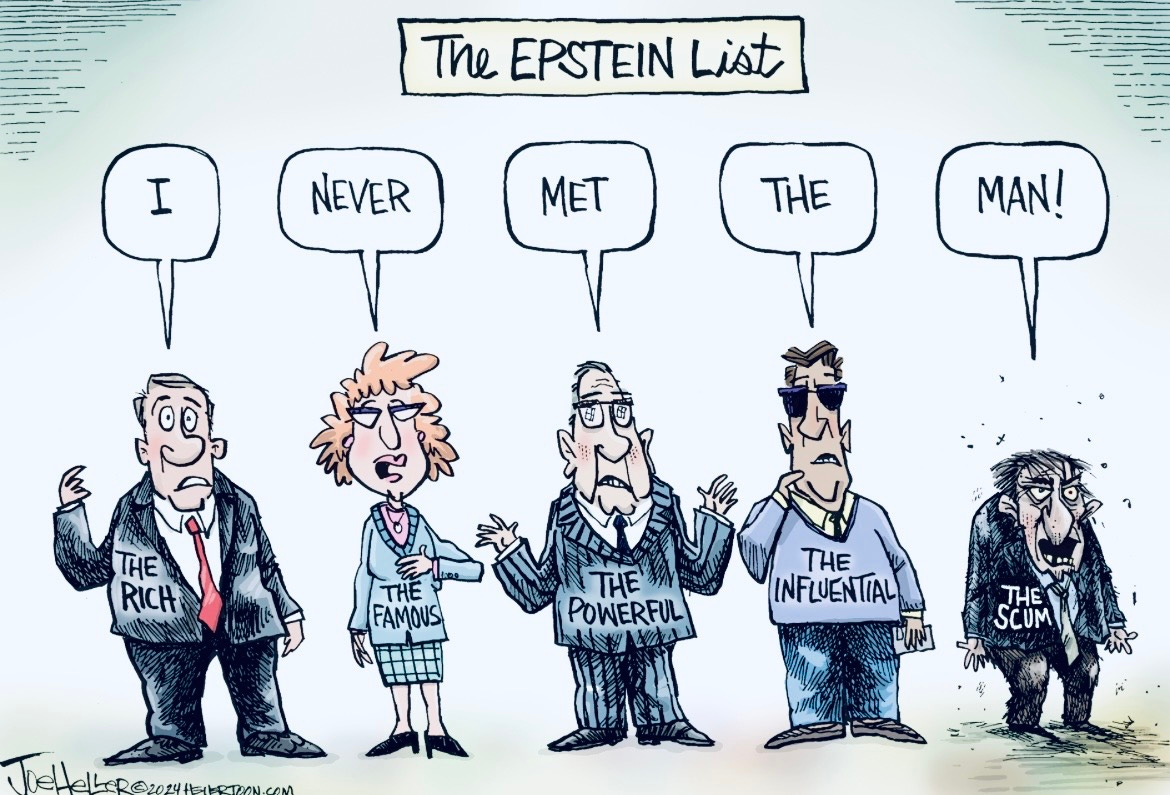
I had to stop reading what was in this recent release of more Epstein Files. I am not sure if I can look again because the sickness in it is far more insidious than one can stomach. I have access to all of them that can be accessed so I can access the details of more of them should I choose to do so. Don’t send me any of them, please.

Many of the men who have clamored for the release of these files have done so primarily to make political capital out of them. They don’t actually care that much about what happened to those girls. And I don’t care if they get angry about what I just wrote. 

These are the same men who rarely, if ever, confront men who have sexually violated women and who never organize as a collective group to publicly state that this behavior is wrong. They tend to just tell women and girls in their orbit how to avoid certain types of men. That is honorable, but… 

the responsibility is still left on women and girls to police men’s behavior. And before I hear that typical smokescreen that says “she should have known better than to…” please know that those kinds of statements not only prove that this heinous sexual behavior exists, but it also tacitly condones that behavior since the men in these scenarios are allegedly not responsible for their behavior because the girls and women should have expected to be violated based on their location or their appearance, not on certain men’s inability to behave themselves. 

An excited 16-year-old girl who just met her favorite male singer and who foolishly follows him up to his hotel room when he says, “I have invited a few friends up, come join us,” should not expect to be raped. He never should have invited her up for a variety of reasons—the first reason being her age and the second reason being that she is a stranger that he just met. 

An impressionable 16-year-old boy with a crush on his neighbor, a 35-year-old woman, should not expect to be forced/seduced by her because he mowed her lawn and then helped her take her groceries in the house. Importantly, his initial feelings of violation should not be replaced with congratulatory praise for his participation in the act which confuses her wrong behavior towards him as some male rite of passage for him. 

These same men crying out for Trump and his sexually perverted team members to be brought to justice are not trying to destroy or collapse the current legal system at least until they have covered their asses and the asses of men they know that might not easily swim out of the Epstein quagmire. Illegality and sexual impropriety were built into the system. It’s still there. 
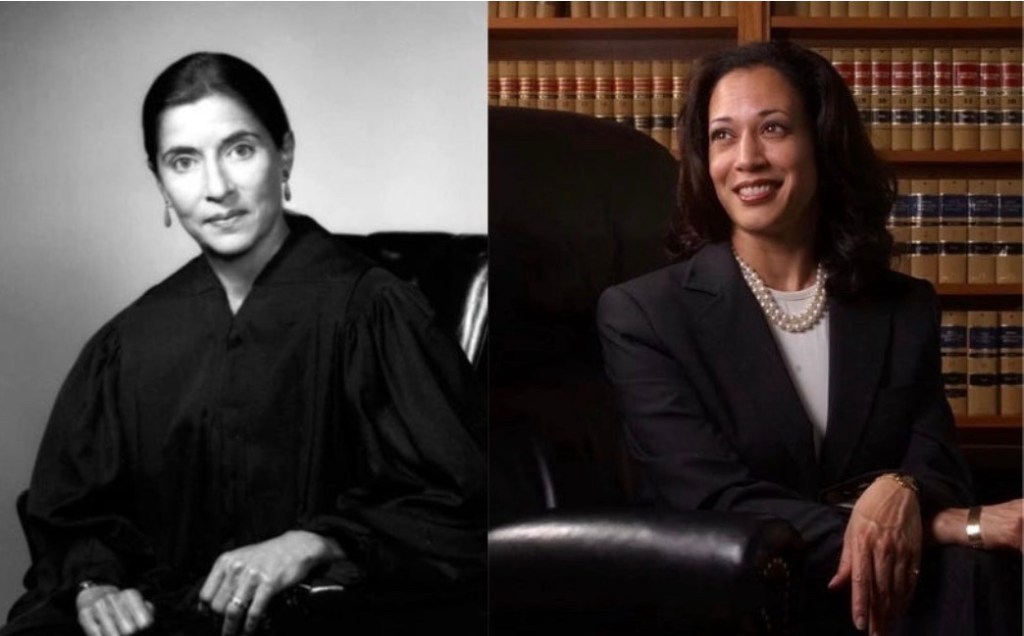
(from The Arbitrary Ages of Consent: The Epstein Files by Leslye Joy Allen on Substack)

It is not that all men (or women) are potential sexual abusers; it’s just that the ability to get away with it or have it somehow described with less severity is enshrined in the very definitions and expectations of masculinity. Rape is rarely forgiven by ethical men, but excessive male sexual prowess and promiscuity often is.

So here’s where it gets dicey, particularly for women. I have several good Black male friends, most of whom I have known since elementary school. There isn’t one of them that would not protect me if they witnessed me being physically harmed in any way by anyone.

There isn’t one of them who would not go, or at least want to go, after someone they believed had assaulted me sexually. Yet, if something like that happened I would not be likely to tell them because they would either end up in jail due to a physical confrontation with my offender or they would be injured or killed for their efforts. That kind of love is gratifying; yet some of the things that kind of love can produce is scary, and it can occasionally make certain scenarios worse. So…

the real onus for ethical and righteous men is not simply protection, but correction. If men do not confront other men about their behavior, their sexism, their misogyny, their misogynoir, and their double standards then the process of bringing sex offenders to justice will always be processed first through that “Boys will be boys” lens.
(from “The Evidence of Things Not Seen” and the Epstein Files by Leslye Joy Allen on Substack)

Furthermore, a woman’s chronic need for protection from rape or other forms of assault essentially means that the problem remains chronically intact. The only way to end this is to end the manner in which men think of women and how they interact with and talk to other men; and whether they can do the most unpopular thing to do, which is: confront other men. 

Additionally, the sexual violation of boys by men and women will continue to be swept under the rug by the perverted tenets of masculinity that insist that a boy or man should be silent because to speak up about his abuse is anathema to the myth that all men are physically and psychologically strong simply because they are men. It is male sexual assault victims’ equivalent to that nonsense that says, “Big boys don’t cry.”

Every opinion, good or bad, biased or unbiased, informed or uninformed, is also a confession. Silence, when the needs of the hour demand that you speak, can be proof of cowardice or a desire to conform to the status quo or an admission that you are protecting the guilt of someone else or even your own. 

Justice for Epstein’s victims and prison time for the participants in these heinous actions is only a first step. Yet, we won’t correct the alleged norms that generated and aided and abetted Epstein and his cronies as long as their actions are seen as some anomaly rather than proof of a perpetual problem. 

©️Leslye Joy Allen

I am an Independent Historian, Oral Historian and Dramaturge. Please consider supporting my work and research with a few bucks for Coffee and Eggs via my CashApp or become a paid subscriber to me on Substack to help me sustain my research.

All blogs written by Leslye Joy Allen are protected by U. S. Copyright Law and licensed under a Creative Commons Attribution-NonCommercial-NoDerivs 3.0 Unported License. Any partial or total reference to any blog authored by Leslye Joy Allen, or any total or partial excerpt of any blog authored by Leslye Joy Allen must contain a direct reference to this hyperlink: https://leslyejoyallen.com with Leslye Joy Allen clearly stated as the author.  Postings or blogs placed here by other writers should clearly reference those writers.  All Rights Reserved.

Remembering Belinda (Lynn)

By Leslye Joy Allen, Copyright © 2017.

(In memory of Belinda E. Fanning, August 1952 to August 2017)

A good friend

was laid to rest,

one who could

make you laugh

until your sides

split open,

one who could

play-the-dozens

until it drew a

crowd of

laughing witnesses,

one who nicknamed

me

“Yellow Biscuit,”

and

whose father

nicknamed

me

“Mosquito,”

one who my late Drew

loved and always

razzed,

DELIBERATELY.

Her laughter was

never muffled,

but

contagious and

deliberate

and natural.

To this

day,

I don’t trust

any

Black person

so prim and proper

that they suppress

their laughter.

As Drew used to say,

“If they don’t feel

better

after

having been around Lynn,

if they don’t like Lynn,

then something’s

wrong with them.”

I’m so glad I got

to tell her

over and over

again that he

was right.

 – Leslye Joy Allen, Copyright © 2017.


Still taking some time away from blogging for a while…So, you are welcome to read my older blogs until I return later (trust, there is some good stuff in my archives at my blog)…I have to get my dissertation finished, and blogging and responding to every little detail is not on the agenda…In the meantime, stay focused, and stay woke, and for God’s sake don’t fall for the easy answers because the news media is full of “easy answers.”  Do your research.  Think for yourself.  Peace and Blessings. I will see you when I see you.  — Leslye Joy Allen


This blog was written by Leslye Joy Allen and is protected by U. S. Copyright Law and licensed under a Creative Commons Attribution-NonCommercial-NoDerivs 3.0 Unported License. Any partial or total reference to this or any blog authored by Leslye Joy Allen, or any total or partial excerpt of this or any blog by Leslye Joy Allen must contain a direct reference to this hyperlink: https://leslyejoyallen.com with Leslye Joy Allen clearly stated as the author. All Rights Reserved.


Thoughts on the Eve of the 50th Anniversary of the Sixteenth Street Church Bombing

By Leslye Joy Allen                                                                                                     Historian, Educator, Theatre and Jazz Advocate & Consultant, Ph.D. Candidate

"Weary - Self Portrait" by Copyright © 2013 by Leslye Joy Allen.  All rights reserved.

“Weary – Self Portrait” by Copyright © 2013 by Leslye Joy Allen. All rights reserved.

Copyright © 2013 by Leslye Joy Allen.  All Rights Reserved.

This blog is short and bittersweet.  It is the evening of Saturday, September 14, 2013, as I write this.  It is the eve of the 50th Anniversary of the Sixteenth Street Baptist Church bombing that killed four little girls.  If they had lived, all of them would be over the age of sixty right now.

I learned today that the ex-husband of an old friend is a member of the Wesley family, the same family that Cynthia D. Morris bka Cynthia D. Wesley lived with.  My friend informed me that Mrs. Gertrude Turner Wesley suffered a nervous breakdown after “Cynthia Diane Morris bka Cynthia Diane Wesley” was killed in this explosion.  It seems that both her biological family and her host (or adoptive) family loved this little girl.  Her host or adoptive family did not have any biological children, which is why she appeared as the “only daughter” of the Wesleys in so many news reports in 1963.  Yet, Fate Morris, the brother of “Cynthia Diane Morris aka Cynthia Wesley” remembers his sister and is a man that needs some answers and some acknowledgement.

With her Death Records amended by the state of Alabama in 2002 which legally changed her name back to her original birth name of “Cynthia Diane Morris,” it must be acknowledged that this problem with her death and who or what she should be called has highlighted an important and beautiful legacy among us Black folks:  We Black folks have always had a tradition of taking in children if they needed to go to another school or if their parents were struggling financially or if they just simply needed a home.

Yet, in many instances—particularly before the late 20th century—we never signed any legal agreements or signed any adoption or guardian papers, we just opened our homes and our hearts.  With that said, it does not matter so much that Cynthia is/was claimed, legally or otherwise, by the now-deceased Wesleys; after all, they loved her.  Yet, what Fate Morris, who remembers his sister’s visits on weekends, needs most of all is to hear someone say that she was “Cynthia Diane Morris,” his sister.  What he and indeed, Birmingham, Alabama desperately needs is all of the truth and some real closure.

On the evening of September 12, 2013, I cried when I listened to Fate Morris describe that day when his sister was killed.  He was eleven years old.  I wept again today when I learned that Mrs. Wesley suffered a nervous breakdown after young Cynthia’s death.  Right now, I weep for them all.  To be continued…:  “Related Material – a BlogTalk Radio Interview and an important new CNN article 9-14-2013”

Leslye Joy Allen is also a perpetual  and proud supporter of the good work of Clean Green Nation.  Visit the website to learn more about it: Gregory at Clean Green Nation!

Copyright © 2013 by Leslye Joy Allen.  All Rights Reserved.
Creative Commons License This Blog was written by Leslye Joy Allen and is protected by U. S. Copyright Law and licensed under a Creative Commons Attribution-NonCommercial-NoDerivs 3.0 Unported License.  Any partial or total reference to this blog, or any total or partial excerpt of this blog must contain a direct reference to this hyperlink: http://leslyejoyallen.com with Leslye Joy Allen clearly stated as the author.

18 Days Earlier We Marched and then We Lost…

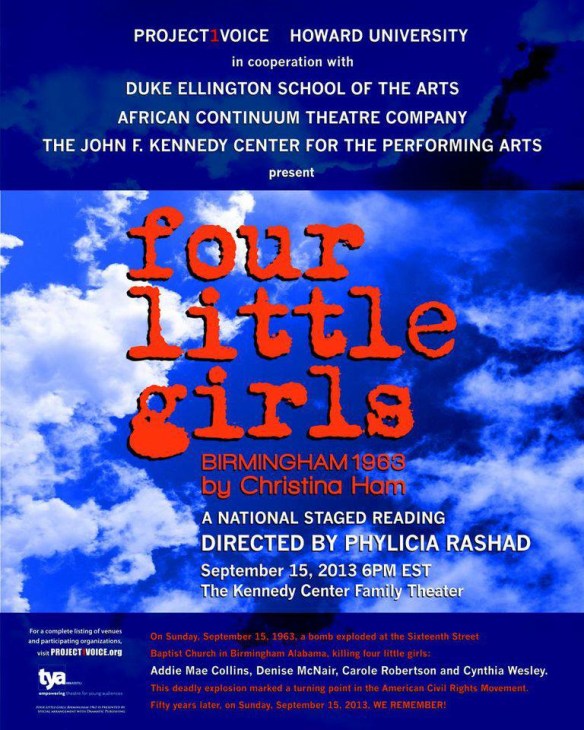
A staged reading of the play "Four Little Girls" streaming live online from the Kennedy Center on September 15, 2013 at 6:00 PM EST.

A staged reading of the play “Four Little Girls” streaming live online from the Kennedy Center on September 15, 2013 at 6:00 PM EST.

…FOUR LITTLE GIRLS

By Leslye Joy Allen

Historian, Educator, Theatre and Jazz Advocate & Consultant, and Doctoral Student

Copyright © 2013 by Leslye Joy Allen.  All Rights Reserved.

There were four little Black girls whose lives were snuffed out on Sunday morning, September 15, 1963 when a bomb planted by racist White terrorists exploded in the Sixteenth Street Baptist Church in Birmingham, Alabama.  They were, Denise McNair who was the youngest at age 11, Carol Robertson aged 14, Cynthia Wesley** aged 14 (**Real and Birth name is “CYNTHIA MORRIS”), and Addie Mae Collins was aged 14.  When that bomb went off, most Black Birmingham citizens and most Black Americans forgot about the “March on Washington,” held a mere eighteen days earlier on August 28.  Not long after the blast, all hell broke loose.  The New York Times headline on the following day read (click here for article): “Birmingham Bomb Kills 4 Negro Girls in Church; Riots Flare; 2 Boys Slain.

Birmingham, then nicknamed “Bombingham,” had an ugly history it would take decades to live down.  A middle class neighborhood in the city had suffered so many bombings that it was nicknamed “Dynamite Hill,” because angry Whites bombed homes to stop Black people from moving into the area.  Dynamite Hill was the neighborhood that honed and developed future Phi Beta Kappa scholar, radical activist, and author Angela Davis.  Yet, that is a story for another essay.  There are those of us, however, who think the story of what and who we lost on that fateful Sunday morning deserves its place in all the national narratives of American history.  I am one of those people; so is actor and activist Erich McMillan-McCall.

My friend, Erich is the founder of Project1Voice, an organization devoted to preserving Black theatre companies and our important historical legacies.  I should add that not only is he a multitalented performance artist with credits on Broadway, national stages, and television, he is also a visionary.  I say he is a visionary, however, with a very important acknowledgement of the type of communities that both of us grew up in as children.  Black women, he emphasizes, were at the center of these communities.  Yet, in several of our usual marathon-long telephone conversations, he has lamented that he is bothered by how Black women’s voices are not only muted or unacknowledged in the historical narratives, but also on the stage, and in the arts.

Erich and I are products of a time when to be young and Black and living in the American South did not necessarily mean that everywhere you went there was danger; what it tended to mean was the Black community in which you grew up was supportive, filled with a great deal of love and encouragement.  There were threats to our wellbeing, to be sure.  Yet, those threats largely came from outside the neighborhoods where we lived.  As much as some very sympathetic White liberal folks and some younger Black Americans have erroneously assumed otherwise, our Black parents and elders made sure we had normal childhoods with school, church, piano lessons, baseball games, concerts, plays, parties, and family picnics.  They did all of this for us in spite of the racism and the perpetual threat of (and often real) racial violence that characterized much of life for us during the 1960s and 1970s.  Erich understands this type of upbringing.

His proactive approach, that provides greater visibility to financially struggling Black theatre companies while engaging educational, civic, and political organizations in this collective struggle for artistic, political, educational, economic, and historical viability is not exactly a new way of doing things.  The Black community that I grew up in was filled with folks who could sing, dance, act, organize, who taught school, practiced medicine, ran businesses, and helped elect Black people to political office—This is what we were/are.  I loved this Black community, and the activism and the theatre it produced.  I still live in the neighborhood my family moved to when I was around the age of eleven.  It has not entirely lost those same qualities that it had during my childhood.  However, I fear that these types of communities become more rare with each passing decade.  At the same time, I am gratified and encouraged by Erich’s embrace of the old collaborative efforts of our neighborhoods and organizations that we remember about our childhoods; and his insistence that those qualities can be modified and used to great affect in the information age.  I hope this is the beginning of a new trend.

Sunday, September 15, 2013, is the 50th anniversary of one of our worst tragedies.  On this date, Project1Voice, in collaboration with Howard University, African Continuum Theatre Company, the Duke Ellington School of the Arts, and the John F. Kennedy Center for the Performing Arts will present a reading of the play “Four Little Girls,” written by Christina Ham, directed by Phylicia Rashad.  It will stream live online at 6:00 PM EST via the Kennedy Center’s website.

Targeted toward young audiences, this will be one of those wonderful opportunities to sit down in front of your computer screens with your children and your friends to watch this important piece of theatre and history—Free of Charge.  You should also check for viewing parties around the country.  Additionally, over thirty Black theatre companies around this nation will be presenting “Four Little Girls” simultaneously on the fiftieth anniversary of this national tragedy.

Erich and I both remember neighborhoods where middle class and working class Black families looked out for each other and each other’s children.  These facts, however, are precisely why the slaughter of Denise McNair, Carol Robertson, Cynthia Wesley** (**born as “Cynthia Morris,” but cited in the historiography and in most news reports as “Cynthia Wesley“) and Addie Mae Collins was so devastating to Birmingham’s Black community and other Black communities throughout the nation.  The reading of this play is not only a way to honor these dead children, but to also recall and remember the kind of stable and warm neighborhoods where all of them and us grew up.  Let us honor these little girls by going home again.  Peace.

Please visit: Project1Voice and the Kennedy Center for the Performing Arts for more information about this play; how to access the play via the internet on Sept. 15, 2013 at 6 PM EST; and for information about other great performances and programs.

Leslye Joy Allen is also a perpetual  and proud supporter of the good work of Clean Green Nation.  Visit the website to learn more about it: Gregory at Clean Green Nation!

Copyright © 2013 by Leslye Joy Allen.  All Rights Reserved.

Creative Commons License This Blog was written by Leslye Joy Allen and is protected by U. S. Copyright Law and licensed under a Creative Commons Attribution-NonCommercial-NoDerivs 3.0 Unported License.  Any partial or total reference to this blog, or any total or partial excerpt of this blog must contain a direct reference to this hyperlink: http://leslyejoyallen.com with Leslye Joy Allen clearly stated as the author.

** Shortly after this blog was published, I, Leslye Joy Allen, was contacted by Fate Morris, the brother of the young girl commonly known in historical and news records as “Cynthia Wesley.”  Fate Morris insisted that his sister’s real name is “CYNTHIA DIANE MORRIS,” and that authorities recorded her name incorrectly the day of the explosion.  Mr. Morris also informed me that he has decided to accept the Congressional Medal for his sister.  Originally he and Sarah Collins Rudolph (sister of Addie Mae Collins) had declined this medal.  Please read the following article about the survivors of this tragedy: “Survivor of ’63 Bombing Seeks Funds”** 

Please join Project1Voice‘s commemoration of the lives of these four little girls: