The Black Study Group That Transformed a Generation: The Afro-American Association

by © Leslye Joy Allen

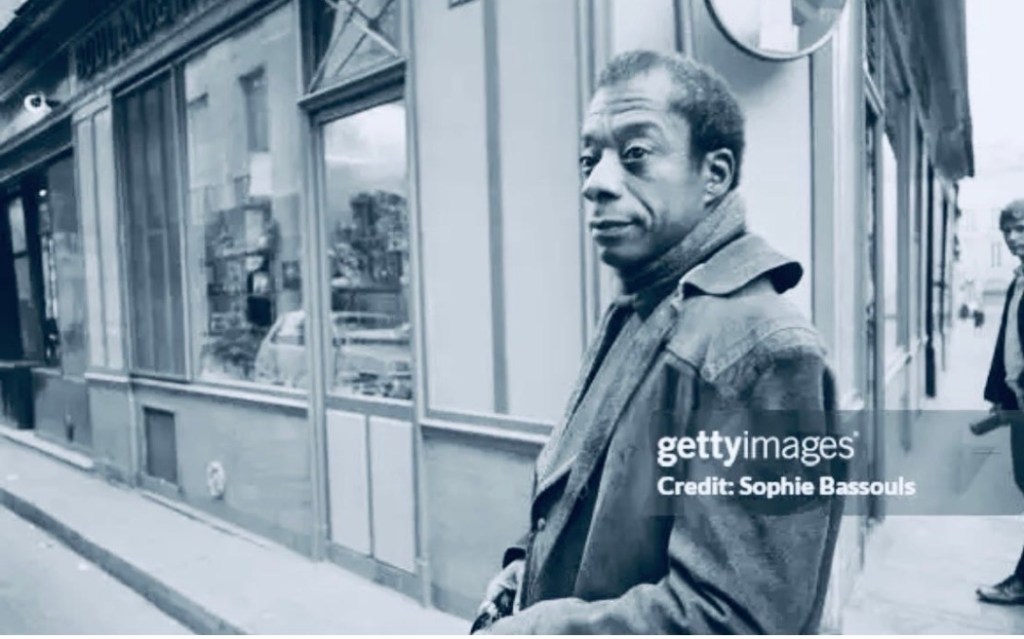
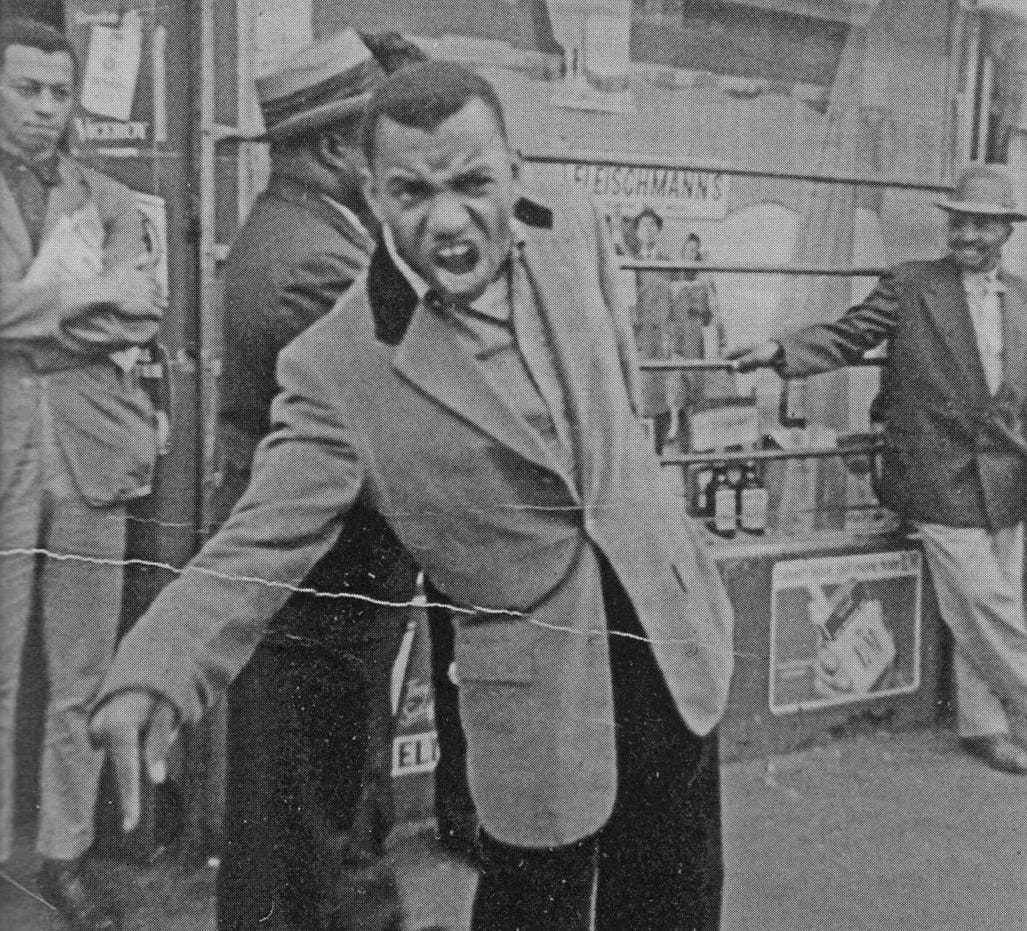
The photo below of Don Warden is from the archives of Khalid and Jamila al Mansour. Don Warden was one of the founders of the Afro-American Association at the University of California at Berkeley. The other founding members were Donald Hopkins, Otho Green, and Henry Ramsey. 

This organization formed in late 1961 and began as a student study group in 1962 at the University of California at Berkeley when there were literally no identifiable Afro-American and African Studies programs on any U. S. college and university campus. The group devoured works by Ralph Ellison, W.E.B. DuBois and other Black scholars that were left out of many colleges curricula. Study meetings of its members initially began at the off-campus home of a UC Berkeley student, and grew from there. In fact, chapters of this organization appeared on hundreds of college campuses in the United States with members numbering in the thousands by the mid-1960s.

The objective of the group was to read and study about the Afro-American, African, and Afro-Diasporic past in order to confront the institutional racism, colonialism and bigotry found in the United States and throughout the world. 

Warden, a UC Berkeley law student, regularly went into Black neighborhoods and literally spoke to young Black citizens directly on street corners or wherever they were. He encouraged them to study about Afro-American and African history in order to fight against their feelings of worthlessness that often accompanied experiencing chronic racism. 

He listened to them tell him about their problems of unemployment, poor housing, you name it. He, like most of his members, espoused that in order to change all systems of oppression, one needed to study about the past in order to do so. Warden eventually became a lawyer for the Black Panther Party of Self-Defense as well as granting legal assistance to the Nation of Islam when Malcolm X was still a member of the group.

The Afro-American Association was heavily influenced by the ideologies of Black American activists Robert F. Williams and Malcolm X. The AAA understood that only sustained study of Black people/s would foster the kind of thinking and strategies for combating systems that sought to suppress and control Black and Brown communities all over the world. Only deep research would correct the far-too-often feelings of inadequacy that came with being Black and oppressed. 

In 1962 when this study group, that was soon named the Afro-American Association, began its study group meetings at UC Berkeley there were roughly only about 100 Black students out of 20,000 white students. And in 1962 there were only two members of the group that were not born in the United States. One was from Jamaica; the other was from India.

In 1962 this tall, skinny, young Black man from Orange Hill, Jamaica and this petite and short, very brown young woman from Chennai, Tamil Nadu (in Southern India) dressed in her Sari and sandals met in an AAA group meeting.

The young man from Jamaica gave a pristine evaluation of how Great Britain had created a rather stiff and proper group of elite Black Jamaicans that often mimicked the mores and habits of British society. It was done, he said, to shield the world from knowing how racist the British empire actually was. The young man was calm, studious with very edgy ideas about the colonization of Black people/s around the world. 

The young brown woman in her Sari and sandals was intrigued. She too had been a British subject in her native state of Tamil Nadu in southern India. She knew something about what this young man spoke of, but not all of it. Back then, the typical path for academically talented Indian and Jamaican students was to study in England, that is if they could secure a path to graduate school. 

She rejected that path because there was no major in Biochemistry in India or in the UK that would have been available to a female. The skinny guy from Jamaica also rejected the educational path to the UK. His decision was so unusual that the approval for his exit from Jamaica took so long that he arrived at UC Berkeley two weeks after the Fall 1961 semester begun.

He, Dr. Donald Harris became a leading economist and she, Dr. Shyamala Gopalan-Harris became a leading biomedical scientist, a contributor to the identification of the function of rMNA, which greatly improved treatments for breast cancer. 

The early members of the Afro-American Association described her as warm, funny, “down for the cause” of Civil Rights and an end to colonialism, and also a fiery debater. At first one member of the AAA noted that some of them thought she was royalty because of the way she carried herself. Yet, she fit right in, several members noted. He was described as professorial even though he was in his early 20s. While their eventual marriage didn’t last (they married roughly 10 months after meeting), their firstborn daughter Kamala noted that she knew they loved each other and felt that if they had been a bit older and a bit more emotionally mature they might have made it. 

She cited them both as activists, and remembers going to protest marches with her parents in a stroller. The blueprint for their activism and for the creation of Afro-American and African Studies as disciplines were rooted in the activities in the Afro-American Association. While at UC Berkeley, Shyamala met and influenced arguably, one of Afro-America’s most important philosophers, Cedric Robinson.

Robinson’s book Black Marxism, first published in 1983, remains one of the most brilliant critiques and reassessments of the Eurocentric theories of Marxism. It has become a must-read in the literary canons of both Afro-American and African Studies.

It was Robinson who coined the phrase “Racial Capitalism.” He argued that capitalism was always based on race and race came before capitalism. Importantly there never was a clean break from European feudalism. He was one of the first Black scholars to identify “race,” as a component that European empires used when feudalism morphed into capitalism. 

Any study he maintained had to be central to Black people/s’ lived experiences wherever they were in the world. When I first read him, it became apparent that European Marxist scholars either forgot or tried to ignore that the peoples of Europe were once considered “races,” races and national identities that were eventually erased in exchange for their being identified as “white” which served the interests of European countries in their quest to colonize and dominate large portions of the world.

In 1959, Shyamala Gopalan was standing in line behind Cedric Robinson while they were both registering for classes. Both became members of the Afro-American Association. In the first edition of Black Marxism, there was only one person who was not a Black American listed in his group of early friends that Robinson acknowledged as influential on the development of his ideas. That person was Dr. Shyamala Gopalan-Harris.

So here’s a brief mini-history of the continuing of the Afro-American Association of University of California at Berkeley. Huey Newton and Bobby Seale who founded the Black Panther Party became members. Huey dared to show up at a meeting of AAA without having read the book assigned for that session. The members sent him home. He never showed up again unprepared. 

Future Congressman Ron Dellums was a member of the AAA at one time as was Kenny Freeman, a contributor to the Black Panthers 10-Point Plan. The AAA literally laid the academic groundwork for Afro-American and African Studies programs throughout the nation as underscored by historian and author Donna Jean Murch who traced the evolution and development of the Black Panther Party from its roots in the Afro-American Association. None of it began without the required reading and research and the on-the-ground grassroots activism that met Black communities in the Oakland area where they were.

I could go on about how police monitored the group’s members particularly when they spoke on street corners, or visited high schools to encourage reading and research among members of the Black community. Yet, I will not do that mainly because well-meaning, good people have started to use the internet like an online set of Cliffnotes

If you’re old enough to remember Cliffnotes you also remember that occasionally they were used instead of reading the actual book or doing the actual research. Yet, your ass was grass when a teacher or professor asked you a highly specific question that Cliffnotes did not cover and you hadn’t bothered to read the whole book.

So there’s a small bibliography below with a list of books that are worth your time. The message is clear: Either you put in the time and read or you remain a dilettante on matters that you need to know both for your safety and your sanity.

© Leslye Joy Allen

This essay was previously posted on Substack on January 22, 2026.

I am an Independent Historian, Oral Historian and Dramaturge. Please consider supporting my work and research with a few bucks for Coffee and Eggs via my CashApp or become a paid subscriber to me on Substack to help me sustain my research.

Recommended Readings:

Living For the City: Migration, Education, and the Rise of the Black Panther Party in Oakland, California by Donna Jean Murch

Fanon for Beginners by Deborah Baker Wyrick

Remaking Black Power: How Black Women Transformed an Era by Ashley D. Farmer

Black Marxism: The Making of the Black Radical Tradition by Cedric Robinson

Oregon Police Department Surveillance Files on Donald Warden and the Afro-American Association which kept surveillance documents on Donald Warden when he visited Oregon to encourage students to read and research.

The Afro-American Association: Forerunner to the Panthers

“How Kamala Harris’ Immigrant Parents Found a Home, and Each Other, in a Black Study Group” by Ellen Barry, September 13, 2020, New York Times.

The Truths We Hold: An American Journey by Kamala Harris

Remembering Cedric Robinson: Humanistic Imaginaries and the Black Radical Tradition

All blogs written by Leslye Joy Allen are protected by U. S. Copyright Law and licensed under a Creative Commons Attribution-NonCommercial-NoDerivs 3.0 Unported License. Any partial or total reference to any blog authored by Leslye Joy Allen, or any total or partial excerpt of any blog authored by Leslye Joy Allen must contain a direct reference to this hyperlink: https://leslyejoyallen.com with Leslye Joy Allen clearly stated as the author.  Postings or blogs placed here by other writers should clearly reference those writers.  All Rights Reserved.

The Arbitrary Ages of Consent: The Epstein Files

by © Leslye Joy Allen

Any belief that is based on distorted facts or on lies will eventually swallow you whole. Any weird science that has been used to perpetuate myths and half truths can get you injured or killed. 

I read an abstract of an article from 2009 called Pedophilia, hebephilia and the DSM-V awhile back. DSM-V stands for Diagnostic and Statistical Manual of Mental Disorders, Fifth Edition. This quote from its abstract stood out:

“One possibility would be to replace the diagnosis of Pedophilia with Pedohebephilia and allow the clinician to specify one of three subtypes: Sexually Attracted to Children Younger than 11 (Pedophilic Type), Sexually Attracted to Children Age 11-14 (Hebephilic Type), or Sexually Attracted to Both (Pedohebephilic Type). We further recommend that the DSM-V encourage users to record the typical age of children who most attract the patient sexually as well as the gender of children who most attract the patient sexually.”

The abstract noted in 2009 that the term “hebephilia,” which described an adult that had a sexual preference for pubescent children ages 11 to 14, had not caught on. That term still has not caught on. 

Pedophilia, which describes someone who has a marked sexual preference for children who have not yet begun puberty is still the preferred term to designate adults who have a sexual preference for underage youth. I am going to play devil’s advocate here.

What is missing from these definitions is the alleged safety clauses for children aged 15 and older. What’s blatantly clear, at least it was in 2009, was that anyone aged 16 or older could be classified as a pedophile as long as their victim/s were at least 5 years younger. In other words a 16-year-old male classified as “pedophile” would necessarily be or attempt to be sexually active with a child/children 11-years-of-age or younger.

If you’re scratching your head, you should be. I can understand a grown man or grown woman looking at a 15 or 16 year old and thinking that those teenagers are awfully cute. Yet, propriety and ethics and morals and good old common sense should remind these same adults that these “teenagers” have no business climbing into bed with them for any reason. It’s called decency. 

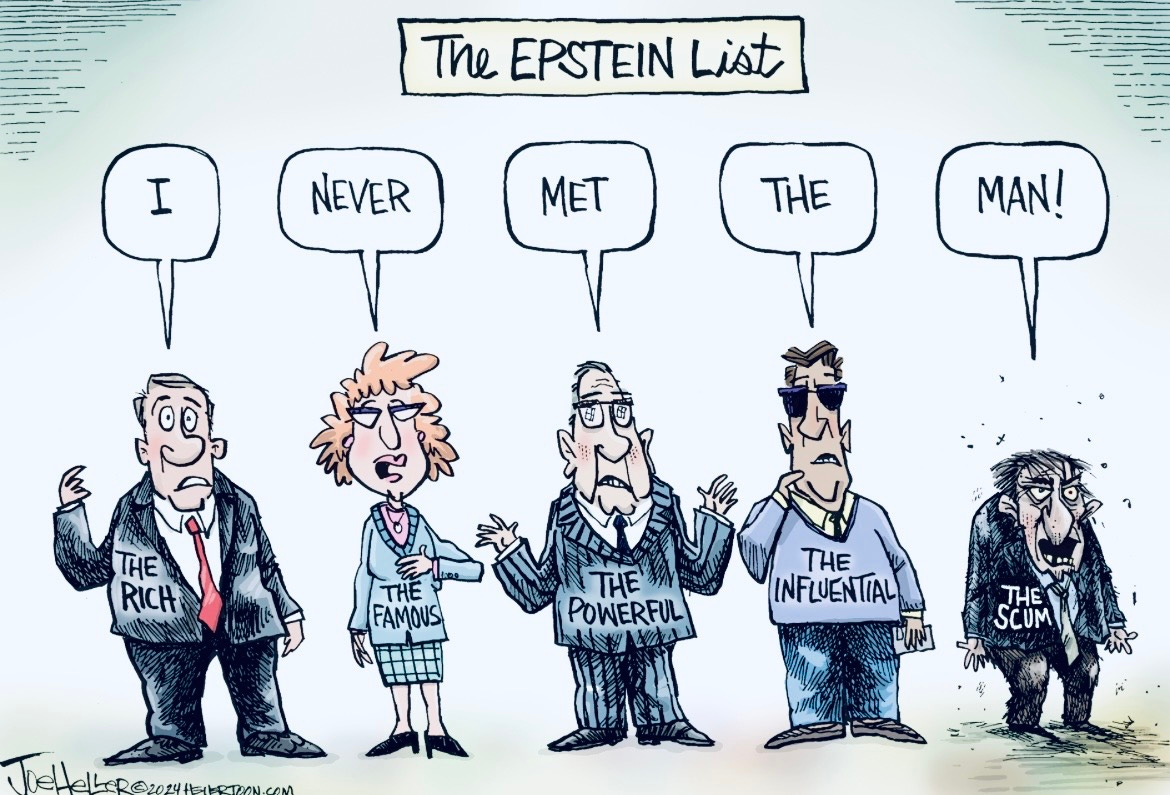
After I read the recent, pathetically weak reporting on what has been released so far from the Epstein Files, I knew I needed to revisit some of the data on pedophilia. Here’s why? 

White Western science has a tendency to describe any and all rotten ass behavior as some form of mental disorder rather than defining certain behavior for what it is: the “I-do-what-I-do-when-it-suits-me-and-when-I-can-stay-in-control-when-I-do-it” syndrome.  White male patriarchy, in all of its excesses and perversions, is protected by the science. 

The white or Black guy that cannot get any woman to have sex with him because he doesn’t know how to talk to or court well-educated adult women might end up in a sexual tryst with a vulnerable and impressionable 16-year-old because he found her attractive because she’s physically well-developed, but mentally she’s still a kid—and his sick, predatory, control freak ass already knows it. 

I am not willing to paint such men as “mentally ill” as much as I am willing to paint them as ethically and morally corrupt. In other words, they are rotten to the core. 

The revelation that there is in excess of over 1.7 million documents in the Epstein Files and that there were at least 10 co-conspirators that aided and abetted Epstein and other men of his ilk ought to tell you something. 

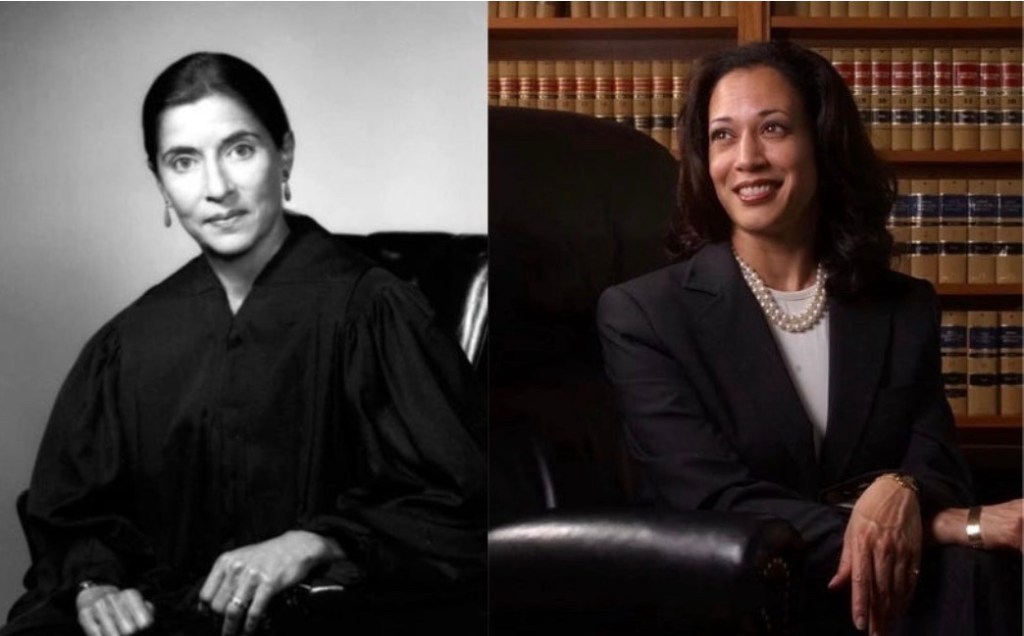
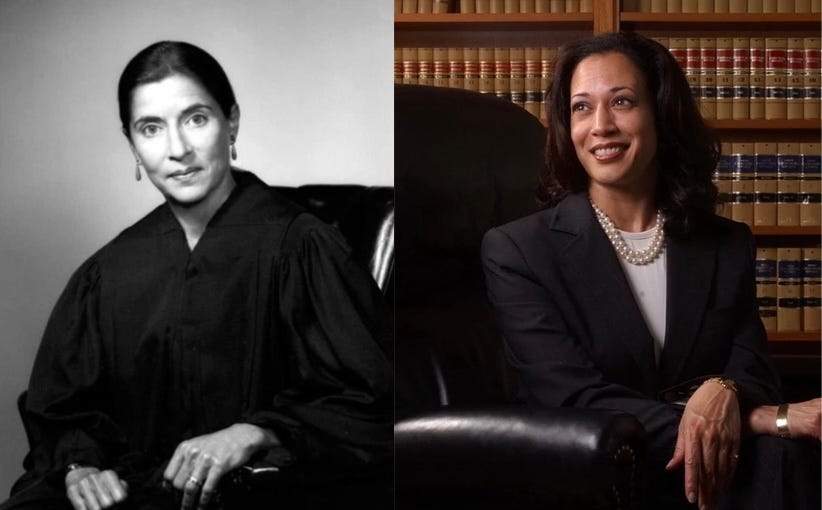
(Young Ruth Bader Ginsburg & Kamala Harris)

If the frontal cortex of your adult brain doesn’t reach full maturity until you are at least in your mid-to-late twenties, ask yourself the following questions: 

Why is the average age of sexual consent across 30 states in the United States only 16-years-of-age? Why do only a handful of states place the age of consent at age 17, with a remaining 11 states placing the age of consent at age 18? 

Do not tell yourself that lie that you were wise when you were between the ages of 16 and 18. It doesn’t matter if you remember that lovely moment when you and another 16 year old decided to do the deed because you were just a couple of horny teenagers. It does matter if that 35-year-old guy that you thought was so cool for being interested in you ran his hand up your dress and coerced you into a sexual scenario that you were not ready for. 

The Supreme Court was established in March of 1789. Yet, it wasn’t until Ruth Bader Ginsberg (long before she was appointed to the Supreme Court in 1993), argued in 1977 in “Sex Bias in the U. S. Code” that she co-authored for the Commission on Civil Rights, that boys and men could be and often were raped and/or sexually exploited. So many men were so damned caught up in patriarchy and male sexual prowess that they didn’t even know to look out for themselves. They still don’t.

The young prosecutor Kamala Harris remembered her high school best friend as having been molested by her father. She pressed her friend to tell her what was going on. Young Kamala remembered that her friend often did not want to go home. 

Kamala told her mother what was going on with her friend; they took this girl into their home. When Kamala made the decision to become a prosecutor she specialized in prosecuting pedophiles and rapists. Do you think if she were president we would be getting Epstein updates in dribs and drabs? I think not.

© Leslye Joy Allen

I am an Independent Historian, Oral Historian and Dramaturge. Please consider supporting my work and research with a few bucks for Coffee and Eggs via my CashApp or become a paid subscriber to me on Substack to help me sustain my research.

All blogs written by Leslye Joy Allen are protected by U. S. Copyright Law and licensed under a Creative Commons Attribution-NonCommercial-NoDerivs 3.0 Unported License. Any partial or total reference to any blog authored by Leslye Joy Allen, or any total or partial excerpt of any blog authored by Leslye Joy Allen must contain a direct reference to this hyperlink: https://leslyejoyallen.com with Leslye Joy Allen clearly stated as the author.  Postings or blogs placed here by other writers should clearly reference those writers.  All Rights Reserved.

Threading Grandma’s Needles, and Kamala Harris

by ©️ Leslye Joy Allen

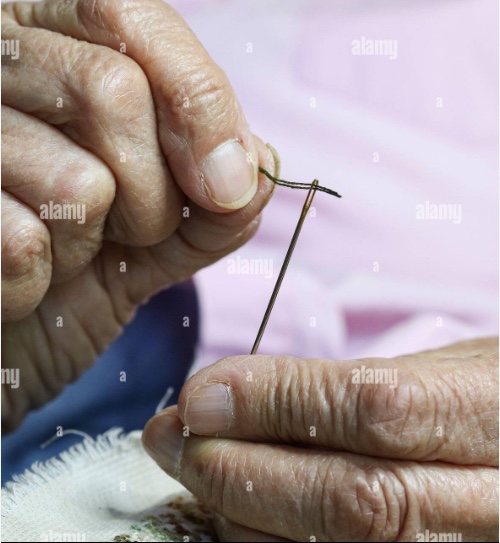
When I was a small girl around the age of 4 or 5, my maternal grandmother would often ask me to thread her needle. I was a late born baby to my parents and Grandma was well into her seventies when I was born.

Grandma was a scholar who read a couple of books a week. I knew instinctively that the reason why she asked me to thread her needle was because the eye of a sewing needle is narrow and often hard to see. The best pair of eyes could have trouble getting that thread through that tiny eye. By the time I was around 4 or 5, Grandma was in her eighties, and I enjoyed doing what I could for my Grandma.

(Stock photo of an elderly woman’s hands threading a needle, Alamy)

Grandma’s eyes were not as steady as they once were; and neither were her hands. But once that needle was threaded, she could sew up a storm. As I have now passed the age of 60, it now takes me damned near 15 minutes to thread a needle. But you do what you can and what you have to do. This brings me to another observation.

For several months this year, after I rolled my herbie-curbie (that’s the name for our garbage cans on wheels in Atlanta) to the curb of my driveway, I arrived back home and instead of my herbie-curbie being left at the curb of my driveway as is customary, someone had rolled it all the way up to the gate to my backyard so I wouldn’t have to retrieve it.

Last week, I was home when the sanitation workers were out. Before I exited my door to retrieve my herbie-curbie, I saw my 20-something neighbor who is autistic grab its handle and roll it up to my gate. He went from house-to-house doing the same thing—saving his older neighbors the trip to the end of the curb.

I bring this up because when I finally saw who was doing this favor on his own, it dawned on me that he was doing what he could do to assist his neighbors.

Then I thought about all of these folks barking about where is Kamala Harris? During the first wave of complaints, she was actually in fire-ravaged California assessing damage, talking with the mayor and governor and firefighters, and assisting her neighbors who had lost their homes.

The second wave of complaints came recently. Now, I have already said that Harris is a private citizen and has done her duty while so many others fail to do so much as contact their representatives and complain.

What is most annoying is the manner in which folks have complained. I watched Harris lose weight on the campaign trail after being given a near-impossible task of organizing a campaign in just over 100 days after a stubborn Joe Biden took his sweet time stepping aside when so many of his colleagues begged him to do so.

I have also been around white women who felt like I was their property and who felt like I was obligated to do whatever they requested, and were insulted when I said “No” even when my work or school schedule and obligations would not permit me to accommodate them.

I have been around men (black and white) who treated me the same way. That is an unfortunate experience that Black women have endured ever since we have been here in this country. We are not supposed to have own lives, but we are supposed to stand ready to salvage somebody else’s. Wedged between battling racism and sexism and misogynoir simultaneously, we are often left hanging when we are having problems.

Instead of these complainers interrogating the majority of white women and men who voted for Felon 47, they want Harris out there speaking for them. And if she did, you know good and damned well Felon 47 and his minions, along with his bought-and-paid-for news rooms would paint her as a “Sore Loser” while his dumb-as-cat-shit voters nodded in agreement while he continued to pick their pockets and threaten their livelihoods. Unlike my sweet autistic neighbor, they do not do what they can but they expect someone else to do it.

Instead of bothering to contact Kamala Harris’ office or website or her page on IG to ask her a question, they went on a rampage of demands. They don’t even know what she might be doing behind the scenes.

So, let me share this bit of my history. I represent only the third generation of my families not born into slavery. I will leave you with what my paternal Great Grandmother said to her mistress who just couldn’t believe Great Grandma would want to leave her mistress and be free. With a nap sack on her shoulder, and right before she went searching for her other siblings who had been sold to other slave owners, she said the following:

“You can do your own work and you can pick your own cotton.”

©️ Leslye Joy Allen

I am an Independent Historian, Oral Historian and Dramaturge. Please consider supporting my work with a few bucks for Coffee and Eggs via my CashApp.

All blogs written by Leslye Joy Allen are protected by U. S. Copyright Law and licensed under a Creative Commons Attribution-NonCommercial-NoDerivs 3.0 Unported License. Any partial or total reference to any blog authored by Leslye Joy Allen, or any total or partial excerpt of any blog authored by Leslye Joy Allen must contain a direct reference to this hyperlink: https://leslyejoyallen.com with Leslye Joy Allen clearly stated as the author.  Postings or blogs placed here by other writers should clearly reference those writers.  All Rights Reserved.

Pawns and Queens: Analogies For a New Era

by ©️Leslye Joy Allen
We historians often find data in some file in an obscure archive, in letters written by someone’s grandmother, in photos, newspaper clippings, legal records. Our discipline demands that we dig, analyze, rethink and revise, constantly. I liken our work to studying the function of each piece in a Chess game. We get different perspectives about the same set of circumstances depending on which Chess piece we examine.

I was a mediocre Chess player. I had a few friends who played like champions. So, I often just watched them play. I remain, however, fascinated by the game’s objectives and, specifically, the roles of Pawns and Queens.

Pawns are the most numerous pieces in Chess; they are the foot soldiers. Each player has eight Pawns. A Pawn can move one or two squares forward if that move is its first move. After the first move, a Pawn can only move one square forward unless the square is blocked by some other piece. A Pawn can capture or attack another piece, however, by moving diagonally to the left or right.

The Pawn is the only piece in a Chess game that can change ranks. Depending on the skill of a Chess player, a Pawn can become a Bishop, a Rook or a Queen. In spite of a Pawn’s ability to advance to a higher rank, it is still considered the lowest ranking piece in the game. It is only worth one point.

The objective of the game is to capture your opponent’s King where that King has no way out, which means Checkmate. While the King is considered the most important piece in the game, it is the Queen that is considered the most powerful piece.

Queens are the only pieces that can move across the board in any manner as long as they are not successfully blocked by other pieces. If you lose, it is highly likely that you lost because your opponent’s Queen checkmated your King. Chess players feel much more confident when they have successfully captured or blocked her.

You can still win the game without capturing the Queen, but you have to be extremely strategic and precise to do so. You can also win without making good moves with your Pawns, but it is highly unlikely.

Chess is now over 1,500 years old. While there is some skepticism about its precise origins, many Chess historians believe that the Indian board game called “Chaturanga” was the earliest predecessor of Chess. There were many other versions that followed, but are too numerous to mention here.

In early versions of Chess, there was a piece called “Vizier” or “Advisor” for centuries. In the 1500s, in the era of great and powerful Queens in Europe, like Spain’s Isabella and England’s Elizabeth, “Viziers” or “Advisors” were redesigned and renamed “Queens.” You can learn an awful lot of world history just by examining Chess.

So here’s the deal: There is no such thing as a Chess game where Queens/Women Heads of State/Women in general are not powerful and flexible while the Kings/Men Heads of State/Men in general are highly important but who have or exercise fewer tactical moves.

There is also no such thing as a Chess game where Pawns/Foot Soldiers/Laborers are not essential to success, even while they are considered less important.

Apply any and all of the above to what you see happening in the United States and the world right now. I refuse to tell you how to analyze and interpret this history because there are so many interpretations and analogies that can be extrapolated from this board game.

All I will say is that nothing is going to change or be corrected without the skill of devoted Pawns, and the power and daring of Queens.

©️Leslye Joy Allen

Shutterstock photo of a Pawn and a Queen on a Chessboard.

All blogs written by Leslye Joy Allen are protected by U. S. Copyright Law and licensed under a Creative Commons Attribution-NonCommercial-NoDerivs 3.0 Unported License. Any partial or total reference to any blog authored by Leslye Joy Allen, or any total or partial excerpt of any blog authored by Leslye Joy Allen must contain a direct reference to this hyperlink: https://leslyejoyallen.com with Leslye Joy Allen clearly stated as the author.  Postings or blogs placed here by other writers should clearly reference those writers.  All Rights Reserved.
Kill the Snake

by ©️Leslye Joy Allen

Harriet Tubman was a nurse, a scout, and a spy for the Union Army during the Civil War. She is best known, however, as a leader of the Underground Railroad where she led many African American enslaved people from the state of Maryland to head north to Canada.

A majority of Black American runaway slaves never made it to Canada, which was the intended destination. Most of them landed somewhere in the Northeast where American chattel slavery was abolished during the 18th through the early 19th centuries.

I want to point out two things about Tubman and about Black American women during the late 19th century.

First, Tubman always kept a rifle or gun under her dress just in case one of her runaway slaves decided to run back to their plantation. After all, these journeys required hundreds of miles on foot while they worried about bounty hunters who searched for runaways in order to reap financial rewards. Slave patrols roamed all night looking for slaves out after dark without permission. If a slave was caught, punishment was severe, and occasionally fatal.

Tubman let her fellow Black freedom-seekers know that she would shoot them dead before she allowed any one of them to run back to their former owners who would inevitably beat them until they confessed about her mission, which would jeopardize the safety of everyone involved. All of the slaves who headed North with Tubman believed her. She never once had to use her gun.

Second, Tubman was clear about her mission to free and save her people. Her demand to, “Kill the Snake before it Kills you,” was her reference to the slave-holding Confederacy and its Army in the American South.

She did not necessarily want anyone to be killed, but she underscored that the Confederate Army was the Snake; and the Snake had to be stopped no matter the casualties it suffered.

During Reconstruction (1863 to 1877) after the Civil War ended, the Republican Party of the North sought to solidify its political dominance and economic control over the South. So, by 1870 it gave Black men who were former slaves the right to vote.

In spite of the fact that no women were granted the franchise, Black families sat down together and decided together how to cast that one vote afforded to male adults in their households. Many Black men were escorted to the polls by their wives, sisters, and mothers who also hid guns and rifles under their dresses just in case some white southerner/s, aka snake/s, decided to harm these Black male voters.

In this new year of 2025, we are again at a moment in our history where our capacity to protect ourselves and those we love, and our capacity to survive economically and to be free is at stake.

We must face the reality that we may have to do things we never thought we would ever have to do in our lifetimes. We must do more than complain about our representatives who are complacent, thereby complicit, about the objectives of the incoming administration.

We do not yet know what we may have to do. But I think about all of those Black women in the late nineteenth century prepared to protect Black men who were going to vote for the first time in their lives.

I also think about some of my sheroes like Congresswoman and former presidential candidate Shirley Chisholm. I think about her mentee, Congresswoman Barbara Lee. I think about the fact that Black Panther Party membership was 70 percent Black women. Then I think of Vice-President Kamala Harris and former First Lady Michelle Obama.

After I remember all of these sisters I admire, I then think of my late maternal grandmother who was a coed at then Clark College during the Atlanta Race Riot of 1906 with her gun under her dress for her protection. I then remember my paternal aunt who had molotov cocktails thrown at her during protest marches in the 1960s, and one thrown in her home because she dared to register Black folks to vote.

Then I remember Tubman’s order to “Kill the Snake before it Kills you.” Then I prepare myself in the event I have to carry out this order, figuratively and literally.

©️Leslye Joy Allen

(Photo of Harriet Tubman by Harvey B. Lindsley, ca. 1871-1876, courtesy of the Library of Congress)

All blogs written by Leslye Joy Allen are protected by U. S. Copyright Law and licensed under a Creative Commons Attribution-NonCommercial-NoDerivs 3.0 Unported License. Any partial or total reference to any blog authored by Leslye Joy Allen, or any total or partial excerpt of any blog authored by Leslye Joy Allen must contain a direct reference to this hyperlink: https://leslyejoyallen.com with Leslye Joy Allen clearly stated as the author.  Postings or blogs placed here by other writers should clearly reference those writers.  All Rights Reserved.