No Contradictions

by ©️Leslye Joy Allen

When I started to hear negative commentary about Kamala Harris’ racial and ethnic background, I started reevaluating how “White Supremacy” works again.

Many people are completely unaware that when the Greek explorer Herodotus named the continent “Αἰθιοπία” (romanized as Aithiopía”), his definition included the continents of Africa, India, and Southeast Asia. Herodotus’ term literally means “Land of Burnt Faces.”

Those kinds of cross-cultural connections and collaborations do not help white supremacy to flourish which is why you rarely hear anything about them. The objective of white supremacy is to make certain that peoples of color look to white folk, and white men specifically, for acceptance, guidance, deliverance, and redemption, but not to each other. Sexism works exactly the same way. A man, not a woman, may rule you and grant you favor in some screwed up patriarchal world as sexists imagine it.

African-American scholar W. E. B. DuBois’ heir apparent Vijay Prashad noted that many Indian men arrived in the USA in the late 18th and 19th centuries, married Black American women and disappeared from most histories. Suraj Yengde, both in his books and in his portrayal of himself in Ava DuVernay’s masterpiece film “ORIGIN,” noted that we must find reconnections with each other. His research on Dr. Bhimrao Ambedkar is fascinating.

Ambedkar was a Dalit, or as he was once called, an “Untouchable.” He wrote India’s constitution. He earned two doctorate degrees and when he came to the United States he wanted to meet his fellow American untouchables. So, he visited Harlem where the Black folks lived. (FYI: Martin Luther King, Jr. was introduced as a fellow “untouchable” when he visited India.)

This is exactly what Shyamala Gopolan-Harris did when she left India to go to school in the United States. She gravitated toward communities where she was less likely to be mistreated. So, she headed to Berkeley, California which was a hotbed of activism—there were Civil Rights protests, anti-Vietnam protests, the Free Speech Movement and the work of the Black Panther Party in nearby Oakland was the world that her daughter Kamala Harris grew up in.

I bring this up because we know so little about our early histories and connections. I don’t bring this up with any foolish idea that everyone is going to suddenly start singing “Kumbaya” and start getting along all the time. Yet, we know more about what Prashad accurately identified as white power structures that, during the late 20th century, deliberately created the myth that “Southeast Asians” were a model minority, a minority he emphasized that was designed as a weapon against Black Americans.

Felon 47 and his minions have lined up a small cadre of Southeast Asians to serve in his administration to do two things: 1) make the administration look less racist than it is and, 2) to also entice India, which now has a larger population than China, that its population is seen somehow as superior. South Africa did damned near the same thing during apartheid.

When Black Americans visited South Africa during its apartheid era, Black American visitors were given passes written in Afrikaans that translated into English as “Honorary White Person.”

Now, the fact that I personally know at least seven Southeast Asians who identify quite accurately as “Black,” does not matter. The fact that so many folks on the continents of Africa and Southeast Asia have near identical DNA doesn’t matter either. When I read the book “A Passage to India,” I noted that an Indian character in the book was described as a “little Black man.” It was the first time I ever saw such a description of anyone outside of a specifically African or African American context. My point, however, is much simpler.

We Black Americans can continue to roll our eyes at the brown guy wearing the turban at the local gas station and vice-versa OR we can recognize and identify our participation in upholding white supremacy while its foot remains situated on both our necks. Before you bother to tell me about the guy at the gas station that you don’t like, remember that he is an employee and all you are is someone pumping gas. White supremacy makes all of us its pawns.

If you are honest, you also remember that moment when you got bad service at a Black-owned business and thought to yourself that you got bad service because the business was Black-owned. The fact that there are, were, and will be folks who simply are not good at customer service regardless of their race or ethnicity or nationality did not enter your mind. That kind of thinking is white supremacy in action too.

Kamala Harris knows this better than anyone. She knows who she is and she didn’t need anyone to tell her who she is. The fact that anyone dared define her speaks not only to their arrogance, but also to their presumptions that they actually have such a right to do so.

She was perceived by some folks as a contradiction and by some folks as having split loyalties. The only thing that actually requires split loyalties is white supremacy. It cannot thrive or survive without its clear contradictions. Let me write that again—It cannot survive or thrive without its clear contradictions. It functions with the assistance of the people who it is designed to either oppress and/or control and/or regulate. Repeat that until you get it. So, no contradictions.

©️Leslye Joy Allen

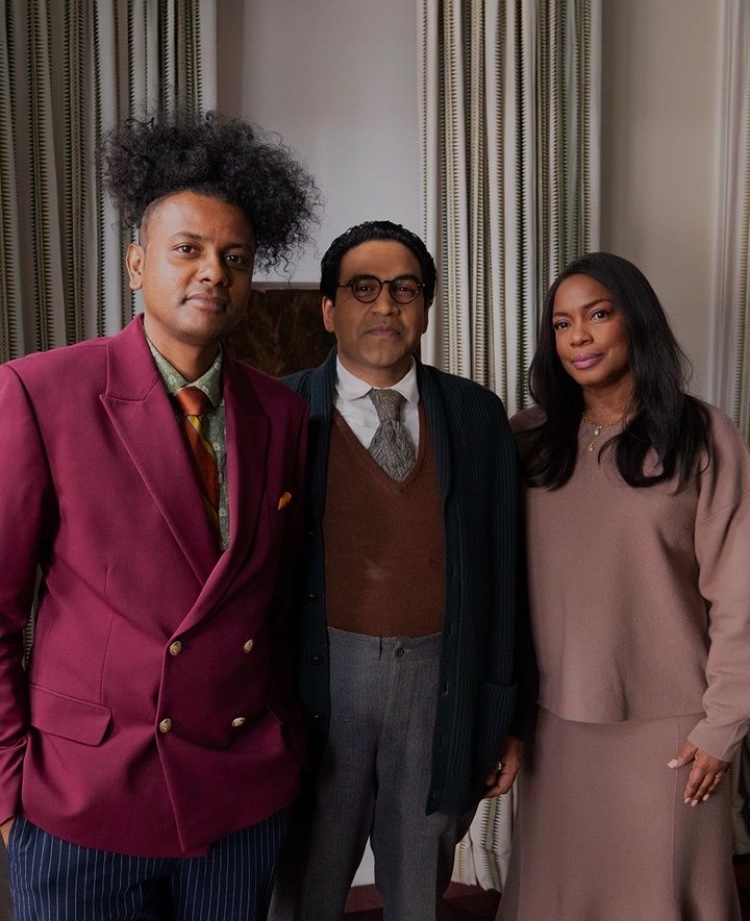
Dr. Suraj Yengde (as “himself”), Dr. Gaurav J. Pathania (as “Dr. Bhimrao Ambedkar”) and Aunjanue Ellis-Taylor (as “Isabel Wilkerson”) in Ava DuVernay’s film “ORIGIN.”

All blogs written by Leslye Joy Allen are protected by U. S. Copyright Law and licensed under a Creative Commons Attribution-NonCommercial-NoDerivs 3.0 Unported License. Any partial or total reference to any blog authored by Leslye Joy Allen, or any total or partial excerpt of any blog authored by Leslye Joy Allen must contain a direct reference to this hyperlink: https://leslyejoyallen.com with Leslye Joy Allen clearly stated as the author.  Postings or blogs placed here by other writers should clearly reference those writers.  All Rights Reserved.

A Thought About Black Panther

By Leslye Joy Allen

Copyright © 2018 by Leslye Joy Allen.  All Rights Reserved.

“Royal Purple” by © Leslye Joy Allen

This is not a review of the film Black Panther.  This is a brief musing about what crossed my mind after I saw this film.  First, Black Panther is unapologetically “Black.” I use “Black” here to indicate that while the film is set in the fictional African nation of Wakanda, it also includes Africans of a variety of ethnicities, African Americans and a genuine nod to the entire African Diaspora most of whom are descendants of former slaves in the West.  I am a member of that African Diaspora. The film also gives a few cultural nods to the Ndebele, Yorùbá, Maasai, and Akan peoples on the African continent (thank you, actor-vocalist-friend Saycon Sengbloh for pointing this out first).  The film gets the multi-facted roles of African women so very right.  The film also has some serious messages unlike any messages you have ever heard in a Marvel Super Hero movie.  Don’t worry, if you have not seen it yet, I’m not going to ruin it for you.  All I can say is that it is an entertaining joy ride of a film that will make you think…really, really think.  With that said, here’s what I thought about immediately after I saw Black Panther.

Black Panther has stirred up a genuine sense of pride in Black Americans that we don’t get to feel with this much enthusiasm too often.  It has taken decades of hard work to undo some of the psychic and spiritual damage done to Africa’s descendants in the West who have endured brutal chattel slavery, Jim Crow, systematic racism and discrimination, police brutality, you-name-it.  It has taken decades of hard work and scholarship to undo some of the psychic and spiritual damage done to Africa’s descendants in the West who, for centuries, were told that Africa had no real history, no real contributions to civilization when all of what these descendants were told is/was/remains patently false.  However, it is dangerous to over-romanticize any history; to make any and every description of our African ancestors totally positive. Black Panther, in its own unique way through fiction, de-romanticizes history by showing us a multi-ethnic, multi-generational Wakanda with all the friction and righteous compromise and conflict such diversity can foster.  You leave the movie theater proud, but fully aware that Africans (and we African descendants) have tremendous gifts and flaws not because we are or ever have been inferior or superior, but rather because we are human.

I remember a lecture given by the late African scholar, Dr. Ali Mazrui back in 1996 where he stated that to deny Africans the ability to be wrong was also the same as denying them their humanity.  Dr. Mazrui was always controversial.  He said the only African-American activist that he had any real respect for was Randall Robinson, the founder of Trans-Africa. When asked why he only dug Robinson, Dr. Mazrui said, “Robinson not only raises his voice when Whites do something wrong to Africans, Robinson speaks out when Africans are doing something to wrong to other Africans.”  I’ve never forgotten that statement and what that statement truly means.

When you love your people, you praise them when they are right and you don’t make excuses for them when they are wrong.  You work to correct them.  You speak out against racism, colonialism, and the exploitation of your people no matter who the adversary is.  That lecture by Dr. Mazrui, and so many lectures given by visiting and former professors drove home that I could not afford to care as much about how Africans and African-descended peoples looked to the rest of the world more than I cared about how well or how poorly they/we all were doing.  If you love your people you don’t worry about what their image is and how it affects you as much as you worry about their well-being, period.  Black Panther shows just how difficult that can be, but it also shows that it can be gloriously done…

Now, if you don’t exactly understand this post, it is probably because you have not seen Black Panther yet.  It could also be because you know very little about the continent of Africa’s very complicated history.  However, my points will be clearer once you’ve opened a few books and taken the ride to Wakanda.  So, get to the movie theater.  You won’t be disappointed.  Wakanda Forever.

Copyright © 2018 by Leslye Joy Allen.  All Rights Reserved.

This blog was written by Leslye Joy Allen and is protected by U. S. Copyright Law and licensed under a Creative Commons Attribution-NonCommercial-NoDerivs 3.0 Unported License. Any partial or total reference to this or any blog authored by Leslye Joy Allen, or any total or partial excerpt of this or any blog by Leslye Joy Allen must contain a direct reference to this hyperlink: https://leslyejoyallen.com with Leslye Joy Allen clearly stated as the author. All Rights Reserved.

#25May2017 #June20and21

Copyright © 2017 by Leslye Joy Allen.  All Rights Reserved.

This is a short blog…because, well, finishing a dissertation is serious business.  There are two dates that are important that I would like to highlight for you.  The first date is May 25, 2017 which is African Liberation Day, but also the launch date of Africans Rising, a continental and global movement spearheaded by its launch director, South African native Kumi Naidoo.  Naidoo daringly states that one of the first problems the continent has is a leadership that will not make room for the young; and young Africans are no longer simply willing to point their fingers at the harsh and lasting damage from past European colonization and exploitation, but also at African leaders who hold power too long and often.  I invite you to visit this organization’s website.  Read the magnificent Kilamanjaro Declaration and sign on to this movement of continental Africans and members of the vast African Diaspora.  Join us on 25 May 2017 by wearing something red and turning off all of your electronics (lights, etcetera) for at least a few hours to acknowledge the millions of Africans across the continent who do not have electricity.  Visit: Africans-Rising.org and read more about this beginning.  You can also watch a video of one of the most brilliant minds on earth: the anti-apartheid activist, feminist and environmentalist Kumi Naidoo here.  This is worth every minute:


The second dates for you to remember are June 20 & 21, 2017 which is the premier of season two of Queen Sugar.  The Ava DuVernay-created show is a revelation.  Never before has such an honest portrayal of a Black farming family been shown on television with their virtues and their flaws and their humanity in tact.  So, I encourage any and everyone to watch the two-night premiere on the OWN TV network or app on June 20 & 21, 2017. You can watch a trailer for the second season right here.


Think.  Stay Engaged.  Àṣé.

Copyright © 2017 by Leslye Joy Allen.  All Rights Reserved.

This blog was written by Leslye Joy Allen and is protected by U. S. Copyright Law and licensed under a Creative Commons Attribution-NonCommercial-NoDerivs 3.0 Unported License. Any partial or total reference to this or any blog authored by Leslye Joy Allen, or any total or partial excerpt of this or any blog by Leslye Joy Allen must contain a direct reference to this hyperlink: https://leslyejoyallen.com with Leslye Joy Allen clearly stated as the author. All Rights Reserved.

Thank You Onesimus of Boston (by Way of Africa)

By Leslye Joy Allen

Historian, Educator, Theatre and Jazz Advocate & Consultant, Doctoral Student

Copyright © 2012 by Leslye Joy Allen. All Rights Reserved.

“The irony and glory of being a person of African descent is that when you study your people’s history, along with their many contradictions and foibles that they possessed like all other human beings, you also learn how much your people contributed to the well-being of the people who abused and mistreated them.” – Leslye Joy Allen, Copyright © 2012 

The year was 1721.  The city of Boston experienced one of the most serious outbreaks of smallpox in its history.  One Puritan minister, the Reverend Cotton Mather—best known for his participation in Salem’s witchcraft trials—watched his male slave Onesimus with continued curiosity.  Onesimus, who was born in Africa, had been in the company of people suffering from smallpox, but he never contracted the disease and became sick.

Cotton Mather had, years earlier, asked Onesimus why he did not get sick. Had he ever had smallpox?  Onesimus replied, “Yes and No.”  He told Mather that he had endured a procedure when still in Africa that forever cured him of smallpox.  He explained that you took a thorn and punctured the pustules of a person who had smallpox; the smallpox fluid that came out of the pustules saturated the thorn.  You then took the thorn and rubbed the smallpox juice into the skin of a healthy person.  Occasionally the person who had this procedure done would become mildly ill for a short time, but once they recovered, they would never have smallpox again.

Onesimus noted that this procedure had been done for centuries amongst his people—the Garamantes—in Africa.  The Garamantes appear in the written records of the Greek historian Herodotus in the 5th century.  Herodotus considered them a great nation.  We know about Onesimus and his African ethnic identity, along with his people’s knowledge of inoculation and immunization from Cotton Mather’s letters to government officials and physicians.  Initially, when White Bostonians learned that Reverend Mather had gotten this information from his African slave Onesimus, they said that what Mather was suggesting to them was nothing more than “African Witchcraft.”  Eventually the desire to stay alive outweighed White Bostonians’ racism, and people there began to receive inoculations against smallpox. Go figure.

Take the time to consider that the only thing that has changed about immunization and inoculation procedures is the instrument medical professionals use to perform them.  Some scholars argue that an early form of smallpox inoculation had been developed centuries earlier in India.  Indeed, the Chinese developed a method of blowing the scabs from smallpox sores up healthy people’s noses, which was successful.  Yet this method was not as effective as the introduction of smallpox “juice” into the skin of healthy people.  Suffice it to say that there obviously was a continued exchange of ideas between Africans and Asians.  Needles have replaced thorns used by early Africans, but this nearly ancient science was accurate and well on its way to perfection long before any European or Euro-American doctor ever set foot on the North American continent.  If you and your children are healthy and have never suffered smallpox or any number of preventable diseases, then thank an African slave named Onesimus.  Thank the Garamantes of Africa.

Books:

Instead of a video game or $200.00 sneakers, give a kid (and yourself) a book!  The story of Onesimus and Cotton Mather is located in numerous books.  Mather’s own medical book, diaries, and letters all give credit to Onesimus.  However, there are several other books worth reading.

Invisible Enemies, Revised Edition: Stories of Infectious Disease by Jeanette Farrell (for children age 12 and up), (Farrar, Straus, Giroux, 2005)

1001 Things Everyone Should Know About African American History by Jeffrey C. Stewart, (Three Rivers Press, 1998).

The African Background in Medical Science: Essays on African History, Science and Civilizations by Charles S. Finch, (Karnak House, 1990).

Blacks in Science: Ancient and Modern (Journal of African Civilizations; Vol. 5, No. 1-2) edited by Ivan Van Sertima, (Transaction Publishers, 1990).

Copyright © 2012 by Leslye Joy Allen. All Rights Reserved.

Leslye Joy Allen is proud to support the good work of Clean Green Nation.  Visit the website to learn more about it: Gregory at Clean Green Nation!

Creative Commons License This Blog was written by Leslye Joy Allen and is protected by U. S. Copyright Law and licensed under a Creative Commons Attribution-NonCommercial-NoDerivs 3.0 Unported License.  Any partial or total reference to this blog, or any total or partial excerpt of this blog must contain a direct reference to this hyperlink: http://leslyejoyallen.com with Leslye Joy Allen clearly stated as the author.