18 Days Earlier We Marched and then We Lost…

A staged reading of the play "Four Little Girls" streaming live online from the Kennedy Center on September 15, 2013 at 6:00 PM EST.

A staged reading of the play “Four Little Girls” streaming live online from the Kennedy Center on September 15, 2013 at 6:00 PM EST.

…FOUR LITTLE GIRLS

By Leslye Joy Allen

Historian, Educator, Theatre and Jazz Advocate & Consultant, and Doctoral Student

Copyright © 2013 by Leslye Joy Allen.  All Rights Reserved.

There were four little Black girls whose lives were snuffed out on Sunday morning, September 15, 1963 when a bomb planted by racist White terrorists exploded in the Sixteenth Street Baptist Church in Birmingham, Alabama.  They were, Denise McNair who was the youngest at age 11, Carol Robertson aged 14, Cynthia Wesley** aged 14 (**Real and Birth name is “CYNTHIA MORRIS”), and Addie Mae Collins was aged 14.  When that bomb went off, most Black Birmingham citizens and most Black Americans forgot about the “March on Washington,” held a mere eighteen days earlier on August 28.  Not long after the blast, all hell broke loose.  The New York Times headline on the following day read (click here for article): “Birmingham Bomb Kills 4 Negro Girls in Church; Riots Flare; 2 Boys Slain.

Birmingham, then nicknamed “Bombingham,” had an ugly history it would take decades to live down.  A middle class neighborhood in the city had suffered so many bombings that it was nicknamed “Dynamite Hill,” because angry Whites bombed homes to stop Black people from moving into the area.  Dynamite Hill was the neighborhood that honed and developed future Phi Beta Kappa scholar, radical activist, and author Angela Davis.  Yet, that is a story for another essay.  There are those of us, however, who think the story of what and who we lost on that fateful Sunday morning deserves its place in all the national narratives of American history.  I am one of those people; so is actor and activist Erich McMillan-McCall.

My friend, Erich is the founder of Project1Voice, an organization devoted to preserving Black theatre companies and our important historical legacies.  I should add that not only is he a multitalented performance artist with credits on Broadway, national stages, and television, he is also a visionary.  I say he is a visionary, however, with a very important acknowledgement of the type of communities that both of us grew up in as children.  Black women, he emphasizes, were at the center of these communities.  Yet, in several of our usual marathon-long telephone conversations, he has lamented that he is bothered by how Black women’s voices are not only muted or unacknowledged in the historical narratives, but also on the stage, and in the arts.

Erich and I are products of a time when to be young and Black and living in the American South did not necessarily mean that everywhere you went there was danger; what it tended to mean was the Black community in which you grew up was supportive, filled with a great deal of love and encouragement.  There were threats to our wellbeing, to be sure.  Yet, those threats largely came from outside the neighborhoods where we lived.  As much as some very sympathetic White liberal folks and some younger Black Americans have erroneously assumed otherwise, our Black parents and elders made sure we had normal childhoods with school, church, piano lessons, baseball games, concerts, plays, parties, and family picnics.  They did all of this for us in spite of the racism and the perpetual threat of (and often real) racial violence that characterized much of life for us during the 1960s and 1970s.  Erich understands this type of upbringing.

His proactive approach, that provides greater visibility to financially struggling Black theatre companies while engaging educational, civic, and political organizations in this collective struggle for artistic, political, educational, economic, and historical viability is not exactly a new way of doing things.  The Black community that I grew up in was filled with folks who could sing, dance, act, organize, who taught school, practiced medicine, ran businesses, and helped elect Black people to political office—This is what we were/are.  I loved this Black community, and the activism and the theatre it produced.  I still live in the neighborhood my family moved to when I was around the age of eleven.  It has not entirely lost those same qualities that it had during my childhood.  However, I fear that these types of communities become more rare with each passing decade.  At the same time, I am gratified and encouraged by Erich’s embrace of the old collaborative efforts of our neighborhoods and organizations that we remember about our childhoods; and his insistence that those qualities can be modified and used to great affect in the information age.  I hope this is the beginning of a new trend.

Sunday, September 15, 2013, is the 50th anniversary of one of our worst tragedies.  On this date, Project1Voice, in collaboration with Howard University, African Continuum Theatre Company, the Duke Ellington School of the Arts, and the John F. Kennedy Center for the Performing Arts will present a reading of the play “Four Little Girls,” written by Christina Ham, directed by Phylicia Rashad.  It will stream live online at 6:00 PM EST via the Kennedy Center’s website.

Targeted toward young audiences, this will be one of those wonderful opportunities to sit down in front of your computer screens with your children and your friends to watch this important piece of theatre and history—Free of Charge.  You should also check for viewing parties around the country.  Additionally, over thirty Black theatre companies around this nation will be presenting “Four Little Girls” simultaneously on the fiftieth anniversary of this national tragedy.

Erich and I both remember neighborhoods where middle class and working class Black families looked out for each other and each other’s children.  These facts, however, are precisely why the slaughter of Denise McNair, Carol Robertson, Cynthia Wesley** (**born as “Cynthia Morris,” but cited in the historiography and in most news reports as “Cynthia Wesley“) and Addie Mae Collins was so devastating to Birmingham’s Black community and other Black communities throughout the nation.  The reading of this play is not only a way to honor these dead children, but to also recall and remember the kind of stable and warm neighborhoods where all of them and us grew up.  Let us honor these little girls by going home again.  Peace.

Please visit: Project1Voice and the Kennedy Center for the Performing Arts for more information about this play; how to access the play via the internet on Sept. 15, 2013 at 6 PM EST; and for information about other great performances and programs.

Leslye Joy Allen is also a perpetual  and proud supporter of the good work of Clean Green Nation.  Visit the website to learn more about it: Gregory at Clean Green Nation!

Copyright © 2013 by Leslye Joy Allen.  All Rights Reserved.

Creative Commons License This Blog was written by Leslye Joy Allen and is protected by U. S. Copyright Law and licensed under a Creative Commons Attribution-NonCommercial-NoDerivs 3.0 Unported License.  Any partial or total reference to this blog, or any total or partial excerpt of this blog must contain a direct reference to this hyperlink: http://leslyejoyallen.com with Leslye Joy Allen clearly stated as the author.

** Shortly after this blog was published, I, Leslye Joy Allen, was contacted by Fate Morris, the brother of the young girl commonly known in historical and news records as “Cynthia Wesley.”  Fate Morris insisted that his sister’s real name is “CYNTHIA DIANE MORRIS,” and that authorities recorded her name incorrectly the day of the explosion.  Mr. Morris also informed me that he has decided to accept the Congressional Medal for his sister.  Originally he and Sarah Collins Rudolph (sister of Addie Mae Collins) had declined this medal.  Please read the following article about the survivors of this tragedy: “Survivor of ’63 Bombing Seeks Funds”** 

Please join Project1Voice‘s commemoration of the lives of these four little girls:

Saying Goodbye to Gayleatha

by Leslye Joy Allen

Historian, Educator, Theatre and Jazz Advocate, Doctoral Student

Copyright © 2013 by Leslye Joy Allen. All Rights Reserved.

I learned late on Monday, 17 June 2013 that one of my Aunt Minnie Belle Veal’s protégées passed this April 2013.  She was Ambassador Gayleatha Beatrice Brown (June 20, 1947 to April 19, 2013).

A Howard University alumna, “Gay,” as I called her, was the first person I knew that worked for Randall Robinson’s TransAfrica, the first person who wore braids before they became popular. In her usual “I-will-not-have-any-of-it” style, my “Aunt Beh Beh” (Minnie Belle Veal) drove from Edison, New Jersey, all the way to Gay’s graduate school, the School of Advanced International Studies (SAIS) at Johns Hopkins University in Baltimore, Maryland, after someone there mildly suggested that Gay, a Black girl from a working class family in New Jersey, should not seriously consider a career in Foreign Service.  And then—with the hell-and-be-damned-with-you that is the best of Black America—she became a diplomat and later an ambassador.

I remember her as someone who loved my Aunt Minnie Belle more than life.  The book she gave Auntie in 1969 was The Life and Times of Frederick Douglass.  I ended up reading the copy of the book she left for my Aunt.  I remember Gay as someone who liked her eggs scrambled hard, like me.  I fixed them several times for her and myself on one of the extended visits to Atlanta that she took with my Aunt Beh Beh.  The last time I saw her both of my parents were still alive, but my Aunt Minnie Belle had just passed and Gay had arrived for her funeral.  Now, all of them are gone. 

In the usual routine of graduate students and, I guess, members of the foreign service, Gay and I lost contact with each other due to moving around.  She quickly went from being a U. S.  Diplomat in France to her later years when she served as Ambassador to two countries on the continent of Africa, Burkina Faso and then later Benin.

I received an email earlier in the day from a former female student of mine.  This student was about to embark on studies that are not so traditional for women in general, to say nothing of Black women.  Later in the evening I decided to look up Gayleatha on the Internet.  I had found her before and quickly forwarded the hyperlinks.  This time I found her again, but what came up first was her obituary and the Funeral Service for Gayleatha Brown, which I did not expect.  I thought about my Dad, who has been gone now for twenty-six years, who was as proud of Gayleatha as he was of his sister Minnie Belle.  As my head raced, my first impulse, in the wee hours of the morning, was to call Mama to tell her that Gayleatha was dead.  It dawned on me, as I reached for the phone, that Mama was also gone.

With the exception of a few cousins on my Dad’s side of the family, most of the people that I knew whom Gay’s passing would upset, have already passed on themselves.  I would tell you how I am holding my chin up, trusting in God and all of the usual stuff that people say at a time like this.  However, I have had about as much death as I care to take in one year.

I lost Mama, a beloved cousin; and while I have two loving families, I had a couple of family members who decided that I made a good emotional punching bag since they could not vent their dissatisfaction with themselves on anyone else.  Additionally, someone who I thought was a friend proved to be anything but one.

Now, I know that I have not earned this and that I have no control over any of this.  And in spite of how truly bad I feel, late Monday into the wee hours of Tuesday morning were not completely awful.  After all, I heard from a former student who is planning to study and do great things; and I made a quick acquaintance of a Vassar College Professor who likes my blog and who does his own bit of social commentary.  I just wish that the day had ended on a better note.  Nevertheless, in spite of the fact that I learned of her passing, I remain grateful to have known Gay.

So, all I ask is that you pray for the family of the late Ambassador Gayleatha Beatrice Brown.  Pray for my students and for all young people who desperately need her example to do the kind of work we all need them to do.  As for me, I am, right now, not much in the mood for anything.   And I make no apologies.  That is just the way it is, for now.

Copyright © 2013 by Leslye Joy Allen.  All Rights Reserved.

Leslye Joy Allen is proud to support the good work of Clean Green Nation.  Visit the website to learn more about it: Gregory at Clean Green Nation!

Creative Commons License This Blog was written by Leslye Joy Allen and is protected by U. S. Copyright Law and licensed under a Creative Commons Attribution-NonCommercial-NoDerivs 3.0 Unported License.  Any partial or total reference to this blog, or any total or partial excerpt of this blog must contain a direct reference to this hyperlink: http://leslyejoyallen.com with Leslye Joy Allen clearly stated as the author.

A Dred Scott Moment About Trayvon Martin

By Leslye Joy Allen

Historian, Educator, Theatre and Jazz Advocate, Doctoral Student

Copyright © 2013 by Leslye Joy Allen.  All Rights Reserved.

For even the worst student of American History, the case of Dred Scott v. Sanford remains one of the easiest to remember.  Many historians believe that this legal drama led to the American Civil War in 1860.  In fact, the name “Dred Scott” conjures up that infamous statement by U. S. Supreme Court Chief Justice Roger B. Taney (pronounced “Tawney”)*, who ruled that, Black people “had no rights which the white man was bound to respect.”  Anyone can use the name “Dred Scott” as a search term on the Internet and find hundreds, if not thousands, of accounts, including reproductions of the legal documents used in this tragic and pivotal court case.  If you need to read a quick summary of it, click here: Dred Scott v. Sanford (1857).

Visit any online bookstore, public or university library and you will find dozens of books on the subject.  There have even been a few fictionalized accounts of his life.  Yet, in the main, the textbook story about him is largely about the case he and his wife ultimately lost when the United States Supreme Court ruled against them in 1857 after this couple had trudged through eleven long years of litigation.  Yet, in spite of the notoriety of this Supreme Court ruling, information about Dred and Harriet Scott as individuals remains largely and primarily the interest of the serious historian or legal scholar.

Some extensive book accounts about the Scott family note certain characteristics of Dred Scott’s personality and his limitations (e.g. Like most slaves in the mid-nineteenth century, he was illiterate).  The textbook and encyclopedia accounts, however, stick to the main facts in the legal case.  Most people forget (or never knew) that after the Supreme Court ruled against him, Taylor Blow (a member of a family that once owned Scott) purchased him and set him free.  Yet, Scott only lived another year and four months—dead by May of 1858.  Even worse, his grave only received an “official marker” some ninety-nine years later when Blow’s granddaughter purchased one for his grave in 1957.**

I bring up these lesser known facts about Scott to make a point about this issue of “individuals,” and to highlight some real limitations often found in history, social commentary, and performance and visual arts—namely, that the human beings at the center of a storm often become transformed into causes, into ideas, into legends.  As much as we all need causes, great ideas and legends, there is the risk of losing the individual.  This is particularly true of the late Trayvon Martin, the unarmed teenager shot and killed in Sanford, Florida by George Zimmerman who is, at the time of this writing, about to stand trial for his murder.  I need not retell the details about the death of Martin here.  You can read my early commentary about this tragedy by reading the blogs in my Blog Archive.  I only ask you to remember a few things.

For the public, particularly the African-American public, Trayvon Martin is another painful reminder of this nation’s history of judicial and social obstruction and neglect; and a long and painful history of racially motivated violence.  With his face emblazoned on T-Shirts, special photos, and artwork, we do not really know who Trayvon Martin was as an individual save for what he now symbolizes to us in death.  We also do not really know Zimmerman, but he too is also now a symbol—Depending on which side you are on he is either the personification of the horrors that acute racist profiling can produce or he is a symbol of every person who ever shot someone in self-defense who was unjustly accused of murder.  Yet, neither Trayvon Martin (nor Zimmerman, for that matter) exists in their parents, extended family and friends’ memories in this manner.

Martin’s Mom and Dad remember his first baby steps, his first words, and yes, even the first time they scolded him.  They will remember birthdays and Christmases.  They will remember his favorite foods, TV shows, toys and gadgets.  They will recall his smiles and his mischief; and they will inevitably remember the first time he got into some potentially serious trouble—he was, after all, an adolescent at the time of his death.  Anyone with a teenager knows that those years are difficult precisely because the child is making that awkward transition from child into adult.  Martin might symbolize a lot to all of us, but he ultimately belonged to his mother and father.

I will not make any predictions about the trial of George Zimmerman.  I can only say that for Trayvon Martin’s parents in particular, this case is not just about fighting for the noble cause of ending racially motivated violence.  It is also and primarily about finding some sense of justice and closure for the loss of their son.  Yet, we must admit that with the passage of time, how most of us will eventually remember Trayvon Martin could easily mirror the way most of us remember Dred Scott.  Those of us who read about him in history classes know that we studied more about the political and social significance of the court case than we ever studied or knew about Dred Scott as a man, a husband and father.  We know even less about his wife Harriet Scott, an often forgotten and overlooked actor in this pivotal litigation.  Years after Zimmerman’s murder trial is over, no matter the outcome, Trayvon Martin’s parents WILL NOT see him as “that case about the Black boy who was wearing a hoodie, who got killed in Sanford, Florida,” but rather as their son who they lost too soon—It is this fact that we, the public, will too soon forget.  Yet, it is this fact that I hope we will somehow struggle to always remember.

Trayvon Martin’s Father Remembers

Copyright © 2013 by Leslye Joy Allen.  All Rights Reserved.

*          Daniel Walker Howe, What God Hath Wrought: The Transformation of America, (New York: Oxford University Press, 2009), p. 379.

**         New York Times,  “Honor For Dred Scott:  Granddaughter of Man Who Freed Slave Places Marker,” 26 July 1957.

Leslye Joy Allen is proud to support the good work of Clean Green Nation.  Visit the website to learn more about it: Gregory at Clean Green Nation!

Creative Commons License This Blog was written by Leslye Joy Allen and is protected by U. S. Copyright Law and licensed under a Creative Commons Attribution-NonCommercial-NoDerivs 3.0 Unported License.  Any partial or total reference to this blog, or any total or partial excerpt of this blog must contain a direct reference to this hyperlink: http://leslyejoyallen.com with Leslye Joy Allen clearly stated as the author.

“Syble’s Poem” by Charles Reese (guest blog)

My friend Charles Reese wrote this poem in honor of my late mother Syble Allen Williams (March 1, 1921 – February 9, 2013).  Thanks Charles for this rare gift; it makes her passing a little bit easier to bear.  — Leslye Joy Allen

Syble Allen Williams in 2007 at age 86. (Copyright © 2007-2013 by Leslye Joy Allen) Syble Allen Williams in 2007 at age 86.
(Copyright © by Leslye Joy Allen)

Syble’s Poem

by Charles Reese

Today feels like a poem for Syble

Syble’s poem is moving

Syble’s poem is taking action

Syble’s poem is moving toward something unknown to man or woman

Syble’s poem is moving beyond the limits of state apparatuses, struggling to control freedom outside its natural formation

Where poems are her songs

Holding us up

Keeping us together

Walking in the Spirit

Shouting

Hallelujah

We are moved

We are changed

Because today feels like a poem for our newest Ancestor…

Queen Syble Allen Williams.

Welcome to the fold.

And so it is.

Ashé.  Amen.

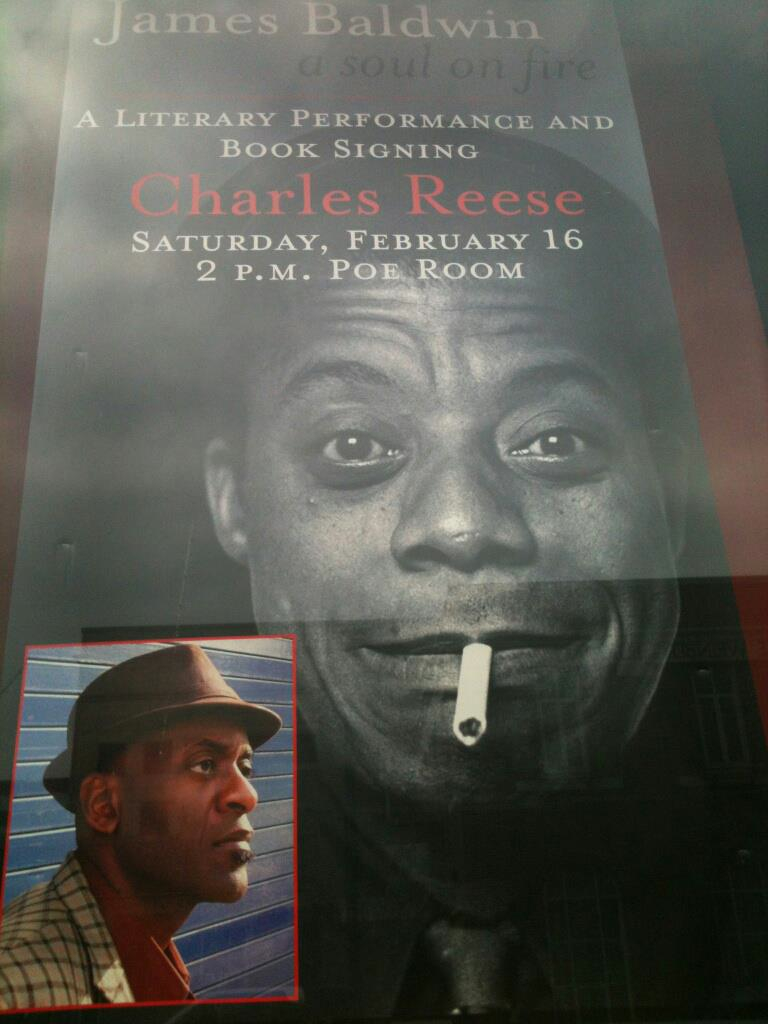
(Charles Reese is an Audelco Award-nominated Actor, Writer, Curator & Founder of The James Baldwin Project; and original actor & editor of the late Howard B. Simon’s Stage Play James Baldwin: A Soul on Fire, published by Glover Lane Press.)

Charles Reese: James Baldwin

Copyright © 2013 by Charles Reese.  All Rights Reserved.  No portion of this poem may be reprinted without permission from the author.

Creative Commons License

This Guest Blog by Charles Reese featured by Leslye Joy Allen is protected under U. S. Copyright Law and is licensed under a Creative Commons Attribution-NonCommercial-NoDerivs 3.0 Unported License.  Any partial or total reference to this blog, or any total or partial excerpt of this blog must contain a direct reference to this hyperlink: http://leslyejoyallen.com with Charles Reese clearly stated as the author and Leslye Joy Allen clearly stated as the owner of this blog.

Leslye Joy Allen and http://leslyejoyallen.com is proud to support the good work of Clean Green Nation  Visit the website to learn more about it: Gregory at Clean Green Nation!

Ralph McGill Would Never Defend “Stand Your Ground”

Photographer: Jon Sullivan. Copyright: Public domain image, not copyrighted, no rights reserved, royalty free stock photo. “Scales of Justice” by Jon Sullivan, photographer. Copyright: Public domain image, not copyrighted, no rights reserved, royalty free stock photo. Available from Public-Domain-Image.com

By Leslye Joy Allen

Historian, Educator, Theatre and Jazz Advocate & Consultant

Copyright © 2012 by Leslye Joy Allen.  All Rights Reserved.

For those of you who are unfamiliar with the late Ralph McGill (1898-1969), he was a White journalist and publisher of the old Atlanta Constitution (now the Atlanta Journal Constitution).  He was also a well-known liberal who wrote about racial discrimination in society at large and within the criminal justice system.  He did this long before the Civil Rights Movement reached its apogee in the 1960s.  Martin Luther King, Jr. mentioned McGill in his eloquent “Letter From a Birmingham Jail.”  King wrote that McGill and some other White journalists, “have written about our struggle in eloquent, prophetic and understanding terms.”  Indeed, McGill was a man who watched, learned, and evolved into one of the most progressive voices in the American South and the nation when it came to race relations, civil rights, and the penal system.  With that said, it is important for you to understand that I did not learn about Ralph McGill from a newspaper or a book, but rather from my schoolteacher mother.

Mama remembered that he emphasized that when a Black person killed another Black person they typically received very light jail or prison sentences—that is, if they received any jail time at all.  It was just the opposite if they had killed a White person.  He noted that because of this failure to properly punish Black people who killed other Black people, the judicial system literally encouraged those individuals to carry out their anger to its fullest possible extreme.  He accused the judicial system of encouraging Black folks to kill each other.  Mama said that there was an unsettling joke going around in Atlanta during the 1940s that said: if you were a Black man that killed another Black man you would be out of jail in time to go to your victim’s funeral.  Indeed, in his column in the Atlanta Constitution on September 17, 1941, McGill wrote:

“In the first place our courts, to our shame and, although no one seems to see it, to our very great financial cost, never take Negro crime seriously.  A Negro murderer, killing another Negro, rarely receives any severe punishment.  Juries and prosecutors have, for years, viewed them lightly as just another Negro killing, and therefore, of not much importance.”  (Ralph McGill – Crime, Standards, Methods 9-17-1941)

He remained one of a handful of White journalists that understood that any law or process or social practice that devalued Black life also made Black people the more likely targets of violence by killers of all races.  He also noted that many members of Atlanta’s then all-White police department had poor training and were “quick-on-the-trigger.”

I thought about Ralph McGill after the tragic killing of Trayvon Martin in Sanford, Florida in February of 2012.  When Jordan Davis of Atlanta, Georgia was killed in Jacksonville, Florida later in November, I again thought about McGill, arguably one of the most vocal writers who paid serious attention to Black-on-Black and White-on-Black violence and the institutionalized racism in the criminal justice systems of Georgia and the nation.  I will not recount how Jordan Davis and Trayvon Martin died needless and preventable deaths.  I will leave it to you to read the details of Davis’ death on your own.  (Take a minute and read Madison Gray’s very brief Time Magazine report “With Echoes of Trayvon Martin, Florida Man Claims Self Defense in Shooting Death of Teen.”)  Yet, I wonder what McGill might have said about the horrible killings of these two unarmed Black teenagers by two men—One of Peruvian and Jewish extraction and the other a White man.  I am sure he would have had much to say about the racial dynamics surrounding these two killings and the law known as “Stand Your Ground.”

Nearly half the states in this country have “Stand Your Ground” laws.  At minimum, these laws allow an individual the right to use deadly force if that individual has a reasonable belief that their lives are threatened.  Importantly, the law typically states that it is not necessary for a threatened individual to retreat from the perceived danger.  The jury is still out on whether this kind of law has reduced crime rates anywhere.  It is important to note, however, that there is nothing in these laws that give citizens the right to provoke and/or create a potentially volatile scenario where they place themselves in danger and then use deadly force in response to the dangerous scenario they created.

The fact that George Zimmerman, charged with second degree murder of Trayvon Martin, was told by a 911 operator not to follow Martin, has forced Zimmerman’s attorneys to drop the use of “Stand Your Ground” as a part of his defense is cause for all of us to pause.  The fact that Michael Dunn, charged with the murder of Jordan Davis (and also charged with attempted murder of the other teens in the SUV), told these kids to turn their music down at a gas station is also problematic.  Most people do not stay at a gas station for very long.  Is it safe or even logical to tell total strangers what to do or what not to do while they are seated in their own vehicles at a public place like a gas station at 7:30 in the evening?  Think about it.  Will Florida lawmakers ever understand that the state’s “Stand Your Ground” laws are not always working in the best interests of its citizens?  McGill would have recognized the counterproductive and dangerous potential for abuse in “Stand Your Ground” legislation.

When I finally got the opportunity to read some of the newspaper columns written by McGill, I noticed some important qualities:  He spoke his mind about what was going on in the city and the world at that moment.  Yet, he did so with an eye on the future.  Like many of Atlanta’s early boosters, he always prescribed the course of action that he believed was best for the city of Atlanta—the entire city of Atlanta.  He knew that crime, racial discrimination, racial virulence, and the like, were bad for the city.  He was as practical and he was ethical.

I do not know exactly what McGill might have said or asked about the killings of Trayvon Martin and Jordan Davis.  Yet, I have little doubt that he would understand and endorse the necessity of raising the following questions about how citizens interpret their rights as defined in “Stand Your Ground” law:  How does the “Stand Your Ground” law define “feeling threatened”?  If you look menacing or say something that makes me feel afraid, will the law allow me the right to use deadly force against you based solely on my assumption of what I think you might do?  Do citizens need more than the basic right of self-defense?  What might an angry person do if they are armed and know that they might be able to get away with killing someone because, by law, they do not have to retreat from danger?  Much like Atlanta in 1941, does not this law encourage people to choose to kill one another?  Don’t these kind of laws eventually breed a flagrant disregard for the law?  McGill wrote that, “Anything that breeds contempt for the law is costly.”  He was right.

When I asked my Mama why she liked Ralph McGill, she simply said,

“He made sense and he was always, always fair.  He always asked for justice and the fair treatment of all citizens.  Justice and fair treatment were the only things Black people wanted.”

Justice and fair treatment are still all we want.


Copyright © 2012 by Leslye Joy Allen.  All Rights Reserved.

Leslye Joy Allen is proud to support the good work of Clean Green Nation.  Visit the website to learn more about it: Gregory at Clean Green Nation!

Creative Commons License This Blog was written by Leslye Joy Allen and is protected by U. S. Copyright Law and licensed under a Creative Commons Attribution-NonCommercial-NoDerivs 3.0 Unported License.  Any partial or total reference to this blog, or any total or partial excerpt of this blog must contain a direct reference to this hyperlink: http://leslyejoyallen.com with Leslye Joy Allen clearly stated as the author.