They Should Live Where You Live

by Leslye Joy Allen

Copyright © 2016 by Leslye Joy Allen. All Rights Reserved.

“Self Portrait” by Copyright © 2015 Leslye Joy Allen. All Rights Reserved.

“Self Portrait,” Copyright © Leslye Joy Allen. All Rights Reserved.

I am not going to rant about the deaths of unarmed Black men and women, and unarmed men and women of color killed by police or those who have unnecessarily died in police custody.  As someone who was once harassed by police, I need no convincing that this nation has a policing problem.  (And I’m too exhausted with the campaigns for President of the United States to make any commentary about that.)  Yet, as much as this nation has a problem about the often poor relationships between police and communities of color, I would add that it is dangerous to make or create a single national narrative about these relationships. We need several narratives and they need to be local.  Let me give you a scenario that paints one local picture about where I live.

On that rare occasion when I have called police, I typically got a quick response.  And I live in a 99.9% Black middle class Atlanta neighborhood.  Typically, the only time the police are called on the street where I live is when someone has a dog that barks late at night (this usually requires a phone call to Animal Control, as well), or when some kids are playing music too loud and late at night; but none of this happens with any real frequency.  Some homes are occupied by renters who often have to learn that some things are not tolerated in this subdivision.  Now, one of the key differences about my subdivision’s relationship to police is that there is a small group of neighbors, all of who are homeowners, who regularly speak with police about anything they see as out of the ordinary.  I also learned from these same neighbors to call the Non-Emergency Police Line and request that an officer come out to see you personally.  You do this when you want a small matter handled without getting someone arrested.  Let me give you an example.

A dog was barking continuously late at night.  I rarely saw the pet’s owner because she worked odd hours.  She was a renter, looked to be maybe twenty-something years old, but I did not know her, and I rarely saw her long enough to speak to her about the dog.  A neighbor had placed a note in her mailbox about the dog, but nothing happened.  I was awakened late at night and in the early morning to this barking dog for about two weeks.  Every night he would bark, I would go look out my windows to make sure there wasn’t some stranger or some intrusive animal lurking around the house.  I never saw anything.  I called Animal Control, first.

Animal Control said call the police because the owner of the dog was violating a Noise Ordinance by allowing the animal to stay outside and disturb the peace after 10:00 PM.  I called the Non-Emergency Police Line.  The officer that answered the phone asked if I had contacted Animal Control.  I told him that I had spoken with Animal Control, and then I asked him to send a police officer to my home so that I could speak with them.  Because it was not an emergency, he told me someone would come by in about two hours.  In roughly 45 minutes a police officer was pulling up in my driveway.  I walked outside and spoke to the officer, and told him about the dog.

“What do you want me to do?” he asked.  I said, “I want you to go over to her house and just tell her that she either needs to put the dog in the house at night or get the dog one of those collars that deters barking.  Let her know about the Noise Ordinance law because she might not know this. I don’t want anyone cited for anything.  I just need you to let her know that the dog is keeping people up late at night.” 

The police officer did exactly what I asked him to do.  He came back and told me he had spoken with the woman.  Since all backyards on my street are fenced in, it is quite typical for pets to remain safely outside in one’s backyard during the day or night.  I reasoned that because she worked odd hours, often at night, she probably never heard her dog creating a disturbance.  That same evening before she left for work, she put her dog inside her house so the pet would not wake up her neighbors.

Now, what I did to resolve this small problem here in Atlanta might not work somewhere else.  It might not even work in another section of Atlanta.  In a different town or neighborhood, I might have been harassed (or possibly, shot) because I dared complain about a barking dog; and the police might not have even bothered to come out to speak with me or with my neighbor about what the police considered a trivial matter.  In some scenarios, where you live matters almost as much as the color of your skin or the nature of the problem.  However, too often the narratives or plans of action, come from national leaders who do not have a clue about the relationships between police and citizens in any particular neighborhood or town.  Furthermore, what works in Atlanta might not work in New York City and then again it might work in New York City.  Yet, Atlanta is not New York City is not Ferguson is not Baltimore is not Chicago, and etcetera.

Many powerful public voices are speaking out against police brutality and the need for more meaningful dialogues between the police and people in the communities the police are supposed to serve.  They are right for doing so.  Yet, many of those national and/or regional voices do not live where you and I live.  In fact, many “so-called” local activists do not live where we live.  Every Black person I know, knows of at least one activist minister who only visits a particular neighborhood to preach on Sunday, while that same minister no longer lives in the neighborhood where the church is located, but rather lives in some distant suburb.  We all know at least one activist politician who is always speaking out about something that has gone terribly wrong in one of our communities.  The problem is that minister or politician often never sets foot in the neighborhood in question until there is a problem or until it is election time.  Their voices may be necessary, and much of what they have to say might be useful.  Yet, they should not be the only voices defining the narrative about how to address these problems.

If you want to find out more about the police where you live, you can and probably should stop by a nearby police precinct and introduce yourself.  You will find out rather quickly how cordial those police are to you in a few minutes.  It never hurts when a few police officers know you as a law-abiding citizen that tries to look out for your neighborhood.  Additionally, when there is a real problem in your neighborhood, you might get a much swifter response because of that relationship.

Yet, you should also carefully monitor and choose who should speak for you and your community.  Whoever it is ought to know the lay of the land, how the people who live there interact with each other and with law enforcement officials.  It ought to be someone that has a personal vested interest in where you live, not simply someone who shows up when a problem arises so that they can get some good press coverage.  It ought to be someone who lives where you live.

Copyright © 2016 by Leslye Joy Allen.  All Rights Reserved.

This blog was written by Leslye Joy Allen and is protected by U. S. Copyright Law and licensed under a Creative Commons Attribution-NonCommercial-NoDerivs 3.0 Unported License. Any partial or total reference to this or any blog authored by Leslye Joy Allen, or any total or partial excerpt of this or any blog by Leslye Joy Allen must contain a direct reference to this hyperlink: http://leslyejoyallen.com with Leslye Joy Allen clearly stated as the author. All Rights Reserved.


Remembering Dr. Edward B. Allen and the Laws/Allens

by Leslye Joy Allen

Photo taken by Billie Allen in 1994 (Copyright © Leslye Joy Allen Photo & Document Collection. All Rights Reserved.)

Photo taken by Billie Allen in 1994. (Copyright © Leslye Joy Allen Photo & Document Collection. All Rights Reserved.)

I did not meet my cousin Dr. Edward B. Allen until I was well in my twenties.  He was the third and last born of three children born to William Roswell “W. R.” Allen and Mamie Wimbish Allen. His sister Lamay was the eldest, then came Wilhelmina (bka “Billie”) and then there was Ed.  He and I met for the first time at his eldest sister Lamay’s home in Milwaukee, Wisconsin.  His sister Billie Allen and I had long been partners-in-crime, but I had not yet met Ed.  All I knew about him was that he was a dentist.  When I saw him he reminded me of my late father Thomas Charles Allen who was also not very tall, tan-complexioned and balding.  Now, allow me to clarify something that Ed and his two late sisters needed clarified: I, Leslye Joy Allen, share the same “Allen” surname as Ed, but my last name comes from an entirely different Allen family, as I am biologically related to two unrelated sets of “Allens,” all on my father’s side of the family.  Let me explain.

The original family surname was “Layende.”  The Layendes were slaves from Cuba that arrived in the mainland United States.  As a historian, I feel obligated to remind people that the Southern region of the USA and Latin America and the Caribbean were quite fluid and did business with one another all throughout the era of chattel slavery.  This surname “Layende” was later anglicized to “Laws.”  Ed’s paternal great grandfather Milton Laws’ sister Mollie Laws-Maddox was my great grandmother.  They were the son and daughter of slaves David and Sarah Laws.  Sometime before American chattel slavery ended, Milton Laws was sold, and he acquired the last name of “Allen,” and became known as “Milton Allen.”  How he got this last name is not clear, but it is highly probable that Dr. Edward Bowden Allen would have been named Dr. Edward Bowden Laws had this slave sale not taken place.

Not long after Billie Allen asked me to do some family research, I had been searching for two men, one named “Milton Laws” and the other named “Milton Allen” only to discover from our mutual cousin Mittie Ann Tillotson that “Milton Laws” and “Milton Allen” were the same person.  Cousin Mittie Ann was the great granddaughter of Richard Laws, the brother of Milton and Mollie.  When Billie sent me photos of she, Ed, and Lamay’s paternal great grandparents Milton and Laura Allen, the first thing that struck me was how much my paternal grandmother Minnie Belle Maddox-Allen looked like her maternal Uncle Milton Allen (formerly named “Milton Laws.”)  And then things began to click.  Stay with me, now…

Now, Mollie Laws-Maddox’s daughter named Minnie Belle Maddox-Allen was my grandmother (My grandmother also named her daughter, my paternal aunt “Minnie Belle,” so I am also related to two “Minnie Belles.” Whew!!)  My grandmother Minnie Belle Maddox married a man named Will Allen who was not related to my cousin Edward Allen.  Will Allen, my paternal grandfather is where my own surname “Allen” comes from.  You can imagine my early confusion at trying to figure out how my paternal grandmother was related to Ed, Billie and Lamay Allen when “Allen” was her married name, not her maiden name.  But such is the case with African American genealogy.  There are hundreds of descendants of slaves whose family surnames were chosen by newly freedmen and women themselves; they made-up some names; and in many instances the maternal and paternal surname was identical because both slave husband and slave wife belonged to the same owners and both bore the same surname.

This research journey began when Ed’s sister Billie could not remember the name of their paternal grandfather, so off I went to look up their father William Roswell “W. R.” Allen’s Social Security application.  On that application were the names of his parents: Doc Roswell Allen and Mary Willie Jones.  Doc Roswell Allen and my paternal grandmother Minnie Belle Maddox-Allen were first cousins.  Soon after this discovery, and with some prodding from his buoyant wife Shelagh (who l instantly liked), Ed wanted to know more about the family tree.  After, acquiring some more information from Billie I discovered that the physician Dr. Edward G. Bowden, who was my paternal grandmother’s physician, was the man Ed was named for.  Dr. Edward G. Bowden married Elizabeth Allen who was the sister of Doc Roswell Allen and daughter of Milton and Laura Allen.  Doc Roswell Allen’s sister Virgil (who later renamed herself “Virginia”) bore one son out of wedlock, and his name was John Wesley Allen and he was a dentist, the first of many dentists in the family. All of these “Allens” were members of that rather complicated “Laws/Allen” family tree.

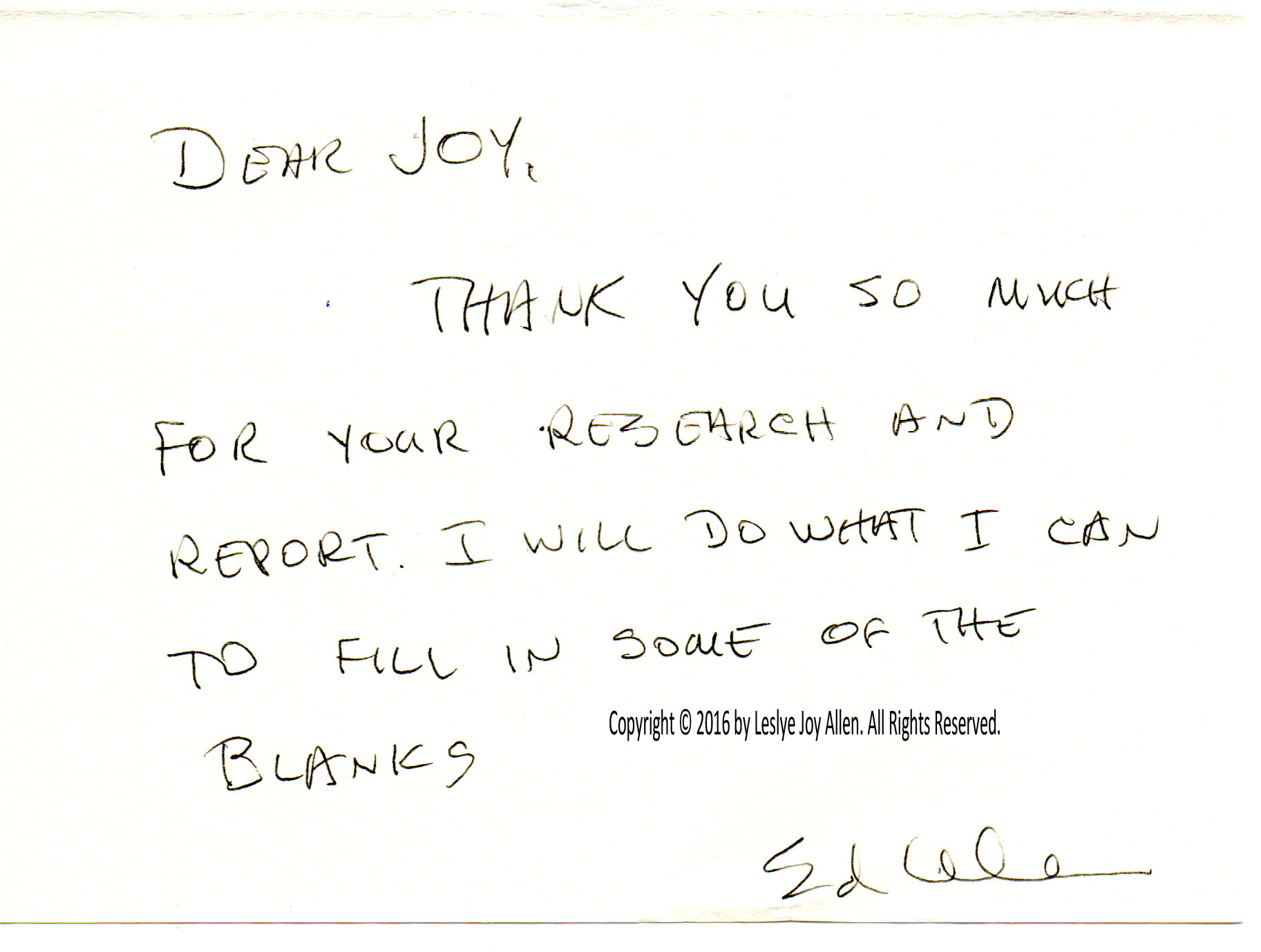
I only saw Ed about four times in my life.  Yet, each time I saw him, something he said to me gave me some nugget of information.  I still remember when he told me he recalled a “John” from his childhood who came to visit but then seemingly disappeared.  I told him Dr. John Wesley Allen was killed in a car accident in the late 1930s. In the late 1990s, I mailed Ed a report of everything I knew about our family.  I don’t think I even knew about the origins of our slave ancestors the “Layendes” from Cuba when I sent that report to Ed, but he was grateful to receive it.   I still have the “Thank You” note he sent me, a “Thank You” note that his sister Billie said was uncharacteristic of her brother.  I laughed because I got the sense that Ed knew that the work I did was much more time-consuming and tedious than most people realize.

I remember Ed as a renaissance man who loved the good life, who could be aloof, who was often funny with a dry wit, who was a man who loved a good drink, but one who also yearned to know more about the home and people he left when he journeyed North to escape some of the harsher realities of life for Black people in the South that colored much of the 20th century.  Although we did not know each other well, I consider it my privilege to have known him and to have been able to help him answer some of the questions about our family tree and heritage.  We always yearn for home, that sense of understanding where and from whom we have come. We yearn for home, no matter where we go.  And now Ed has gone home (May 27, 1926 to July 18, 2026).  Àṣé.

Copyright © 2016 by Leslye Joy Allen.  All Rights Reserved.

"Thank You Note" from Dr. Edward B. Allen to Leslye Joy Allen, July 1997. ((Copyright © Leslye Joy Allen Photo & Document Collection. All Rights Reserved.)

“Thank You Note” from Dr. Edward B. Allen to Leslye Joy Allen, July 1997. (Copyright © Leslye Joy Allen Photo & Document Collection. All Rights Reserved.)

This blog was written by Leslye Joy Allen and is protected by U. S. Copyright Law and licensed under a Creative Commons Attribution-NonCommercial-NoDerivatives-4.0 International License. Any partial or total reference to this or any blog authored by Leslye Joy Allen, or any total or partial excerpt of this or any blog by Leslye Joy Allen must contain a direct reference to this hyperlink: https://leslyejoyallen.com with Leslye Joy Allen clearly stated as the author. All Rights Reserved.

A Cautionary Blog for Teachers, Directors, and those in Charge of any kind of Team

"Weary - Self Portrait" by Copyright © 2013 by Leslye Joy Allen.  All rights reserved.

“Weary – Self Portrait” by Copyright © 2016 by Leslye Joy Allen. All rights reserved.

Copyright © 2016 by Leslye Joy Allen. All Rights Reserved.

I can never forget one moment in a graduate History class that I took when I was working on my Master’s Degree. (FYI: My former professors at my alma maters need not worry about what I am about to say. I took this class on some other college campus.)

I remember the professor’s instructions. In a small class of no more than ten graduate students, the professor said something to this effect,

“You are to write a five-page review of this book. It must have one-inch margins, be double-spaced, and it must be EXACTLY FIVE pages. I don’t want FOUR and a half pages. I don’t want FIVE and one-fourth pages. It must be EXACTLY FIVE pages. If you do not follow these instructions, I will hand the paper back to you and you will have to do it over. This is an exercise to teach you how to edit with precision.”

Now, in all fairness, it was a good exercise. I edited and rewrote until I got that paper to exactly five pages. I re-read it to make sure that it still made sense and was clear. I turned it in. When the professor returned the papers, I anxiously turned to the last page. There it was, an A+. Now, this story does not exactly have a good ending.

Before I could tuck my paper away into my book bag, the professor stood before the class and said this,

“The only person that DOES NOT have to do her paper over is Leslye Joy Allen.”

I gasped.  Damn, I thought!  I did not mind the “A+.” I earned it. Yet, I did mind being singled-out! All of my classmates stared in my direction. A few of them gave me icy looks, others just looked embarrassed. On the way out, I asked the professor if I could speak with him privately.

When we arrived at his office, I told him “Please don’t ever do that to me again.” “What do you mean?” he said. “Single me out like that,” I answered. “But you’re a good student. Good students deserve praise,” he said.  “But not at the expense of making other students feel small,” I replied. I left his office.

At that moment, I understood what every student labeled a “nerd” felt like. I was ashamed of myself because there had been a few times in high school when, even though I made good grades, I had been guilty of calling a few super-brainiac students “nerds.”

Over the next couple of weeks in this graduate class, a few of my classmates barely spoke back when I said, “Hello,” and those that did respond, responded rather coldly. I cut back for a while on participating in class discussions. Eventually the chill thawed and I resumed my normal relations with my classmates and with the professor. Yet, I share this story to make a point.

While I did not deserve the coldness from some of my classmates, I also did not deserve to be singled-out in front of them as the only person who followed the instructions. It produced an unhealthy atmosphere where I appeared as the “favorite” of the professor. Even worse, it placed me in the unnatural and untenable position of being the “standard” by which all others were judged. I’ve never cared for that kind of attention. 

I hope all of the people who are reading this, those who have some form of direction over any group of individuals, will remember that if there is a high achiever in your group, that you can damage the morale of the whole group by singling out that achiever in a manner that denigrates or undervalues the others. Importantly, you can also dampen the spirits and isolate the high achiever(s), which could destroy the type of unity and the free exchange of ideas that makes for a great class, a great production, or a great team. This is a lesson I have never forgotten.

Copyright © 2016 by Leslye Joy Allen. All Rights Reserved.

This blog was written by Leslye Joy Allen and is protected by U. S. Copyright Law and licensed under a Creative Commons Attribution-NonCommercial-NoDerivs 3.0 Unported License.   Any partial or total reference to this or any blog authored by Leslye Joy Allen, or any total or partial excerpt of this or any blog by Leslye Joy Allen must contain a direct reference to this hyperlink: http://leslyejoyallen.com with Leslye Joy Allen clearly stated as the author. All Rights Reserved.

A Messed-Up Religious Narrative

by Leslye Joy Allen, Copyright © 2016. All Rights Reserved.

“Self Portrait” by Copyright © 2015 Leslye Joy Allen.  All Rights Reserved.

“Self Portrait” by Copyright © 2015 Leslye Joy Allen. All Rights Reserved.

On Easter Sunday morning, 27 March 2016, I received a rather cryptic text message from Facebook.  It read as:

“Facebook Safety Check: Are you affected by the explosion?

Reply SAFE if you’re ok or OUT if you aren’t in the area.”

I got nervous.  I went online to look up if there had been any explosions.  I did not find anything on the Internet that said anything about a recent explosion.  I found older stories about bombings and terrorist attacks in other parts of the world from last year, but not one for Easter Sunday in 2016.  Then I really got paranoid…

I rarely use my smart phone for anything other than an occasional phone call.  I almost never use apps—don’t exactly trust them—and I was slightly worried that this Facebook text might be some hoax going around to see how many people would respond to such a strange message.  If I respond, I thought, I am going to end up with some computer virus…

Reluctantly, I replied “OUT” to the Facebook text. Whoever (or whatever) sent the text would know that I was not in or near this explosion wherever it was, I thought to myself.

I checked the Internet again in about an hour.  The news reports began coming in, stating that some group of Muslim terrorists was claiming responsibility for an explosion in Lahore, Pakistan that killed a minimum of 72 people, and injured over 300 people who were celebrating the Christian holiday of Easter, which commemorates the resurrection of Jesus (Yeshua), the Christ.  The murder of Christians by Muslims would again frame much of the news coverage. The religious narrative would—at least superficially—be a Muslim versus Christian narrative.  That narrative is messed-up…

I have never visited Lahore, Pakistan.  Yet, one of my former professors was born there. Indirectly, my association with him, a man who I consider a mentor and good friend, has introduced me to many people located in or from Pakistan.  I am proud to say that I have given academic advice and encouragement via my Facebook inbox to many young men in Lahore who are either going to college or planning to attend graduate school.   So, Facebook, for what it is worth, obviously assumed that I, an African American woman who is from and located in the United States, might actually be located in or near Lahore, Pakistan.  This time Social Media’s interpretation of who (or even what) I was taught me a lesson via an obvious scan of my Facebook Friend list…

I am not Muslim.  The natives of Pakistan that I personally know and those I am in contact with are all Muslims.  They are Muslims who constantly pray for peace, and who condemn the heinous acts of extremists and terrorists, and who also speak out against racism and sexism and religious intolerance. The American news media, however, has conveniently forgotten to tell Americans that the splinter group that broke away from the Taliban, named “Jamaat-ul-Ahrar,” killed as many Muslims as it has Christians. In fact, the majority of those Pakistanis who died in the attacks on Easter Sunday in Lahore, Pakistan happened to be Muslim.

CNN’s provocative and rather misleading headline was “In Pakistan, Taliban’s Easter Bombing, targets, kills scores of Christians.”  To be sure, scores of Christians died in that awful attack.  Yet, to ignore the random acts of violence by groups like this (including ISIS or ISIL) that have, honestly, killed more Muslims than Christians is to perpetuate a religious narrative that can get us all killed, have all of us turning on each other instead of talking to each other.

If you have half a brain, you know that to single out any group of people as the sole source of your problems is to also invite a group (any group) outside of that definition to do all manner of harm to you.  This all reminds me of the time when one of my history students hipped me to a video where all of a particular department store’s security guards were watching all of the store’s African-American customers.  Yet, while those same security guards were scrutinizing the Black customers, there was a small band of White patrons who were shoplifting at the store. 

I am only a historian and academic.  Yet, I am one who knows that when people do not do their research, when they fail to look below the surface, when they do not think outside the box, when they succumb to easy answers and easy stereotypes because those stereotypes make them feel safe or superior, all of us suffer.  With an Internet that contains volumes of information—some tainted information, and some that is accurate—there is really no excuse for you or I not knowing anything and not questioning those easy answers that our bought-and-paid-for media and politicians and pundits hand to us on a regular basis.  

Do not be a fool.  Do your work.  Do your research.  Now some people reading this will be upset or annoyed by my comments.  Religion for many people is, after all, a cultural, national, and often racial marker.  After all, the first terrorists my people knew were so-called Christians wearing sheets, lynching and torturing Black bodies and burning crosses on Black families’ lawns.  I would hate to think about my ancestors enduring that on Easter Sunday.   Àṣé!

Leslye Joy Allen, Copyright © 2016.  All Rights Reserved.


This blog was written by Leslye Joy Allen and is protected by U. S. Copyright Law and licensed under a Creative Commons Attribution-NonCommercial-NoDerivs 3.0 Unported License.   Any partial or total reference to this or any blog authored by Leslye Joy Allen, or any total or partial excerpt of this or any blog by Leslye Joy Allen must contain a direct reference to this hyperlink: http://leslyejoyallen.com with Leslye Joy Allen clearly stated as the author. All Rights Reserved.
A New Definition of Brother…

Copyright © 2016 by Leslye Joy Allen. All Rights Reserved.

“Self Portrait” by Copyright © 2015 Leslye Joy Allen.  All Rights Reserved.

“Self Portrait” by Copyright © 2015 Leslye Joy Allen. All Rights Reserved.

I had to learn the hard way not to rely solely on

American-born brothers who

talk plenty smack and talk plenty righteousness about

how we Black folk have work to do, but at the same time demand

that I keep my mouth shut about the mess that affects me as a woman and all 

that infects us/we as a people…

I had to learn the hard way that many of my brothers did not

arrive speaking with American accents, but

some had/have foreign accents so thick that I

need(ed) someone to decipher what they were saying, but

what they said mattered less than what they did…

I learned that plenty Josés and Juans and Ahmads and Maliks and

Etiennes and Lúcios and Willies and Sams

 of my world

and my hemisphere

weighed in on matters that affected my life as a Black woman when

so many other so-called brothers assumed that my problems as a Black female

would be handled by someone else or

handled by me by myself…

I had to learn the hard way that my definition of “brother” needed to remain

outside of my typical geographic boundaries of what I/We call the USA

and we either grab hold of each other as kith and kin

or we drown in the waters waiting for

some definition that none of us could live with anyway.

                                  – Leslye Joy Allen, Copyright © 2016. All Rights Reserved.


This blog was written by Leslye Joy Allen and is protected by U. S. Copyright Law and licensed under a Creative Commons Attribution-NonCommercial-NoDerivs 3.0 Unported License.   Any partial or total reference to this or any blog authored by Leslye Joy Allen, or any total or partial excerpt of this or any blog authored by Leslye Joy Allen must contain a direct reference to this hyperlink: http://leslyejoyallen.com with Leslye Joy Allen clearly stated as the author.  Postings or blogs placed here by other writers should clearly reference those writers.  All Rights Reserved.