A Quick Word to Millennial (and Younger) Protesters and Activists

by ©️Leslye Joy Allen

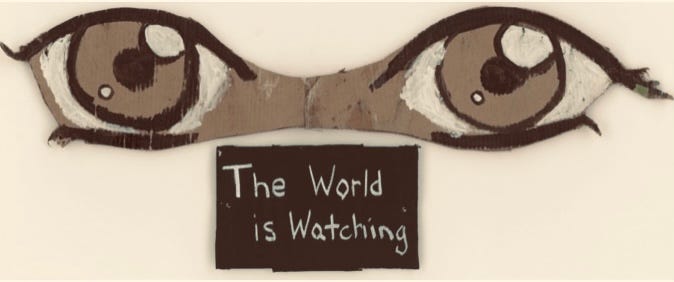
The photo below is of a creation titled “The World is Watching.”  The artist is not known. It is located at the Library of Congress which has a long history of collecting Protest Art and Protest Photography. Visually stunning and a reminder that protests and activism change with the technology of the times.

I was born during the last years of what was called the Baby Boom. As a Baby Boomer, I did not grow up from Childhood to Early adulthood with a Personal Computer, the Internet, and definitely not Social Media or a cellphone with a camera.

I learned of protest marches and various forms of activism via word-of-mouth, letters, signs on school and church bulletin boards, and via Black-owned newspapers. Sometimes these protests were featured on the 6 O’Clock News.

Fast forward to the late 20th and early 21st centuries and you have young adults who grew up with everything we Baby Boomers grew up without. Millennials get messages out there in cyberspace in a matter of seconds. They can rally thousands (even millions) of people with brief blurbs and blogs in a matter of a couple of days and occasionally a couple of minutes. There are, however, a few drawbacks.

In addition to creating mediums that make it seem as if a few “likes” on social media has resolved the problem, it also exposes certain tactics that should not be seen by everyone. Social Media exposes protest tactics to our enemies as much as it exposes those tactics to our friends. So let me share the following history. Ignore it; modify it; and/or adapt this in any way you see fit.

The Black American Civil Rights Movement typically had a 3-pronged approach. 

  1. Back in the day, you had a set of individuals who could not physically participate in protest marches because they were the folks who were designated to bail you out of jail if you were arrested. The folks who were part of the Black community who had a degree of affluence and wealth were often in this position. Although many of them were out there in the streets protesting. 
  2. Another group was the observers. These were individuals who lined routes of marches who watched and recorded what they saw. Sometimes they would stand on sidewalks and pretend to be window shoppers or they would sit near the windows inside places of business so that they could see what was going on outside in order to report what they saw. There were no cellphones with cameras in them back then. Their hardest role was to not intervene when they saw any physical violence. They had to record what they saw.
  3. Finally, there were the Black protesters themselves who were trained in non-violent resistance in order to highlight the sheer brutality of their oppressors. They were trained to endure and not fight back.

Now, I am not at all advocating for any of you to quietly endure any form of brutality and violence as you fight against this onslaught of abuse from the administration of Felon 47. What I am suggesting is that you create a 3 or even 4 or 5-pronged approach to how you protest and advocate for the causes you believe in.

Right now, activism is highly tied to how much press and social media presence one can generate. That’s not a bad strategy, but the limitations of that approach is that almost anyone can see it. You win most against enemies when enemies do not know EXACTLY what is coming at them all the time. And that is not my original idea. It actually comes from Sun Tzu, a Chinese General and Strategist born around 544 B.C.E. Some ideas stand the test of time. Study those ideas. Onward!

©️Leslye Joy Allen

I am an Independent Historian, Oral Historian and Dramaturge. Please consider supporting my work with a few bucks for Coffee and Eggs via my CashApp.

All blogs written by Leslye Joy Allen are protected by U. S. Copyright Law and licensed under a Creative Commons Attribution-NonCommercial-NoDerivs 3.0 Unported License. Any partial or total reference to any blog authored by Leslye Joy Allen, or any total or partial excerpt of any blog authored by Leslye Joy Allen must contain a direct reference to this hyperlink: https://leslyejoyallen.com with Leslye Joy Allen clearly stated as the author.  Postings or blogs placed here by other writers should clearly reference those writers.  All Rights Reserved.

Enough Is Enough

by ©️Leslye Joy Allen

I have more than a few favorite writers, journalists, and/or activists on Substack. One of them is Lorissa Rinehart. When she wrote that too many children are addicted to social media, I got the impression that she drew on scientific studies and her own observations.

She delivered a good hard punch to catch our attention. She wrote:

“If religion is the opium of the masses, then social media is the meth.” —©️Lorissa Rinehart

You should be aware that an addiction to substances like Crystal Meth are among the most difficult of all habits to kick. Rinehart waxed poetic about how the Zuckerbergs and the Musks of this world prey on the minds of our children in much the same way drug dealers pounce on entire communities.

Her statement reminded me that addiction to social media is one thing that aided and abetted our current political climate. She reminded me that our children are particularly vulnerable to social media propaganda pushed by the Far Right.

So, here are some family practices I suggest that I learned from a friend of mine over 15 years ago. My friend limited TV viewing to one night a week with the whole family watching together. Her kids were only allowed 3 days per week to surf the web at home for 1 hour each day with parental controls on.

The rest of the week she and her offspring discussed Art, Music, Current Events, School and Books at the dinner table. After dinner there was homework. After homework they would pick a topic to discuss or a book to read together over the coming week. I must say she now has some of the smartest young adults I have met in quite a while.

Now, before you say that all of this is too difficult to do; that your work schedule is too difficult to navigate around in order to do any of this; or that you are not sure if you can get your kids to participate in anything like this, answer a few questions for yourself.

When is the last time you read a book or visited a library? How often do you have face-to-face conversations with friends and family, with everyone’s cellphone silenced or turned off and put away out of sight?

If you have not done any of the above in quite some time or you have stopped doing most of it regularly, consider how social media has altered how you communicate with others. Come to think of it, social media has altered nearly everybody’s way of communicating.

Social media is not inherently evil nor inherently good. Social media’s information, however, is the easiest information to manipulate and the fastest to spread. Now think of how easy it can manipulate your children’s ideas about the world and themselves, often before you know anything about the ideas that have formed in their heads. Before I say anything else about Meth addiction, think about social drinking.

If you are a social drinker who is not an alcoholic, you tend to know your limit. You might feel a mild buzz, feel a bit relaxed, but not drunk. In your youth you probably learned the hard way when to say “I have had enough.” Long term Meth addicts don’t have any moments of “I have had enough.” They often suffer from everything from depression, psychotic episodes, an inability to sleep, and tooth decay.

Unlike addictions to controlled substances—legal and illegal—social media addiction has no noticeable physical symptoms. So, when it comes to social media, do you know when enough is enough for yourself? More importantly, do you know when enough is enough for your kids? Think about that for a while.

©️Leslye Joy Allen

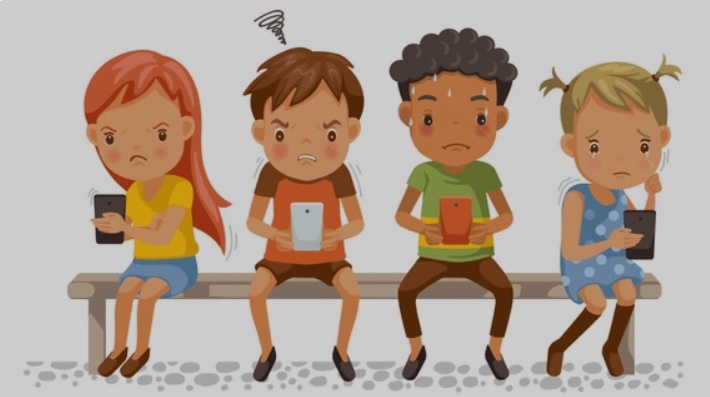
(Stock drawing of kids on their cellphones)

All blogs written by Leslye Joy Allen are protected by U. S. Copyright Law and licensed under a Creative Commons Attribution-NonCommercial-NoDerivs 3.0 Unported License. Any partial or total reference to any blog authored by Leslye Joy Allen, or any total or partial excerpt of any blog authored by Leslye Joy Allen must contain a direct reference to this hyperlink: https://leslyejoyallen.com with Leslye Joy Allen clearly stated as the author.  Postings or blogs placed here by other writers should clearly reference those writers.  All Rights Reserved.

Social Media Overload

by Leslye Joy Allen

Copyright © by Leslye Joy Allen

I freely admit I enjoy social media.  We social media denizens trade ideas, photos, debate politics, say prayers for people in need, raise money, promote good causes, advertise our own enterprises, post recipes and witty sayings, talk about art, film, theatre, and occasionally go on rants.  I try to keep rants to a bare minimum. But hey, if ranting on social media is what keeps you from going out and shooting people at the mall, then rant away.  Now with all that’s good about social media, I’ve also experienced what I now call “social media overload.” I thought I would share some of my opinions because occasionally I get messages from people asking me why I don’t comment on posts as much as I used to.  Well, I know I’ve lost time in the past by spending too much time posting, commenting, clicking and tweeting.

I primarily use my laptop much more than I use my smartphone for any form of social media; and I always log out when I’m done, so I don’t hear those dings you hear on a smartphone when someone posts or tweets something new. Plus, with a sporadic and highly irregular work schedule while I also try to write and edit and finish a dissertation is hard enough.  I can typically write a blog in less than 30 minutes, but writing and editing a dissertation in squirts is a slow and agonizing process, so staying online isn’t possible anyway.  I now deliberately and regularly go a minimum of 24 to 48 hours (often longer) without checking in on social media. The first time I did this several months ago, I discovered something about these 24 to 48 hour cycles.  My first full day away, I found myself severely missing posting and commenting on other people’s posts.

If you stay away from all social media for roughly 24 to 48 hours and then return, you will probably notice one or two (or maybe three) subjects trending.  There will be one post after another about essentially the same thing.  Let’s say it’s something that everyone seems to like; so everyone is super happy about an event, a film, you name it.  When that happens I can almost guarantee that if you sign off again and then revisit after the next 24 to 48 hours, whatever was trending that everyone liked a few days ago will now have its critics.  So then there will be a series of comments or a few articles telling you that what you initially liked 24 to 48 hours ago is no longer something that you should like, but something you should question or at least greet with some suspicion.  Some of these fresh critiques often have some value and tend to make good reading.  Yet, I noticed that a lot of these articles and comments read like the pseudo-intellectual hogwash they are; and often the real tragedy is that these articles are penned by perfectly good writers who seem to be having a hard time finding something to write about and have simply jumped on the bandwagon with the rest of the cynics.  Then if you sign off and stay gone for yet another couple of days, something even more curious will have probably happened.  Within that next 24 to 48-hour cycle—this is our third cycle, now—you will have another set of reverse critics who will critique those initial critics who dared criticize what you and everyone else liked in the first place. If you have a headache reading this, don’t feel bad.  I have one too!  However, I didn’t see these patterns until I let a few days go by without visiting social media.

I had an interesting conversation recently with a Personal Development Counselor. He was a charismatic young man who looked to be in his late twenties to early thirties.  He told me something that I found quite troubling.  Most of his work, he said, was with young male Internet Technology professionals, commonly called ITs.  He stated that almost all of the young male ITs he meets have problems talking to women because they spend all day staring at a computer screen.  He bluntly told me that most of them don’t know how to make small talk.  Almost all of the questions they ask him are about how they might best find the right words to approach a woman to date via some online service.  Simple things like having a conversation with a woman and then asking her out for a simple cup of coffee is totally foreign to many of these guys.  His job as a Personal Development Counselor is to give these young men some kind of road map to use to help them create a satisfying personal life because they do not know how to do it by themselves.

Now, before every Internet Technology professional sends me personal denials of such behavior and/or hate comments, hold your horses and slow your roll.  I know plenty of well-rounded IT professionals and I know that the majority of folks in this profession do not have the problems identified by this Personal Development Counselor.  I do suspect that  youth plays a factor in these problems. Those of us who are now in our AARP years remember a time when you didn’t need a computer or a smartphone to do anything and everything.  You had to go out and meet people, make eye contact, have conversations, and you did not have a smartphone as a constant distraction.  Younger men and women have no such memories.  What this young Personal Development Councilor shared with me made me take a good hard look at how much, how long and what content I place on social media and why I do it.

A while back I made a personal commitment to not post the news on my Facebook, Twitter or Instagram accounts.  What appears on MSNBC or CNN or FOX is almost always bad news anyway. I’ve managed to stick with this formula about 98 percent of the time.  On those days when something tragic has happened yet again to another Black person, to another woman, another LGBTQ person, another child, and etcetera, you can expect the threads on most social media to be filled to the brim with this bad news, tragic news, and horrible news, along with their shock and hurt about these tragedies.  All of it would be easier to stomach if there wasn’t so much of it.  It’s not that racists and sexists and misogynists and homophobes and rapists and murderers don’t do ugly, horrible mess to people with great regularity; it’s that this ugliness is not happening to me or you every single minute of the day because if it were happening to all of us 24/7, none of us would have the time or the luxury to post about it and debate about it on social media.  It is not that bad things don’t happen, but rather that good things happen as well. Now before you say that we all need to talk about these problems and vent about these tragedies, consider this:  If you do not post or comment about some major issue or problem, what exactly is going to happen or not happen if you don’t post or if you are absent for a few days?  What exactly would you be doing if you were not posting and commenting on your own or someone else’s posts?  This leads me to what I call the “Instant Gratification Trap.”  I’m as guilty of being caught by it and in it as anyone.

The “Instant Gratification Trap” is when you discover that your posts are rather popular and/or make people feel better and/or make people think deeply. Suddenly you feel important and admired. When I simply stopped posting anything negative and made it a point to post something positive, I found nothing wrong with basking in the warmth of compliments generated by folks who pressed the “Like” button and “Share” button and those who “Re-Tweeted” my posts.  All of this makes for good feelings all around.  However, the next thing I felt was obligated to continue making these kinds of intellectually stimulating posts.  “Obligated” is actually the wrong word here.  I felt compelled to post more positive posts because I ENJOYED and DESIRED the affirmative reactions of my real friends and my “cyberspace associates.”  Even further, I started to believe that what I had to say was so very important that I better hurry up and post something else that was wise and wonderful because, hey, what’s going to happen to all of those people who rely on my posts and my comments if I’m not there to post or comment?!  Let me say this as plainly as possible:  This is some ego tripping of the highest order.  All of us, hopefully, get to help people out, give some good advice and feel a little extra special, which is healthy.  We should feel confident about our work and our words and our contributions.  But exactly where do we draw the line?

Now, I read a lot of writing by my own real personal friends and many of my cyberspace associates; and there are some seriously talented writers and thinkers among them. Many of us are quite bright and we might say a lot of things that need to be said, but we’re not the only crayons in the box.  The problem with Instant Gratification is that it is short-lived because you haven’t worked that hard for it; it’s fleeting.  So, like a drug addict in search of another high, you post more and more to get more and more validation.  That validation strokes the ego; at least I know it stroked mine.  However, here’s how I’ve decided to use my ego.  I have enough of an ego to not want my very best writing to be on some social media site because once it’s posted there, it belongs to the site.  You can always lay claim to what you wrote, but the jury is still out as to whether any social media site needs your permission to reproduce what you’ve written somewhere else for the site’s own purposes.  When I feel the need to say something really serious, I put it in my blog or in my notes for some future essay.

Now, here’s an aspect of social media that is more delicate.  On most social media sites you can “unfollow” or “block” people. On Facebook you can “unfriend and block” people.  Every person I know has had that moment when they suddenly discover that “friend” or what I call a “cyberspace associate” who disagrees with them on every moral or ethical question out there.  Their contradictory opinions seem to come out of nowhere, but they really don’t come out of nowhere.  Remember, you don’t actually personally know a lot of these people who make it to your friend list; and they typically made it to your list because they know about thirty people that you actually know or they seem to be natural allies due to their posts and comments. Then one day they comment on some thread of yours and manage to annoy everyone with their narrowmindedness or their determination to ram their opinions down everyone’s throat and by their unwillingness to respect the opinions of others.  So after a few acrimonious comments and a variety of pithy rebuttals to their opinion, you get angry as hell and you click that “Unfriend” button so you don’t have to hear from them again.  Now, there are some good reasons for unfriending these creeps.  I got rid of one that was running for public office and who also turned out to be damned near a stalker.  (I also blocked him and thank God he lost his election.)

Now, I don’t blame folks for not wanting to be bothered with internet trolls or real life ass holes who spend the better part of their days trying to start arguments and foment dissension among groups of people who might be having a stimulating and insightful discussion. Yet, the problem with unfriending people with opposing views is that’s not how it works in the real world. As I have encouraged healthy debates among my former History students, they know like I do that you don’t learn as much from the people with whom you agree, but from those people with whom you disagree.  It might make you feel better to “unfriend” someone. I know it made me feel better. Yet, when met with opposition face-to-face instead of in cyberspace, you have to monitor your anger to prevent a debate from turning into a full-fledged argument or worse.  You have to think with more precision because you are in the physical presence of someone who disagrees with you and who has also pushed your buttons. I often think we argue on social media because it’s physically safer to do so; and there is nothing wrong with that. However, you might discover in face-to-face communications that your adversary has a point worth listening to.  And the key word here is “listen.”  Unless you’re communicating via FaceTime, most communication on social media is written. I have read (and learned to stay the hell off of) some threads where someone’s words were misconstrued precisely because no one on the thread could see that person’s body language or hear the natural inflections in that person’s voice that give additional meanings and depth to the point they were trying to make. And this leads me to something the Personal Development Counselor said about empathy.

The last thing he told me was that he thought too much consumption of social media led a lot of folks to believe that they were highly informed and highly sympathetic to people with problems when they were not.  Reading a book or a story, he said, created empathy.  He’s right.  You identify with the protagonist or some character in the book.  After you’ve finished reading the book, you continue thinking about the characters, the themes, what did it all mean, and why you enjoyed it, etcetera.  The brevity of posts on social media, he said, doesn’t require this kind of investment. You read a few lines of a post, and think about it for a few minutes, and then you move on to the next post or the next thread.  There isn’t much time to ponder and process what you just read if you’re suddenly distracted by something else that is more provocative.

I met a couple of young people recently who have deleted several of their social media accounts, including this Personal Development Counselor.  I probably will continue to enjoy social media for all the reasons I listed at the beginning of this blog.  I personally know plenty of people on social media who are caring, thoughtful people who genuinely want everyone they know to be informed about some serious problems going on in the world or about the good that’s out there; but there’s a creeping shallowness on social media that I’ve noticed in recent years.  It is no accident that the rapper Kanye West thinks “slavery was a choice,” if we consider that his exposure to the subject and its history has obviously been through imbibing short blurbs, 30 second soundbites, memes and slogans designed more to catch the ear and eye than to honestly analyze and inform anyone about what was a highly complex and brutally oppressive institution.

The fact that West and others think you can explain and reduce Chattel Slavery in the Americas—a 400-plus year old institution—to something as simple and singular as “choice” not only speaks volumes about what books they haven’t read, but also how their brains are now wired to believe that their ability to understand complex subjects can be accomplished via tweets, short articles, and a few posts.  West is not unusual nor is he an anomaly.  Kanye West is the results.  It’s hard to invest in people and consider their feelings when empathy with other people and their history is short term because the next post or thread about someone or something else is so much more exciting.  It’s easy to dismiss what is not provocative or catchy; after all, most of these posts are designed to draw people to them.  I don’t know what the long term repercussions of this type of media saturation will mean to everyone, but for me it means I’m going to be taking regular breaks from all forms of it from now on. Peace.

Copyright © by Leslye Joy Allen.

This blog was written by Leslye Joy Allen and is protected by U. S. Copyright Law and licensed under a Creative Commons Attribution-NonCommercial-NoDerivs 3.0 Unported License. Any partial or total reference to this or any blog authored by Leslye Joy Allen, or any total or partial excerpt of this or any blog by Leslye Joy Allen must contain a direct reference to this hyperlink: https://leslyejoyallen.com with Leslye Joy Allen clearly stated as the author. All Rights Reserved.

A Messed-Up Religious Narrative

by Leslye Joy Allen, Copyright © 2016. All Rights Reserved.

“Self Portrait” by Copyright © 2015 Leslye Joy Allen.  All Rights Reserved.

“Self Portrait” by Copyright © 2015 Leslye Joy Allen. All Rights Reserved.

On Easter Sunday morning, 27 March 2016, I received a rather cryptic text message from Facebook.  It read as:

“Facebook Safety Check: Are you affected by the explosion?

Reply SAFE if you’re ok or OUT if you aren’t in the area.”

I got nervous.  I went online to look up if there had been any explosions.  I did not find anything on the Internet that said anything about a recent explosion.  I found older stories about bombings and terrorist attacks in other parts of the world from last year, but not one for Easter Sunday in 2016.  Then I really got paranoid…

I rarely use my smart phone for anything other than an occasional phone call.  I almost never use apps—don’t exactly trust them—and I was slightly worried that this Facebook text might be some hoax going around to see how many people would respond to such a strange message.  If I respond, I thought, I am going to end up with some computer virus…

Reluctantly, I replied “OUT” to the Facebook text. Whoever (or whatever) sent the text would know that I was not in or near this explosion wherever it was, I thought to myself.

I checked the Internet again in about an hour.  The news reports began coming in, stating that some group of Muslim terrorists was claiming responsibility for an explosion in Lahore, Pakistan that killed a minimum of 72 people, and injured over 300 people who were celebrating the Christian holiday of Easter, which commemorates the resurrection of Jesus (Yeshua), the Christ.  The murder of Christians by Muslims would again frame much of the news coverage. The religious narrative would—at least superficially—be a Muslim versus Christian narrative.  That narrative is messed-up…

I have never visited Lahore, Pakistan.  Yet, one of my former professors was born there. Indirectly, my association with him, a man who I consider a mentor and good friend, has introduced me to many people located in or from Pakistan.  I am proud to say that I have given academic advice and encouragement via my Facebook inbox to many young men in Lahore who are either going to college or planning to attend graduate school.   So, Facebook, for what it is worth, obviously assumed that I, an African American woman who is from and located in the United States, might actually be located in or near Lahore, Pakistan.  This time Social Media’s interpretation of who (or even what) I was taught me a lesson via an obvious scan of my Facebook Friend list…

I am not Muslim.  The natives of Pakistan that I personally know and those I am in contact with are all Muslims.  They are Muslims who constantly pray for peace, and who condemn the heinous acts of extremists and terrorists, and who also speak out against racism and sexism and religious intolerance. The American news media, however, has conveniently forgotten to tell Americans that the splinter group that broke away from the Taliban, named “Jamaat-ul-Ahrar,” killed as many Muslims as it has Christians. In fact, the majority of those Pakistanis who died in the attacks on Easter Sunday in Lahore, Pakistan happened to be Muslim.

CNN’s provocative and rather misleading headline was “In Pakistan, Taliban’s Easter Bombing, targets, kills scores of Christians.”  To be sure, scores of Christians died in that awful attack.  Yet, to ignore the random acts of violence by groups like this (including ISIS or ISIL) that have, honestly, killed more Muslims than Christians is to perpetuate a religious narrative that can get us all killed, have all of us turning on each other instead of talking to each other.

If you have half a brain, you know that to single out any group of people as the sole source of your problems is to also invite a group (any group) outside of that definition to do all manner of harm to you.  This all reminds me of the time when one of my history students hipped me to a video where all of a particular department store’s security guards were watching all of the store’s African-American customers.  Yet, while those same security guards were scrutinizing the Black customers, there was a small band of White patrons who were shoplifting at the store. 

I am only a historian and academic.  Yet, I am one who knows that when people do not do their research, when they fail to look below the surface, when they do not think outside the box, when they succumb to easy answers and easy stereotypes because those stereotypes make them feel safe or superior, all of us suffer.  With an Internet that contains volumes of information—some tainted information, and some that is accurate—there is really no excuse for you or I not knowing anything and not questioning those easy answers that our bought-and-paid-for media and politicians and pundits hand to us on a regular basis.  

Do not be a fool.  Do your work.  Do your research.  Now some people reading this will be upset or annoyed by my comments.  Religion for many people is, after all, a cultural, national, and often racial marker.  After all, the first terrorists my people knew were so-called Christians wearing sheets, lynching and torturing Black bodies and burning crosses on Black families’ lawns.  I would hate to think about my ancestors enduring that on Easter Sunday.   Àṣé!

Leslye Joy Allen, Copyright © 2016.  All Rights Reserved.


This blog was written by Leslye Joy Allen and is protected by U. S. Copyright Law and licensed under a Creative Commons Attribution-NonCommercial-NoDerivs 3.0 Unported License.   Any partial or total reference to this or any blog authored by Leslye Joy Allen, or any total or partial excerpt of this or any blog by Leslye Joy Allen must contain a direct reference to this hyperlink: http://leslyejoyallen.com with Leslye Joy Allen clearly stated as the author. All Rights Reserved.
One Helluva Conversation with My Students Today…

by Leslye Joy Allen

Copyright © 2014 by Leslye Joy Allen. All Rights Reserved.

Leslye Joy Allen, Copyright © 2013.  All Rights Reserved.  Self-Portrait.

Leslye Joy Allen, Copyright © 2013. All Rights Reserved. Self-Portrait.

Today I spoke with my history students…I reminded them of some advice that both of my parents gave to me.

Mom and Dad said that I must never speak for any person or any group of people that I did not know personally or at least have some first hand knowledge about.

I reminded these students that no matter what they saw on the news, or who they liked on the news, that a good portion of who or what was reported was tainted, including the news that comes from the Left and the Right…

And don’t start whining because you know I am on the Left or leaning Left…because several of my journalist friends on both sides of the political aisle have reminded me that in these last days of 2014 that journalists and news rooms have forgotten their duties and started twisting and altering stories just to…

stir up more trouble and unrest so that they could have something to talk about or write about…because you know if it bleeds, it leads

So, I reminded my students that the only promise I have actually kept to my parents was that I would never try to pass myself off as representative, or a spokesperson for anyone or anything I did not know well…

So, again, I put on my sneakers and walked miles through my neighborhood with my iron pipe to ward off crazy stray dogs (and fools, if necessary)…and I talked to old folk on their front porches, and…

Watched children play and ride their bikes in the street, and reminded myself that no one on CNN or MSNBC or any other network has bothered to visit some of these neighborhoods which is why…

I will avoid the shrill and unnecessary and unproductive conversations and debates of those on the so-called Left and the so-called Right who do nothing but spout their, “I’m-right-and-you’re-wrong” diatribes until I see all or any of them put their sneakers on…

and stroll through the neighborhoods and speak to the people they allegedly claim to speak for…and that admonition goes for our local elected officials and our clergy too…

My students are fired up and that was/is enough for me.


Copyright © 2014 by Leslye Joy Allen. All Rights Reserved.

This Blog was written by Leslye Joy Allen and is protected by U. S. Copyright Law and licensed under a Creative Commons Attribution-NonCommercial-NoDerivs 3.0 Unported License. Any partial or total reference to this blog, or any total or partial excerpt of this blog must contain a direct reference to this hyperlink: http://leslyejoyallen.com with Leslye Joy Allen clearly and visibly stated as the author. All Rights Reserved.