What Is In A Name?

by ©️Leslye Joy Allen

My late mother struggled with infertility for 13 years before I was born. She told me that not only did doctors test my father’s sperm, but that she had her Fallopian tubes blown out with hot water. Many times she was in so much pain from the treatments that she couldn’t bend down to tie her shoes.

When I was born, my parents were 3 and 4 months away from turning ages 40 and 41, respectively. Mama and Daddy decided on the name “Leslye” because it was gender-neutral and also because my father did not particularly care for the practice of men naming sons after themselves.

“A boy either has a reputation to live up to or one to live down,” Daddy used to say. Anyhow, my name, had I been born a boy, would have been “Leslye Charles Allen” which would have included only my father’s middle name.

My late mother discovered the spelling of “Leslye” in a Reader’s Digest article where a young woman with that name and spelling was being sent on a tour of Europe as her graduation present from her parents.

When Mama brought the name and spelling of “Leslye” up to her good friend Esther Flournoy, my Aunt Esther said, “Cooter (their nickname for each other), what will be the middle name if your baby is a girl?”

Mama told me that she honestly did not know. At that moment, Aunt Esther said, “I like names like ‘Faith,’ ‘Hope,’ and ‘Joy.’”

Mama tried all combinations of these names until she arrived with “Leslye Joy.”

The hilarious and thought provoking book “Children’s Letters to God,” first published in 1966, was the very first book given to me by someone other than my parents.

It was given to me by the woman responsible for my middle name. Most of my classmates from Saint Paul of the Cross Elementary School and Saint Joseph High School never knew my first name was “Leslye” until long after we graduated.

Yet, I have had college professors, most notably Dr. Waqas Khwaja, and those wonderful women who cooked and fed me while I was a student at Agnes Scott College, just simply start calling me by my middle name “Joy” as if they all automatically knew that my middle name was the one that had the most love and history behind it. I was and remain warmed by that.

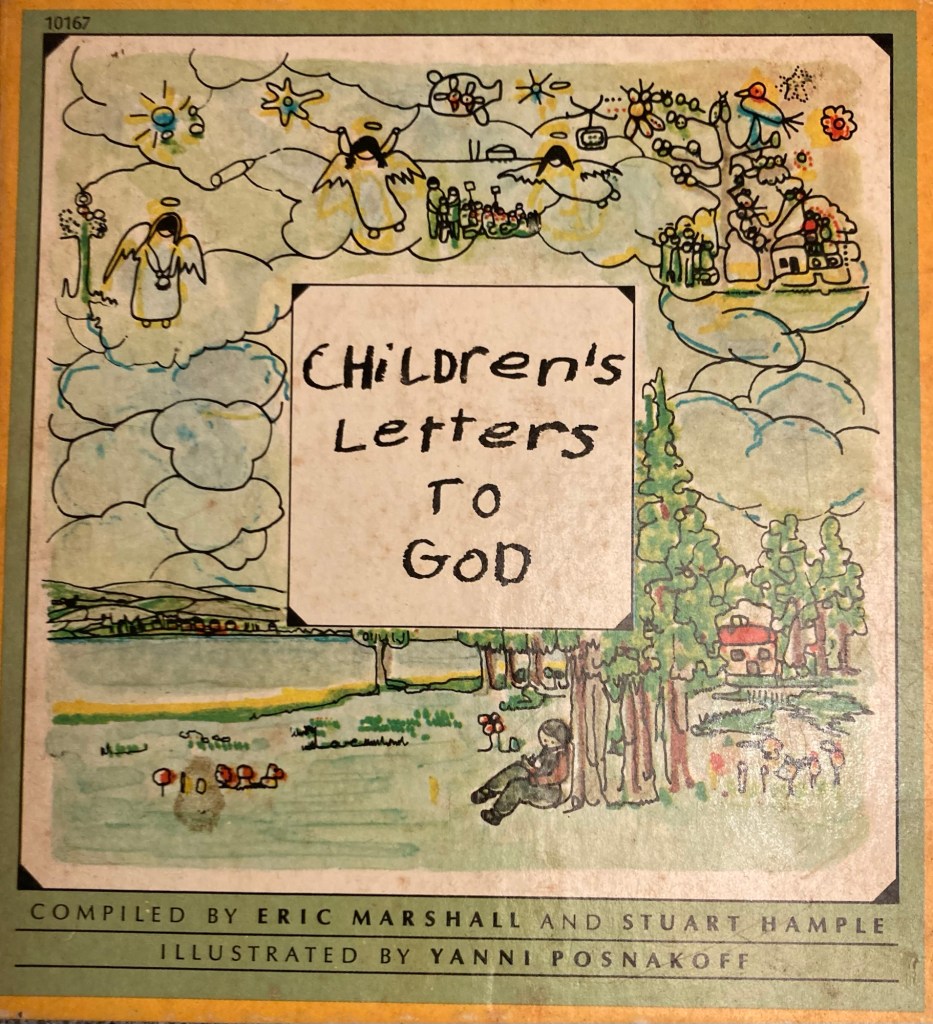
©️Leslye Joy Allen

“Children’s Letters To God,” 1966

All blogs written by Leslye Joy Allen are protected by U. S. Copyright Law and licensed under a Creative Commons Attribution-NonCommercial-NoDerivs 3.0 Unported License. Any partial or total reference to any blog authored by Leslye Joy Allen, or any total or partial excerpt of any blog authored by Leslye Joy Allen must contain a direct reference to this hyperlink: https://leslyejoyallen.com with Leslye Joy Allen clearly stated as the author.  Postings or blogs placed here by other writers should clearly reference those writers.  All Rights Reserved.

Something That Olúfẹ́mi O. Táíwò Made Me Think About By Default

by ©️Leslye Joy Allen

I read Olúfẹ́mi O. Táíwò’s book Elite Capture in a day. And even though I highly recommend it, this blog is not a review of his book. You can read a great review of it right here by Hunter Hilinski. It is what this book made me think about much later that I’m addressing here.

I thought a lot about Táíwò’s ideas after this 2024 United States presidential election. Published in 2022, I was intrigued by Táíwò’s observation that during the Covid-19 pandemic, police violence went on unabated not only in the United States but in various countries across the continent of Africa and in Latin America.

While most of the police violence against primarily Black victims in the United States was racially motivated, that was not always the case across countries in Africa and Latin America. So, here’s why that particular piece of information popped back into my head after the election.

I had the extreme misfortune to speak with a few young men (both Black and White) who voted for Trump because they “liked the way he pushes people around.” They also did not think a woman could run anything as well as a man.

To the 78% of Black men who voted for Kamala Harris, I thank you, but that percentage of you was much too low. You now have another dilemma where Black women can no longer help you.

Black women cannot correct or fix the sexists and misogynists among us as a people. Those kinds of men do not listen to women or engage in any meaningful dialogue with us. I have learned my lesson. I have wasted my time with them.

When we got hit with a wave of police violence during the pandemic in the USA, Africa, and Latin America as Elite Capture points out, I wondered out loud if men on police forces enjoyed the abuse they heaped on citizens. Was that their definition of manhood, of power? Is pushing someone around attractive?

I cannot speak to anyone else’s experience except my own—The men I grew up around were not violent. A violent man, an abusive man, and a thug were anomalies in my childhood. The boys I attended elementary and high school with were not saints, but the majority of them were respectful and none of them ever wanted to be a “thug.” I was never once called out of my name by any man, at least not to my face.

The ironies for me are endless. All of my mentees—I have about eight of them—are young men in their 20s and 30s. All but two of them were born outside of the United States. Well-educated and feminist, they hail from Ghana, The Gambia, Nigeria, Pakistan, and India. I did not go looking for them. They came and found me. I am grateful to them because they prevent me from being insular and American-centric.

While increases in thuggery and sexism seem to be a worldwide phenomenon now that is either praised as a path to follow or justified by bullshit theories about Black and Brown boys not having enough role models and being unjustly incarcerated, I wonder how Black men will address these problems in the aftermath of this election. I wonder where my mentees will fit in.

Will conversations at barbershops and lodge meetings and board meetings and conferences and church council meetings ever focus on and address the core issues of sexism and misogyny and how you might approach and speak to these disaffected and misinformed young Black men? Black women cannot do it anymore. We are not going anywhere near these types of young men anymore.

©️Leslye Joy Allen

All blogs written by Leslye Joy Allen are protected by U. S. Copyright Law and licensed under a Creative Commons Attribution-NonCommercial-NoDerivs 3.0 Unported License. Any partial or total reference to any blog authored by Leslye Joy Allen, or any total or partial excerpt of any blog authored by Leslye Joy Allen must contain a direct reference to this hyperlink: https://leslyejoyallen.com with Leslye Joy Allen clearly stated as the author.  Postings or blogs placed here by other writers should clearly reference those writers.  All Rights Reserved.

An Aging, Weary Black Woman’s Directives

©️ by Leslye Joy Allen

1. Do not waste what is left of your life on sexists, misogynists, practitioners of misogynoir, racists, homomisics, transmisics, xenomisics, and on people too lazy to look inside a dictionary to discover what these words, with their prefixes and suffixes, mean.

2. Never render CPR nor succor to those who are not kind, who cannot be kind, and who think it is a waste of their time to be kind.

3. Follow Malcolm X’s request to never call any man “brother” until he demonstrates that he is one.

4. When confronted by sworn enemies, do not, as my late Mama would say, “bother to piss down their throats even if their guts are on fire.”

5. If some illiterate soul wants to learn how to read, point them to the nearest literacy class. If some soul doesn’t read much, but wants to read more, give them books. The ones who refuse to read, leave them alone.

6. Per the instructions of my second grade teacher Sister Mary Gemma, always remember that, “you only have two cheeks. Therefore, you only turn the other cheek once.”

7. Rest on purpose. My late Daddy used to say, “Let the men do some of the work because they owe you the same things they already believe you owe them, on demand.”

8. Stop fighting every battle. My late cousin Billie used to say, “You can’t fight in every skirmish if you plan to win the war.”

9. Stop adding caveats like, “I don’t want anybody to take this the wrong way, but…” or “I don’t want anybody to get upset, but…”to your opinions. These kinds of caveats and prefaces, as Dr. Jacqueline Howard Matthews would say, is an apology for your opinion before you even render your opinion.

10. As Black women en masse we have no permanent friends, only permanent interests.

©️ Leslye Joy Allen

#MakeAmericaLiterateAgain

Blogs written by Leslye Joy Allen are protected by U. S. Copyright Law and licensed under a Creative Commons Attribution-NonCommercial-NoDerivs 3.0 Unported License. Any partial or total reference to any blog authored by Leslye Joy Allen, or any total or partial excerpt of any blog authored by Leslye Joy Allen must contain a reference to this hyperlink: https:/leslyejoyallen.com with Leslye Joy Allen clearly stated as the author. Postings or blogs placed here by other writers should clearly reference those writers.  All Rights Reserved.

Bookstores & Librarians & Libraries Rock: Writers & Readers, Pay Attention

by ©️Leslye Joy Allen

I love bookstores & libraries and librarians, but particularly librarians. They are natural allies to historians or anyone doing research. When you tell them what you are looking for they can point you right to it. I love archivists for the same reason, but archivists deal with materials that are older, and rarer than the books you see on the shelves in bookstores and in public, school and university libraries. This blog, however, is more than a shout out to the folks who handle books, it is for anyone who has written or who plans to write a book.

Here’s a tip. Do your best to get your book reviewed by a librarian. Here’s why.

While most scholarly articles and many scholarly books are peer-reviewed (which means exactly what it says: reviewed by one’s academic peers), the majority of novels, memoirs, some scholarly works, and popular authors’ books are not reviewed by their peers or by librarians.

There is one advantage that a librarian-reviewed book has: If the librarians responsible for purchasing books like the book and recommend the book, they will buy it and other libraries will buy it too! Library sales are not like other purchases. Let me explain.

Let’s say you are a new author. You and/or your publisher (if you have one) get a local bookstore to buy 100 copies of your book for 50 percent off of the retail price of each book. The typical timeline to return copies of books that did not sell is around 6 months. Let’s say, all but 20 copies of your book sold, so the bookstore returns the unsold books for a refund. Now, you certainly sold more books to the local bookstore than to a public or university library, BUT libraries’ sales are final and books are never returned unless there’s some physical damage to the actual book.

So, here’s a suggestion. Scholars and Librarians rarely review books that do not appear to have some scholarly value. Yet, you can always send your manuscript—whether it is a Science Fiction Thriller, a Memoir, or a Book of Poetry—along with a Cover Letter, requesting a review of your book.

Library Journals like Kirkus Reviews (librarians read this one all the time), Library Journal, Booklist, School Library Journal are some of the journals that librarians read and publish in. If you get a positive review in any one of these, you are bound to sell a few books and potentially earn another audience of readers because Bookstores and Libraries and Librarians Rock!

“If libraries order your book, you’re golden, because those sales are non-returnable—an author and publisher’s dream.” — from Returns 101: What New Authors Need to Know

©️Leslye Joy Allen

Vice-President Kamala Harris at Bold Fork Books, on Small Business Saturday, November 30, 2024. Bold Fork Books is a Culinary Bookstore located in Washington, D. C.

#MakeAmericaLiterateAgain

Blogs written by Leslye Joy Allen are protected by U. S. Copyright Law and licensed under a Creative Commons Attribution-NonCommercial-NoDerivs 3.0 Unported License. Any partial or total reference to any blog authored by Leslye Joy Allen, or any total or partial excerpt of any blog authored by Leslye Joy Allen must contain a reference to this hyperlink: https:/leslyejoyallen.com with Leslye Joy Allen clearly stated as the author. Postings or blogs placed here by other writers should clearly reference those writers.  All Rights Reserved.

The Other DMX Lesson

by Leslye Joy Allen

Copyright © by Leslye Joy Allen.  All Rights Reserved.

Let me first extend my deepest sympathies to the family, friends, and fans of DMX (né Earl Simmons). Full disclosure: I am a Traditional Jazz, Bebop, CuBop, Afro-Latin Jazz, Tin Pan Alley, Soul/R&B, Johnny Mathis music fan. Aside from a couple of Rap tunes, I am not much of a Rap/Hip Hop fan. My former students keep me up-to-date on the genre. So, this blog is not going to be filled with memories about when I first heard this very talented man who died too soon. I do hope, however, that DMX’s passing does more than have us publicly bemoan the perils of substance abuse, but rather, we Black folks start thinking seriously about mental health. I have no way of knowing if DMX had any form of mental disease, but a lot of drug users do…

Way back in the day, a friend as close as a brother, had a pattern of woofing down about FOUR 16-ounce Schlitz Malt Liquor Beers, coupled with about a fifth of Vodka, in one sitting over a couple of hours. Yet, I never saw him drunk. He would sleep 8 hours, then get up fresh as a daisy and go to work the next day. This was his daily ritual. He never had a hangover, if you can believe that. I couldn’t understand how he did it. Later, he was diagnosed with “Mania,” often an early symptom of Bipolar Disorder. The excessive booze was his way of self-medicating, of literally slowing down his brain that was constantly racing on all cylinders. The excessive alcohol made it possible for him to function, even if it was an unhealthy way to get some relief.

Now, drug abuse can cause mania, but drug use can also be a response to the mania itself. When I learned that DMX—a long term, off-and-on-again substance abuser—had a massive heart attack that put him in a coma with little brain function, I wondered if the source of his inability to permanently kick his drug habit was rooted in an undiagnosed mental illness. I don’t know. We may never know, but it is certainly a possibility.

We, in the Black community, have a serious mental health crisis precisely because, en masse, we don’t take mental illness seriously enough. Mental illness is not prayed away; it has to be treated. We casually and often humorously say that people have “lost their minds,” but sometimes they have actually done just that—lost their minds. A failure to seek treatment or to encourage someone to seek treatment means the disease gets worse. Sometimes, as in the case with my old friend, using both legal and illegal substances are signs of a larger problem that, if identified, can be successfully treated.

As of this writing, it has not yet been confirmed whether DMX’s heart attack, subsequent coma and death were the results of an overdose on opioids or some other drug. Even though the majority of opioid addicts are white, we have too often dismissed opioid addiction as strictly a “white” phenomenon, forgetting that there were/are glaring racial disparities in opioid addiction diagnosis and in addiction treatment. We can’t even afford to recall, with nostalgia, those days back in the mid-20th century, when there were virtually no statistics on “Black Suicide” because back then, for the most part, Black folks rarely, if ever, committed suicide. That day is dead and gone too.

Today, the second leading cause of death for Black youngsters from the ages of 10 to 14 is suicide. Let me repeat that: Today, the second leading cause of death for Black youngsters from the ages of 10 to 14 is suicide. And now it is estimated that Black children are more likely to commit suicide than white kids. When you have time, just read the data: Addressing the Crisis of Black Youth Suicide.

No matter what mental or physical problems led to DMX’s erratic drug habits and premature death, it was fairly obvious that he was an immensely talented man. We will read one tribute after another in his honor. Inevitably, people will mention how he “battled his demons.” They will easily recall when they heard DMX say something profound, something that changed their lives. What too many of them will not say is when they noticed a change in his behavior or habits or health or moods, and then tried to do something about it. And that’s not just a problem, it’s a shame.

Let’s do something more palpable than wring our hands and hang our heads in prayer. Say something to friends and family members when you witness erratic behavior and/or substance abuse. Pay attention to your own mental and physical health. Pay attention to your children’s mental and physical health. Call a psychiatrist, a physician whenever you believe it necessary. Ignore people who tell you that you are over-reacting. Help stop the trend of us losing too many of our people much too soon. Àṣẹ.

Copyright © by Leslye Joy Allen.  All Rights Reserved.

This blog was written by Leslye Joy Allen and is protected by U. S. Copyright Law and licensed under a Creative Commons Attribution-NonCommercial-NoDerivatives-4.0 International License. Any partial or total reference to this or any blog authored by Leslye Joy Allen, or any total or partial excerpt of this or any blog by Leslye Joy Allen must contain a direct reference to this hyperlink: https://leslyejoyallen.com with Leslye Joy Allen clearly stated as the author. All Rights Reserved.