One of the things I loved most about the late playwright August Wilson’s work was that his plays on Black life insisted on the importance of every member of any given Black community. Wilson crafted his plays based on his experiences hanging out and observing the denizens of the Hill District of Pittsburgh.
Cab drivers, beauticians, bums, architects, lawyers, bricklayers, members of the Nation of Islam, you name it—they all contributed to the love and humor that made up Black neighborhoods throughout the 1960s and 1970s of my childhood.
I remember when I first read an excerpt of comedian-turned-activist Dick Gregory’s autobiography “N*gger.” I was in 8th grade. I was impressed by Gregory’s statement that he was fond of winos because they never hurt anyone but themselves. I grew up watching and imbibing all of my people in all of their varieties at the corner of Hunter and Ashby Streets (now MLK Drive and Joseph E. Lowry Blvd.)
Back in the 1960s there was “Bo” the wino. Bo’s brain was so pickled that he never could understand that I was a girl. Never mind that I had two long braids with ribbons. When Dad ventured to that intersection of Hunter and Ashby Streets without me and he ran into Bo, the question was always the same, “How is that boy?” Daddy responded with the same information he always did. “Bo, I have a daughter.”
My Aunt Ella who was called “Sister” or called by me “Aunt Sis,” owned and ran Top Cats Fish Market. I always loved the painting on the side of the building of the cartoon character “Top Cat.” Winos like Bo and Mumbles would stop by and sweep the floor or wash the windows for a few coins so that they could purchase their wine for the day. “Sister let me have a dime,” Bo would request. “Bo, I don’t have a dime,” she would respond. “You a damn lie,” he would answer.
I never will forget the time Bo came by her fish market and there was a Black physician there who needed his car washed. Bo gladly offered to wash his car. Now, back in the day it was not uncommon to pour some expensive whiskey into a beautiful flask as a gift for a friend. It was also not uncommon to pay a wino anywhere from 10 cents to a few bucks to wash a car or sweep a floor.
Bo went out to wash the doctor’s car. When the doctor paid Bo a few dollars for washing his car, the doctor looked in the backseat of his car and discovered that his flask of whiskey was empty.
“Bo, what happened to my whiskey?!”
Bo replied, “I don’t know what happened. I don’t drink whiskey. I drink wine!”
The doctor looked at him and said, “Are you sure?”
Bo responded, lying through his teeth, “I DON’T DRINK WHISKEY. I DRINK WINE!”
The physician responded, “Well that’s good to know that you didn’t drink it because I was carrying that flask to the lab because I think there is some poison in it!!”
A few years ago, I received an email from a Black male performance artist that I know who is now retired. He dogged out another Black male performance artist after having attended a function. Don’t ask. I am not naming any names.
In this particular email he had nothing but vitriol for the other artist. I read his jealousy in every line because there was a time when the writer of this email was a hot topic of conversations. Yet, that ship had long since passed.
The performance artist that criticized the other performance artist did not know that who he was criticizing was loved by one of my most beloved and righteous late cousins. She was a cousin who helped damned near every Black performer who ever entered her orbit. You have seen her acting mentees, because they are everywhere. My cousin was one of the founders of The League of Professional Theatre Women.
The man doing all of this unnecessary critiquing did not know that the artist he criticized spoke at my cousin’s memorial services. For him to not know that simple fact basically meant he never listened to me. Men do that quite often. He never realized how completely offensive he was because I never bothered to respond to his unnecessary email. He never did any research before he opened his mouth. Or maybe he did know everything and just didn’t care.
An intelligent, well-educated Black woman not only does her background work but she also assesses what is best left unsaid as well as said. If she is in the process of cutting a good business deal with your Uncle, and she knows that you are on the outs with your Uncle, she will never mention you in any conversation with him.
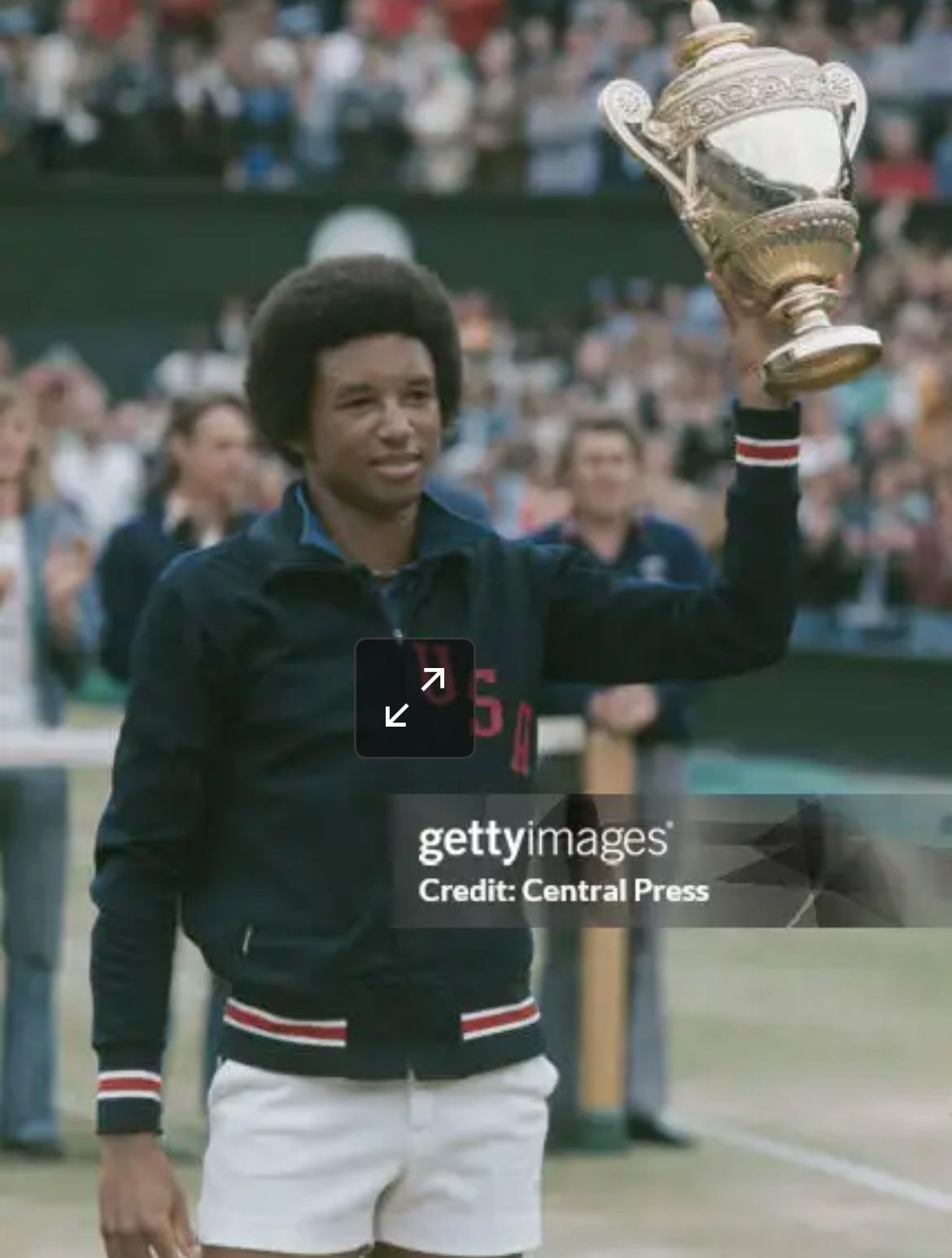
Male privilege in any man of any color or race or ethnicity teaches men that they don’t really have to be all that concerned with the ideas or issues that women are interested in. Male privilege teaches that it is not really necessary for men to pay that much attention to the ideas or issues important to women in order to function. One of the men who did not succumb to the effects of male-centricity was the late tennis champion Arthur Ashe.
Ashe (above) was the only Black male athlete I ever heard who said things like, “The average man who talks about how many women he has bedded can’t even explain the hormonal changes that occur when a woman is menstruating.” I never forgot that because when he said it I knew that he could explain a woman’s menstrual cycle. He was a scholar, and an athlete that thought further than the head of his dick or the size of it.
Well, white privilege operates the same way as male privilege. Many white people assumed that they knew/know all they needed to know about Black folks, Latinos, Native Americans, and other peoples of color. Yet, now many of the most honorable among them are groping in the dark as to how they arrived at this moment in time in the United States where democracy and their liberties are at stake.
Have you ever wondered why school shooters in the United States are 95 percent male (and roughly 52 percent white males) and damned near no one raises the question “Is there something wrong with young males?”? You hear or read the occasional commentary or the occasional essay raising this point, but the obvious problems affecting boys and young men are swept under the rug for the sake of the illusion of male supremacy while the malevolence these crazy bastards inflict on children and adolescents are treated like isolated incidents.
If you do a quick Google search about the American population you will learn that Americans of every color, race, gender, and ethnicity only make up roughly 4.2 to 5 percent of the world’s population.
Let me repeat it another way. Roughly 95 percent of the population of the entire world exists outside of US borders; and 85 percent of the world’s population are people of color. There’s a little chart in Consumption by the United States that compares our consumption to other countries. Although this analysis was conducted in 2008, it does paint a disturbing picture of American excess.
There is a severe penalty for not paying any real attention to the thoughts and circumstances of people of color, and of people who are not Americans. There’s a penalty for not paying attention to the thoughts and circumstances of women, and particularly of women of color. I have written about American-centricity before; and the perils that go along with it.
As I write this, Felon 47 is in Scotland trying to fend off every question from Scottish journalists who want to know why he will not release the Epstein Files. Americans of all stripes need not think this will not reflect badly on all of us.
News is not always reported American-style everywhere in the world. What is important to us here in the United States is not always a headline somewhere else. Add the fact that Americans are primarily unilingual, and you can be sure there will be those moments when we just don’t know how damaged and inept we appear to the rest of the world because for most of us, all we speak is English.
The penalty is that we automatically know less than the people who we believe are less important than us; and we don’t find out how in the dark we are until we’re all in trouble. It is not Felon 47 that we need to worry about, but rather the future he is designing for us long after he is gone.
Felon 47 was recently stunned to hear a Liberian official speak good English when the fact is the state that became the nation of Liberia was established by former African-American slaves with the assistance of the American Colonization Society in 1822.
In 1847, the state of Liberia established itself as a Republic and was recognized as such by several European nations.
Yet, Trumpolini was amazed to hear a Liberian speak grammatically correct English when English has been Liberia’s official language ever since its inception as a settlement, then later as a country over 200 years ago.
It gets worse. Back when George W. Bush was president he admitted to Condoleeza Rice that he didn’t know that there were Black people in Brazil. Brazil has more people of African descent than any other nation outside of the continent of Africa itself.
During the trans-Atlantic slave trade 4.9 million Africans were transported to Brazil. Yet, George W. Bush—never the sharpest crayon in the box—was surprised that there were Black folks in Brazil.
This kind of ignorance ranks right up there with the people who don’t know and never knew that the majority of Africans were not transported to the American Colonies/United States, but were transported primarily to Latin America and the Caribbean.
And the worst ignorance of all is the notion that Africans learned specific skills once they left the continent. Africans in the Senegambia region of Africa had been planting rice for over 2,000 years before Yeshu’a ben Yosef (aka “Jesus”) was born. For the record, there is no letter “J” in the Hebrew and Aramaic languages that he spoke.
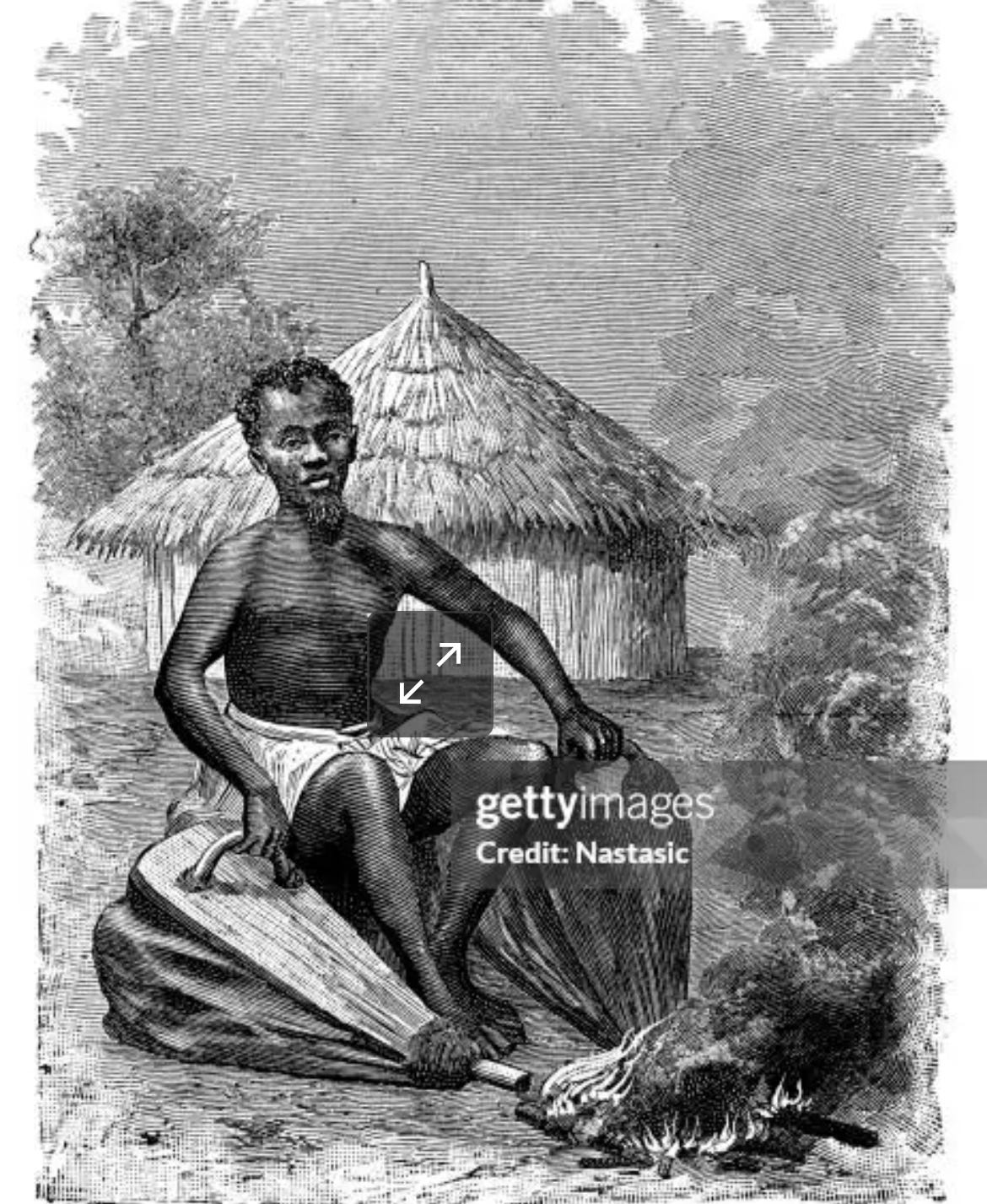
(Graphic of an African Blacksmith)
The Nok culture, the Kingdom of Kush and the Shona people of the continent of Africa were specialists in Iron smeltingthousands of years before there was any trans-Atlantic slave trade. Many African ethnic groups arrived here as Blacksmiths. Africans were transported to what Europeans called the “New World” or the “Americas” to do two things—perform the work Europeans did not want to do and the work Europeans could not do.
Now, just look at what is sitting in the White House: a man meaner than a rattlesnake and dumber than a box of rocks who doesn’t know how to do anything but mistreat people.
For people who have been reading my posts, you may have noticed that I have written about the United States’ severe literacy crisis twice on this platform. If not, you can read them here: The USA Literacy Crisis & This Election and Literacy Crisis, Part II.
This essay is Part III. Let me point out a few things first. Some 65 years ago in 1960, the United States was one of the most literate nations in the world. In 1960, only a handful of states in this country had an illiteracy rate of 10% for people aged 14 and over. The rest of the states registered only about 3% illiteracy. Now we rank 36th in the world for literacy among industrialized nations. There are other sources that place the USA at a literacy rate much lower.
In 2025, 21% of American adults are completely illiterate while 54% of adults read below the 6th grade level. I want to share with you in this essay, however, what poor reading and writing skills look like when these circumstances are also combined with educational red tape.
I taught College History courses for roughly 7+ years, from 2007 to early 2015. My first 2 years, I taught at a Junior College that had several campuses outside the city limits of Atlanta in the outlying metropolitan areas. My last 5 years I taught at large state universities. Junior Colleges are structured for students who have some academic deficits. Students often attend Junior Colleges to fix a deficit in some academic discipline so that they can eventually qualify to attend a four-year institution to earn a Bachelor’s degree.
When I started teaching, I taught year round. After I taught on this particular campus for about two semesters, I noticed that this campus was slowly being converted into a cash cow. The school started accepting anyone who could pay tuition and occasionally referred to students as “customers.” That did not go down well with me and a lot of other Instructors and Professors.
Most of my History students had some problems with reading, writing, and critical thinking skills. I usually spent the first 3 weeks of every semester correcting grammar and insisting that they trust their answers and their own instincts.
When I asked a simple question, initially none of them could state the obvious answer. I demanded that my students give complete and well-thought out answers and opinions in class discussions instead of the abbreviated and one-word answers that chronic text messaging had fostered.
The majority of my students rose to the occasion. They did the work, read my comments, listened to my instructions and suggestions, and put in the extra time needed to get up to speed in writing and having in-depth discussions about History. I did have one student, whose identity I never knew, who complained about having to write 3 five-page long History papers. Imagine having to write 3 papers in a 16-week long semester in college.
I learned later through the grapevine that this student allegedly had an inappropriate relationship with some man in the Junior College’s administration to who that student complained. One day I was informed that I would have to attend a meeting with my Department Chair and the Ombudsman of the School.
During the meeting, both my Department Chair and the Ombudsman kept telling me things like “Many of these students might not know how to interpret what you tell them. They might not understand what you say to them or write on their papers. One student said you told him or her that they could not write!”
I was confused and raised these points: “I have NEVER told a student that they cannot write. I have told or wrote to many of them, however, that they needed to take a good writing course so that they can improve their writing skills and get more practice writing cogent papers. Also, I speak grammatically correct English in the classroom. How can I know when a student cannot understand grammatically correct English? What type of language or techniques are you asking me to use?”
They both stopped talking for about 30 seconds. I interrupted their silence. “Are you asking me to water down my curriculum?!” No one answered my question. They both began to reiterate how much the students might not understand what I asked students to do. I repeated the question FOUR more times. They NEVER answered my question.
When they suggested that I attend a seminar on Customer Service Skills, it was all I could do to hold my tongue. Then my Department Chair finally ruptured this charade of a meeting and asked me, “Do you want this job?”
I swallowed hard and paused for a good 20 seconds and responded, “That’s a rather loaded question, don’t you think? Obviously, when I applied for this job, I wanted and needed a job. I still do. However, anyone who might be offered a better job somewhere else would probably take the better job. That includes me too.”
When I walked out of that office, I was so angry I couldn’t see straight. The Department Chair’s secretary looked at me as I exited and said “Leslye, what did they do to you in there?! Please, please don’t look like that.” I told her I would come back later and fill her in on the details after the Department Chair went to lunch.
So, here was the dilemma. That handful of students that never had any intention of studying and improving their literacy and writing abilities were now expecting to receive passing grades when they were just as inept at the end of the semester as they were at the beginning of it. That meeting, however, was not my worst moment on that campus.
A young Black woman student emailed me and asked me, when the time came, to write her recommendation letter to Spelman College. She had sent in an application to Spelman and assumed that she would be accepted. When I checked her records, she only had a GPA of about 2.0.
Spelman College is a Historically Black College for women that has always teemed with academic brilliance. No girl graduating high school will even be considered for admission with a GPA less than a 3.5. The average GPA of students who are admitted is a 3.8. It is a highly competitive school with an admission rate of only about 34% of applicants.
I very delicately wrote to this young woman that she would need to pull her grades up in order to get into Spelman. I wrote that she should not be discouraged because, “I know you can do it if you work hard and apply yourself by taking some additional classes.” This was my attempt to tell her the hard truth without crushing her dreams or suggesting that she give up. I signed my name to the email, pressed the “Send” button, and sat and cried for about 15 minutes.
It took me years to understand that people who don’t read well or who rarely read at all constantly misinterpret the meanings in spoken and written language. They also assign their own meanings to what people say and write with little to no comprehension. They make decisions based on what they think or feel about something a person said or wrote.
That is where we are in the United States right now. We have a majority adult population that responds to most political propaganda with their emotions and assumptions, never exactly or entirely based on actual facts. Moreover, many don’t even know where or how to look for the facts.
If the Democrats do not figure out how to reach out to semi-literate people stumbling in the dark with information they can barely decipher, then the Democrats are in danger of losing elections for the next several decades. The Political Left is also doomed to be reduced to little more than a group of well-read, but also self-righteous, ideologues that do not know how to reach the people they need to reach who don’t fit the definition of “well-read.”
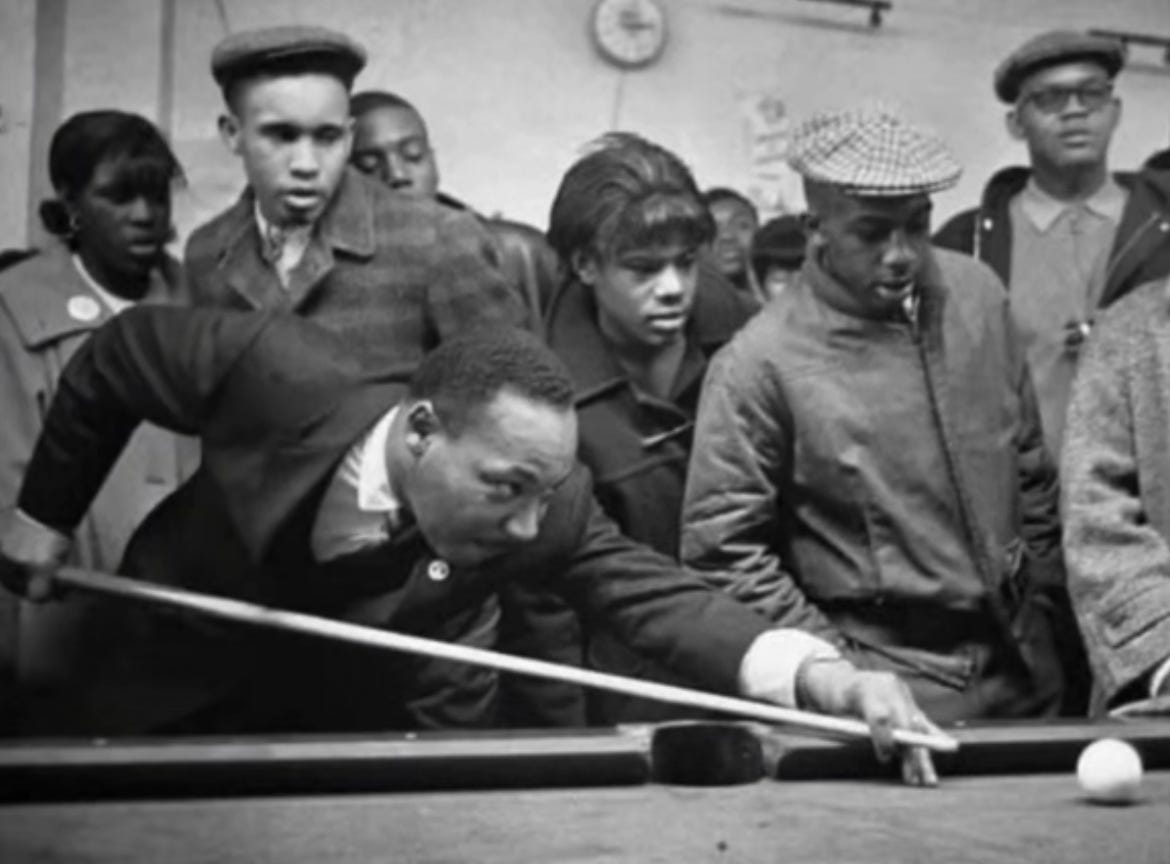
One of the things that made my home boy Dr. Martin Luther King, Jr. so effective was that he was a young man with a doctorate degree who could go hang out in a pool room and shoot pool and talk trash with the men who hung out there as easily as he could address heads-of-state. He could render presidents and prime ministers speechless because he was better educated and more in-tune with what people needed than the vast majority of them.
He could talk with ease to the poorly educated and to the best educated. For those who don’t know, Martin Luther King Jr. was an exceptional scholar who entered college at age 14 and who graduated Morehouse College at the age of 18 and had earned his doctorate by the time he was 25 years old. Kamala Harris’ Mama also had her doctorate degree by the age of 25. She was working in a laboratory when her water broke with her then soon-to-be-born first child that she named “Kamala.”
(Photo of M.L. shooting pool in Atlanta in 1966. The tall guy on the far right in the cap and glasses was then a Morehouse College Freshman named Samuel Leroy Jackson.)
What is my point? Education and literacy matters; and its singular purpose is to help people focus on what they need to be focused on. In 1960, a man or woman in the United States with little resources knew that the public library was still free and they made good use of it. Today, our semi-literate majority adult population that cannot stay still long enough to read a 5-minute article because they are always ready to look at something that is “trending,” is what we are confronted with now.
Long after I left the classroom, I ran into one of my former students from the Junior College where I once taught. He was attending Georgia State University and was about to graduate. Excited to run into me, he said, “I hated you back then. But you pushed me and demanded that I get the work done. Now, I can’t stop reading and doing research. I cannot read enough BOOKS!”
Hugging his neck I said, “Don’t ever stop. The more you dig the more you will know.
So, in the names of your favorite teachers, instructors and professors, please keep talking about the truths and the dangers of a largely illiterate and poor reading nation. Our welfare as a nation and as human beings depend on it.
I was am an Independent Historian, Oral Historian and Dramaturge. Please consider supporting my work with a few bucks for Coffee and Eggs via my CashApp.
You can also subscribe to my writings on Substack and stay in the loop with the best new research, history, journalism, prose, poetry, and etcetera.
I remember the first time I heard someone say, “If you want to hide something, hide it in a book.” The comment depressed me.
When you are a historian, you have books everywhere. You have to read all the time. I have not seen the top of my dining room table in nearly 15 years as it is covered with stacks of books. Books occupy every nook and cranny of my home.
With the United States ranking 36th in the world for literacy, with a 79% literacy rate, with only 25% of literate adults reading above the 6th grade level, we are already dumb. We can expect to see more decline in literacy with Felon 47 living on Pennsylvania Avenue.
So, I have a proposal. It might not change anything, but it is worth a try. Walk out of your door with a book in your hand or tucked under your arm everyday for at least a month.
Let kids and other adults see you walk with that book. And don’t say you can’t do this. You have carried books before when you were in grade school.
Make your book/s visible at your job, on a trip to a store. Hell, go for a walk with your book until someone asks you why you always have a book in your hand or under your arm. And then have the audacity to tell them why.




 Leslye Joy Allen