No Contradictions

by ©️Leslye Joy Allen

When I started to hear negative commentary about Kamala Harris’ racial and ethnic background, I started reevaluating how “White Supremacy” works again.

Many people are completely unaware that when the Greek explorer Herodotus named the continent “Αἰθιοπία” (romanized as Aithiopía”), his definition included the continents of Africa, India, and Southeast Asia. Herodotus’ term literally means “Land of Burnt Faces.”

Those kinds of cross-cultural connections and collaborations do not help white supremacy to flourish which is why you rarely hear anything about them. The objective of white supremacy is to make certain that peoples of color look to white folk, and white men specifically, for acceptance, guidance, deliverance, and redemption, but not to each other. Sexism works exactly the same way. A man, not a woman, may rule you and grant you favor in some screwed up patriarchal world as sexists imagine it.

African-American scholar W. E. B. DuBois’ heir apparent Vijay Prashad noted that many Indian men arrived in the USA in the late 18th and 19th centuries, married Black American women and disappeared from most histories. Suraj Yengde, both in his books and in his portrayal of himself in Ava DuVernay’s masterpiece film “ORIGIN,” noted that we must find reconnections with each other. His research on Dr. Bhimrao Ambedkar is fascinating.

Ambedkar was a Dalit, or as he was once called, an “Untouchable.” He wrote India’s constitution. He earned two doctorate degrees and when he came to the United States he wanted to meet his fellow American untouchables. So, he visited Harlem where the Black folks lived. (FYI: Martin Luther King, Jr. was introduced as a fellow “untouchable” when he visited India.)

This is exactly what Shyamala Gopolan-Harris did when she left India to go to school in the United States. She gravitated toward communities where she was less likely to be mistreated. So, she headed to Berkeley, California which was a hotbed of activism—there were Civil Rights protests, anti-Vietnam protests, the Free Speech Movement and the work of the Black Panther Party in nearby Oakland was the world that her daughter Kamala Harris grew up in.

I bring this up because we know so little about our early histories and connections. I don’t bring this up with any foolish idea that everyone is going to suddenly start singing “Kumbaya” and start getting along all the time. Yet, we know more about what Prashad accurately identified as white power structures that, during the late 20th century, deliberately created the myth that “Southeast Asians” were a model minority, a minority he emphasized that was designed as a weapon against Black Americans.

Felon 47 and his minions have lined up a small cadre of Southeast Asians to serve in his administration to do two things: 1) make the administration look less racist than it is and, 2) to also entice India, which now has a larger population than China, that its population is seen somehow as superior. South Africa did damned near the same thing during apartheid.

When Black Americans visited South Africa during its apartheid era, Black American visitors were given passes written in Afrikaans that translated into English as “Honorary White Person.”

Now, the fact that I personally know at least seven Southeast Asians who identify quite accurately as “Black,” does not matter. The fact that so many folks on the continents of Africa and Southeast Asia have near identical DNA doesn’t matter either. When I read the book “A Passage to India,” I noted that an Indian character in the book was described as a “little Black man.” It was the first time I ever saw such a description of anyone outside of a specifically African or African American context. My point, however, is much simpler.

We Black Americans can continue to roll our eyes at the brown guy wearing the turban at the local gas station and vice-versa OR we can recognize and identify our participation in upholding white supremacy while its foot remains situated on both our necks. Before you bother to tell me about the guy at the gas station that you don’t like, remember that he is an employee and all you are is someone pumping gas. White supremacy makes all of us its pawns.

If you are honest, you also remember that moment when you got bad service at a Black-owned business and thought to yourself that you got bad service because the business was Black-owned. The fact that there are, were, and will be folks who simply are not good at customer service regardless of their race or ethnicity or nationality did not enter your mind. That kind of thinking is white supremacy in action too.

Kamala Harris knows this better than anyone. She knows who she is and she didn’t need anyone to tell her who she is. The fact that anyone dared define her speaks not only to their arrogance, but also to their presumptions that they actually have such a right to do so.

She was perceived by some folks as a contradiction and by some folks as having split loyalties. The only thing that actually requires split loyalties is white supremacy. It cannot thrive or survive without its clear contradictions. Let me write that again—It cannot survive or thrive without its clear contradictions. It functions with the assistance of the people who it is designed to either oppress and/or control and/or regulate. Repeat that until you get it. So, no contradictions.
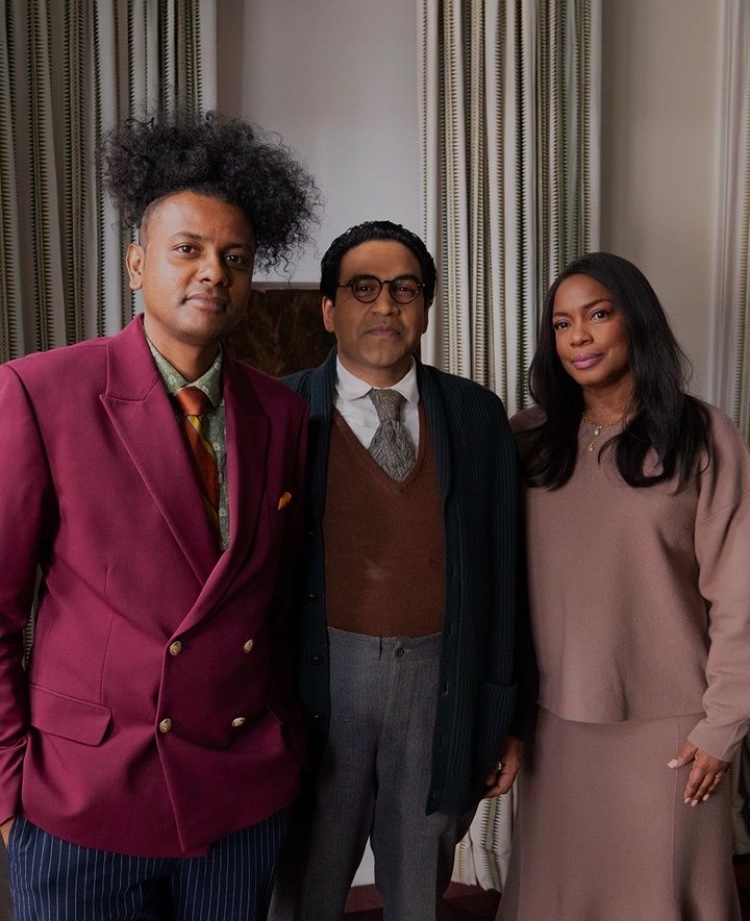
©️Leslye Joy Allen

Dr. Suraj Yengde (as “himself”), Dr. Gaurav J. Pathania (as “Dr. Bhimrao Ambedkar”) and Aunjanue Ellis-Taylor (as “Isabel Wilkerson”) in Ava DuVernay’s film “ORIGIN.”

All blogs written by Leslye Joy Allen are protected by U. S. Copyright Law and licensed under a Creative Commons Attribution-NonCommercial-NoDerivs 3.0 Unported License. Any partial or total reference to any blog authored by Leslye Joy Allen, or any total or partial excerpt of any blog authored by Leslye Joy Allen must contain a direct reference to this hyperlink: https://leslyejoyallen.com with Leslye Joy Allen clearly stated as the author.  Postings or blogs placed here by other writers should clearly reference those writers.  All Rights Reserved.

Why We Fail: Forgetting Malcolm and Martin’s Internationalism

Weary Self-Portrait 2 “Weary Self-Portrait 2” (Copyright © 2014 by Leslye Joy Allen. All Rights Reserved.)

by Leslye Joy Allen

Copyright © 2014 by Leslye Joy Allen. All Rights Reserved.


As bad as things are in the USA—in particular, the killing of a young Black man named Michael Brown in Ferguson, Missouri—what we Black Americans are enduring is “a cakewalk” by comparison to some of the tragedies that are currently taking place in India, parts of Africa, Iraq, Israel, and so many other places around the world.  Yet, our current Black leadership has been conspicuously silent on so many of these international matters, including the excessive policies of Israel against an already displaced Palestinian people.  Yet, Arab, Jewish, African, and African American women found enough of a unified voice to write a statement of solidarity with the Palestinian people.  I wonder why they could do it, but not our elected officials.  These women understand an important component of previous human rights struggles—including the Civil Rights and Freedom struggles that took place during the 1950s well into the 1970s in the United States—the international component.

Martin Luther King, Jr. and Malcolm X always placed Black American freedom struggles in an international context.  If you do not believe me, then read or listen to Malcolm X’s “Message to the Grass Roots” and listen to him rattle off the names of those nations and peoples that too many of us frequently ignore.  Listen to King speak poetically and prophetically against the Vietnam War.  These are only a few examples, often scary examples.  Yet, there are many others.

What happened to Michael Brown in Ferguson, Missouri is going to resonate with other people in other parts of the world.  When we lost Trayvon Martin, you found people across the globe putting on “hoodies” in solidarity.  And, if it were not for the women of Nigeria taking full advantage of social media, most of us would never have known anything about the kidnapping of the Nigerian girls, who have still not been returned to their families.  Yet, when was the last time you saw a massive movement of Black Americans speaking out against and lending assistance to anyone outside of the USA.  Arguably, there has been no massive international activity on OUR part, at least not since the zenith of an internationally led movement that demanded that colleges and businesses divest from South Africa in protest of the country’s brutal and virulent social system known as apartheid, and that was in the late 1970s into the 1980s.

The question is when are we going to get our international legs back, and stop looking at what and who we are as if we are isolated in one country called the United States.  Does it not matter that two teenage Indian girls were gang-raped, and then lynched just a few months ago in Bengal, India?  Does it not matter that several hundred Nigerian girls were kidnapped and—sorry to say this—will probably never return to their families?  Does it not matter that former UK Prime Minister Gordon Brown has stayed on top of the problem in Nigeria and spoken out about this problem of female trafficking in Nigeria and elsewhere, and more often than many Black American politicians and self-appointed pundits?  You are damned right it matters.

I can count on one of my former English professors to regularly post articles and his own occasional eloquent outbursts on his page on Facebook about many of the atrocities that happen to women worldwide and, also what happens to Black Americans—He, however, was born in Pakistan.  The Executive Director of Greenpeace International was born and raised in South Africa, and spent his teenage years in the anti-Apartheid movement.  He regularly articulates how women’s oppression, the problems with the environment and human rights struggles are tied together.  I knew something had become completely out-of-whack when the only men I could count on—with any real regularity—to lend their voices and support against sexism were men of color who were also NON-American.  The difference is, they can and do connect the dots and see environmental problems, discrimination and the persecution of women, and battles to end racism and/or ethnic violence as connected problems in ways that so many Americans simply do not.  Yet, a few Black Americans do connect the dots, but they are not part of what is traditional Black leadership, which is a good thing.

Ron Davis, the father of Jordan Davis—the Black teenage boy that was killed in Florida when a man shot into his vehicle over a quarrel about loud music—took his complaint about the senseless murders and expendability of young Black men to Geneva, Switzerland at the 85th annual meeting of the Committee on the Elimination of Racial Discrimination.  The talks in Geneva run from August 11 through August 29, 2014. This was a bold move by Mr. Davis, but proof positive that he was paying attention in the sixties and seventies when international opinion about the United States government’s slow response to discrimination and racial virulence damaged the USA’s image abroad.  Both Mr. Davis and the women of all colors and nations who signed that Solidarity Pledge fully understand what Malcolm X and Martin Luther King, Jr. tried to teach.  We can hope that some citizens in Ferguson, Missouri are paying attention.

Now, thinking internationally or being concerned with tragedies or the well-being of people outside of the United States will not stop police officers from killing unarmed Black male teenagers.  My interest and sadness over the senseless gang rape and lynching of two teenage girls in India several months ago will not stop the rape and abuse of women anywhere, neither will my continued anguish over the kidnapping of girls in Nigeria.  Yet, to be a Black woman born and raised in the American South is to understand that racism and sexism come from all quarters of the country of my birth, and indeed all quarters of the world itself.

To fail to see the connections I have with peoples who may or may not speak my language or belong to the same racial and/or ethnic and/or gender group is to forget the real lessons of the Civil Rights Movement—that WE are not alone if WE will simply acknowledge that WE need allies, and international allies at that.  Yet, WE will be alone if WE operate from the position that people in other parts of the world do not have anything to teach us.  WE cannot afford to function from the position that because WE dwell in the United States that no one else’s problems or persecution matters as much as ours matter.  If WE do, WE will have missed Martin and Malcolm’s most important lesson, namely that if WE labor alone, WE, and everybody else, will lose.

Copyright © 2014 by Leslye Joy Allen. All Rights Reserved.

CCThis Blog was written by Leslye Joy Allen & is protected by U. S. Copyright Law and licensed under a Creative Commons Attribution-NonCommercial-NoDerivs 3.0 Unported License. Any partial or total reference to this blog, or any total or partial excerpt of this blog must contain a direct reference to this hyperlink: http://leslyejoyallen.com with Leslye Joy Allen clearly and visibly stated as the author. All Rights Reserved.