Ralph McGill Would Never Defend “Stand Your Ground”

Photographer: Jon Sullivan. Copyright: Public domain image, not copyrighted, no rights reserved, royalty free stock photo. “Scales of Justice” by Jon Sullivan, photographer. Copyright: Public domain image, not copyrighted, no rights reserved, royalty free stock photo. Available from Public-Domain-Image.com

By Leslye Joy Allen

Historian, Educator, Theatre and Jazz Advocate & Consultant

Copyright © 2012 by Leslye Joy Allen.  All Rights Reserved.

For those of you who are unfamiliar with the late Ralph McGill (1898-1969), he was a White journalist and publisher of the old Atlanta Constitution (now the Atlanta Journal Constitution).  He was also a well-known liberal who wrote about racial discrimination in society at large and within the criminal justice system.  He did this long before the Civil Rights Movement reached its apogee in the 1960s.  Martin Luther King, Jr. mentioned McGill in his eloquent “Letter From a Birmingham Jail.”  King wrote that McGill and some other White journalists, “have written about our struggle in eloquent, prophetic and understanding terms.”  Indeed, McGill was a man who watched, learned, and evolved into one of the most progressive voices in the American South and the nation when it came to race relations, civil rights, and the penal system.  With that said, it is important for you to understand that I did not learn about Ralph McGill from a newspaper or a book, but rather from my schoolteacher mother.

Mama remembered that he emphasized that when a Black person killed another Black person they typically received very light jail or prison sentences—that is, if they received any jail time at all.  It was just the opposite if they had killed a White person.  He noted that because of this failure to properly punish Black people who killed other Black people, the judicial system literally encouraged those individuals to carry out their anger to its fullest possible extreme.  He accused the judicial system of encouraging Black folks to kill each other.  Mama said that there was an unsettling joke going around in Atlanta during the 1940s that said: if you were a Black man that killed another Black man you would be out of jail in time to go to your victim’s funeral.  Indeed, in his column in the Atlanta Constitution on September 17, 1941, McGill wrote:

“In the first place our courts, to our shame and, although no one seems to see it, to our very great financial cost, never take Negro crime seriously.  A Negro murderer, killing another Negro, rarely receives any severe punishment.  Juries and prosecutors have, for years, viewed them lightly as just another Negro killing, and therefore, of not much importance.”  (Ralph McGill – Crime, Standards, Methods 9-17-1941)

He remained one of a handful of White journalists that understood that any law or process or social practice that devalued Black life also made Black people the more likely targets of violence by killers of all races.  He also noted that many members of Atlanta’s then all-White police department had poor training and were “quick-on-the-trigger.”

I thought about Ralph McGill after the tragic killing of Trayvon Martin in Sanford, Florida in February of 2012.  When Jordan Davis of Atlanta, Georgia was killed in Jacksonville, Florida later in November, I again thought about McGill, arguably one of the most vocal writers who paid serious attention to Black-on-Black and White-on-Black violence and the institutionalized racism in the criminal justice systems of Georgia and the nation.  I will not recount how Jordan Davis and Trayvon Martin died needless and preventable deaths.  I will leave it to you to read the details of Davis’ death on your own.  (Take a minute and read Madison Gray’s very brief Time Magazine report “With Echoes of Trayvon Martin, Florida Man Claims Self Defense in Shooting Death of Teen.”)  Yet, I wonder what McGill might have said about the horrible killings of these two unarmed Black teenagers by two men—One of Peruvian and Jewish extraction and the other a White man.  I am sure he would have had much to say about the racial dynamics surrounding these two killings and the law known as “Stand Your Ground.”

Nearly half the states in this country have “Stand Your Ground” laws.  At minimum, these laws allow an individual the right to use deadly force if that individual has a reasonable belief that their lives are threatened.  Importantly, the law typically states that it is not necessary for a threatened individual to retreat from the perceived danger.  The jury is still out on whether this kind of law has reduced crime rates anywhere.  It is important to note, however, that there is nothing in these laws that give citizens the right to provoke and/or create a potentially volatile scenario where they place themselves in danger and then use deadly force in response to the dangerous scenario they created.

The fact that George Zimmerman, charged with second degree murder of Trayvon Martin, was told by a 911 operator not to follow Martin, has forced Zimmerman’s attorneys to drop the use of “Stand Your Ground” as a part of his defense is cause for all of us to pause.  The fact that Michael Dunn, charged with the murder of Jordan Davis (and also charged with attempted murder of the other teens in the SUV), told these kids to turn their music down at a gas station is also problematic.  Most people do not stay at a gas station for very long.  Is it safe or even logical to tell total strangers what to do or what not to do while they are seated in their own vehicles at a public place like a gas station at 7:30 in the evening?  Think about it.  Will Florida lawmakers ever understand that the state’s “Stand Your Ground” laws are not always working in the best interests of its citizens?  McGill would have recognized the counterproductive and dangerous potential for abuse in “Stand Your Ground” legislation.

When I finally got the opportunity to read some of the newspaper columns written by McGill, I noticed some important qualities:  He spoke his mind about what was going on in the city and the world at that moment.  Yet, he did so with an eye on the future.  Like many of Atlanta’s early boosters, he always prescribed the course of action that he believed was best for the city of Atlanta—the entire city of Atlanta.  He knew that crime, racial discrimination, racial virulence, and the like, were bad for the city.  He was as practical and he was ethical.

I do not know exactly what McGill might have said or asked about the killings of Trayvon Martin and Jordan Davis.  Yet, I have little doubt that he would understand and endorse the necessity of raising the following questions about how citizens interpret their rights as defined in “Stand Your Ground” law:  How does the “Stand Your Ground” law define “feeling threatened”?  If you look menacing or say something that makes me feel afraid, will the law allow me the right to use deadly force against you based solely on my assumption of what I think you might do?  Do citizens need more than the basic right of self-defense?  What might an angry person do if they are armed and know that they might be able to get away with killing someone because, by law, they do not have to retreat from danger?  Much like Atlanta in 1941, does not this law encourage people to choose to kill one another?  Don’t these kind of laws eventually breed a flagrant disregard for the law?  McGill wrote that, “Anything that breeds contempt for the law is costly.”  He was right.

When I asked my Mama why she liked Ralph McGill, she simply said,

“He made sense and he was always, always fair.  He always asked for justice and the fair treatment of all citizens.  Justice and fair treatment were the only things Black people wanted.”

Justice and fair treatment are still all we want.


Copyright © 2012 by Leslye Joy Allen.  All Rights Reserved.

Leslye Joy Allen is proud to support the good work of Clean Green Nation.  Visit the website to learn more about it: Gregory at Clean Green Nation!

Creative Commons License This Blog was written by Leslye Joy Allen and is protected by U. S. Copyright Law and licensed under a Creative Commons Attribution-NonCommercial-NoDerivs 3.0 Unported License.  Any partial or total reference to this blog, or any total or partial excerpt of this blog must contain a direct reference to this hyperlink: http://leslyejoyallen.com with Leslye Joy Allen clearly stated as the author.

No Pedestals

by Leslye Joy Allen

If you love someone

the worst place for them

is a pedestal, which

was built to hold

statues, figurines, bric-a-brac,

and yet, it cannot hold anyone you love

or expect to love,

as these objects of your affection, always and

too often, fall from these podiums and break bones and smash

images, sturdy and fragile, that never

could withstand that inevitable tumble to earth where you knew

they would eventually land,

that is, if

you ever really expected to embrace them and immerse yourself in

the fullness and richness and contradictions of

their humanity, rather than in that narrow space of where you assumed

them near perfect, a space

that you could never even occupy yourself

nor in the cement plaster idolatry of

the legend you

imposed on them.

Please, no pedestals.

Copyright © 2012 by Leslye Joy Allen.  All Rights Reserved.

(I have been blessed with wonderful teachers who have insisted that my being a historian had nothing to do with my ability to write something other than history.  Much love & respect to my two favorite Partners-in-crime: Poet-Professors Dr. Waqas Ahmad Khwaja & Dr. Steven Guthrie of Agnes Scott College.)

Leslye Joy Allen is proud to support the good work of Clean Green Nation.  Visit the website to learn more about it: Gregory at Clean Green Nation!

Creative Commons License This Blog was written by Leslye Joy Allen and is protected by U. S. Copyright Law and licensed under a Creative Commons Attribution-NonCommercial-NoDerivs 3.0 Unported License.  Any partial or total reference to this blog, or any total or partial excerpt of this blog must contain a direct reference to this hyperlink: http://leslyejoyallen.com with Leslye Joy Allen clearly stated as the author.


Soldiers, Scholars, and “Black Redtail Angels” in Southwest Atlanta

by Leslye “Joy” Allen                                                                                                        Historian, Educator, Theatre & Jazz Advocate, Doctoral Student                                               Copyright © 2012 by Leslye Joy Allen. All Rights Reserved.

“White American bomber crews reverently referred to them as “The Black Redtail Angels” because of the identifying red paint on their tail assemblies and because of their reputation for not losing bombers to enemy fighters as they provided fighter escort to bombing missions over strategic targets in Europe.” –Lieutenant Colonel Charles W. Dryden (1920-2008) from A-Train: Memoirs of a Tuskegee Airman

Back in early December 2011, I received an email from a cousin that contained a trailer from the movie Red Tails, a film about the Tuskegee Airmen directed by Anthony Hamilton, produced and largely funded by George Lucas.  Not long after I received the email with the trailer, I was thinking about my one and only meeting with the late Lieutenant Colonel Charles W. “Chuck” Dryden.

I had called Dryden when I briefly served as an intern for a World War II Oral History project.  When I called him, he looked at his Caller ID and determined that I was calling from a phone in Southwest Atlanta.  He told me to hang up the phone and come on over.  With no hesitation, I drove to his home, which was about six minutes from my own.

Dryden was a decorated Tuskegee Airman, and one of many Tuskegee Airmen that lived in Atlanta, which is home to more Tuskegee Airmen than any other city in the nation.  A member of the famous 99th Pursuit Squadron, and later the 332nd Fighter Group, it was Dryden who led a group of six Black fighter pilots in aerial combat in Italy in 1943—This was the first time in aviation history that Black pilots in the U. S. Army Air Corps engaged an enemy in aerial combat.

I spent an afternoon at his home in Southwest Atlanta back in the summer of 2007 where he told me how he had to be perfect as a fighter pilot if we were going to stop Hitler’s Third Reich and if he and others were going to prove that Black men made excellent fighter pilots.

That afternoon I learned that he was much, much more than a fighter pilot.  I had owned his memoir A Train: Memoirs of a Tuskegee Airman for years, but at that time, I had not yet had an opportunity to read it in its entirety.  However, from what I had read and from my conversation with him, it was apparent that he was very much a scholar.

We discussed history, politics, art, World War II, U. S. military intervention in Iraq and Afghanistan, the upcoming “Democratic Presidential nomination” of Barack Obama, and of all things: my Master’s thesis.  He insisted that I tell him more about my research on the White politicians that made up the Georgia Know-Nothing Party, a group that did not want Georgia to secede from the Union as the South reeled from the election of Abraham Lincoln.

I should add that we also talked some mess!  I noticed a picture of Dryden and his beautiful and brilliant wife Marymal Dryden.  She was not there when I visited, but I remember reading one of her essays.  The handsome couple stood there in the photo with the Arizona sunset as their background.

“You remember that scene in the movie Waiting to Exhale where Angela Bassett burns up all of her ex-husband’s stuff in the car,” he asked.  “Yeah,” I answered.  “Well, we are standing right there in that same spot where she burned up everything.”  We both burst into laughter.

He could not stand upright, as he had been afflicted with a severe stroke.  Yet, his mind was razor sharp.  He thought U. S. involvement in Iraq and Afghanistan was dangerous.  Moreover, of more than a dozen WWII vets that I spoke with, ALL of them thought this way.  In less than a year after my wonderful visit, Lt. Col. Dryden passed on to the ancestors.

Not long after his death, a young woman in one of my history classes informed me that she would be attending the United States Air Force Academy.  In one of our conversations where we talked about everything from the fact that the Air Force had fewer Blacks than any other part of the armed services, she told me that she met Lt. Col. Dryden before his death.

When I asked her about their conversation, she looked me straight in the eye and said that Dryden’s face lit up when she introduced herself and told him she was planning to go the United States Air Force Academy.

He told her, “When you get to the Air Force Academy, you give THEM HELL!”  We both laughed because we knew what he meant, and we offered no apologies for his pointed audacity-filled instructions to her to kick some you-know-what at the Air Force Academy.

Nearly four generations her senior, Dryden let this young sister know that his expectations of her were high.  He also knew that his vote of confidence in her abilities would buttress her against any doubts she might develop should she encounter those individuals who thought the United States Air Force had no need of Black female officers and pilots.  Like every other Tuskegee Airman I know of, Dryden never lost his swagger, his sense of possibility.  Like many other men and women of his era, he expected much from himself and from all of us who were born after him.

Dryden and my parents were contemporaries.  I am a late born child—my mom turns 91 years young this year.  If my father were living, he would be turning the age of 92.  The men and women of Dryden and my parents’ era not only lived long enough to see the world change, but they were largely responsible for changing it.

Folks my age and younger often complain about what needs to be done to create racial and economic justice.  Many of us have been vocal critics of our elders, and often our analyses of what did or did not work in the past have been correct.  However, if there is any lesson to learn from the “Black Redtail Angels,” and our elders from the World War II era and beyond is their dedication to education and their examples of extreme sacrifice.

These men and women—Black and White— those in the military and those keeping the home front, were in their twenties when Adolph Hitler threatened to destroy any semblance of racial or ethnic equality in Europe and elsewhere.  I shudder to think of how different the world might have been had he and his minions been successful.

We often forget that the Third Reich did not just target Jews for extermination.  It exterminated and planned the extermination of Poles, and all Slavic peoples, persons with mental and physical disabilities, Gays and Lesbians, and yes, Afro-Germans.

We owe folks like Lt. Col. Dryden and Lt. Col. Hap Chandler, a White fighter pilot from Toccoa, Georgia.  Not long after I met Chandler, I learned that he had shown up at a meeting of Georgia’s Tuskegee Airmen to thank them for keeping him alive and to apologize for the awful way that “members of my race treated you.”

Chandler also had that same swagger, intellectualism, and expectation that I noticed about Dryden.  In the late 1940s, he also belonged to that small but growing number of White veterans who had to reassess their erroneous beliefs about alleged “Black inferiority” that remained endemic to every aspect of American life and was the very basis of the social and economic order of the American South.  I should add that Chandler was cool.  He drove a Jaguar and arrived for his interview wearing a suit and tie and holding hands with his seventy-year-old girlfriend.

The Tuskegee Airmen, and other Black World War II veterans came back home to the United States and demanded equality from a country that denied them the very thing they had fought for abroad.  The modern-day Civil Rights movement began with the efforts and work of all of these men and women.

They went to college (or back to college) in record numbers under the G. I. Bill.  They sought advanced degrees, pursued well-paying skilled jobs in new industries, started businesses, and swelled the numbers of the Black middle class so that you and I could do much of what we are able to do now.  They bought homes and sent kids to college.

They registered and voted in every election.  They marched with and sometimes paid to get civil rights activists, students and radicals out of jail.  They set examples for us to follow and repeat, and made some mistakes for us to study and avoid, but they never stopped moving and searching for new ways to create a more just and equitable nation for their children and grandchildren.

They did all of these things without computers, cable television, the Internet, email, blogs, social media or cell phones.  We should do no less.  Peace.

Copyright © 2012 by Leslye Joy Allen. All Rights Reserved.

Leslye Joy Allen is proud to support the good work of Clean Green Nation.  Visit the website to learn more about it: Gregory at Clean Green Nation!

Creative Commons License This Blog was written by Leslye Joy Allen and is protected by U. S. Copyright Law and licensed under a Creative Commons Attribution-NonCommercial-NoDerivs 3.0 Unported License.  Any partial or total reference to this blog, or any total or partial excerpt of this blog must contain a direct reference to this hyperlink: http://leslyejoyallen.com with Leslye Joy Allen clearly stated as the author.

The Paper Yet to be Returned

by Leslye Joy Allen                                                                                                               Historian, Educator, Theatre & Jazz advocate, Doctoral Student

Copyright © 2012 by Leslye Joy Allen. All Rights Reserved.

My last blog for Cascade Patch attempted to remind everyone that Tuskegee Airman, one Lt. Col. Charles W. Dryden had a clear vision about what and whom he was fighting against when he valiantly fought in World War II.

Yet, another group of soldiers now struggle with what it meant to be in the military in Iraq; and some are still trying to understand the complicated mission of remaining in Afghanistan.  The following is a personal story about one of my former students:

Back in 2008 when I was teaching United States and World History courses at a local junior college, I encountered a young 20-something male student who I initially feared might earn an “F” in my class.  Like many students I have encountered in recent years, writing was not his forte; and history is research and writing intensive.  However, much like many other students, he performed much better on his second paper after he followed the directions, suggestions, and criticisms I wrote on his first paper.

It is a thrill to watch a struggling student take off at top speed and make real, concrete progress.  This student, who I will refer to here as “M,” did just that.  There is still only one problem: M has not yet been able to pick up his final paper, a paper where he worked like a trooper to earn an “A.”

A few weeks before that semester in 2008 ended, M approached me after class to let me know that he was in the U. S. Army Reserves.  He was part of a reserve troops that would soon go to Iraq.  His deployment could occur at any time and at a moment’s notice.  He feared he would have to leave for Iraq before the semester ended.  He worried about missing his final examinations.  I told him not to worry.  He had enough graded assignments for me to figure out his grade point average if it became necessary.

Since educators and employers are required by law to accommodate, as best we can, those employees and students who may be called to military service, I had to come up with the best possible solution for M.  After discussing the matter with my department head, I decided to wave his having to take my final examination.  After a careful review of all of his grades, he averaged a solid “B.”  He left for Iraq, however, before I could return his last paper.

A few days after his departure, he emailed me to let me know that he had safely arrived.  He thanked me for all that I had taught him, and asked me to remember him in my prayers.  He also told me that I had taught him to “think outside of the box.”  I freely admit that I can be a bit radical and unorthodox.  I would never have survived even working in the post office in Uncle Sam’s army.  When M made that comment, I wondered how my teaching him to “think outside the box” would actually help him in Iraq.

I quickly responded and asked that he email me and his other instructors to let us know how he was doing.  He responded that he would try to stay in touch, but that his commanding officer had warned him about sending too many emails.  Because of where he was located in Iraq, it might be dangerous to regularly contact too many United States citizens by email as the area was potentially teeming with internet-savvy terrorists.  Emails, he wrote, were particularly vulnerable to enemy infiltration.  That worried me.

Sure enough, his emails abruptly stopped.  Months after his departure, I wondered if he was still alive.  I even caught myself paying extra attention to news reports of casualties in Iraq.  Then, I misplaced the last paper I graded for him.  Misplacing the paper felt like a bad omen.  Then in 2009, I ran across a blog where a blogger had spoken with Paul Rieckhoff, the author of the Iraq Memoir Chasing Ghosts.  Of soldiers in Iraq, Rieckhoff stated:

“This is not a drafted army, it’s a professional force, so folks are staying in longer, they’re older and they’re more likely to have families…But those who are being killed and injured are disproportionately young — the people you played soccer with and went to high school with.”  (For the full article, go to: http://stand-up-4-veterans.tressugar.com/Toll-Iraq-US-Soldiers-3294102)

After I read the blog, I felt worse.  I knew that any war almost always consists of young soldiers, but exactly how young?  How often had military service in Iraq or Afghanistan interrupted college students’ educations?

Another year passed and soon, I briefly forgot about M.  Then, in 2010, I got a phone call from a former co-worker.  She received news that one of her former students was killed in Iraq.  I did not know this particular student well, but she did.  With both of us weeping over lives lost too young, I thought about M again.  I did not email him for fear that I would not receive a reply email and again wonder if he was still alive.  I could not and cannot imagine what the families of these young women and men have gone through during the course of the Iraq war and the seemingly endless problems in Afghanistan.

Right before this past Christmas 2011, I decided to sort through the tons of papers and assorted items that had accumulated into a small mountain on my dining room table.  There were stacks of papers, books, photographs, and notebooks on the table and in boxes around the table and elsewhere in my house.  We historians are the world’s most notorious packrats, always afraid that we might throw away some document we might need later for our research.  Yet, enough was enough.

After sorting through all of the excess and deciding what might go into the recycling bin, I found the last paper M wrote that I graded at the bottom of one of my many boxes.  Early Christmas morning, I summoned the nerve to email him to ask how he was doing, noting that I had just stumbled across the last paper he turned in for my World History class.  FYI: M’s paper was about one of the Zanj revolts that took place in the Afro-Arabic world (Look it up if you do not know what I am talking about because I am not even going to define “Zanj” for any reader younger than M.)

Later that Christmas night, I received an email from M stating that he was well, but still in Afghanistan.  The military has now deployed him OVER FIVE TIMES.  Scheduled to return home in the summer of 2012, he noted that he felt like Iraq and Afghanistan were recipes for civil war.  Indeed, he said, Afghanistan already was engaged in what he believed to be a civil conflict that neither the United States military’s presence (or absence) could remedy.  Later on January 10, 2012, I stumbled on an article that described how the Taliban attempted to invade a government building in East Afghanistan.  I worried again.

As a historian, I study and lecture about politics, the performance arts, racism, social change, and war all the time.  Yet, nothing prepared me to watch a young scholar go off to war with his education interrupted or to contemplate that he might not make it back home.

M emailed me that the military had taught him how to think one way, but he emphasized that I had taught him another way to look at and examine the world.

“You taught me to see things for more than what is put in front of me,” he wrote.  In the last weeks of 2011 and the first month or so of 2012, when we Black folks have lost so many of our brothers and sisters in so many ways, I am thankful, grateful, and rather proud of M’s compliment.

Yet, as far as I am concerned, U. S. military involvement in Afghanistan and Iraq can only officially end for me when I can put M’s final graded paper in his hand.

Peace.

Copyright © 2012 by Leslye Joy Allen. All Rights Reserved.

Leslye Joy Allen is proud to support the good work of Clean Green Nation.  Visit the website to learn more about it: Gregory at Clean Green Nation!

Creative Commons License This Blog was written by Leslye Joy Allen and is protected by U. S. Copyright Law and licensed under a Creative Commons Attribution-NonCommercial-NoDerivs 3.0 Unported License.  Any partial or total reference to this blog, or any total or partial excerpt of this blog must contain a direct reference to this hyperlink: http://leslyejoyallen.com with Leslye Joy Allen clearly stated as the author.

James Baldwin’s Soul is Still on Fire!

by Leslye “Joy” Allen                                                                                                         Historian, Educator, Theatre & Jazz Advocate, Doctoral Student

Copyright © 2012 by Leslye Joy Allen. All Rights Reserved.

On Thursday, May 23, 1963, writer and activist James Baldwin met privately with Robert F. Kennedy at Kennedy’s home in McLean, Virginia. Baldwin was infuriated by the virulence meted out on peaceful civil rights protestors by Birmingham, Alabama police.  Robert Kennedy got an earful.

A second meeting was hastily held the next day, this time at Robert Kennedy’s New York City apartment.  However, on that Friday, May 24, Baldwin brought along a group that can best be described as a “civil rights arsenal”!

Harry Belafonte, Lena Horne, playwright Lorraine Hansberry, Rip Torn, Dr. Kenneth Clark, freedom rider Jerome Smith, attorney Clarence B. Jones, Edwin C. Berry of Chicago’s Urban League, and Franklin Delano Roosevelt’s former Secretary of the Treasury Henry Morganthau arrived at this meeting at Baldwin’s request.

Baldwin’s group came to discuss and complain to Robert Kennedy and Burke Marshall (head of the Justice Department’s Civil Rights wing) about President John F. Kennedy’s failure to use the power of the presidency to stem the police violence that continued to plague peaceful civil rights protesters.

The meeting of this group of individuals was not particularly successful. Yet, Baldwin’s outspokenness, audacity, and literary genius was—and remains—a source of both political and artistic inspiration.

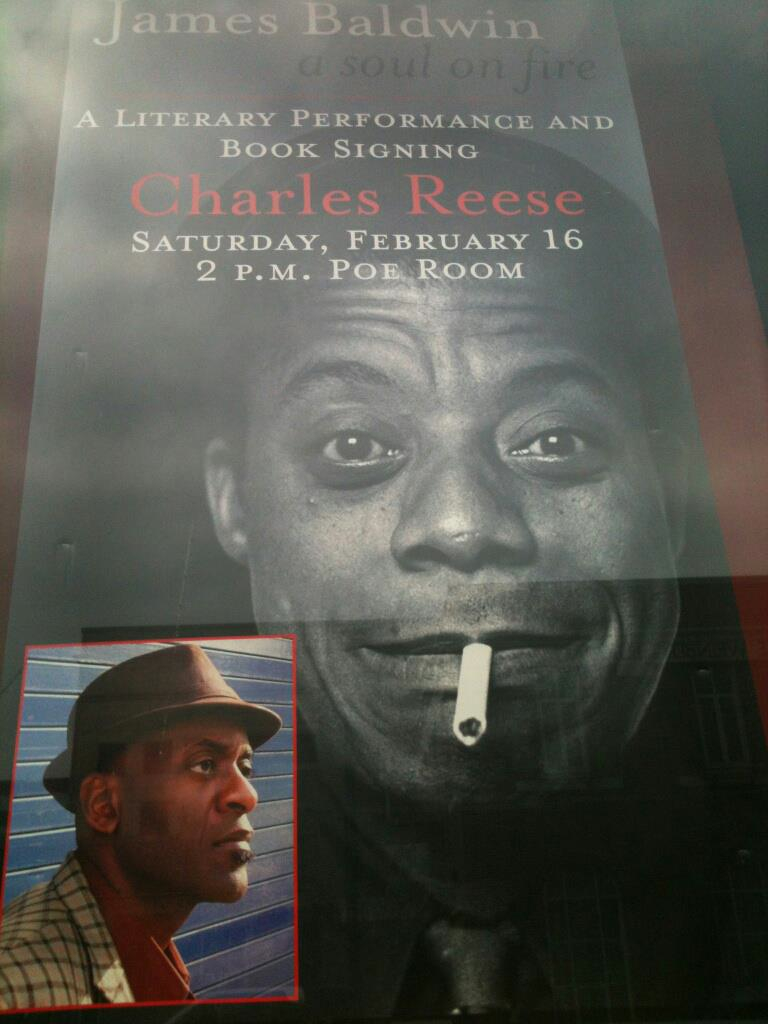
My good friend, actor-writer-curator-activist, and now editor, Charles Reese is but one of many keepers of Baldwin’s legacy.

Reese—who stays in Southwest Atlanta whenever he is in town—is pulling double duty in the legacy preservation department.  I learned about his plans when he and I had one of our long breakfast sessions at “The Beautiful Restaurant” on Cascade Road.

Back in the year 2000, Reese, a Morehouse College alumnus, had a daunting task.  He had to figure out a way to preserve, protect, and promote the work of his good friend, fellow Morehouse alumnus and playwright Howard B. Simon who died that year of complications brought on by streptococcus meningitis—He was only 37 years old.  Even more tragic, Simon never got a chance to read the great reviews theatre critics wrote about his seminal play James Baldwin: A Soul on Fire.

A Soul on Fire is not an account of what happened in Bobby Kennedy’s apartment that Friday in 1963.  It is, rather, Simon’s vision of what Baldwin did, said, and imagined the day before.

Via the dramatic genius of Simon and the bravura performance of Reese in the title role, the play captured the essence of Baldwin and the spirit of the 1960s.  With both Simon and Baldwin gone, Reese has not waivered in his determination to preserve the legacies of both men.

With a lot of tenacity (and a little help from his friends), Charles Reese has edited and published the play James Baldwin: A Soul on Fire by Howard B. Simon.*

Reese kicked off a book/play-signing tour on January 29, 2012 in Los Angeles with plans to go from city to city hosting book signings and reading salons, inviting the public to take part in the drama and the discussion.

I urge you to join the celebration of James Baldwin and Morehouse alums Howard B. Simon and Charles Reese.  The play James Baldwin: A Soul on Fire is available at: Amazon.com.

For more information about hosting a book-signing and play-reading event; and to keep up with Charles Reese’s many multimedia projects (The James Baldwin Project, the Howard B. Simon Literary Canon and The Charles Reese Experience), go to: The Charles Reese Experience.

For additional historical information about James Baldwin and Howard B. Simon; and to keep up with the plans to develop a film version of the play, visit: James Baldwin: A Soul on Fire.

*Finishing the last edits and details in late December 2011, Charles Reese chose 2012 as the target year to promote the publication of Simon’s play because this year marks the 25th anniversary of Baldwin’s death.  Baldwin’s body departed us on December 1, 1987 in Saint-Paul-De-Vence, France.  His Soul, however, is Still On Fire!  Peace.

Copyright © 2012 by Leslye Joy Allen. All Rights Reserved.

Leslye Joy Allen is proud to support the good work of Clean Green Nation.  Visit the website to learn more about it: Gregory at Clean Green Nation!

Creative Commons License This Blog was written by Leslye Joy Allen and is protected by U. S. Copyright Law and licensed under a Creative Commons Attribution-NonCommercial-NoDerivs 3.0 Unported License.  Any partial or total reference to this blog, or any total or partial excerpt of this blog must contain a direct reference to this hyperlink: http://leslyejoyallen.com with Leslye Joy Allen clearly stated as the author..