A Personal Bibliography (After “Four Little Girls”)

By Leslye Joy Allen                                                                                                     Historian, Educator, Theatre and Jazz Advocate & Consultant, Ph.D. Candidate

Copyright © 2013 by Leslye Joy Allen.  All Rights Reserved.

“Books II” by Leslye Joy Allen, Copyright © 2013.  All Rights Reserved.

“Books II” by Leslye Joy Allen, Copyright © 2013. All Rights Reserved.

When Erich McMillan-McCall, founder of Project1Voice said, “We need a bibliography,” I knew I was about to be called upon to begin pulling together books that focused on the lives and accomplishments of Black women.  I almost declined because there really is no shortage of books written by or about or which target Black women and girls as a reading audience.  The real task was not finding books, but rather which ones should be on the list.   Erich (pronounced “Eh-rish”) asked me to do this as part of his overall focus on Black women, but also in some ways as a response to the reading of the Christina Ham play “Four Little Girls” that streamed live online at the Kennedy-Center’s website at 6:00 PM EST on Sunday, September 15, 2013.

Although Diane McWhorter’s Pulitzer Prize-winning book Carry Me Home gives a detailed account of that fateful Sunday morning when Cynthia, Addie Mae, Carole, and Denise were killed, there is no book written exclusively about these four little girls who died in that church bombing on September 15, 1963.  Indeed, it can be debated that the White racist terrorists that bombed Birmingham, Alabama’s Sixteenth Street Baptist Church that ended the lives of these girls did not specifically set out to kill young Black females.  Often the targets of racial violence were and tend to be Black males, or at least many folks think the targets are always Black males.  After all, two Black boys, 16-year-old Johnny Robinson and 13-year-old Virgil Ware were shot and killed the same day in the immediate aftermath of the church bombing.  Yet, Black women and girls were not only routine victims of sexual violence, but were often beaten or killed with impunity during slavery, the era of Jim Crow, and well into and beyond the Civil Rights era.  Black female martyrdom and valor in the struggle for human and civil rights is often muted in favor of other types of narratives.  A perfect example of this is how most people view Rosa Parks.

Too often the public (and a few historians) mistakes Rosa Parks’ refusal to give up her seat to a White person in Montgomery, Alabama in 1955 as just an example of what happens when a Black woman simply gets tired of racial injustice.  But it was much, much more than that.  Historian Danielle L. McGuire aptly noted that Parks had a long career of dangerous work as an NAACP investigator in the decades before her fateful act in 1955.  McGuire also reported that the very first question Rosa Parks’ mother asked her after Parks was released from jail for her now-famous refusal to give up her seat to a white bus passenger was: “Did they beat you?”  That kind of question was, at one time, almost as typical for Black women as the sun coming up.

One way to dispel myths and increase our understanding of our lives and the world we live in is to read and do our own research.  One way to honor those four little girls tragically killed on that fateful Sunday in 1963 (and all of our Black heroines) is to examine and celebrate our resilient and diverse and often brilliant Black womanhood, a womanhood denied to them.  So here goes…

The books contained in the .pdf attachment at the end of this blog were my favorites and the first books that came to mind, along with a few marvelous book suggestions about Black female musicians courtesy of my good friend and alumna sister from Agnes Scott College, ethnomusicologist Dr. Birgitta Johnson.

Some books are old and some relatively new.   There are no separate sections where fiction is separated from nonfiction.  The only separate section in this bibliography is a section of books devoted exclusively to and for Black girls from preschool to middle school.  A few parents might find this useful.   I am also happy to report that books for and about Black girls is a growing industry.

My book list is not comprehensive.  For some of you who read all the time, you might find some glaring omissions.  I make no apologies.  I never choose a book simply because it was or is popular, and neither should you.   I also have not been fond of everything on the bestseller list now or in the past.  This list is MY LIST and it is hardly an exhaustive list of all the books I have read about Black women and/or any other subject.  Yet it is a beginning.  For those of you who read occasionally, you might find this list particularly useful so that you can begin that journey where you read and discover new things, new ideas, and new writers.

Now, for those of you who might be tempted to send me some remark about how I left out what you consider to be the “best book ever,” do not despair and save your energy.  The attached bibliography has an important page with a header that reads: “Add Your Favorite Books Here.”  THIS IS YOUR PAGE.  This is where I hope you will begin to write down the authors and titles of those books that have mattered the most to you.  I hope you will create your own bibliography, because if you do, we can begin to shape a real dialogue that is truly about ALL OF US.   I invite you to start one part of your/our journey by clicking here: **By, About, and For Black Women, a Personal Bibliography by Leslye Joy Allen.pdf**

Portable Document Files (.pdf ) have to be opened with an Adobe Reader.  If you have a problem opening the file above, please visit http://www.adobe.com, click on the section near the top of the page that is marked “Download,” then highlight and click “Adobe Reader” and download the Adobe Reader free of charge.

Also be sure to visit the Gist of Freedom, free podcasts devoted to preserving our rich African American History at: http://www.blackhistoryuniversity.com

Leslye Joy Allen is also a perpetual and proud supporter of the good work of Clean Green Nation.  Visit the website to learn more about it: Gregory at Clean Green Nation!

Copyright © 2013 by Leslye Joy Allen.  All Rights Reserved.
Creative Commons License This Blog was written by Leslye Joy Allen and is protected by U. S. Copyright Law and licensed under a Creative Commons Attribution-NonCommercial-NoDerivs 3.0 Unported License.  Any partial or total reference to this blog, or any total or partial excerpt of this blog must contain a direct reference to this hyperlink: http://leslyejoyallen.com with Leslye Joy Allen clearly stated as the author.

18 Days Earlier We Marched and then We Lost…

A staged reading of the play "Four Little Girls" streaming live online from the Kennedy Center on September 15, 2013 at 6:00 PM EST.

A staged reading of the play “Four Little Girls” streaming live online from the Kennedy Center on September 15, 2013 at 6:00 PM EST.

…FOUR LITTLE GIRLS

By Leslye Joy Allen

Historian, Educator, Theatre and Jazz Advocate & Consultant, and Doctoral Student

Copyright © 2013 by Leslye Joy Allen.  All Rights Reserved.

There were four little Black girls whose lives were snuffed out on Sunday morning, September 15, 1963 when a bomb planted by racist White terrorists exploded in the Sixteenth Street Baptist Church in Birmingham, Alabama.  They were, Denise McNair who was the youngest at age 11, Carol Robertson aged 14, Cynthia Wesley** aged 14 (**Real and Birth name is “CYNTHIA MORRIS”), and Addie Mae Collins was aged 14.  When that bomb went off, most Black Birmingham citizens and most Black Americans forgot about the “March on Washington,” held a mere eighteen days earlier on August 28.  Not long after the blast, all hell broke loose.  The New York Times headline on the following day read (click here for article): “Birmingham Bomb Kills 4 Negro Girls in Church; Riots Flare; 2 Boys Slain.

Birmingham, then nicknamed “Bombingham,” had an ugly history it would take decades to live down.  A middle class neighborhood in the city had suffered so many bombings that it was nicknamed “Dynamite Hill,” because angry Whites bombed homes to stop Black people from moving into the area.  Dynamite Hill was the neighborhood that honed and developed future Phi Beta Kappa scholar, radical activist, and author Angela Davis.  Yet, that is a story for another essay.  There are those of us, however, who think the story of what and who we lost on that fateful Sunday morning deserves its place in all the national narratives of American history.  I am one of those people; so is actor and activist Erich McMillan-McCall.

My friend, Erich is the founder of Project1Voice, an organization devoted to preserving Black theatre companies and our important historical legacies.  I should add that not only is he a multitalented performance artist with credits on Broadway, national stages, and television, he is also a visionary.  I say he is a visionary, however, with a very important acknowledgement of the type of communities that both of us grew up in as children.  Black women, he emphasizes, were at the center of these communities.  Yet, in several of our usual marathon-long telephone conversations, he has lamented that he is bothered by how Black women’s voices are not only muted or unacknowledged in the historical narratives, but also on the stage, and in the arts.

Erich and I are products of a time when to be young and Black and living in the American South did not necessarily mean that everywhere you went there was danger; what it tended to mean was the Black community in which you grew up was supportive, filled with a great deal of love and encouragement.  There were threats to our wellbeing, to be sure.  Yet, those threats largely came from outside the neighborhoods where we lived.  As much as some very sympathetic White liberal folks and some younger Black Americans have erroneously assumed otherwise, our Black parents and elders made sure we had normal childhoods with school, church, piano lessons, baseball games, concerts, plays, parties, and family picnics.  They did all of this for us in spite of the racism and the perpetual threat of (and often real) racial violence that characterized much of life for us during the 1960s and 1970s.  Erich understands this type of upbringing.

His proactive approach, that provides greater visibility to financially struggling Black theatre companies while engaging educational, civic, and political organizations in this collective struggle for artistic, political, educational, economic, and historical viability is not exactly a new way of doing things.  The Black community that I grew up in was filled with folks who could sing, dance, act, organize, who taught school, practiced medicine, ran businesses, and helped elect Black people to political office—This is what we were/are.  I loved this Black community, and the activism and the theatre it produced.  I still live in the neighborhood my family moved to when I was around the age of eleven.  It has not entirely lost those same qualities that it had during my childhood.  However, I fear that these types of communities become more rare with each passing decade.  At the same time, I am gratified and encouraged by Erich’s embrace of the old collaborative efforts of our neighborhoods and organizations that we remember about our childhoods; and his insistence that those qualities can be modified and used to great affect in the information age.  I hope this is the beginning of a new trend.

Sunday, September 15, 2013, is the 50th anniversary of one of our worst tragedies.  On this date, Project1Voice, in collaboration with Howard University, African Continuum Theatre Company, the Duke Ellington School of the Arts, and the John F. Kennedy Center for the Performing Arts will present a reading of the play “Four Little Girls,” written by Christina Ham, directed by Phylicia Rashad.  It will stream live online at 6:00 PM EST via the Kennedy Center’s website.

Targeted toward young audiences, this will be one of those wonderful opportunities to sit down in front of your computer screens with your children and your friends to watch this important piece of theatre and history—Free of Charge.  You should also check for viewing parties around the country.  Additionally, over thirty Black theatre companies around this nation will be presenting “Four Little Girls” simultaneously on the fiftieth anniversary of this national tragedy.

Erich and I both remember neighborhoods where middle class and working class Black families looked out for each other and each other’s children.  These facts, however, are precisely why the slaughter of Denise McNair, Carol Robertson, Cynthia Wesley** (**born as “Cynthia Morris,” but cited in the historiography and in most news reports as “Cynthia Wesley“) and Addie Mae Collins was so devastating to Birmingham’s Black community and other Black communities throughout the nation.  The reading of this play is not only a way to honor these dead children, but to also recall and remember the kind of stable and warm neighborhoods where all of them and us grew up.  Let us honor these little girls by going home again.  Peace.

Please visit: Project1Voice and the Kennedy Center for the Performing Arts for more information about this play; how to access the play via the internet on Sept. 15, 2013 at 6 PM EST; and for information about other great performances and programs.

Leslye Joy Allen is also a perpetual  and proud supporter of the good work of Clean Green Nation.  Visit the website to learn more about it: Gregory at Clean Green Nation!

Copyright © 2013 by Leslye Joy Allen.  All Rights Reserved.

Creative Commons License This Blog was written by Leslye Joy Allen and is protected by U. S. Copyright Law and licensed under a Creative Commons Attribution-NonCommercial-NoDerivs 3.0 Unported License.  Any partial or total reference to this blog, or any total or partial excerpt of this blog must contain a direct reference to this hyperlink: http://leslyejoyallen.com with Leslye Joy Allen clearly stated as the author.

** Shortly after this blog was published, I, Leslye Joy Allen, was contacted by Fate Morris, the brother of the young girl commonly known in historical and news records as “Cynthia Wesley.”  Fate Morris insisted that his sister’s real name is “CYNTHIA DIANE MORRIS,” and that authorities recorded her name incorrectly the day of the explosion.  Mr. Morris also informed me that he has decided to accept the Congressional Medal for his sister.  Originally he and Sarah Collins Rudolph (sister of Addie Mae Collins) had declined this medal.  Please read the following article about the survivors of this tragedy: “Survivor of ’63 Bombing Seeks Funds”** 

Please join Project1Voice‘s commemoration of the lives of these four little girls:

Mama’s Garden

by Leslye Joy Allen

Historian, Educator, Theatre and Jazz Advocate & Consultant, Doctoral Student

Copyright © 2013 by Leslye Joy Allen. All Rights Reserved.

cherry-tomatoes-plant Cherry Tomatoes Plant (available from: Public-Domain-Image.com)


“If you plant it in the earth, give it just enough sunlight, just enough water, and just enough nurturing, it will yield something.” – Syble Wilson Allen Williams (1921 -2013)

Now, when I think of teaching, I think about my Mama’s gardens and the first time I read the quote by author Gail Godwin who said that, “Good teaching is one-fourth preparation and three-fourths pure theatre.” 

A while back, I did not exactly understand the connection between teaching and theatre or any connection to my Mama’s conceptualization of gardening.  After all, was it not possible to be a gardener or agriculturalist without being an artist?  Even further, when I thought of theatre or any performance art, I thought and continue to think of people trained to act, sing, dance (or all of the above), and who are on stage for the sole purpose of entertaining and enlightening a receptive audience. 

The idea that a teacher and students were engaged in any kind of performance art escaped me until I stood in front of a classroom and gave a lecture without reading from any notes.  My Mama, Syble Wilson Allen Williams, understood the performance element in teaching the first time she set foot in a classroom to teach.  

Only after she died, however, did I begin to understand some other things about the “pure theatre” or the creativity of teaching that was not readily apparent to me when she was alive.

I remember how she would begin to count to ten in order to get her kindergarteners to take their seats.  “One…Two…Three…” she would say slowly and deliberately.  The objective was to have all of her students seated BEFORE she reached the number ten.  They would scramble to their chairs, each one determined not to be the last child to make it to his or her seat.

Then there were Mama’s famous gold stars that she posted next to the names of those kids who ate all of their lunch—they were the fabulous members of the “Clean Plate Club.” Many children decided to sample a vegetable that they really did not want to eat in order to earn that gold star.  Yet, she was at her most creative with her classroom gardens and her trips to the farm.

After Mama’s funeral service, our cousin James—who served as one of her pallbearers—told me that before her funeral began, four of her pallbearers were discussing their trips to farms and the gardens they helped to plant and tend when they were mere kindergarteners in her class. 

Four of Mama’s pallbearers were her former kindergarten students.  I remember when she made the switch from teaching third grade to kindergarten.  I also recall her comments about children who grew up in the city.  While she loved city life, she noted that children in cities rarely got much, if any, exposure to farm life.

Mama was born on a working farm in a tiny Georgia hamlet about forty minutes away by car from Atlanta.  She lived there until she was about nine years old.  Around her ninth birthday, her family migrated to Atlanta, as did so many Black rural families during and after the Great Depression.  The beauty is that Mama’s appreciation for her agricultural roots ultimately became a wonderful lesson for her students.

Back in the 1970s when she started teaching kindergarten, she told me one day that too many of her students really did not know anything about where their food came from or the teamwork required to run a farm. 

Eventually she located a nice man—whose name escapes me now—who had a small working farm in McDonough, Georgia complete with crops, chickens, pigs, and cows.  I only remember him as a middle aged, brown-skinned man who seemed tickled to death that the work he did as a farmer had some intrinsic value to Mama and her young students.

Every year she taught kindergarten she included a trip to that farm in McDonough, Georgia so that “her children” could witness the interaction of farmer and crop and cows and chickens.  The cows’ manure fertilized the soil that yielded the crops.  It was all organic and interactive.  Every year, she would have her five-year-olds plant a garden in their classroom. 

She would gleefully remark how they would become mesmerized when they would see something that they had planted in the soil begin to grow.  “Their eyes just light up at the first sight of the smallest bud,” she would say.  For me, the strongest memory was her garden at our house and her household plants.

Each year she grew tomatoes, cabbage, collards, and squash on a strip of land in our backyard.  I also recall one year she grew the hottest jalapeño peppers ever grown in the history of humankind—I remember it well; I ate one of those peppers and needed a couple of pitchers of ice water to cool the heat. 

Then there was her endless sea of green plants that lined our porch and windowsills.  She often noted that the tomatoes might not grow as big as you wished, but if you nurtured those seeds, you would still get tomatoes.  This was her lesson to her kindergarteners and to me: you always get something back if you plant something and nurture it.

Mama’s gardens and farming adventures were lessons in sheer creativity.  In these activities were a science lesson, another lesson that taught respect for animals’ contributions to our welfare and an appreciation for our natural environment, a lesson in how any one of us who had patience could nurture a plant from a seed or seedling to full bloom.  Even further, when I think of how many people never want to revisit their childhoods, I am comforted.  

Mama found beauty, resilience, and lifelong lessons in her own childhood, a childhood that she spent helping her parents and grandparents tend to plants and animals on the old family farm. Her students got a chance to share in a part of her upbringing.

On a nearly cloudless, sunny day in February of 2013, Mama had six pallbearers: one was a dear cousin, another was a family friend, and four were her former kindergarteners.  These six dignified, hardworking, respectable, responsible, and well-educated Black men—all over the age of forty—donned white gloves, and hoisted Mama’s coffin and took her to her final place of rest in the soil—soil she respected.  

Proudly, I watched them, as I am sure she did.  And then I thought, “If you plant it in the earth, give it just enough sunlight, just enough water, and just enough nurturing, it will yield something.”

Copyright © 2013 by Leslye Joy Allen. All Rights Reserved.

Leslye Joy Allen is proud to support the good work of Clean Green Nation.  Visit the website to learn more about it: Gregory at Clean Green Nation!

Creative Commons License This Blog was written by Leslye Joy Allen and is protected by U. S. Copyright Law and licensed under a Creative Commons Attribution-NonCommercial-NoDerivs 3.0 Unported License.  Any partial or total reference to this blog, or any total or partial excerpt of this blog must contain a direct reference to this hyperlink: http://leslyejoyallen.com with Leslye Joy Allen clearly stated as the author.

“Syble’s Poem” by Charles Reese (guest blog)

My friend Charles Reese wrote this poem in honor of my late mother Syble Allen Williams (March 1, 1921 – February 9, 2013).  Thanks Charles for this rare gift; it makes her passing a little bit easier to bear.  — Leslye Joy Allen

Syble Allen Williams in 2007 at age 86. (Copyright © 2007-2013 by Leslye Joy Allen) Syble Allen Williams in 2007 at age 86.
(Copyright © by Leslye Joy Allen)

Syble’s Poem

by Charles Reese

Today feels like a poem for Syble

Syble’s poem is moving

Syble’s poem is taking action

Syble’s poem is moving toward something unknown to man or woman

Syble’s poem is moving beyond the limits of state apparatuses, struggling to control freedom outside its natural formation

Where poems are her songs

Holding us up

Keeping us together

Walking in the Spirit

Shouting

Hallelujah

We are moved

We are changed

Because today feels like a poem for our newest Ancestor…

Queen Syble Allen Williams.

Welcome to the fold.

And so it is.

Ashé.  Amen.

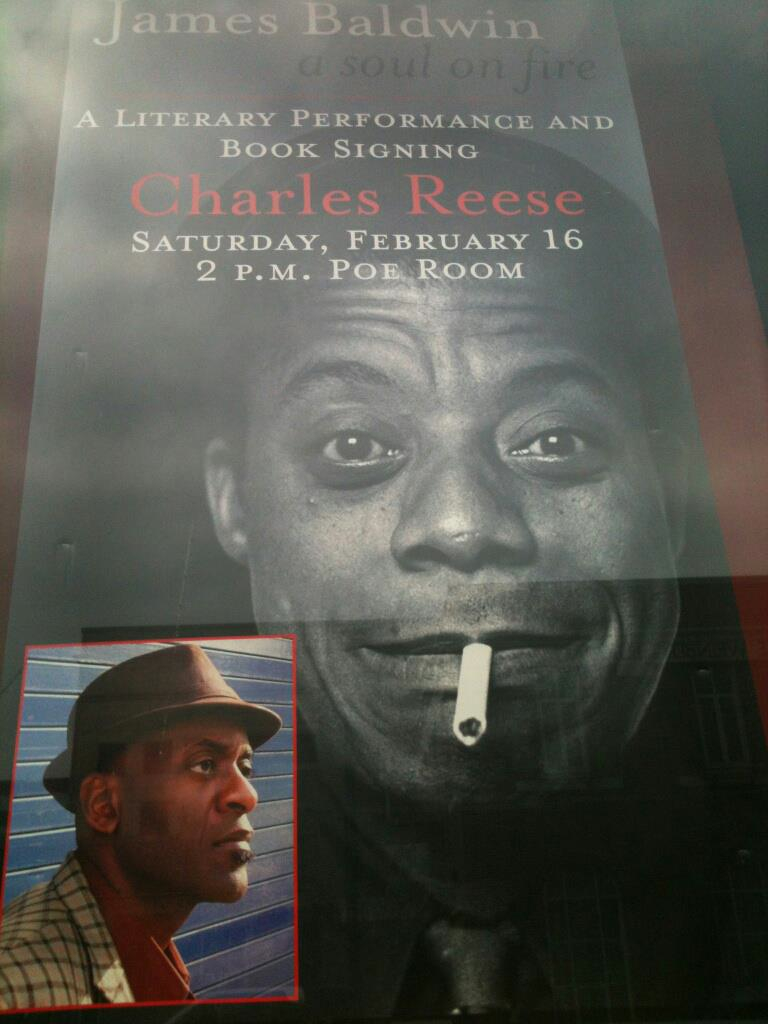
(Charles Reese is an Audelco Award-nominated Actor, Writer, Curator & Founder of The James Baldwin Project; and original actor & editor of the late Howard B. Simon’s Stage Play James Baldwin: A Soul on Fire, published by Glover Lane Press.)

Charles Reese: James Baldwin

Copyright © 2013 by Charles Reese.  All Rights Reserved.  No portion of this poem may be reprinted without permission from the author.

Creative Commons License

This Guest Blog by Charles Reese featured by Leslye Joy Allen is protected under U. S. Copyright Law and is licensed under a Creative Commons Attribution-NonCommercial-NoDerivs 3.0 Unported License.  Any partial or total reference to this blog, or any total or partial excerpt of this blog must contain a direct reference to this hyperlink: http://leslyejoyallen.com with Charles Reese clearly stated as the author and Leslye Joy Allen clearly stated as the owner of this blog.

Leslye Joy Allen and http://leslyejoyallen.com is proud to support the good work of Clean Green Nation  Visit the website to learn more about it: Gregory at Clean Green Nation!

The Persistence of Old Models / Old Beliefs

by Leslye Joy Allen                                                                                                      Historian, Educator, Theatre and Jazz Advocate & Consultant, Doctoral Student

Copyright © 2012 by Leslye Joy Allen. All Rights Reserved.

Last month, I had the good fortune to sit down with, break bread with, and drink good wine a couple of times with award-winning playwright, Black Theatre expert, and educator Paul Carter Harrison.  I have to thank fellow scholar R. Candy Tate for turning what was supposed to be our first meeting (to trade academic notes and talk shop) into a meeting where we added yet another spirited scholar to the mix.  This was one of those rare opportunities we graduate students receive where we can converse with someone who is, arguably, one of the first artists to seriously study Black Theatre and create a scholarly canon that tells us what Black Theatre is and what it is not.

However, I deliberately did not ask Paul about his many books (The Drama of Nommo or Black Theatre: Ritual Performance in the African Diaspora).  Among the many things we discussed was his frustration and anger about what he considered to be some younger playwrights, actors, and directors’ pandering to the tastes of White audiences; and an unfortunate dumbing-down of theatre, television and film in an effort to appeal to audiences of all races for the sole benefit of entertainment just for entertainment’s sake.  He was not ambiguous at all; he was livid.  He saw a disturbing trend where some Black performers decided to cater to what White producers and audiences—even well-meaning White folks—wanted them to appear to be on stage.  No more martyred Black folks, he said.  Exactly how many times must everything WE do be a response to some other group of people?  Exactly how many times must we be characterized as long-suffering and stoic or, for that matter, be the super baadaass Black man who always manages to rush in and save the day?  He made his point.

He saw this pandering as something that, while it might be quite commercially satisfying,  stifled Black creativity and stunted artistic risk-taking while it simultaneously applauded and rewarded the mundane, the ordinary.  He noted that this lack of vision, this lack of adventurousness, would eventually cause a lot of artists to hit a commercial brick wall.  He did not bite his tongue about the fact that certain Black stereotypes and certain Black archetypes had become the norm in film, on TV, and on the stage.  While Paul is a part of my larger ongoing research, which will not be discussed here, he did make me think about not only why artistic and scholarly risk-taking is necessary for growth, but also why stereotypes are particularly dangerous.

After our two marathon conversations, I thought about how people on both sides of the political and racial aisle, so to speak, hold onto and cling to certain images and ideas about Black people.  I have to honestly wonder whether, WE Black folks have any real friends who actually know US; that is, friends outside of our own racial/ethnic group.  I am not kidding; I mean this.  Aside from the racist who assumes that at any given moment I will be spitting out watermelon seeds or that I have bred babies like rabbits, there are also those White folks that go to other extremes.  They are so hell bent on proving that they are not racist that they see beauty and goodness in everything and everybody that is Black—and that is a fallacy as well.  Blackness and Black people become a fetish.  One of the first things that makes us, Black folks, human is our ability to be great or weak, right or wrong, smart or dumb, honest or dishonest.  Any belief, sentiment, or romanticism that strips us of the full range of human expression denies us our humanity, no matter how flattering those beliefs and sentiments might be.  It is dangerous to hold onto those kinds of extremes and expectations.

Only a few days after my meeting and hanging out with Paul, one of my History students, a young White male, told me about this funny video he saw.  According to this student, someone filmed security personnel in a department store.  In the video, all of the security personnel were following all the Black customers assuming that the Black customers would be the customers who would shoplift.  However, while security was following all the Black customers, White shoplifters were stealing everything they could get their hands on.  Both my student and I laughed, but the humor quickly faded when we began to consider what really happens when someone makes assumptions based solely and purely on race, or I should say, on racism.  Now, anyone with half a brain knows that people of all races and ethnicities steal for a variety of reasons.  Nevertheless, this video—that I have never seen, by the way—said something else about misconceptions based solely on race.

When people buy into any stereotype it does something more than degrade and devalue the victim of the stereotype, it tells everyone else exactly who they need to victimize or who they need to “not look like” or “not behave like” in order to get away with whatever they are attempting to get away with.  I am not going to say anything about Trayvon Martin, this time.  However, for all of those frightened and paranoid White folks (and Black folks) who live in gated communities in Florida and elsewhere, I have only one thing to say:  Beware of respectable looking young White males who may be walking through your neighborhoods.

While I am sure most of these young White men will not be planning to commit any crime or do anyone any harm, one of them might have decided that since he did not look a certain way that he could get away with certain things.  When you buy into and believe those old models and old beliefs, eventually, someone figures out that all they have to do is make sure they do not fit the model.  After that, they can get away with anything!  And for those folks who might be feeling guilty for believing the worst stereotypes about Black people,  the last thing you need to do is stop for some poor Black guy on the side of the road at midnight, just to prove a point.

The majority of us Black people work hard, pay our bills, take care of our homes and lawns, and never ever hurt anyone, but that does not mean that all Black people are saints.  If we could just let these old models and old beliefs go, we could proceed in this world based just on facts rather than assumptions.  Now, I have a Black elder statesman of Theatre and a young White male student to thank for raising the level of the discussion.

Copyright © 2012 by Leslye Joy Allen. All Rights Reserved.

Leslye Joy Allen is proud to support Clean Green Nation.  Visit the website to learn more about it: Gregory at Clean Green Nation!

Creative Commons License This Blog was written by Leslye Joy Allen and is protected by U. S. Copyright Law and licensed under a Creative Commons Attribution-NonCommercial-NoDerivs 3.0 Unported License.  Any partial or total reference to this blog, or any total or partial excerpt of this blog must contain a direct reference to this hyperlink: http://leslyejoyallen.com with Leslye Joy Allen clearly stated as the author.