Literacy Crisis, Part II

by ©️Leslye Joy Allen

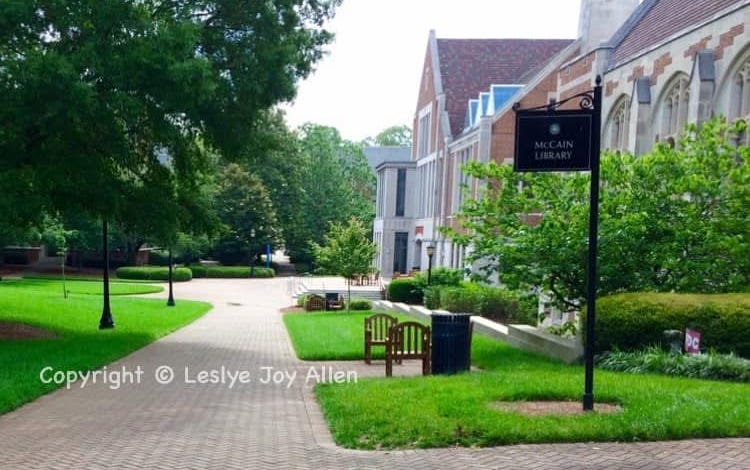
Back in November of 2024, I wrote a blog titled The USA Literacy Crisis & This Election where I bemoaned the fact that only 25 percent of American adults were currently reading above the 6th grade level. Don’t flatline, but that’s a fact we must face if we want to fight Felon 47.

I have also posted frequent videos of The Library Dads, founded in Atlanta, where young Black fathers take their small children to the library to read and to have a playtime session on a weekly and/or monthly basis. It is one of the most encouraging sights to see all these young Dads headed to the library for the sake of their children’s literacy and to spend time bonding with their kids and each other.

People who read always think deeper than people who rarely read. Critical thinking skills are virtually non-existent in people who do not read. Stimulating thought and critical thinking is essential to fighting Felon 47.

I looked at the percentages of voting eligible Americans, tabulated by the Cook Political Report Popular Vote Tracker in the University of Florida’s Election Lab General Election Turnout data, and saw that 36.70 percent of voters did not bother to vote at all. I don’t have any evidence, but I bet these non-voters don’t read much. 

Our political system was flawed even before Felon 47 won the Whitehouse a second time. Yet, thinking people, including some racists and sexists, know that going to vote is essential to the maintenance of our democracy. When over a third of voters stayed home, it spoke to a lack of depth and a lack of civic responsibility that is not easy to fix. 

So let me share this. I taught college History courses for 7 years. I would have to say that I enjoyed all of my students, except for a couple of them. One day in class a young white male student complained that he had to take History and English to fulfill the general requirements to earn a Bachelor’s degree. He was a Math Major so he felt like subjects like History and English were of no use to him. I let him talk and then reminded him that subjects like History and English inspire ideas, and would cause him to think more. “You will be a better mathematician,” I said.

The following week my class had a discussion about police brutality. This same student stated that he was unlikely to be the victim of police brutality simply because he was white. All of his classmates that represented all colors, races, and ethnicities looked at him like he was crazy. Two days later he was jaywalking. A police officer stopped him and this student decided to mouth off at the police officer who then promptly hauled him to jail.

When this student returned to class, his classmates were ready to poke fun at him. I stopped them, but I reminded this student that what he did not know could, would, and did hurt him. I reminded him that making assumptions without any proof or knowledge could cripple him. He then decided that maybe reading was essential. He turned out to be a pretty good student. 

So, if you have a friend, a kid, a relative, or a neighbor that never reads, take them to the library yourself. Encourage them to read. Give them book suggestions because whatever fight we put up against Felon 47 will require the most erudite fighters among us. We won’t win if we cannot outthink the enemies of democracy and fairplay.

©️Leslye Joy Allen

I am an Independent Historian, Oral Historian and Dramaturge. Please consider supporting my work with a few bucks for Coffee and Eggs via my CashApp.

All blogs written by Leslye Joy Allen are protected by U. S. Copyright Law and licensed under a Creative Commons Attribution-NonCommercial-NoDerivs 3.0 Unported License. Any partial or total reference to any blog authored by Leslye Joy Allen, or any total or partial excerpt of any blog authored by Leslye Joy Allen must contain a direct reference to this hyperlink: https://leslyejoyallen.com with Leslye Joy Allen clearly stated as the author.  Postings or blogs placed here by other writers should clearly reference those writers.  All Rights Reserved.
The 13th Amendment and El Salvador

by ©️Leslye Joy Allen

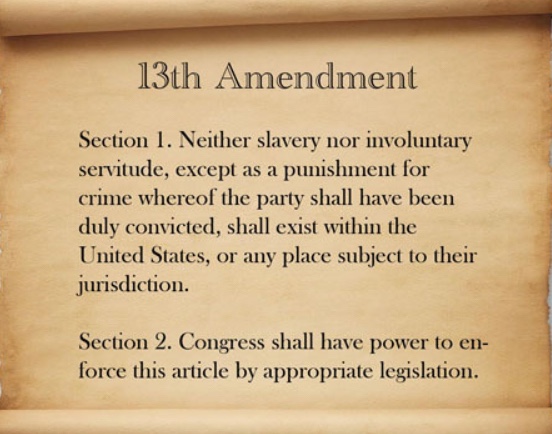
The first time I taught a US History class, I had my students study the wording of the 13th Amendment of the US Constitution and debate whether or not slavery had actually been abolished or had it simply been reconstructed: 

“Section 1. Neither slavery nor involuntary servitude, except as a punishment for crime whereof the party shall have been duly convicted, shall exist within the United States, or any place subject to their jurisdiction.

Section 2. Congress shall have power to enforce this article by appropriate legislation.”

By the time master filmmaker Ava DuVernay finished her documentary 13thI was salivating with anticipation. She did not and never does disappoint. She traced the origins of that loophole in the 13th Amendment that allowed for servitude to be imposed for crimes well into the 21st century. 

Slavery had/has gone away in some form. Yet, one of my favorite Black judges, the late New York Supreme Court Judge Bruce M. Wright noted the awful way Black and Brown defendants were treated. Wright earned the nickname “Turn ‘Em Loose Bruce” because he had witnessed one too many Black men and women end up in court because they stole something trying to feed their families only to be sentenced to anywhere from 10 to 20 years in prison. So, Wright gave them some minimal punishment, but he often turned them loose.

I remember his description of a case where a Black man had an extremely sick wife. Neither he nor his wife could afford her medicine. So, in desperation, the man stole a television set from the hotel where he worked. He pawned the television to purchase his wife’s medications. This man had never committed a crime before in his life, but he was sentenced to 10 years in prison.

Now here’s the next rub. For people old enough to remember, the only thing we knew for sure about prisoners when we were growing up was that prisoners pressed license plates. Well, folks that isn’t true anymore. Now American prisoners make…Clothing, Computers, Electronics, Furniture, and all that discounted stuff you find at Walmart and Target. US prisons generate anywhere from 2 to 5 billion a year in profit while prisoners who do the work never earn the standard minimum wage. 

So, as you rightly fight for and ponder the fate of Kilmar Abrego Garcia, an American citizen who sits unlawfully in a jail in El Salvador, think about Felon 47 and El Salvador’s Nayib Bukele giving each other a high-five and talking about not returning individuals who are wrongfully detained while they also discuss building more prisons in El Salvador. I’m going to leave it right there. 

©️Leslye Joy Allen

I am an Independent Historian, Oral Historian and Dramaturge. Please consider supporting my work with a few bucks for Coffee and Eggs via my CashApp.

You can also subscribe to my writings on Substack and stay in the loop with the best new research, history, journalism, prose, poetry, and etcetera.

All blogs written by Leslye Joy Allen are protected by U. S. Copyright Law and licensed under a Creative Commons Attribution-NonCommercial-NoDerivs 3.0 Unported License. Any partial or total reference to any blog authored by Leslye Joy Allen, or any total or partial excerpt of any blog authored by Leslye Joy Allen must contain a direct reference to this hyperlink: https://leslyejoyallen.com with Leslye Joy Allen clearly stated as the author.  Postings or blogs placed here by other writers should clearly reference those writers.  All Rights Reserved.

Black Women and Police: One Day on My Way to Agnes Scott College

by ©️Leslye Joy Allen

This essay is a revisit and an edit to a memory I wrote about 10 years ago, but a memory I hope might help someone else, particularly a Black or Brown woman.

Most of my encounters with police have been rare and routine. Most of the police officers I have dealt with have been courteous and helpful. I have made the occasional phone call about the neighbor whose dog has been running around the neighborhood terrorizing a few people. The police come out, speak with the offender, and the matter is resolved. Yet, I remember this incident…

A police officer discovered I had a “First Insurance Cancellation Suspension” on my driver’s license. For those of you born late in the 20th century, let me explain. An insurance cancellation suspension was common if you changed cars or changed insurance companies. You used to get a form in the mail from the Department of Motor Vehicles instructing you to record your new insurance or your new car. Occasionally, however, you might not receive the form by mail, and you could easily forget about it. 

If your new car/new insurance data had not arrived at the Department of Motor Vehicles when you bought a new car or changed your car insurance, you could end up with this particular type of suspension. You typically had to go to the Department of Motor Vehicles, show them your new purchase, along with your new insurance card.

In what appeared to be a routine road check for driver’s license and insurance, the Decatur, Georgia Police held me for three hours only a few months after I purchased a car from my elderly uncle. This happened in the spring of 1998 when I was back in college to complete my Bachelor’s degree at Agnes Scott College

After checking my Driver’s License number the officer stated that I had a “First Insurance Cancellation Suspension” on the car I previously owned. I showed him my new insurance card on the car I was driving. I knew I would have to straighten out the suspension before I drove any car again. Since I was about a mile from the campus, I asked him if he could radio the Agnes Scott College Police and have someone from that police department drive down the street, and pick me (and the car) up.

I explained that I would have my Mama come pick me up at Agnes Scott and we would go to the Department of Motor Vehicles and get the suspension problem cleared up. 

“I’m not calling anybody,” he yelled. I pulled out my student ID. He said, “I don’t need that. Girl, get out of the car.” I was a grown woman then in my thirties; and while I might not have looked as old as my birth certificate said I was, I was nobody’s “girl.” I kept my mouth closed, but I am sure he sensed my displeasure.

I got out of the car and he instructed me to lie down in the street. When I asked why are you doing this? He told me to shut up. While I lay down in the street for over 30 minutes, he and another two officers pulled the back seat out of my car. They searched the trunk. If it had not been for the little old man that came out of his house to watch, I do not know what else might have happened. I was terrified, but I suffer from something my Mama used to call, “Your Daddy’s Disease.”

She said my father never showed fear when under pressure. I don’t show it either. Daddy always looked fearless, even menacing, when some horrible event was going on. Then later when everything was all over, he would fall apart, shaking and reaching for a good stiff drink. “That kind of thing can get you killed, Joy,” Mama said, “When someone expects you to be afraid, sometimes the worst thing you can do is look like you have no fear.”

This event was before everyone had a cellphone. A female police officer appeared and asked me if I wanted to call my Mama using her phone. The first police officer decided to write me a simple ticket for driving with a suspended license and he left me standing there in the street. He drove off. 

That sweet little old man stood there and talked with me until Mama arrived. He told me he thought the Decatur police were doing some kind of sweep. “They’re looking for somebody that’s up to no good, and they’re tryin’ to find ‘em in these road blocks,” he said. Mama arrived in about 30 minutes and picked me up. My new best friend—that sweet observant little old Black man told me to leave my car where it was until the suspension problem was straightened out.

Them SOBs are probably waiting somewhere watching and waiting for you to drive off so they can give you another ticket or take you to jail. I’ll watch your car until you get back,” he said.

Mama asked me how my clothes got so dirty. I lied and told her I slipped and fell. She would have had a heart attack if I told her what really happened to her only child. We headed to the Department of Motor Vehicles. The clerk handed me a simple form that I filled out citing that I no longer owned the previous vehicle and therefore had no insurance on that vehicle. 

I had to write down the serial number and model of my current car and provide my proof of insurance. The clerk recorded my data and lifted my “First Insurance Cancellation Suspension.” All of this took about 20 minutes.

I did argue my case in traffic court. The police officer rolled his eyes at me as I explained in detail his refusal to call the Agnes Scott College police even after I showed him my student ID. I told the judge every detail and showed him my insurance card, the purchase of my car, and the statement from the Department of Motor Vehicles that lifted my insurance cancellation suspension. 

To add as much injury as I could, I said, “I missed my Latin Class because of this!” The judge dismissed my case. I paid no fine. I was lucky. Yet, I sensed that what happened to me was not rare. This kind of treatment happens to women, and particularly Black women and women of color, with a frequency that many people do not want to admit. 

Black women encounter more than our share of rudeness and physical intimidation from male police. This offending officer was Black. It’s easy to talk about racist cops, but it is not so easy to talk about SEXIST ones. And for the record, I don’t like Black men who are cops anymore than I like White men who are cops. Here’s the rub…

I consider myself to be an average size woman. By the time I was 50 years old, I managed to gain enough weight to make it to a whopping 135 pounds at 5 feet, 5 inches tall. At the time of this incident, I weighed only about 115 pounds. That police officer was at least 6’ 2” tall and weighed well over 200 pounds. He called me a girl. He told me to shut up. He did not throw me to the ground, Thank God. Yet, just imagine how easy it would have been for him to do so.

©️Leslye Joy Allen

I am an Independent Historian, Oral Historian and Dramaturge. Please consider supporting my work with a few bucks for Coffee and Eggs via my CashApp.

All blogs written by Leslye Joy Allen are protected by U. S. Copyright Law and licensed under a Creative Commons Attribution-NonCommercial-NoDerivs 3.0 Unported License. Any partial or total reference to any blog authored by Leslye Joy Allen, or any total or partial excerpt of any blog authored by Leslye Joy Allen must contain a direct reference to this hyperlink: https://leslyejoyallen.com with Leslye Joy Allen clearly stated as the author.  Postings or blogs placed here by other writers should clearly reference those writers.  All Rights Reserved.
The Intersectionality of Suffragist & Abolitionist Lucy Stone

by ©️Leslye Joy Allen

“Intersectionality is a metaphor for understanding the ways that multiple forms of inequality or disadvantage sometimes compound themselves and create obstacles that often are not understood among conventional ways of thinking.” — Kimberlé Crenshaw

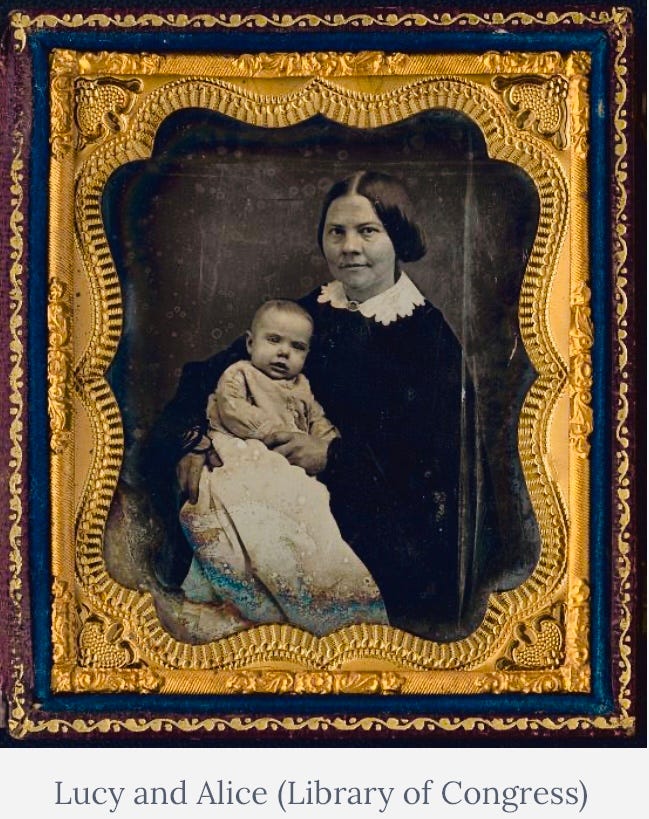
Recently, I responded to a question about the factors that stymied women’s quest for suffrage during the mid-to-late 19th century. I brought up the pragmatism and egalitarianism of suffragist and abolitionist Lucy Stone whose legacy remains largely overlooked. And therein lies the problem.

Susan B. Anthony and Elizabeth Cady Stanton have rightfully earned their place in Women’s history. They battled for the vote in ways almost unimaginable. Yet, they both held racist and classist views. Now before you start yelling about how both of them worked in the abolitionist movement, spare me. You can be anti-slavery and still not think the slave is your social or political equal. The inability to shake off one’s sense of entitlement has extreme consequences for everyone.

When lawmakers decided to include Black men as voters in the 15th Amendment without including the franchise for white women, both Stanton and Anthony were rightfully livid, but livid to the point where they then fought against the passage of the 15th Amendment altogether. It passed, however, in 1869 and was ratified in 1870.

Stanton wrote that it was unconscionable and dangerous to give the vote to Black, Chinese or Irish men because they were inferior. Anyone that did not fit a strict Anglo-Saxon and native-born status was considered inferior. Additionally, neither Stanton nor Anthony had thought about Black women voting at all. 

Stone broke with Anthony and Stanton over their racism. Orator, writer, abolitionist and former slave Frederick Douglass cut his ties to Anthony and Stanton as well. The tragedy was that Douglass had attended the Women’s Conference at Seneca Falls in 1848 and had been a huge and early advocate for women’s rights. Moreover, it was Lucy Stone’s brilliant oratory that had inspired Susan B. Anthony to join the suffrage movement.

Stone read the political winds correctly. She formed the American Woman Suffrage Association which concentrated on gaining women the right to vote on a state-by-state basis. She knew that Congress was not going to grant the franchise to everyone. 

Stone believed that the enfranchisement of Black men was progress. Although she was disappointed that the 15th Amendment did not include women’s suffrage, she did not believe that denying the franchise to others would help women in the long run.

Black men, rather than white women, were granted the right to vote first for a variety of reasons. As a historian, I know that the Republican Party in the 1860s was the party of Lincoln (not the sh*t show it is now) that freed Black American slaves. They controlled both the House and the Senate in 1867 to 1869. They knew that recently freed and enfranchised Black men would inevitably vote Republican and increase the party’s political dominance.

Granting the franchise to white women would have mixed political results as many white women still believed in the lost cause of the South in spite of its loss during the Civil War. They would have voted Democrat which was then the favored party of the former slave-holding South.

Some of Stone’s ideas were tied to her upbringing. She came from a hardworking farming family in Massachusetts. Both of her parents were abolitionists. While quite young, she, along with Lucretia Mott and Abby Kelly Foster helped William Lloyd Garrison establish the American Anti-slavery Society which was founded in 1833.

All of her brothers attended college. Yet, Stone had to postpone her education. She taught school for several years and was able to scrape up enough money to attend Oberlin College, the first college in the nation to accept Black people and women. When she graduated in 1847, she became the first woman in Massachusetts to earn a college degree.

Stone had planned to remain a single woman because she feared losing her independence to a husband. She finally yielded to Henry Browne Blackwell’s persistence. Blackwell was also an abolitionist and women’s rights advocate. Blackwell would learn years later that Stone finally decided to marry him after he met and aided a young slave with her owners while traveling on a train.

When Blackwell asked the girl would she rather be free, she answered “yes.” Blackwell and an accomplice helped get the young girl off of the train and away from her owners. It was that act of liberation that won Stone over.

When Blackwell and Stone married their written protest against laws that denied women equal rights was read before the ceremony. The promise “to obey” was removed from their wedding vows. Stone retained her maiden name and refused to pay taxes as long as she was denied her equal rights.

While neither Stone nor her contemporaries Anthony and Stanton lived long enough to see women receive the right to vote, their different approaches and beliefs underscored a perpetual problem in the quest for women’s equality and the right to vote.

Stone never stopped fighting for the rights of Black people as she continued her fight to get the vote for women. She believed that both causes were interrelated. The same cannot be said of Anthony and Stanton. 

The fight for the right to vote for women was often fractured by racism well into the 20th century. Stone’s stances on racial equality and equal rights for women cost her some popularity among some white women. Anthony and Stanton emerged as the face of white women’s suffrage. Yet, Anthony and Stanton also emerged as suspect to Black men and women. 

After Lucy Stone died of stomach cancer in 1893, her only child, Alice Stone Blackwell reached out to the daughter of Elizabeth Cady Stanton and began the process of repairing the divided women’s suffrage movement. They created a new coalition. Alice Stone Blackwell followed her mother’s mantra to make the world better.

Lucy Stone deserves more historical attention than she receives. Her example should be emulated precisely because she understood the “intersectionality” of gender and race (and the political implications that go along with it) long before Black scholar and lawyer Kimberlé Crenshaw coined the term and defined the theory in the late 20th century. Stone recognized that, no matter how different gender and race may appear, women’s equality was inextricably linked to racial equality. You must fight for both, not just one or the other.

©️Leslye Joy Allen

I am an Independent Historian, Oral Historian and Dramaturge. Please consider supporting my work with a few bucks for Coffee and Eggs via my CashApp.

All blogs written by Leslye Joy Allen are protected by U. S. Copyright Law and licensed under a Creative Commons Attribution-NonCommercial-NoDerivs 3.0 Unported License. Any partial or total reference to any blog authored by Leslye Joy Allen, or any total or partial excerpt of any blog authored by Leslye Joy Allen must contain a direct reference to this hyperlink: https://leslyejoyallen.com with Leslye Joy Allen clearly stated as the author.  Postings or blogs placed here by other writers should clearly reference those writers.  All Rights Reserved.
A Quick Word to Millennial (and Younger) Protesters and Activists

by ©️Leslye Joy Allen

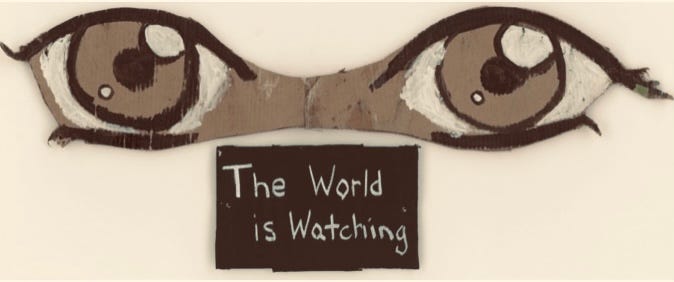
The photo below is of a creation titled “The World is Watching.”  The artist is not known. It is located at the Library of Congress which has a long history of collecting Protest Art and Protest Photography. Visually stunning and a reminder that protests and activism change with the technology of the times.

I was born during the last years of what was called the Baby Boom. As a Baby Boomer, I did not grow up from Childhood to Early adulthood with a Personal Computer, the Internet, and definitely not Social Media or a cellphone with a camera.

I learned of protest marches and various forms of activism via word-of-mouth, letters, signs on school and church bulletin boards, and via Black-owned newspapers. Sometimes these protests were featured on the 6 O’Clock News.

Fast forward to the late 20th and early 21st centuries and you have young adults who grew up with everything we Baby Boomers grew up without. Millennials get messages out there in cyberspace in a matter of seconds. They can rally thousands (even millions) of people with brief blurbs and blogs in a matter of a couple of days and occasionally a couple of minutes. There are, however, a few drawbacks.

In addition to creating mediums that make it seem as if a few “likes” on social media has resolved the problem, it also exposes certain tactics that should not be seen by everyone. Social Media exposes protest tactics to our enemies as much as it exposes those tactics to our friends. So let me share the following history. Ignore it; modify it; and/or adapt this in any way you see fit.

The Black American Civil Rights Movement typically had a 3-pronged approach. 

  1. Back in the day, you had a set of individuals who could not physically participate in protest marches because they were the folks who were designated to bail you out of jail if you were arrested. The folks who were part of the Black community who had a degree of affluence and wealth were often in this position. Although many of them were out there in the streets protesting. 
  2. Another group was the observers. These were individuals who lined routes of marches who watched and recorded what they saw. Sometimes they would stand on sidewalks and pretend to be window shoppers or they would sit near the windows inside places of business so that they could see what was going on outside in order to report what they saw. There were no cellphones with cameras in them back then. Their hardest role was to not intervene when they saw any physical violence. They had to record what they saw.
  3. Finally, there were the Black protesters themselves who were trained in non-violent resistance in order to highlight the sheer brutality of their oppressors. They were trained to endure and not fight back.

Now, I am not at all advocating for any of you to quietly endure any form of brutality and violence as you fight against this onslaught of abuse from the administration of Felon 47. What I am suggesting is that you create a 3 or even 4 or 5-pronged approach to how you protest and advocate for the causes you believe in.

Right now, activism is highly tied to how much press and social media presence one can generate. That’s not a bad strategy, but the limitations of that approach is that almost anyone can see it. You win most against enemies when enemies do not know EXACTLY what is coming at them all the time. And that is not my original idea. It actually comes from Sun Tzu, a Chinese General and Strategist born around 544 B.C.E. Some ideas stand the test of time. Study those ideas. Onward!

©️Leslye Joy Allen

I am an Independent Historian, Oral Historian and Dramaturge. Please consider supporting my work with a few bucks for Coffee and Eggs via my CashApp.

All blogs written by Leslye Joy Allen are protected by U. S. Copyright Law and licensed under a Creative Commons Attribution-NonCommercial-NoDerivs 3.0 Unported License. Any partial or total reference to any blog authored by Leslye Joy Allen, or any total or partial excerpt of any blog authored by Leslye Joy Allen must contain a direct reference to this hyperlink: https://leslyejoyallen.com with Leslye Joy Allen clearly stated as the author.  Postings or blogs placed here by other writers should clearly reference those writers.  All Rights Reserved.