I know a lot of great actors and Henry G. Sanders is one of them. I have watched him perform for over 50 years from “The Killer of Sheep” to “Dr. Quinn Medicine Woman” to “Selma” and beyond. His most recent and notable role has been the character “Prosper Denton” on Ava DuVernay’s “QUEEN SUGAR.”
Yesterday I was relieved when Henry, who lives in Altadena, California, texted me to let me know that he and his family were okay, but “We lost the house.”
It hurt to think of this gracious man, at age 82, having to rebuild. And contrary to popular belief most actors are not rich. The stories about how Henry and his wife have taken in so many struggling young people are too numerous to mention in a single blog. His generosity with his time to me will never be forgotten.
When I started to hear negative commentary about Kamala Harris’ racial and ethnic background, I started reevaluating how “White Supremacy” works again.
Many people are completely unaware that when the Greek explorer Herodotus named the continent “Αἰθιοπία” (romanized as “Aithiopía”), his definition included the continents of Africa, India, and Southeast Asia. Herodotus’ term literally means “Land of Burnt Faces.”
Those kinds of cross-cultural connections and collaborations do not help white supremacy to flourish which is why you rarely hear anything about them. The objective of white supremacy is to make certain that peoples of color look to white folk, and white men specifically, for acceptance, guidance, deliverance, and redemption, but not to each other. Sexism works exactly the same way. A man, not a woman, may rule you and grant you favor in some screwed up patriarchal world as sexists imagine it.
African-American scholar W. E. B. DuBois’ heir apparent Vijay Prashad noted that many Indian men arrived in the USA in the late 18th and 19th centuries, married Black American women and disappeared from most histories. Suraj Yengde, both in his books and in his portrayal of himself in Ava DuVernay’s masterpiece film “ORIGIN,” noted that we must find reconnections with each other. His research on Dr. Bhimrao Ambedkar is fascinating.
Ambedkar was a Dalit, or as he was once called, an “Untouchable.” He wrote India’s constitution. He earned two doctorate degrees and when he came to the United States he wanted to meet his fellow American untouchables. So, he visited Harlem where the Black folks lived. (FYI: Martin Luther King, Jr. was introduced as a fellow “untouchable” when he visited India.)
This is exactly what Shyamala Gopolan-Harris did when she left India to go to school in the United States. She gravitated toward communities where she was less likely to be mistreated. So, she headed to Berkeley, California which was a hotbed of activism—there were Civil Rights protests, anti-Vietnam protests, the Free Speech Movement and the work of the Black Panther Party in nearby Oakland was the world that her daughter Kamala Harris grew up in.
I bring this up because we know so little about our early histories and connections. I don’t bring this up with any foolish idea that everyone is going to suddenly start singing “Kumbaya” and start getting along all the time. Yet, we know more about what Prashad accurately identified as white power structures that, during the late 20th century, deliberately created the myth that “Southeast Asians” were a model minority, a minority he emphasized that was designed as a weapon against Black Americans.
Felon 47 and his minions have lined up a small cadre of Southeast Asians to serve in his administration to do two things: 1) make the administration look less racist than it is and, 2) to also entice India, which now has a larger population than China, that its population is seen somehow as superior. South Africa did damned near the same thing during apartheid.
When Black Americans visited South Africa during its apartheid era, Black American visitors were given passes written in Afrikaans that translated into English as “Honorary White Person.”
Now, the fact that I personally know at least seven Southeast Asians who identify quite accurately as “Black,” does not matter. The fact that so many folks on the continents of Africa and Southeast Asia have near identical DNA doesn’t matter either. When I read the book “A Passage to India,” I noted that an Indian character in the book was described as a “little Black man.” It was the first time I ever saw such a description of anyone outside of a specifically African or African American context. My point, however, is much simpler.
We Black Americans can continue to roll our eyes at the brown guy wearing the turban at the local gas station and vice-versa OR we can recognize and identify our participation in upholding white supremacy while its foot remains situated on both our necks. Before you bother to tell me about the guy at the gas station that you don’t like, remember that he is an employee and all you are is someone pumping gas. White supremacy makes all of us its pawns.
If you are honest, you also remember that moment when you got bad service at a Black-owned business and thought to yourself that you got bad service because the business was Black-owned. The fact that there are, were, and will be folks who simply are not good at customer service regardless of their race or ethnicity or nationality did not enter your mind. That kind of thinking is white supremacy in action too.
Kamala Harris knows this better than anyone. She knows who she is and she didn’t need anyone to tell her who she is. The fact that anyone dared define her speaks not only to their arrogance, but also to their presumptions that they actually have such a right to do so.
She was perceived by some folks as a contradiction and by some folks as having split loyalties. The only thing that actually requires split loyalties is white supremacy. It cannot thrive or survive without its clear contradictions. Let me write that again—It cannot survive or thrive without its clear contradictions. It functions with the assistance of the people who it is designed to either oppress and/or control and/or regulate. Repeat that until you get it. So, no contradictions.
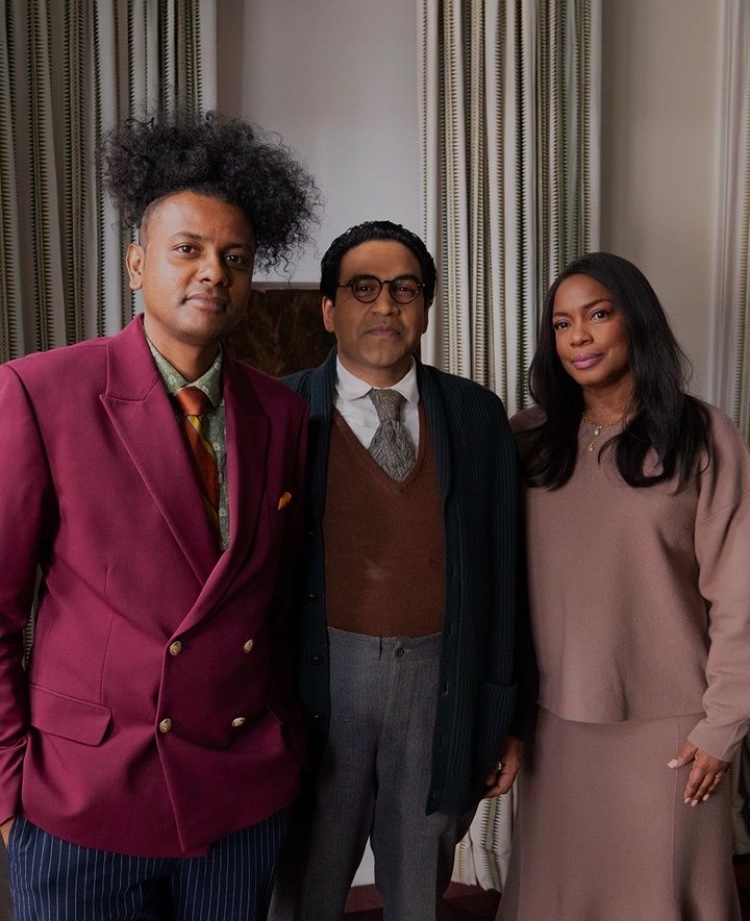
Dr. Suraj Yengde (as “himself”), Dr. Gaurav J. Pathania (as “Dr. Bhimrao Ambedkar”) and Aunjanue Ellis-Taylor (as “Isabel Wilkerson”) in Ava DuVernay’s film “ORIGIN.”
My late mother struggled with infertility for 13 years before I was born. She told me that not only did doctors test my father’s sperm, but that she had her Fallopian tubes blown out with hot water. Many times she was in so much pain from the treatments that she couldn’t bend down to tie her shoes.
When I was born, my parents were 3 and 4 months away from turning ages 40 and 41, respectively. Mama and Daddy decided on the name “Leslye” because it was gender-neutral and also because my father did not particularly care for the practice of men naming sons after themselves.
“A boy either has a reputation to live up to or one to live down,” Daddy used to say. Anyhow, my name, had I been born a boy, would have been “Leslye Charles Allen” which would have included only my father’s middle name.
My late mother discovered the spelling of “Leslye” in a Reader’s Digest article where a young woman with that name and spelling was being sent on a tour of Europe as her graduation present from her parents.
When Mama brought the name and spelling of “Leslye” up to her good friend Esther Flournoy, my Aunt Esther said, “Cooter (their nickname for each other), what will be the middle name if your baby is a girl?”
Mama told me that she honestly did not know. At that moment, Aunt Esther said, “I like names like ‘Faith,’ ‘Hope,’ and ‘Joy.’”
Mama tried all combinations of these names until she arrived with “Leslye Joy.”
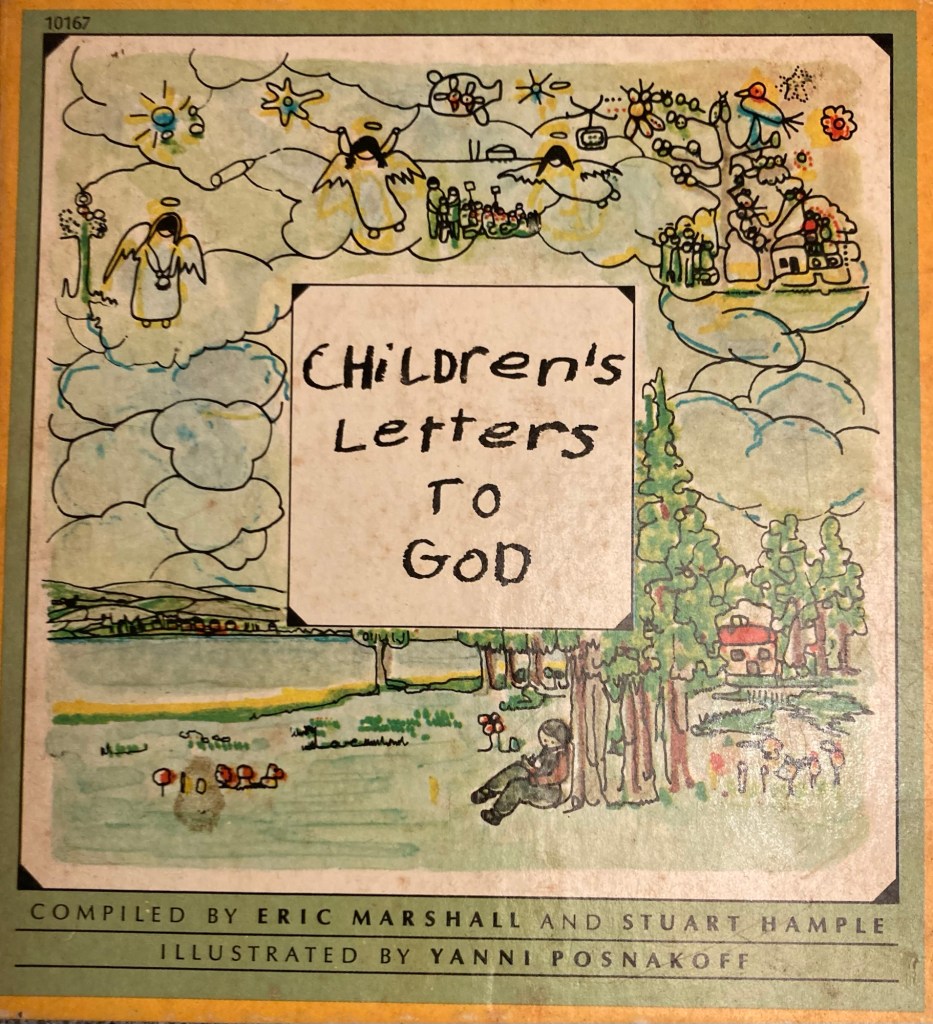
The hilarious and thought provoking book “Children’s Letters to God,” first published in 1966, was the very first book given to me by someone other than my parents.
It was given to me by the woman responsible for my middle name. Most of my classmates from Saint Paul of the Cross Elementary School and Saint Joseph High School never knew my first name was “Leslye” until long after we graduated.
Yet, I have had college professors, most notably Dr. Waqas Khwaja, and those wonderful women who cooked and fed me while I was a student at Agnes Scott College, just simply start calling me by my middle name “Joy” as if they all automatically knew that my middle name was the one that had the most love and history behind it. I was and remain warmed by that.
I cannot remember everybody’s Mamas first names, but here is what I know.
There is not a Black woman in Atlanta born between say 1945 to 1965 that can name 3 Black women that were bigger bad asses than their own Mamas who had names like Dorothy, Mary, Geraldine, Syble, Sadye, Carrye, Sarah, Hattie, Laware, Mattie, Helen, Mignon, Gloria, Etta Mae, Carolyn, Violet, Lena, Sophia, Vivian, Myrtle, Evelyn, Mamie, Miriam, Frances, Geneva, Cora, Doris, Andrea, Delores, Agnes, and the list goes on. I am sure I have left out a name or two, but…
think of just three women that might outdo your Mamas in any one of their endeavors. Try to do that so that you will fail and know how lucky you are and on whose shoulders you stand. Try it so you know how much you deserve rest, support and praise. Try it so you know you don’t owe anyone anything. They owe you.
Let me first extend my deepest sympathies to the family, friends, and fans of DMX (né Earl Simmons). Full disclosure: I am a Traditional Jazz, Bebop, CuBop, Afro-Latin Jazz, Tin Pan Alley, Soul/R&B, Johnny Mathis music fan. Aside from a couple of Rap tunes, I am not much of a Rap/Hip Hop fan. My former students keep me up-to-date on the genre. So, this blog is not going to be filled with memories about when I first heard this very talented man who died too soon. I do hope, however, that DMX’s passing does more than have us publicly bemoan the perils of substance abuse, but rather, we Black folks start thinking seriously about mental health. I have no way of knowing if DMX had any form of mental disease, but a lot of drug users do…
Way back in the day, a friend as close as a brother, had a pattern of woofing down about FOUR 16-ounce Schlitz Malt Liquor Beers, coupled with about a fifth of Vodka, in one sitting over a couple of hours. Yet, I never saw him drunk. He would sleep 8 hours, then get up fresh as a daisy and go to work the next day. This was his daily ritual. He never had a hangover, if you can believe that. I couldn’t understand how he did it. Later, he was diagnosed with “Mania,” often an early symptom of Bipolar Disorder. The excessive booze was his way of self-medicating, of literally slowing down his brain that was constantly racing on all cylinders. The excessive alcohol made it possible for him to function, even if it was an unhealthy way to get some relief.
Now, drug abuse can cause mania, but drug use can also be a response to the mania itself. When I learned that DMX—a long term, off-and-on-again substance abuser—had a massive heart attack that put him in a coma with little brain function, I wondered if the source of his inability to permanently kick his drug habit was rooted in an undiagnosed mental illness. I don’t know. We may never know, but it is certainly a possibility.
We, in the Black community, have a serious mental health crisis precisely because, en masse, we don’t take mental illness seriously enough. Mental illness is not prayed away; it has to be treated. We casually and often humorously say that people have “lost their minds,” but sometimes they have actually done just that—lost their minds. A failure to seek treatment or to encourage someone to seek treatment means the disease gets worse. Sometimes, as in the case with my old friend, using both legal and illegal substances are signs of a larger problem that, if identified, can be successfully treated.
Today, the second leading cause of death for Black youngsters from the ages of 10 to 14 is suicide. Let me repeat that: Today, the second leading cause of death for Black youngsters from the ages of 10 to 14 is suicide. And now it is estimated that Black children are more likely to commit suicide than white kids. When you have time, just read the data: Addressing the Crisis of Black Youth Suicide.
No matter what mental or physical problems led to DMX’s erratic drug habits and premature death, it was fairly obvious that he was an immensely talented man. We will read one tribute after another in his honor. Inevitably, people will mention how he “battled his demons.” They will easily recall when they heard DMX say something profound, something that changed their lives. What too many of them will not say is when they noticed a change in his behavior or habits or health or moods, and then tried to do something about it. And that’s not just a problem, it’s a shame.
Let’s do something more palpable than wring our hands and hang our heads in prayer. Say something to friends and family members when you witness erratic behavior and/or substance abuse. Pay attention to your own mental and physical health. Pay attention to your children’s mental and physical health. Call a psychiatrist, a physician whenever you believe it necessary. Ignore people who tell you that you are over-reacting. Help stop the trend of us losing too many of our people much too soon. Àṣẹ.





 Leslye Joy Allen