DEI: Flipping the Script With ARRAY

by ©️Leslye Joy Allen

I remember when master filmmaker Ava DuVernay started AFFRM which stood for African-American Film Festival Releasing Movement. Later she modified it and renamed it ARRAY which has gone on to release one masterpiece independent film after another by Black women, Women of Color, white Women filmmakers and other Black filmmakers.

Goddess knows that Ava’s television series Queen Sugar remains my all time favorite television series of all time, right up there with POSE. Her film ORIGIN completely shattered every boundary of how a film infused with activism and history could be made and change minds. If you haven’t seen that film, I really don’t consider you a member of the Left if you haven’t done so. If you watch it, you will not be the same. You will never think the same; and every assumption you ever had, you will rethink it.
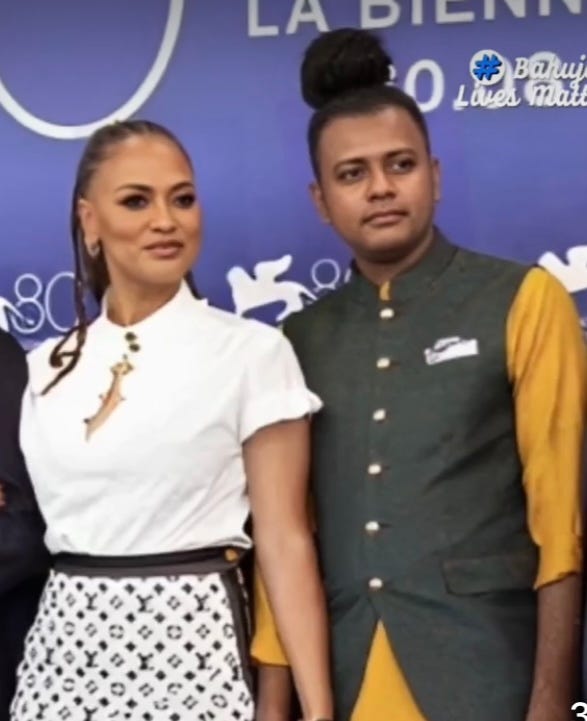
(Ava DuVernay here with Dr. Suraj Yengde who portrayed himself in the film ORIGIN. The film received a 9-minute standing ovation at the Vienna Film Festival in 2023.)

There was one thing Ava did when Queen Sugar hit the airwaves. She decided that only women, and particularly Black and other women of color, would direct the show. She gave over 40 women directors their television directorial debuts because, she reasoned, if she did not do it they would never be given the chance. 

The irony is that DuVernay’s production of Queen Sugar earned recognition as one of the most ethnically and racially diverse crews in television history. Ain’t that something?

So, here’s something to think about. Ava DuVernay has some real badass men around her. Yet, ARRAY was and still is staffed primarily with women; and this company has run like a top since its inception.

So, here’s something else to ponder. Since Felon 47 is hellbent on controlling women, eliminating the histories of Black people and other POC from the record, and granting companies the right to not give a good Got-damned whether any of us will be hired for any job, isn’t it just as plausible for us to not hire or phuck with any of them?

I mean, if I am a Black woman running a successful business and I don’t want to be bothered with sexism or racism, then I can simply not hire any man of any color and not hire any white person of any gender. And what I will be doing will be perfectly legal under the administration of this president. Marinate on that for a moment.

©️Leslye Joy Allen

I am an Independent Historian, Oral Historian and Dramaturge. Please consider supporting my work with a few bucks for Coffee and Eggs via my CashApp.

All blogs written by Leslye Joy Allen are protected by U. S. Copyright Law and licensed under a Creative Commons Attribution-NonCommercial-NoDerivs 3.0 Unported License. Any partial or total reference to any blog authored by Leslye Joy Allen, or any total or partial excerpt of any blog authored by Leslye Joy Allen must contain a direct reference to this hyperlink: https://leslyejoyallen.com with Leslye Joy Allen clearly stated as the author.  Postings or blogs placed here by other writers should clearly reference those writers.  All Rights Reserved.

Buzz About Boycotts

by ©️ Leslye Joy Allen

I’m delighted that folks have decided not to shop on February 28th as an act of solidarity to demonstrate to businesses what our buying power means. It’s a great beginning, but to have real impact boycotts need to last for months or years.

Let me share the following. The image on the left is the now boarded up storefront of what was Buzz Coffee and Winehouse in my hometown Atlanta. The image on the right is from a few years ago. It’s myself and my brother-from-another-mother, actor, writer, poet, cultural curator, and James Baldwin expert Charles Reese. We took this photo sitting at Buzz’s tables on the sidewalk drinking hot coffee out of big mugs.

Buzz was a neighborhood hangout where you might get to view a photo or art exhibit. You might stop by for a breakfast sandwich or piece of pastry. You ran into people you knew and you met people you didn’t know but soon found out the trip was worth it in order to meet them.

Buzz closed a few years ago because the money-grubbing c*nt that owned this little strip of property where Buzz was located raised the rent until the owner of Buzz could no longer afford to stay open. The owner has vowed to reopen somewhere, but so far I haven’t seen any signs of a new location.

Now, there’s a Starbucks about a mile down the street further southwest. I have nothing against Starbucks or people who enjoy Starbucks coffee. Yet, I won’t be going there to get a cup of coffee, just like I won’t be buying Folgers that supports Project 2025.

I only suggest this. When you’re keeping your money in your pocket, take a good hard look at the small businesses in your neighborhood and ask yourself how you can help them? Ask yourself what products can you do without permanently? Then just do it.

©️ Leslye Joy Allen

All blogs written by Leslye Joy Allen are protected by U. S. Copyright Law and licensed under a Creative Commons Attribution-NonCommercial-NoDerivs 3.0 Unported License. Any partial or total reference to any blog authored by Leslye Joy Allen, or any total or partial excerpt of any blog authored by Leslye Joy Allen must contain a direct reference to this hyperlink: https://leslyejoyallen.com with Leslye Joy Allen clearly stated as the author.  Postings or blogs placed here by other writers should clearly reference those writers.  All Rights Reserved.

Race and Reproductive Rights

by ©️Leslye Joy Allen

I remember a conversation with my late cousin Billie Allen, who was an actor, dancer and stage director. She was here in Atlanta in 2003 directing her close friend, actor Ruby Dee in “Saint Lucy’s Eyes,” a play written by Bridgette Wimberly.

The play was about a woman who performed back room abortions for young women who were in serious trouble. The protagonist named “Old Woman” performed abortions out of mercy and out of a sense that those pregnant women were having their futures derailed by unplanned pregnancies.

Billie mailed me a copy of the play before it came to Atlanta’s Alliance Theatre, and not long after it had a successful off-Broadway premiere at New York’s Women’s Project Theater in 2001. Turning me into her personal dramaturge again, she and I discussed the hot topic of abortion. Then she shared with me something I did not know.

She told me that back in the 1940s and 1950s, when a Hollywood actress became pregnant and had too many professional and contractual obligations to a studio, she typically went to Puerto Rico to have an abortion.

I soon learned that in 1937, the Puerto Rican legislature made abortion and contraception legal. It also made sterilization legal. That’s the kicker—sterilization. An island with a population of people, many of who have Indian, African, and Spanish ancestry were often seen as expendable.

Puerto Rico’s legislature voted with all of the eugenicist and racist taint that emanated from the United States’ highly racist sterilization programs that were completely in line with the eugenics (racial cleansing) going on in Nazi Germany.

I mentioned to Billie that I had seen a short documentary called “La Operación,” by Ana María García back in the early 1980s. It was a documentary about how people involved with “population control” arrived in Puerto Rico in the 1950s and 1960s and sterilized about a third of the island’s women who were of childbearing age.

While there were certainly Puerto Rican women who no longer wanted to have more children, many women were sterilized without knowing exactly what was being done to them.

Puerto Rico was the location of where the first large scale trials of birth control pills took place before “the pill” debuted in 1960 in the United States. Various pills were first tested on a tiny group of women in Boston. Yet, the largest group of clinical guinea pigs were Puerto Rican women; other women of color in the Western hemisphere soon followed.

In 1933 Margaret Sanger, long heralded as a leader in the birth control movement, wrote in Birth Control Review that “Eugenic sterilization is an urgent need …We must prevent multiplication of this bad stock.” People of color were the bad stock.

In 1939 in a letter to Dr. Clarence Gamble, one of the architects of the United States’ eugenics movement (and heir to the Proctor & Gamble fortune), Sanger wrote that they should use Black male ministers to appeal to Black women to get them to agree to be sterilized. She sought to use Black women’s typical deference to Black clergy to accomplish her mission.

By 1955 biologist Gregory Pincus visited Puerto Rico and found it the best location to test birth control pills. After all, the island had no laws preventing contraception. Pincus and his partner John Rock, a gynecologist, promoted their work as poverty-prevention by making it possible for poor Puerto Rican women to have fewer babies.

And here we cisgender women are right now in 2025. We all worry about losing the right to make decisions about our own bodies; and we should. Yet, early birth control and abortion initiatives were never about women having the right to make their own reproductive choices.

The primary objective was to slow or stop the biological reproduction of any woman who did not belong to an accepted class or status of women classifiable as “white.”

Without fully understanding the racist origins of the state’s reproductive control over women, you will miss its original intent. Reproductive procedures, no matter how necessary they are, remain a political football; and Puerto Rican women, and other women of color were its first sacrifices.

©️Leslye Joy Allen

I am an Independent Historian, Oral Historian and Dramaturge. Please consider supporting my work with a few bucks via my CashApp.

My copy of the script of “Saint Lucy’s Eyes,” and one of several promotional posters for “La Operación.”

All blogs written by Leslye Joy Allen are protected by U. S. Copyright Law and licensed under a Creative Commons Attribution-NonCommercial-NoDerivs 3.0 Unported License. Any partial or total reference to any blog authored by Leslye Joy Allen, or any total or partial excerpt of any blog authored by Leslye Joy Allen must contain a direct reference to this hyperlink: https://leslyejoyallen.com with Leslye Joy Allen clearly stated as the author.  Postings or blogs placed here by other writers should clearly reference those writers.  All Rights Reserved.

For Henry G. Sanders

by ©️Leslye Joy Allen

I know a lot of great actors and Henry G. Sanders is one of them. I have watched him perform for over 50 years from “The Killer of Sheep” to “Dr. Quinn Medicine Woman” to “Selma” and beyond. His most recent and notable role has been the character “Prosper Denton” on Ava DuVernay’s “QUEEN SUGAR.”

Yesterday I was relieved when Henry, who lives in Altadena, California, texted me to let me know that he and his family were okay, but “We lost the house.”

It hurt to think of this gracious man, at age 82, having to rebuild. And contrary to popular belief most actors are not rich. The stories about how Henry and his wife have taken in so many struggling young people are too numerous to mention in a single blog. His generosity with his time to me will never be forgotten.

One of his relatives has started a Go Fund Me campaign to help Henry and his family. Here’s the hyperlink: https://www.gofundme.com/f/help-my-family-rebuild-after-eaton-canyon-fire.

I hope you will give generously.

©️Leslye Joy Allen

Ava DuVernay asks for help for Henry G. Sanders and his family.

All blogs written by Leslye Joy Allen are protected by U. S. Copyright Law and licensed under a Creative Commons Attribution-NonCommercial-NoDerivs 3.0 Unported License. Any partial or total reference to any blog authored by Leslye Joy Allen, or any total or partial excerpt of any blog authored by Leslye Joy Allen must contain a direct reference to this hyperlink: https://leslyejoyallen.com with Leslye Joy Allen clearly stated as the author.  Postings or blogs placed here by other writers should clearly reference those writers.  All Rights Reserved.

A Thought About Black Panther

By Leslye Joy Allen

Copyright © 2018 by Leslye Joy Allen.  All Rights Reserved.

“Royal Purple” by © Leslye Joy Allen

This is not a review of the film Black Panther.  This is a brief musing about what crossed my mind after I saw this film.  First, Black Panther is unapologetically “Black.” I use “Black” here to indicate that while the film is set in the fictional African nation of Wakanda, it also includes Africans of a variety of ethnicities, African Americans and a genuine nod to the entire African Diaspora most of whom are descendants of former slaves in the West.  I am a member of that African Diaspora. The film also gives a few cultural nods to the Ndebele, Yorùbá, Maasai, and Akan peoples on the African continent (thank you, actor-vocalist-friend Saycon Sengbloh for pointing this out first).  The film gets the multi-facted roles of African women so very right.  The film also has some serious messages unlike any messages you have ever heard in a Marvel Super Hero movie.  Don’t worry, if you have not seen it yet, I’m not going to ruin it for you.  All I can say is that it is an entertaining joy ride of a film that will make you think…really, really think.  With that said, here’s what I thought about immediately after I saw Black Panther.

Black Panther has stirred up a genuine sense of pride in Black Americans that we don’t get to feel with this much enthusiasm too often.  It has taken decades of hard work to undo some of the psychic and spiritual damage done to Africa’s descendants in the West who have endured brutal chattel slavery, Jim Crow, systematic racism and discrimination, police brutality, you-name-it.  It has taken decades of hard work and scholarship to undo some of the psychic and spiritual damage done to Africa’s descendants in the West who, for centuries, were told that Africa had no real history, no real contributions to civilization when all of what these descendants were told is/was/remains patently false.  However, it is dangerous to over-romanticize any history; to make any and every description of our African ancestors totally positive. Black Panther, in its own unique way through fiction, de-romanticizes history by showing us a multi-ethnic, multi-generational Wakanda with all the friction and righteous compromise and conflict such diversity can foster.  You leave the movie theater proud, but fully aware that Africans (and we African descendants) have tremendous gifts and flaws not because we are or ever have been inferior or superior, but rather because we are human.

I remember a lecture given by the late African scholar, Dr. Ali Mazrui back in 1996 where he stated that to deny Africans the ability to be wrong was also the same as denying them their humanity.  Dr. Mazrui was always controversial.  He said the only African-American activist that he had any real respect for was Randall Robinson, the founder of Trans-Africa. When asked why he only dug Robinson, Dr. Mazrui said, “Robinson not only raises his voice when Whites do something wrong to Africans, Robinson speaks out when Africans are doing something to wrong to other Africans.”  I’ve never forgotten that statement and what that statement truly means.

When you love your people, you praise them when they are right and you don’t make excuses for them when they are wrong.  You work to correct them.  You speak out against racism, colonialism, and the exploitation of your people no matter who the adversary is.  That lecture by Dr. Mazrui, and so many lectures given by visiting and former professors drove home that I could not afford to care as much about how Africans and African-descended peoples looked to the rest of the world more than I cared about how well or how poorly they/we all were doing.  If you love your people you don’t worry about what their image is and how it affects you as much as you worry about their well-being, period.  Black Panther shows just how difficult that can be, but it also shows that it can be gloriously done…

Now, if you don’t exactly understand this post, it is probably because you have not seen Black Panther yet.  It could also be because you know very little about the continent of Africa’s very complicated history.  However, my points will be clearer once you’ve opened a few books and taken the ride to Wakanda.  So, get to the movie theater.  You won’t be disappointed.  Wakanda Forever.

Copyright © 2018 by Leslye Joy Allen.  All Rights Reserved.

This blog was written by Leslye Joy Allen and is protected by U. S. Copyright Law and licensed under a Creative Commons Attribution-NonCommercial-NoDerivs 3.0 Unported License. Any partial or total reference to this or any blog authored by Leslye Joy Allen, or any total or partial excerpt of this or any blog by Leslye Joy Allen must contain a direct reference to this hyperlink: https://leslyejoyallen.com with Leslye Joy Allen clearly stated as the author. All Rights Reserved.