To End Crucifixion

by ©️Leslye Joy Allen

The first time I heard of crucifixion outside of a biblical context I was watching the film Spartacus, released in 1960 that starred Kirk Douglas. I was in high school in the 1970s when I first saw the film on television.

Crucifixion was one of the most excruciating and barbaric of all forms of execution. The person on the cross, slowly and agonizingly, died from suffocation as their rib cage was forced upwards. They could not fully breathe and eventually they died.

No moment in the film Spartacus brought me more tears than the fight scene when the slaves “Spartacus” (Douglas) and “Antoninus” (played by Tony Curtis) were forced by Roman authorities to fight each other to the death.

Spartacus and Antoninus, who loved each other like brothers, were determined to kill one another in order to spare the other the agony of crucifixion. Spartacus eventually kills Antoninus. In grief, Spartacus yells at his tormentors, “He’ll come back. He’ll come back; and he’ll be millions.”

That scene gave me the sense that when the best people die, they will somehow be reincarnated and other people of goodwill will join them. That belief, however, has never brought me much comfort.

MAGA supporters are not likely to understand my interpretation of the themes in the film Spartacus. They follow orders, not facts. They don’t think of people on the Left, or people of peace as anything other than unrealistic and subhuman. They don’t think compromise with people with whom they disagree is anything other than a show of weakness.

MAGA adherents of all races and ethnicities believe in White male supremacy in a world that gets browner by the day. While U. S. Immigration and Customs Enforcement officers round up every undocumented brown worker they can find, Felon 47 wants to annex countries inhabited primarily by people classifiable as white.

White male supremacy only functions when people believe in the stereotype of the “Great White Father” who is considered the only one fit to lead and to appoint others to important positions. This is part of the reason why a lot of voters voted against their own interests and against their own people.

Felon 47 supporters always claim to be Christians. I do not entirely trust the Christianity formulated in the Western World because the people who formulated it cannot even so much as admit that there is virtually no such thing as a person classifiable as “white” that was/is native to any location in the Middle East or North and Eastern Africa.

A sandy blond-haired, white-complexioned, blue-eyed Yeshu’a has always been a lie. So, when you engage with MAGA supporters (and many anti-MAGA folks) you are engaging with people where generations of their families have prescribed to the lie for centuries. Felon 47 stepped into a centuries old illusion, proclaimed himself to be sent by God, then went around autographing Bibles.

I can count on one hand the Christian ministers I respect; most of them are women. They inspire. They pray. They analyze. They talk about justice. They talk to you like you have a brain; and they do so without the big egos and the expectance of deference I have encountered from a few too many clergymen.

At the end of all discussions and analyses, Yeshu’a’s life still ends the same way. No matter how good he was, he was still executed by crucifixion which was the Roman Empire’s method of execution for paupers and other petty criminals.

No matter how popular an itinerant preacher Yeshu’a was, church fathers and the Roman government considered him a threat to their power; and they used every lie, every smear campaign against him until many of his own followers turned against him and called for him to be put to death.

I do wonder when we, particularly those of us in the Western World, will get sick of that perpetual narrative where someone has to die in order to free us?

Must the good man or the good woman always be the sacrifice? Or, have we absorbed a skewed Western Christian Worldview for so long that we cannot even imagine any form of salvation, deliverance or peace without someone being killed?

Is some form of crucifixion inevitable or merely a twisted human habit where we refuse to think our way out and fight our way out of problems we cannot completely face so that we require a martyr to prove we were, at least, thinking in the right manner? That kind of thinking should not ease our consciences.

Maybe I’m a fool, but I still think that if we learned anything—even from an edited and modified form of Christianity—it ought to be that goodness and mercy and fair play may get someone jailed or killed, but it should not have to be that way.

Church services are often filled with sermons that make Yeshu’a seem more like a spirit than a flesh and blood man who once walked the earth. And if it is true that he died for our sins, exactly when do we accept that the point of his crucifixion was for us to do more than just acknowledge the awful habits of human history where we persecute or allow good men and women to continue to be persecuted?

Felon 47 and his underlings corrupt every precedent set by Yeshu’a. They resemble the Roman government and its sycophants while they embrace the Nihilistic principles of a 19th century Russian Party that used terrorism and assassination as part of their reform.

MAGA supporters and Felon 47 let people be detained or die in order to stave off the inevitability of the collapse of the White Western World. But will we, who know Felon 47 is wrong, fight to stop the deaths, persecutions, and detentions of people who only want to work and feed their families?

Will we ever admit that the story of Yeshu’a’s crucifixion means that we are charged with ending the blood-letting, the needless assaults, the threats? Will we ever be brave enough to end needless persecutions; or will we watch these modern-day crucifixions as if we were watching the fight between Spartacus and Antoninus thinking that it is only a movie. So, no one actually died.

©️Leslye Joy Allen

Tony Curtis (left) ; Kirk Douglas (right) in the film SPARTICUS, 1960. Alamy Stock Photo

All blogs written by Leslye Joy Allen are protected by U. S. Copyright Law and licensed under a Creative Commons Attribution-NonCommercial-NoDerivs 3.0 Unported License. Any partial or total reference to any blog authored by Leslye Joy Allen, or any total or partial excerpt of any blog authored by Leslye Joy Allen must contain a direct reference to this hyperlink: https://leslyejoyallen.com with Leslye Joy Allen clearly stated as the author.  Postings or blogs placed here by other writers should clearly reference those writers.  All Rights Reserved.
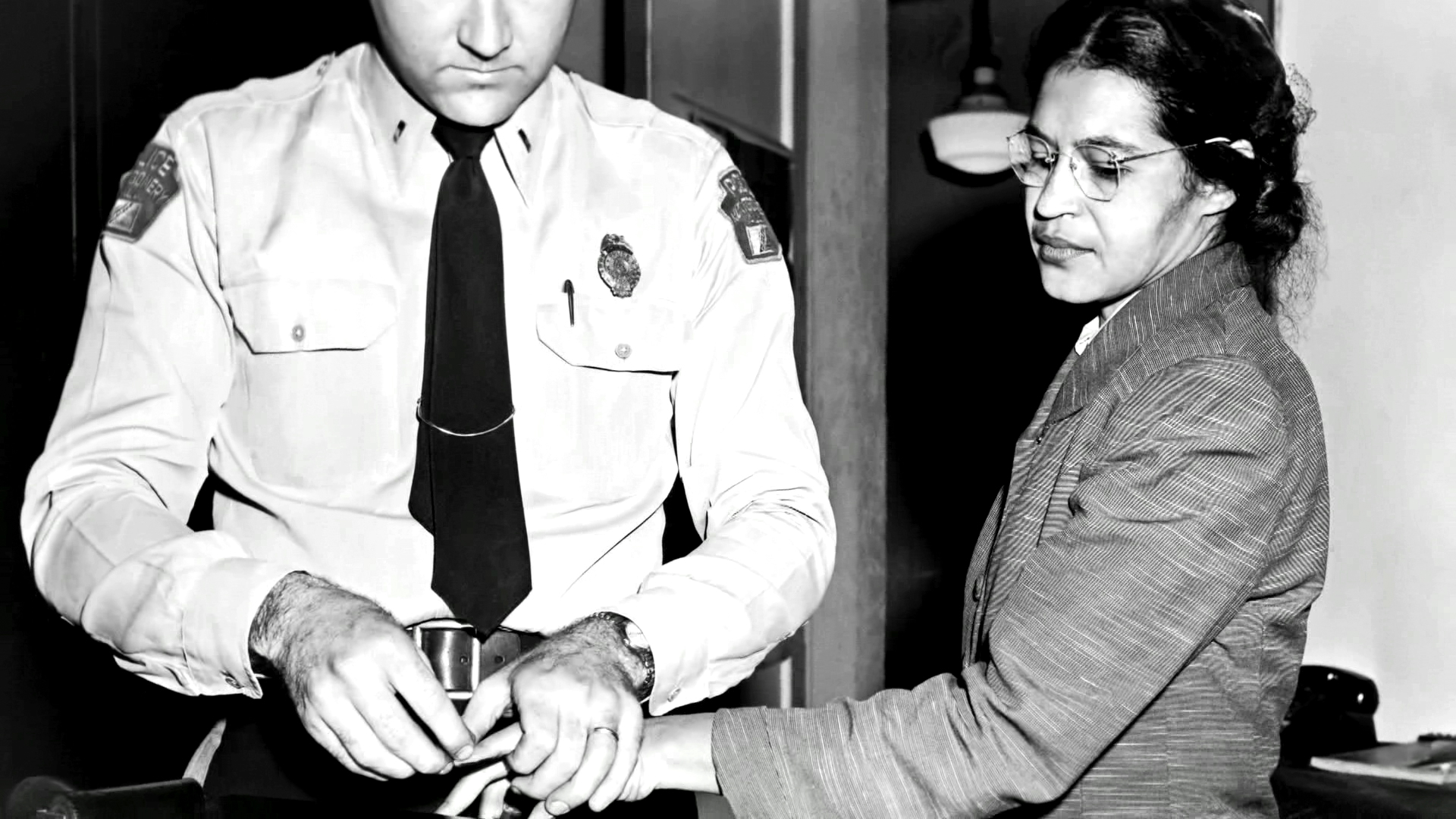
Woman Boycott

Rosa Parks Being Fingerprinted 1955

by Leslye Joy Allen

What if every male member of clergy in this nation arrived at his church on a Sunday or Saturday morning and not a single woman or girl was seated in the pews, or in the choir loft.  Let’s say there were no women who ushered, and importantly no women putting money in his collection plate. And let’s say that every woman church goer decided to hold her own prayer meetings at a home or some other large venue with all of the other women that had stopped attending and working for these churches.

Now, let’s pretend that all of these women did this for over a year, just like the overwhelmingly Black female majority of bus riders did in Montgomery, Alabama during the Montgomery Bus Boycott of 1955-1956, the one sparked by Rosa Parks.  And what if women stopped worrying about whether they fell out of favor with their pastors, even if many of their pastors were good men? What if they set up their own soup kitchens and their own counseling centers and homeless shelters and never asked Reverend So-and-So for his opinion, his input or his permission?

If women did all of the above in response to the weak and pathetic way too many male ministers have responded to the problem of women’s and children’s sexual abuse and harassment, I bet a lot of male ministers would rethink being apathetic or silent about this issue. I bet a lot of male ministers would rethink ignoring or condoning this kind of behavior.  I bet a lot of male ministers would also do this out of the fear that without his female church members, he might end up at the unemployment office or in the soup line.  Just a thought. Àṣẹ!


I’m still not blogging as much for a while…So, you are welcome to read my older blogs until I return later (trust, there is some good stuff in my archives at my blog)…I have to get my dissertation finished, and blogging and responding to every little detail is not on the agenda…In the meantime, stay focused, and stay woke, and for God’s sake don’t fall for the easy answers because the news media is full of “easy answers.”  Do your research.  Think for yourself.  Peace and Blessings. I will see you when I see you.  — Leslye Joy Allen

This blog was written by Leslye Joy Allen and is protected by U. S. Copyright Law and licensed under a Creative Commons Attribution-NonCommercial-NoDerivs 3.0 Unported License. Any partial or total reference to this or any blog authored by Leslye Joy Allen, or any total or partial excerpt of this or any blog by Leslye Joy Allen must contain a direct reference to this hyperlink: https://leslyejoyallen.com with Leslye Joy Allen clearly stated as the author. All Rights Reserved.


They Should Live Where You Live

by Leslye Joy Allen

Copyright © 2016 by Leslye Joy Allen. All Rights Reserved.

“Self Portrait” by Copyright © 2015 Leslye Joy Allen. All Rights Reserved.

“Self Portrait,” Copyright © Leslye Joy Allen. All Rights Reserved.

I am not going to rant about the deaths of unarmed Black men and women, and unarmed men and women of color killed by police or those who have unnecessarily died in police custody.  As someone who was once harassed by police, I need no convincing that this nation has a policing problem.  (And I’m too exhausted with the campaigns for President of the United States to make any commentary about that.)  Yet, as much as this nation has a problem about the often poor relationships between police and communities of color, I would add that it is dangerous to make or create a single national narrative about these relationships. We need several narratives and they need to be local.  Let me give you a scenario that paints one local picture about where I live.

On that rare occasion when I have called police, I typically got a quick response.  And I live in a 99.9% Black middle class Atlanta neighborhood.  Typically, the only time the police are called on the street where I live is when someone has a dog that barks late at night (this usually requires a phone call to Animal Control, as well), or when some kids are playing music too loud and late at night; but none of this happens with any real frequency.  Some homes are occupied by renters who often have to learn that some things are not tolerated in this subdivision.  Now, one of the key differences about my subdivision’s relationship to police is that there is a small group of neighbors, all of who are homeowners, who regularly speak with police about anything they see as out of the ordinary.  I also learned from these same neighbors to call the Non-Emergency Police Line and request that an officer come out to see you personally.  You do this when you want a small matter handled without getting someone arrested.  Let me give you an example.

A dog was barking continuously late at night.  I rarely saw the pet’s owner because she worked odd hours.  She was a renter, looked to be maybe twenty-something years old, but I did not know her, and I rarely saw her long enough to speak to her about the dog.  A neighbor had placed a note in her mailbox about the dog, but nothing happened.  I was awakened late at night and in the early morning to this barking dog for about two weeks.  Every night he would bark, I would go look out my windows to make sure there wasn’t some stranger or some intrusive animal lurking around the house.  I never saw anything.  I called Animal Control, first.

Animal Control said call the police because the owner of the dog was violating a Noise Ordinance by allowing the animal to stay outside and disturb the peace after 10:00 PM.  I called the Non-Emergency Police Line.  The officer that answered the phone asked if I had contacted Animal Control.  I told him that I had spoken with Animal Control, and then I asked him to send a police officer to my home so that I could speak with them.  Because it was not an emergency, he told me someone would come by in about two hours.  In roughly 45 minutes a police officer was pulling up in my driveway.  I walked outside and spoke to the officer, and told him about the dog.

“What do you want me to do?” he asked.  I said, “I want you to go over to her house and just tell her that she either needs to put the dog in the house at night or get the dog one of those collars that deters barking.  Let her know about the Noise Ordinance law because she might not know this. I don’t want anyone cited for anything.  I just need you to let her know that the dog is keeping people up late at night.” 

The police officer did exactly what I asked him to do.  He came back and told me he had spoken with the woman.  Since all backyards on my street are fenced in, it is quite typical for pets to remain safely outside in one’s backyard during the day or night.  I reasoned that because she worked odd hours, often at night, she probably never heard her dog creating a disturbance.  That same evening before she left for work, she put her dog inside her house so the pet would not wake up her neighbors.

Now, what I did to resolve this small problem here in Atlanta might not work somewhere else.  It might not even work in another section of Atlanta.  In a different town or neighborhood, I might have been harassed (or possibly, shot) because I dared complain about a barking dog; and the police might not have even bothered to come out to speak with me or with my neighbor about what the police considered a trivial matter.  In some scenarios, where you live matters almost as much as the color of your skin or the nature of the problem.  However, too often the narratives or plans of action, come from national leaders who do not have a clue about the relationships between police and citizens in any particular neighborhood or town.  Furthermore, what works in Atlanta might not work in New York City and then again it might work in New York City.  Yet, Atlanta is not New York City is not Ferguson is not Baltimore is not Chicago, and etcetera.

Many powerful public voices are speaking out against police brutality and the need for more meaningful dialogues between the police and people in the communities the police are supposed to serve.  They are right for doing so.  Yet, many of those national and/or regional voices do not live where you and I live.  In fact, many “so-called” local activists do not live where we live.  Every Black person I know, knows of at least one activist minister who only visits a particular neighborhood to preach on Sunday, while that same minister no longer lives in the neighborhood where the church is located, but rather lives in some distant suburb.  We all know at least one activist politician who is always speaking out about something that has gone terribly wrong in one of our communities.  The problem is that minister or politician often never sets foot in the neighborhood in question until there is a problem or until it is election time.  Their voices may be necessary, and much of what they have to say might be useful.  Yet, they should not be the only voices defining the narrative about how to address these problems.

If you want to find out more about the police where you live, you can and probably should stop by a nearby police precinct and introduce yourself.  You will find out rather quickly how cordial those police are to you in a few minutes.  It never hurts when a few police officers know you as a law-abiding citizen that tries to look out for your neighborhood.  Additionally, when there is a real problem in your neighborhood, you might get a much swifter response because of that relationship.

Yet, you should also carefully monitor and choose who should speak for you and your community.  Whoever it is ought to know the lay of the land, how the people who live there interact with each other and with law enforcement officials.  It ought to be someone that has a personal vested interest in where you live, not simply someone who shows up when a problem arises so that they can get some good press coverage.  It ought to be someone who lives where you live.

Copyright © 2016 by Leslye Joy Allen.  All Rights Reserved.

This blog was written by Leslye Joy Allen and is protected by U. S. Copyright Law and licensed under a Creative Commons Attribution-NonCommercial-NoDerivs 3.0 Unported License. Any partial or total reference to this or any blog authored by Leslye Joy Allen, or any total or partial excerpt of this or any blog by Leslye Joy Allen must contain a direct reference to this hyperlink: http://leslyejoyallen.com with Leslye Joy Allen clearly stated as the author. All Rights Reserved.