
by ©️Leslye Joy Allen
For people who have been reading my posts, you may have noticed that I have written about the United States’ severe literacy crisis twice on this platform. If not, you can read them here: The USA Literacy Crisis & This Election and Literacy Crisis, Part II.
This essay is Part III. Let me point out a few things first. Some 65 years ago in 1960, the United States was one of the most literate nations in the world. In 1960, only a handful of states in this country had an illiteracy rate of 10% for people aged 14 and over. The rest of the states registered only about 3% illiteracy. Now we rank 36th in the world for literacy among industrialized nations. There are other sources that place the USA at a literacy rate much lower.
In 2025, 21% of American adults are completely illiterate while 54% of adults read below the 6th grade level. I want to share with you in this essay, however, what poor reading and writing skills look like when these circumstances are also combined with educational red tape.
I taught College History courses for roughly 7+ years, from 2007 to early 2015. My first 2 years, I taught at a Junior College that had several campuses outside the city limits of Atlanta in the outlying metropolitan areas. My last 5 years I taught at large state universities. Junior Colleges are structured for students who have some academic deficits. Students often attend Junior Colleges to fix a deficit in some academic discipline so that they can eventually qualify to attend a four-year institution to earn a Bachelor’s degree.
When I started teaching, I taught year round. After I taught on this particular campus for about two semesters, I noticed that this campus was slowly being converted into a cash cow. The school started accepting anyone who could pay tuition and occasionally referred to students as “customers.” That did not go down well with me and a lot of other Instructors and Professors.

Most of my History students had some problems with reading, writing, and critical thinking skills. I usually spent the first 3 weeks of every semester correcting grammar and insisting that they trust their answers and their own instincts.
When I asked a simple question, initially none of them could state the obvious answer. I demanded that my students give complete and well-thought out answers and opinions in class discussions instead of the abbreviated and one-word answers that chronic text messaging had fostered.
The majority of my students rose to the occasion. They did the work, read my comments, listened to my instructions and suggestions, and put in the extra time needed to get up to speed in writing and having in-depth discussions about History. I did have one student, whose identity I never knew, who complained about having to write 3 five-page long History papers. Imagine having to write 3 papers in a 16-week long semester in college.
I learned later through the grapevine that this student allegedly had an inappropriate relationship with some man in the Junior College’s administration to who that student complained. One day I was informed that I would have to attend a meeting with my Department Chair and the Ombudsman of the School.
During the meeting, both my Department Chair and the Ombudsman kept telling me things like “Many of these students might not know how to interpret what you tell them. They might not understand what you say to them or write on their papers. One student said you told him or her that they could not write!”
I was confused and raised these points: “I have NEVER told a student that they cannot write. I have told or wrote to many of them, however, that they needed to take a good writing course so that they can improve their writing skills and get more practice writing cogent papers. Also, I speak grammatically correct English in the classroom. How can I know when a student cannot understand grammatically correct English? What type of language or techniques are you asking me to use?”
They both stopped talking for about 30 seconds. I interrupted their silence. “Are you asking me to water down my curriculum?!” No one answered my question. They both began to reiterate how much the students might not understand what I asked students to do. I repeated the question FOUR more times. They NEVER answered my question.
When they suggested that I attend a seminar on Customer Service Skills, it was all I could do to hold my tongue. Then my Department Chair finally ruptured this charade of a meeting and asked me, “Do you want this job?”
I swallowed hard and paused for a good 20 seconds and responded, “That’s a rather loaded question, don’t you think? Obviously, when I applied for this job, I wanted and needed a job. I still do. However, anyone who might be offered a better job somewhere else would probably take the better job. That includes me too.”
When I walked out of that office, I was so angry I couldn’t see straight. The Department Chair’s secretary looked at me as I exited and said “Leslye, what did they do to you in there?! Please, please don’t look like that.” I told her I would come back later and fill her in on the details after the Department Chair went to lunch.
So, here was the dilemma. That handful of students that never had any intention of studying and improving their literacy and writing abilities were now expecting to receive passing grades when they were just as inept at the end of the semester as they were at the beginning of it. That meeting, however, was not my worst moment on that campus.
A young Black woman student emailed me and asked me, when the time came, to write her recommendation letter to Spelman College. She had sent in an application to Spelman and assumed that she would be accepted. When I checked her records, she only had a GPA of about 2.0.
Spelman College is a Historically Black College for women that has always teemed with academic brilliance. No girl graduating high school will even be considered for admission with a GPA less than a 3.5. The average GPA of students who are admitted is a 3.8. It is a highly competitive school with an admission rate of only about 34% of applicants.
I very delicately wrote to this young woman that she would need to pull her grades up in order to get into Spelman. I wrote that she should not be discouraged because, “I know you can do it if you work hard and apply yourself by taking some additional classes.” This was my attempt to tell her the hard truth without crushing her dreams or suggesting that she give up. I signed my name to the email, pressed the “Send” button, and sat and cried for about 15 minutes.
It took me years to understand that people who don’t read well or who rarely read at all constantly misinterpret the meanings in spoken and written language. They also assign their own meanings to what people say and write with little to no comprehension. They make decisions based on what they think or feel about something a person said or wrote.
That is where we are in the United States right now. We have a majority adult population that responds to most political propaganda with their emotions and assumptions, never exactly or entirely based on actual facts. Moreover, many don’t even know where or how to look for the facts.
If the Democrats do not figure out how to reach out to semi-literate people stumbling in the dark with information they can barely decipher, then the Democrats are in danger of losing elections for the next several decades. The Political Left is also doomed to be reduced to little more than a group of well-read, but also self-righteous, ideologues that do not know how to reach the people they need to reach who don’t fit the definition of “well-read.”
One of the things that made my home boy Dr. Martin Luther King, Jr. so effective was that he was a young man with a doctorate degree who could go hang out in a pool room and shoot pool and talk trash with the men who hung out there as easily as he could address heads-of-state. He could render presidents and prime ministers speechless because he was better educated and more in-tune with what people needed than the vast majority of them.
He could talk with ease to the poorly educated and to the best educated. For those who don’t know, Martin Luther King Jr. was an exceptional scholar who entered college at age 14 and who graduated Morehouse College at the age of 18 and had earned his doctorate by the time he was 25 years old. Kamala Harris’ Mama also had her doctorate degree by the age of 25. She was working in a laboratory when her water broke with her then soon-to-be-born first child that she named “Kamala.”
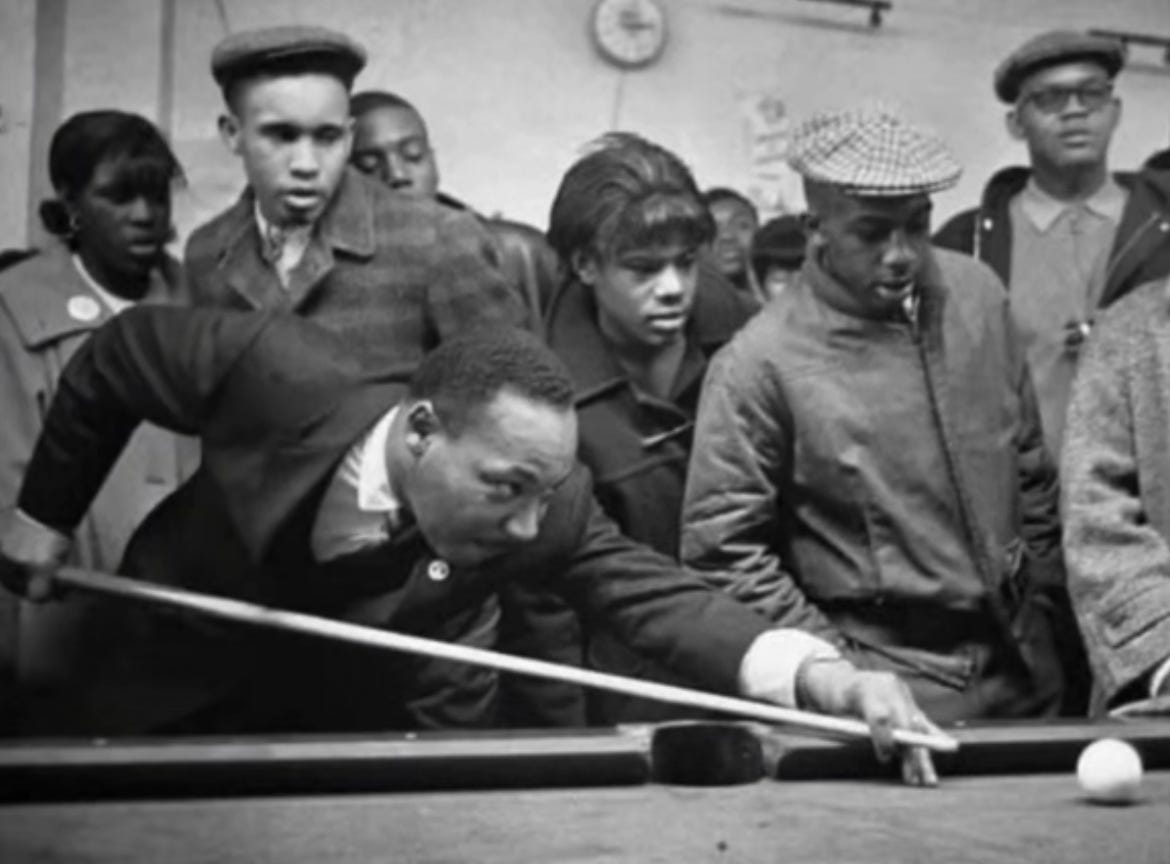
(Photo of M.L. shooting pool in Atlanta in 1966. The tall guy on the far right in the cap and glasses was then a Morehouse College Freshman named Samuel Leroy Jackson.)
What is my point? Education and literacy matters; and its singular purpose is to help people focus on what they need to be focused on. In 1960, a man or woman in the United States with little resources knew that the public library was still free and they made good use of it. Today, our semi-literate majority adult population that cannot stay still long enough to read a 5-minute article because they are always ready to look at something that is “trending,” is what we are confronted with now.
Long after I left the classroom, I ran into one of my former students from the Junior College where I once taught. He was attending Georgia State University and was about to graduate. Excited to run into me, he said, “I hated you back then. But you pushed me and demanded that I get the work done. Now, I can’t stop reading and doing research. I cannot read enough BOOKS!”
Hugging his neck I said, “Don’t ever stop. The more you dig the more you will know.
So, in the names of your favorite teachers, instructors and professors, please keep talking about the truths and the dangers of a largely illiterate and poor reading nation. Our welfare as a nation and as human beings depend on it.
I was am an Independent Historian, Oral Historian and Dramaturge. Please consider supporting my work with a few bucks for Coffee and Eggs via my CashApp.
You can also subscribe to my writings on Substack and stay in the loop with the best new research, history, journalism, prose, poetry, and etcetera.
All blogs written by Leslye Joy Allen are protected by U. S. Copyright Law and licensed under a Creative Commons Attribution-NonCommercial-NoDerivs 3.0 Unported License. Any partial or total reference to any blog authored by Leslye Joy Allen, or any total or partial excerpt of any blog authored by Leslye Joy Allen must contain a direct reference to this hyperlink: https://leslyejoyallen.com with Leslye Joy Allen clearly stated as the author. Postings or blogs placed here by other writers should clearly reference those writers. All Rights Reserved.


 Leslye Joy Allen