The Steps Called Books

by ©️Leslye Joy Allen

For people who have been reading my posts, you may have noticed that I have written about the United States’ severe literacy crisis twice on this platform. If not, you can read them here: The USA Literacy Crisis & This Election and Literacy Crisis, Part II.

This essay is Part III. Let me point out a few things first. Some 65 years ago in 1960, the United States was one of the most literate nations in the world. In 1960, only a handful of states in this country had an illiteracy rate of 10% for people aged 14 and over. The rest of the states registered only about 3% illiteracy. Now we rank 36th in the world for literacy among industrialized nations. There are other sources that place the USA at a literacy rate much lower.

In 2025, 21% of American adults are completely illiterate while 54% of adults read below the 6th grade level. I want to share with you in this essay, however, what poor reading and writing skills look like when these circumstances are also combined with educational red tape. 

I taught College History courses for roughly 7+ years, from 2007 to early 2015. My first 2 years, I taught at a Junior College that had several campuses outside the city limits of Atlanta in the outlying metropolitan areas. My last 5 years I taught at large state universities. Junior Colleges are structured for students who have some academic deficits. Students often attend Junior Colleges to fix a deficit in some academic discipline so that they can eventually qualify to attend a four-year institution to earn a Bachelor’s degree.

When I started teaching, I taught year round. After I taught on this particular campus for about two semesters, I noticed that this campus was slowly being converted into a cash cow. The school started accepting anyone who could pay tuition and occasionally referred to students as “customers.” That did not go down well with me and a lot of other Instructors and Professors. 

Most of my History students had some problems with reading, writing, and critical thinking skills. I usually spent the first 3 weeks of every semester correcting grammar and insisting that they trust their answers and their own instincts. 

When I asked a simple question, initially none of them could state the obvious answer. I demanded that my students give complete and well-thought out answers and opinions in class discussions instead of the abbreviated and one-word answers that chronic text messaging had fostered. 

The majority of my students rose to the occasion. They did the work, read my comments, listened to my instructions and suggestions, and put in the extra time needed to get up to speed in writing and having in-depth discussions about History. I did have one student, whose identity I never knew, who complained about having to write 3 five-page long History papers. Imagine having to write 3 papers in a 16-week long semester in college.

I learned later through the grapevine that this student allegedly had an inappropriate relationship with some man in the Junior College’s administration to who that student complained. One day I was informed that I would have to attend a meeting with my Department Chair and the Ombudsman of the School. 

During the meeting, both my Department Chair and the Ombudsman kept telling me things like “Many of these students might not know how to interpret what you tell them. They might not understand what you say to them or write on their papers. One student said you told him or her that they could not write!”

I was confused and raised these points: “I have NEVER told a student that they cannot write. I have told or wrote to many of them, however, that they needed to take a good writing course so that they can improve their writing skills and get more practice writing cogent papers. Also, I speak grammatically correct English in the classroom. How can I know when a student cannot understand grammatically correct English? What type of language or techniques are you asking me to use?”

They both stopped talking for about 30 seconds. I interrupted their silence. “Are you asking me to water down my curriculum?!”  No one answered my question. They both began to reiterate how much the students might not understand what I asked students to do. I repeated the question FOUR more times. They NEVER answered my question.

When they suggested that I attend a seminar on Customer Service Skills, it was all I could do to hold my tongue. Then my Department Chair finally ruptured this charade of a meeting and asked me, “Do you want this job?”

I swallowed hard and paused for a good 20 seconds and responded, “That’s a rather loaded question, don’t you think? Obviously, when I applied for this job, I wanted and needed a job. I still do. However, anyone who might be offered a better job somewhere else would probably take the better job. That includes me too.”

When I walked out of that office, I was so angry I couldn’t see straight. The Department Chair’s secretary looked at me as I exited and said “Leslye, what did they do to you in there?! Please, please don’t look like that.” I told her I would come back later and fill her in on the details after the Department Chair went to lunch.

So, here was the dilemma. That handful of students that never had any intention of studying and improving their literacy and writing abilities were now expecting to receive passing grades when they were just as inept at the end of the semester as they were at the beginning of it. That meeting, however, was not my worst moment on that campus.

A young Black woman student emailed me and asked me, when the time came, to write her recommendation letter to Spelman College. She had sent in an application to Spelman and assumed that she would be accepted. When I checked her records, she only had a GPA of about 2.0.

Spelman College is a Historically Black College for women that has always teemed with academic brilliance. No girl graduating high school will even be considered for admission with a GPA less than a 3.5. The average GPA of students who are admitted is a 3.8. It is a highly competitive school with an admission rate of only about 34% of applicants.

I very delicately wrote to this young woman that she would need to pull her grades up in order to get into Spelman. I wrote that she should not be discouraged because, “I know you can do it if you work hard and apply yourself by taking some additional classes.” This was my attempt to tell her the hard truth without crushing her dreams or suggesting that she give up. I signed my name to the email, pressed the “Send” button, and sat and cried for about 15 minutes.

It took me years to understand that people who don’t read well or who rarely read at all constantly misinterpret the meanings in spoken and written language. They also assign their own meanings to what people say and write with little to no comprehension. They make decisions based on what they think or feel about something a person said or wrote.

That is where we are in the United States right now. We have a majority adult population that responds to most political propaganda with their emotions and assumptions, never exactly or entirely based on actual facts. Moreover, many don’t even know where or how to look for the facts. 

If the Democrats do not figure out how to reach out to semi-literate people stumbling in the dark with information they can barely decipher, then the Democrats are in danger of losing elections for the next several decades. The Political Left is also doomed to be reduced to little more than a group of well-read, but also self-righteous, ideologues that do not know how to reach the people they need to reach who don’t fit the definition of “well-read.” 

One of the things that made my home boy Dr. Martin Luther King, Jr. so effective was that he was a young man with a doctorate degree who could go hang out in a pool room and shoot pool and talk trash with the men who hung out there as easily as he could address heads-of-state. He could render presidents and prime ministers speechless because he was better educated and more in-tune with what people needed than the vast majority of them. 

He could talk with ease to the poorly educated and to the best educated. For those who don’t know, Martin Luther King Jr. was an exceptional scholar who entered college at age 14 and who graduated Morehouse College at the age of 18 and had earned his doctorate by the time he was 25 years old. Kamala Harris’ Mama also had her doctorate degree by the age of 25. She was working in a laboratory when her water broke with her then soon-to-be-born first child that she named “Kamala.” 
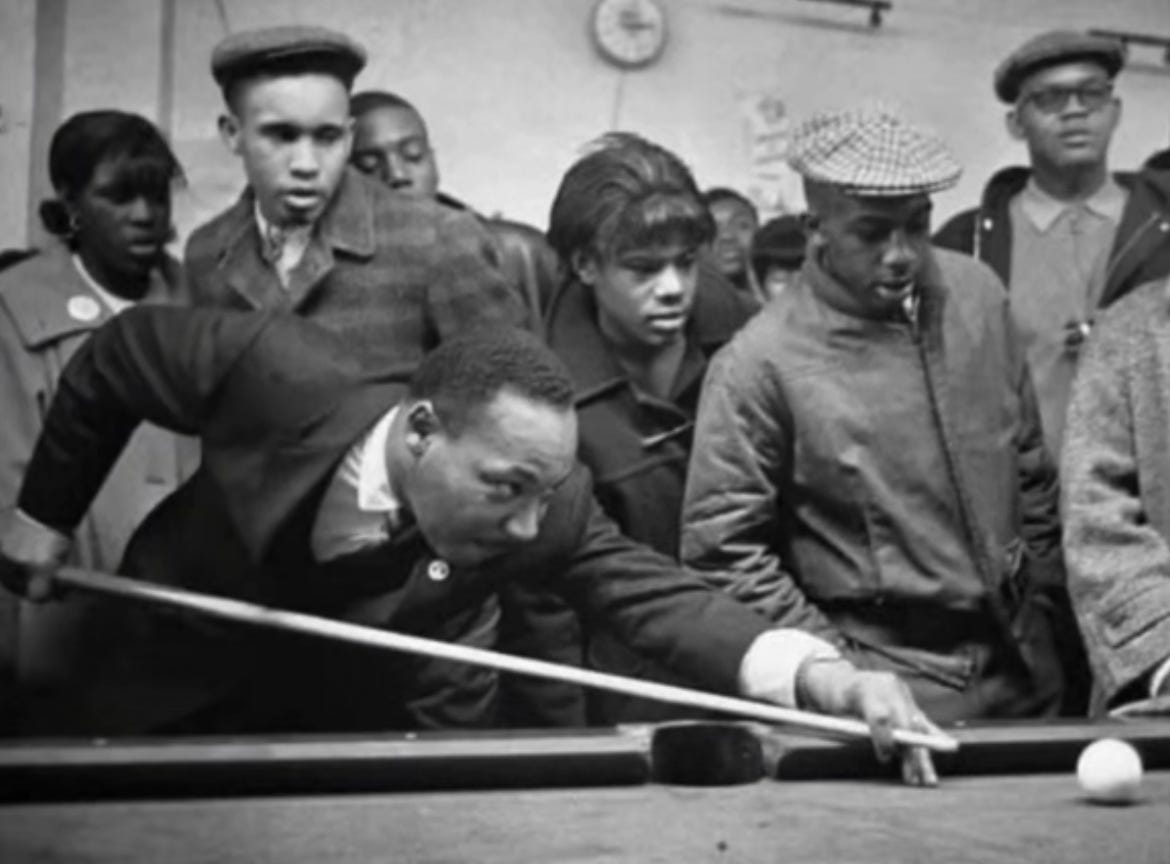
(Photo of M.L. shooting pool in Atlanta in 1966. The tall guy on the far right in the cap and glasses was then a Morehouse College Freshman named Samuel Leroy Jackson.)

What is my point? Education and literacy matters; and its singular purpose is to help people focus on what they need to be focused on. In 1960, a man or woman in the United States with little resources knew that the public library was still free and they made good use of it. Today, our semi-literate majority adult population that cannot stay still long enough to read a 5-minute article because they are always ready to look at something that is “trending,” is what we are confronted with now. 

Long after I left the classroom, I ran into one of my former students from the Junior College where I once taught. He was attending Georgia State University and was about to graduate. Excited to run into me, he said, “I hated you back then. But you pushed me and demanded that I get the work done. Now, I can’t stop reading and doing research. I cannot read enough BOOKS!”

Hugging his neck I said, “Don’t ever stop. The more you dig the more you will know.

So, in the names of your favorite teachers, instructors and professors, please keep talking about the truths and the dangers of a largely illiterate and poor reading nation. Our welfare as a nation and as human beings depend on it.

©️Leslye Joy Allen

I was am an Independent Historian, Oral Historian and Dramaturge. Please consider supporting my work with a few bucks for Coffee and Eggs via my CashApp.

You can also subscribe to my writings on Substack and stay in the loop with the best new research, history, journalism, prose, poetry, and etcetera.

All blogs written by Leslye Joy Allen are protected by U. S. Copyright Law and licensed under a Creative Commons Attribution-NonCommercial-NoDerivs 3.0 Unported License. Any partial or total reference to any blog authored by Leslye Joy Allen, or any total or partial excerpt of any blog authored by Leslye Joy Allen must contain a direct reference to this hyperlink: https://leslyejoyallen.com with Leslye Joy Allen clearly stated as the author.  Postings or blogs placed here by other writers should clearly reference those writers.  All Rights Reserved.
Dads and Public Spaces

by ©️Leslye Joy Allen

When I was a little girl I went everywhere my Daddy. I often had solo trips to a store, a library, and the park with my school teacher Mama too, but I was a Daddy’s Girl. I remember when it was just the two of us and I had to use the restroom, Daddy and I would often run into a woman who was a friend of our family and she would take me into the women’s restroom so I could do my business.

On many occasions when I was small and I had to use the restroom, Daddy would place his hands over my eyes, walk into the men’s restroom and yell, “Father coming in with his daughter; zip it up or hide it!” He would find a stall with a door, line the toilet seat with paper and then sit me on it. 

I bring this up because public spaces like restrooms were not designed for fathers and daughters nor fathers with infants. A mother could take her little ones of any gender and age into the women’s restroom. Dads could certainly take sons into the men’s restroom. My Daddy, like so many other Black fathers I knew defied the limitations of public spaces. He never once said that he couldn’t take me with him somewhere because he wasn’t sure if I could use the restroom. 

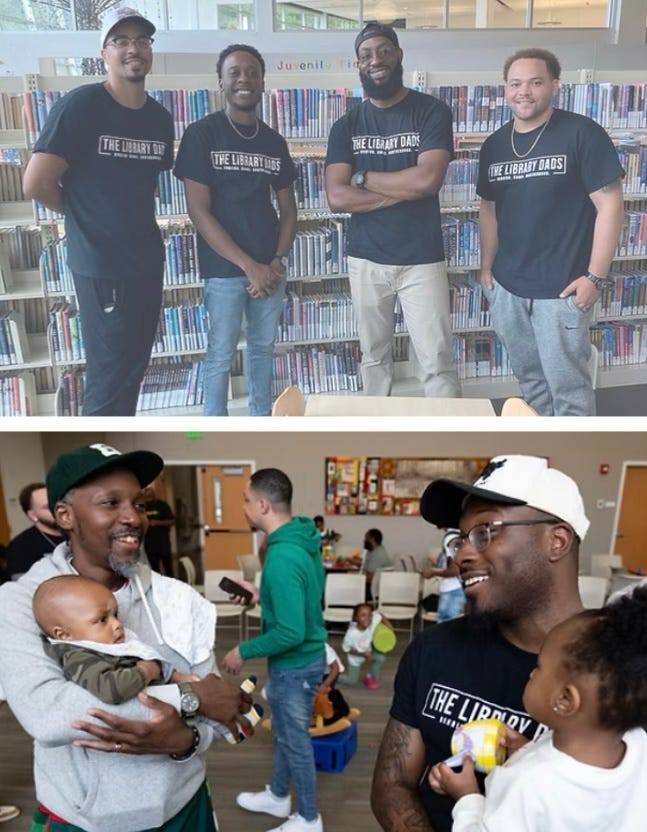
If you are one of my subscribers on Substack, you have probably seen a few videos on my feed of The Library Dads, which is a non-profit organization that has scheduled weekly library visits for Dads with their children at the public library. It was founded in Atlanta by a young father named Khari Arnold who took his 4-month-old daughter to the library to familiarize her with books. That was her first of many visits.

Arnold noticed a strikingly advanced development of his daughter’s cognitive skills over the course of a year because he read to her all the time. This program is designed to help fathers become involved in the educational and literacy development of their children; and to deepen their bonds with their children. That’s Khari Arnold on the far left in the top photo.

What struck me about The Library Dads was not just their active engagement with their offspring every Saturday at the public library, but also their pushback against the limits of certain public spaces that are less accommodating for fathers and their small children.

My Mama and Daddy took me to the library regularly as did many of the Black parents I knew growing up. I know they both would be impressed with The Library Dads for a variety of reasons. Yet, I must add one more reason that helps us all… 

In addition to these young men taking responsibility for their children’s education and development, they also shift the narrative that tends to center on mothers as almost solely responsible for their children’s development. They are a most welcome pushback on the confining and inaccurate gender definitions that the Western world imposes on us all. Go Library Dads!

©️Leslye Joy Allen

I am an Independent Historian, Oral Historian and Dramaturge. Please consider supporting my work with a few bucks for Coffee and Eggs via my CashApp.

You can also subscribe to my writings on Substack and stay in the loop with the best new research, history, journalism, prose, poetry, and etcetera.

All blogs written by Leslye Joy Allen are protected by U. S. Copyright Law and licensed under a Creative Commons Attribution-NonCommercial-NoDerivs 3.0 Unported License. Any partial or total reference to any blog authored by Leslye Joy Allen, or any total or partial excerpt of any blog authored by Leslye Joy Allen must contain a direct reference to this hyperlink: https://leslyejoyallen.com with Leslye Joy Allen clearly stated as the author.  Postings or blogs placed here by other writers should clearly reference those writers.  All Rights Reserved.
Black Women and Police: One Day on My Way to Agnes Scott College

by ©️Leslye Joy Allen

This essay is a revisit and an edit to a memory I wrote about 10 years ago, but a memory I hope might help someone else, particularly a Black or Brown woman.

Most of my encounters with police have been rare and routine. Most of the police officers I have dealt with have been courteous and helpful. I have made the occasional phone call about the neighbor whose dog has been running around the neighborhood terrorizing a few people. The police come out, speak with the offender, and the matter is resolved. Yet, I remember this incident…

A police officer discovered I had a “First Insurance Cancellation Suspension” on my driver’s license. For those of you born late in the 20th century, let me explain. An insurance cancellation suspension was common if you changed cars or changed insurance companies. You used to get a form in the mail from the Department of Motor Vehicles instructing you to record your new insurance or your new car. Occasionally, however, you might not receive the form by mail, and you could easily forget about it. 

If your new car/new insurance data had not arrived at the Department of Motor Vehicles when you bought a new car or changed your car insurance, you could end up with this particular type of suspension. You typically had to go to the Department of Motor Vehicles, show them your new purchase, along with your new insurance card.

In what appeared to be a routine road check for driver’s license and insurance, the Decatur, Georgia Police held me for three hours only a few months after I purchased a car from my elderly uncle. This happened in the spring of 1998 when I was back in college to complete my Bachelor’s degree at Agnes Scott College

After checking my Driver’s License number the officer stated that I had a “First Insurance Cancellation Suspension” on the car I previously owned. I showed him my new insurance card on the car I was driving. I knew I would have to straighten out the suspension before I drove any car again. Since I was about a mile from the campus, I asked him if he could radio the Agnes Scott College Police and have someone from that police department drive down the street, and pick me (and the car) up.

I explained that I would have my Mama come pick me up at Agnes Scott and we would go to the Department of Motor Vehicles and get the suspension problem cleared up. 

“I’m not calling anybody,” he yelled. I pulled out my student ID. He said, “I don’t need that. Girl, get out of the car.” I was a grown woman then in my thirties; and while I might not have looked as old as my birth certificate said I was, I was nobody’s “girl.” I kept my mouth closed, but I am sure he sensed my displeasure.

I got out of the car and he instructed me to lie down in the street. When I asked why are you doing this? He told me to shut up. While I lay down in the street for over 30 minutes, he and another two officers pulled the back seat out of my car. They searched the trunk. If it had not been for the little old man that came out of his house to watch, I do not know what else might have happened. I was terrified, but I suffer from something my Mama used to call, “Your Daddy’s Disease.”

She said my father never showed fear when under pressure. I don’t show it either. Daddy always looked fearless, even menacing, when some horrible event was going on. Then later when everything was all over, he would fall apart, shaking and reaching for a good stiff drink. “That kind of thing can get you killed, Joy,” Mama said, “When someone expects you to be afraid, sometimes the worst thing you can do is look like you have no fear.”

This event was before everyone had a cellphone. A female police officer appeared and asked me if I wanted to call my Mama using her phone. The first police officer decided to write me a simple ticket for driving with a suspended license and he left me standing there in the street. He drove off. 

That sweet little old man stood there and talked with me until Mama arrived. He told me he thought the Decatur police were doing some kind of sweep. “They’re looking for somebody that’s up to no good, and they’re tryin’ to find ‘em in these road blocks,” he said. Mama arrived in about 30 minutes and picked me up. My new best friend—that sweet observant little old Black man told me to leave my car where it was until the suspension problem was straightened out.

Them SOBs are probably waiting somewhere watching and waiting for you to drive off so they can give you another ticket or take you to jail. I’ll watch your car until you get back,” he said.

Mama asked me how my clothes got so dirty. I lied and told her I slipped and fell. She would have had a heart attack if I told her what really happened to her only child. We headed to the Department of Motor Vehicles. The clerk handed me a simple form that I filled out citing that I no longer owned the previous vehicle and therefore had no insurance on that vehicle. 

I had to write down the serial number and model of my current car and provide my proof of insurance. The clerk recorded my data and lifted my “First Insurance Cancellation Suspension.” All of this took about 20 minutes.

I did argue my case in traffic court. The police officer rolled his eyes at me as I explained in detail his refusal to call the Agnes Scott College police even after I showed him my student ID. I told the judge every detail and showed him my insurance card, the purchase of my car, and the statement from the Department of Motor Vehicles that lifted my insurance cancellation suspension. 

To add as much injury as I could, I said, “I missed my Latin Class because of this!” The judge dismissed my case. I paid no fine. I was lucky. Yet, I sensed that what happened to me was not rare. This kind of treatment happens to women, and particularly Black women and women of color, with a frequency that many people do not want to admit. 

Black women encounter more than our share of rudeness and physical intimidation from male police. This offending officer was Black. It’s easy to talk about racist cops, but it is not so easy to talk about SEXIST ones. And for the record, I don’t like Black men who are cops anymore than I like White men who are cops. Here’s the rub…

I consider myself to be an average size woman. By the time I was 50 years old, I managed to gain enough weight to make it to a whopping 135 pounds at 5 feet, 5 inches tall. At the time of this incident, I weighed only about 115 pounds. That police officer was at least 6’ 2” tall and weighed well over 200 pounds. He called me a girl. He told me to shut up. He did not throw me to the ground, Thank God. Yet, just imagine how easy it would have been for him to do so.

©️Leslye Joy Allen

I am an Independent Historian, Oral Historian and Dramaturge. Please consider supporting my work with a few bucks for Coffee and Eggs via my CashApp.

All blogs written by Leslye Joy Allen are protected by U. S. Copyright Law and licensed under a Creative Commons Attribution-NonCommercial-NoDerivs 3.0 Unported License. Any partial or total reference to any blog authored by Leslye Joy Allen, or any total or partial excerpt of any blog authored by Leslye Joy Allen must contain a direct reference to this hyperlink: https://leslyejoyallen.com with Leslye Joy Allen clearly stated as the author.  Postings or blogs placed here by other writers should clearly reference those writers.  All Rights Reserved.

A Memory from a Small Black Girl in Atlanta

by ©️Leslye Joy Allen

When I was a small girl in Atlanta, Grandma’s lap and bedroom remained my soft landing if I had misbehaved and Mama was patiently waiting to give me that lecture about my behavior. 

Grandma’s bed had a ton of blankets where I couldn’t move if I got in it, but the visit was worth the trip because Grandma had a sweet tooth. There was candy I wasn’t supposed to have in her nightstand and her pockets.

Before I began going to school and even after I started school, Grandma and I had a daily routine of debate and opinions and arguments that could only be had between a 78-year-old woman and her 4-year-old granddaughter whose job was to help sort home grown tomatoes, snap beans, squash and peas from the garden except when I stopped to make mud pies from the rich red Georgia clay after a rain.

We spent hours discussing everything like two old women, but I was a midget version of an old woman. Grandma insisted on me having a reason and an explanation for why I believed certain things, nurturing propositions and hypotheses from my diminutive brain before I knew what a proposition or a hypothesis was. 

So, I became a historian.

©️Leslye Joy Allen

I am an Independent Historian, Oral Historian and Dramaturge. Please consider supporting my work with a few bucks for Coffee and Eggs via my CashApp.

All blogs written by Leslye Joy Allen are protected by U. S. Copyright Law and licensed under a Creative Commons Attribution-NonCommercial-NoDerivs 3.0 Unported License. Any partial or total reference to any blog authored by Leslye Joy Allen, or any total or partial excerpt of any blog authored by Leslye Joy Allen must contain a direct reference to this hyperlink: https://leslyejoyallen.com with Leslye Joy Allen clearly stated as the author.  Postings or blogs placed here by other writers should clearly reference those writers.  All Rights Reserved.

The Reckoning

by ©️Leslye Joy Allen

I remember back when Arthur Herman Bremer shot former Alabama Governor and presidential candidate George Wallace in 1972. Wallace ended up in a wheelchair for the rest of his life. He had been an avowed segregationist for most of his life.

He became a humanitarian after he was shot and paralyzed from the waist down. To his credit, he did assist Congresswoman Shirley Chisholm with passing legislation that aided workers and farmers. Their alliance, brought on by his tragedy, was unique in the annals of American political history.

Wallace assumed he was invincible. Yet, no matter how much power you have or think you have, you cannot hold that power forever.

No matter how many times you kiss the ring of those in power, and swallow your pride and principles for the approval of those in power, you too will eventually be sacrificed with neither your dignity nor principles to hold your legacy together.

The Muskrat and Felon 47 will die, just like all of us will. History will record them as monsters because that is exactly what they are. The politicians who shy away from questioning the rationale of their policies will be recorded as the cowards they are.

Shutterstock photo of depressed man/New Africa

As activist Audre Lorde said, “Your silence will not protect you.” In the end when the folks upon whose altar you have sacrificed all of your principles are done with you, you will be no more than the rest of us. All you will ever be is mortal.

Power does not transfer to the grave. Your progeny will live long enough after your death to be vilified and hated while struggling to figure out what it is that they have done. History will answer them the same way it has answered all others in perpetuity, “Your crime is your having been born unto monsters.”

©️Leslye Joy Allen

I am an Independent Historian, Oral Historian and Dramaturge. Please consider supporting my work with a few bucks for Coffee and Eggs via my CashApp.

All blogs written by Leslye Joy Allen are protected by U. S. Copyright Law and licensed under a Creative Commons Attribution-NonCommercial-NoDerivs 3.0 Unported License. Any partial or total reference to any blog authored by Leslye Joy Allen, or any total or partial excerpt of any blog authored by Leslye Joy Allen must contain a direct reference to this hyperlink: https://leslyejoyallen.com with Leslye Joy Allen clearly stated as the author.  Postings or blogs placed here by other writers should clearly reference those writers.  All Rights Reserved.