Rebuilding from Scratch

by ©️Leslye Joy Allen

The other day I told a friend about the year I got a chance to watch a Brown Thrasher build a nest in a tall shrub near my carport. I watched her pick up pine needles and leaves, and craft them together until a nest was in place.

I watched her sit on her eggs. Then later still, I heard the sound of chicks; and finally I saw her nudge them out of the nest. Her babies were gone. She left the nest as well. That nest stayed intact, however, for several years.

Then I remember when the late Dr. Sadye Young told me about her father who built whole houses without any floor plans. Although she was then a retired college professor, Dr. Young knew her way around a house. She had learned certain aspects of building because when she was a child, she often accompanied her father when he was building a home. My eyes brightened because my late maternal Uncle Frank could do the same thing.

Both of these men built foundations, installed plumbing, wiring, and etcetera without any floor plans. Neither of these men had college degrees. Both had been apprentices of carpenters, plumbers, and electricians. But neither of them set foot in a college classroom and majored in architectural engineering. Yet, the homes they built stood the test of time.

Dr. Young’s father and my uncle had something in common with each other and with that Brown Thrasher. They built homes from scratch. They relied on their observations, practice, and their skills, not on architectural drawings. That Brown Thrasher relied on her instincts.

The current state of affairs in this country is going to require all of us to go back to some basics that many of us have lost. We all have instincts, yet we no longer use them. My late maternal grandmother (born in 1886) could predict when it was going to snow simply by observing whole flocks of birds gathering.

We now rely quite heavily on gadgets and technology and self-appointed pundits to tell us everything. But real knowledge comes from reading, research, study, practice, listening, and observation. It is only when we do all of the above that we can trust our gut instincts again.

As Felon 47 attempts to destroy one institution after another, we better ready ourselves to rebuild from his wreckage. Depending on how bad the damage is, we need to prepare to rebuild from scratch which is made more difficult by a population accustomed to having everything done with the press of a button. It is not going to work like that this time.

©️Leslye Joy Allen

I am an Independent Historian, Oral Historian and Dramaturge. Please consider supporting my work with a few bucks for Coffee and Eggs via my CashApp.

All blogs written by Leslye Joy Allen are protected by U. S. Copyright Law and licensed under a Creative Commons Attribution-NonCommercial-NoDerivs 3.0 Unported License. Any partial or total reference to any blog authored by Leslye Joy Allen, or any total or partial excerpt of any blog authored by Leslye Joy Allen must contain a direct reference to this hyperlink: https://leslyejoyallen.com with Leslye Joy Allen clearly stated as the author.  Postings or blogs placed here by other writers should clearly reference those writers.  All Rights Reserved.
A Quick Word to Millennial (and Younger) Protesters and Activists

by ©️Leslye Joy Allen

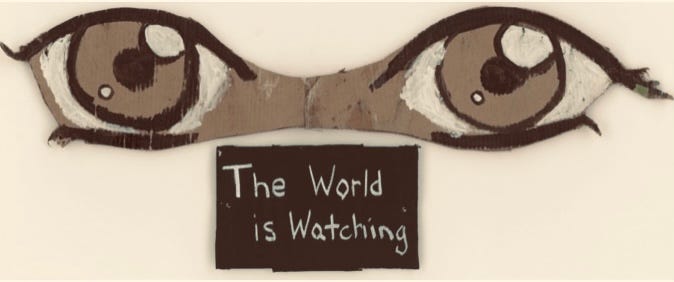
The photo below is of a creation titled “The World is Watching.”  The artist is not known. It is located at the Library of Congress which has a long history of collecting Protest Art and Protest Photography. Visually stunning and a reminder that protests and activism change with the technology of the times.

I was born during the last years of what was called the Baby Boom. As a Baby Boomer, I did not grow up from Childhood to Early adulthood with a Personal Computer, the Internet, and definitely not Social Media or a cellphone with a camera.

I learned of protest marches and various forms of activism via word-of-mouth, letters, signs on school and church bulletin boards, and via Black-owned newspapers. Sometimes these protests were featured on the 6 O’Clock News.

Fast forward to the late 20th and early 21st centuries and you have young adults who grew up with everything we Baby Boomers grew up without. Millennials get messages out there in cyberspace in a matter of seconds. They can rally thousands (even millions) of people with brief blurbs and blogs in a matter of a couple of days and occasionally a couple of minutes. There are, however, a few drawbacks.

In addition to creating mediums that make it seem as if a few “likes” on social media has resolved the problem, it also exposes certain tactics that should not be seen by everyone. Social Media exposes protest tactics to our enemies as much as it exposes those tactics to our friends. So let me share the following history. Ignore it; modify it; and/or adapt this in any way you see fit.

The Black American Civil Rights Movement typically had a 3-pronged approach. 

  1. Back in the day, you had a set of individuals who could not physically participate in protest marches because they were the folks who were designated to bail you out of jail if you were arrested. The folks who were part of the Black community who had a degree of affluence and wealth were often in this position. Although many of them were out there in the streets protesting. 
  2. Another group was the observers. These were individuals who lined routes of marches who watched and recorded what they saw. Sometimes they would stand on sidewalks and pretend to be window shoppers or they would sit near the windows inside places of business so that they could see what was going on outside in order to report what they saw. There were no cellphones with cameras in them back then. Their hardest role was to not intervene when they saw any physical violence. They had to record what they saw.
  3. Finally, there were the Black protesters themselves who were trained in non-violent resistance in order to highlight the sheer brutality of their oppressors. They were trained to endure and not fight back.

Now, I am not at all advocating for any of you to quietly endure any form of brutality and violence as you fight against this onslaught of abuse from the administration of Felon 47. What I am suggesting is that you create a 3 or even 4 or 5-pronged approach to how you protest and advocate for the causes you believe in.

Right now, activism is highly tied to how much press and social media presence one can generate. That’s not a bad strategy, but the limitations of that approach is that almost anyone can see it. You win most against enemies when enemies do not know EXACTLY what is coming at them all the time. And that is not my original idea. It actually comes from Sun Tzu, a Chinese General and Strategist born around 544 B.C.E. Some ideas stand the test of time. Study those ideas. Onward!

©️Leslye Joy Allen

I am an Independent Historian, Oral Historian and Dramaturge. Please consider supporting my work with a few bucks for Coffee and Eggs via my CashApp.

All blogs written by Leslye Joy Allen are protected by U. S. Copyright Law and licensed under a Creative Commons Attribution-NonCommercial-NoDerivs 3.0 Unported License. Any partial or total reference to any blog authored by Leslye Joy Allen, or any total or partial excerpt of any blog authored by Leslye Joy Allen must contain a direct reference to this hyperlink: https://leslyejoyallen.com with Leslye Joy Allen clearly stated as the author.  Postings or blogs placed here by other writers should clearly reference those writers.  All Rights Reserved.
Threading Grandma’s Needles, and Kamala Harris

by ©️ Leslye Joy Allen

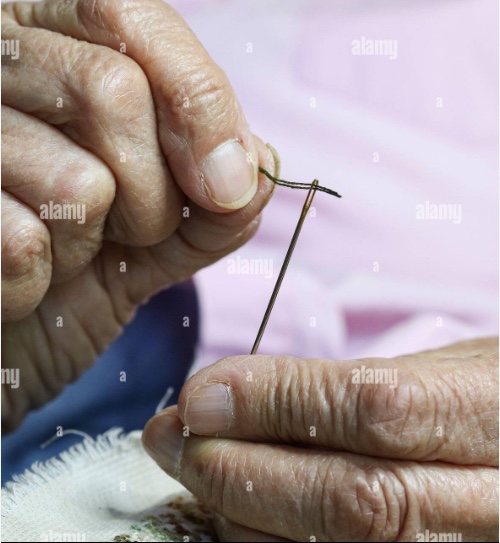
When I was a small girl around the age of 4 or 5, my maternal grandmother would often ask me to thread her needle. I was a late born baby to my parents and Grandma was well into her seventies when I was born.

Grandma was a scholar who read a couple of books a week. I knew instinctively that the reason why she asked me to thread her needle was because the eye of a sewing needle is narrow and often hard to see. The best pair of eyes could have trouble getting that thread through that tiny eye. By the time I was around 4 or 5, Grandma was in her eighties, and I enjoyed doing what I could for my Grandma.

(Stock photo of an elderly woman’s hands threading a needle, Alamy)

Grandma’s eyes were not as steady as they once were; and neither were her hands. But once that needle was threaded, she could sew up a storm. As I have now passed the age of 60, it now takes me damned near 15 minutes to thread a needle. But you do what you can and what you have to do. This brings me to another observation.

For several months this year, after I rolled my herbie-curbie (that’s the name for our garbage cans on wheels in Atlanta) to the curb of my driveway, I arrived back home and instead of my herbie-curbie being left at the curb of my driveway as is customary, someone had rolled it all the way up to the gate to my backyard so I wouldn’t have to retrieve it.

Last week, I was home when the sanitation workers were out. Before I exited my door to retrieve my herbie-curbie, I saw my 20-something neighbor who is autistic grab its handle and roll it up to my gate. He went from house-to-house doing the same thing—saving his older neighbors the trip to the end of the curb.

I bring this up because when I finally saw who was doing this favor on his own, it dawned on me that he was doing what he could do to assist his neighbors.

Then I thought about all of these folks barking about where is Kamala Harris? During the first wave of complaints, she was actually in fire-ravaged California assessing damage, talking with the mayor and governor and firefighters, and assisting her neighbors who had lost their homes.

The second wave of complaints came recently. Now, I have already said that Harris is a private citizen and has done her duty while so many others fail to do so much as contact their representatives and complain.

What is most annoying is the manner in which folks have complained. I watched Harris lose weight on the campaign trail after being given a near-impossible task of organizing a campaign in just over 100 days after a stubborn Joe Biden took his sweet time stepping aside when so many of his colleagues begged him to do so.

I have also been around white women who felt like I was their property and who felt like I was obligated to do whatever they requested, and were insulted when I said “No” even when my work or school schedule and obligations would not permit me to accommodate them.

I have been around men (black and white) who treated me the same way. That is an unfortunate experience that Black women have endured ever since we have been here in this country. We are not supposed to have own lives, but we are supposed to stand ready to salvage somebody else’s. Wedged between battling racism and sexism and misogynoir simultaneously, we are often left hanging when we are having problems.

Instead of these complainers interrogating the majority of white women and men who voted for Felon 47, they want Harris out there speaking for them. And if she did, you know good and damned well Felon 47 and his minions, along with his bought-and-paid-for news rooms would paint her as a “Sore Loser” while his dumb-as-cat-shit voters nodded in agreement while he continued to pick their pockets and threaten their livelihoods. Unlike my sweet autistic neighbor, they do not do what they can but they expect someone else to do it.

Instead of bothering to contact Kamala Harris’ office or website or her page on IG to ask her a question, they went on a rampage of demands. They don’t even know what she might be doing behind the scenes.

So, let me share this bit of my history. I represent only the third generation of my families not born into slavery. I will leave you with what my paternal Great Grandmother said to her mistress who just couldn’t believe Great Grandma would want to leave her mistress and be free. With a nap sack on her shoulder, and right before she went searching for her other siblings who had been sold to other slave owners, she said the following:

“You can do your own work and you can pick your own cotton.”

©️ Leslye Joy Allen

I am an Independent Historian, Oral Historian and Dramaturge. Please consider supporting my work with a few bucks for Coffee and Eggs via my CashApp.

All blogs written by Leslye Joy Allen are protected by U. S. Copyright Law and licensed under a Creative Commons Attribution-NonCommercial-NoDerivs 3.0 Unported License. Any partial or total reference to any blog authored by Leslye Joy Allen, or any total or partial excerpt of any blog authored by Leslye Joy Allen must contain a direct reference to this hyperlink: https://leslyejoyallen.com with Leslye Joy Allen clearly stated as the author.  Postings or blogs placed here by other writers should clearly reference those writers.  All Rights Reserved.

Pawns and Queens: Analogies For a New Era

by ©️Leslye Joy Allen

We historians often find data in some file in an obscure archive, in letters written by someone’s grandmother, in photos, newspaper clippings, legal records. Our discipline demands that we dig, analyze, rethink and revise, constantly. I liken our work to studying the function of each piece in a Chess game. We get different perspectives about the same set of circumstances depending on which Chess piece we examine.

I was a mediocre Chess player. I had a few friends who played like champions. So, I often just watched them play. I remain, however, fascinated by the game’s objectives and, specifically, the roles of Pawns and Queens.

Pawns are the most numerous pieces in Chess; they are the foot soldiers. Each player has eight Pawns. A Pawn can move one or two squares forward if that move is its first move. After the first move, a Pawn can only move one square forward unless the square is blocked by some other piece. A Pawn can capture or attack another piece, however, by moving diagonally to the left or right.

The Pawn is the only piece in a Chess game that can change ranks. Depending on the skill of a Chess player, a Pawn can become a Bishop, a Rook or a Queen. In spite of a Pawn’s ability to advance to a higher rank, it is still considered the lowest ranking piece in the game. It is only worth one point.

The objective of the game is to capture your opponent’s King where that King has no way out, which means Checkmate. While the King is considered the most important piece in the game, it is the Queen that is considered the most powerful piece.

Queens are the only pieces that can move across the board in any manner as long as they are not successfully blocked by other pieces. If you lose, it is highly likely that you lost because your opponent’s Queen checkmated your King. Chess players feel much more confident when they have successfully captured or blocked her.

You can still win the game without capturing the Queen, but you have to be extremely strategic and precise to do so. You can also win without making good moves with your Pawns, but it is highly unlikely.

Chess is now over 1,500 years old. While there is some skepticism about its precise origins, many Chess historians believe that the Indian board game called “Chaturanga” was the earliest predecessor of Chess. There were many other versions that followed, but are too numerous to mention here.

In early versions of Chess, there was a piece called “Vizier” or “Advisor” for centuries. In the 1500s, in the era of great and powerful Queens in Europe, like Spain’s Isabella and England’s Elizabeth, “Viziers” or “Advisors” were redesigned and renamed “Queens.” You can learn an awful lot of world history just by examining Chess.

So here’s the deal: There is no such thing as a Chess game where Queens/Women Heads of State/Women in general are not powerful and flexible while the Kings/Men Heads of State/Men in general are highly important but who have or exercise fewer tactical moves.

There is also no such thing as a Chess game where Pawns/Foot Soldiers/Laborers are not essential to success, even while they are considered less important.

Apply any and all of the above to what you see happening in the United States and the world right now. I refuse to tell you how to analyze and interpret this history because there are so many interpretations and analogies that can be extrapolated from this board game.

All I will say is that nothing is going to change or be corrected without the skill of devoted Pawns, and the power and daring of Queens.

©️Leslye Joy Allen

Shutterstock photo of a Pawn and a Queen on a Chessboard.

All blogs written by Leslye Joy Allen are protected by U. S. Copyright Law and licensed under a Creative Commons Attribution-NonCommercial-NoDerivs 3.0 Unported License. Any partial or total reference to any blog authored by Leslye Joy Allen, or any total or partial excerpt of any blog authored by Leslye Joy Allen must contain a direct reference to this hyperlink: https://leslyejoyallen.com with Leslye Joy Allen clearly stated as the author.  Postings or blogs placed here by other writers should clearly reference those writers.  All Rights Reserved.

Parable of the Sower

by ©️Leslye Joy Allen

“…the plant of freedom has grown only a bud and not yet a flower.” — Martin Luther King, Jr.

“God is your first and your last teacher. God is your harshest teacher: subtle, demanding. Learn or die.” — Octavia Butler, (from “The Parable of the Sower, 1993)

I woke up before dawn annoyed that January 20, 2025 is inauguration day for Felon 47 and it is also the federal holiday celebrating the birth and life of Martin Luther King, Jr. I also could not help thinking about how our abuse of the earth has contributed to the fires in California.

A week ago, I re-read Octavia Spencer’s prescient novel “Parable of the Sower.” Butler’s protagonist Lauren, the daughter of a preacher, lives in a safe and comfortable, walled-up cul-de-sac. Outside those walls are desperately poor people, racial and economic inequality, and drug addicts that use a drug called “pyro” that makes its users want to set fires.

Lauren tries to convince others to accept that the world has changed and will continue to change. The others prefer to pretend nothing has happened to the earth and its inhabitants.

Butler predicted ecological disaster by fire coming over 30 years ago, and named her novel after a biblical parable. Right after I finished reading the book again, I thought about how M. L. got his name.

Many people do not know that M. L. (what we called him here in Atlanta) was born Michael King, Jr. I knew many elderly Black Atlanta citizens who called him “Mike” their entire lives.

His father, best known as “Daddy King,” attended a World Baptist Conference in Germany in 1934. Reborn and rejuvenated after he learned more about the philosophies of Protestant reformer Martin Luther, Daddy King soon renamed himself and his son “Martin Luther King, Sr. and Jr.

In 1957, “Michael King, Jr.” was officially changed to “Martin Luther King, Jr.” on his birth certificate. There are other stories about why and when Daddy King changed their names, but I like this story the best.

I bring this up because another story goes that when the German Protestant leader Martin Luther was asked what he would do if he knew the world was going to end tomorrow, he allegedly answered, “I would plant an apple tree today.”

While I am a believer in Goddess/God, I am not particularly religious. I know too well how organized religion has failed us in so many ways. I am, however, a historian who finds truth and sustenance in some parts of the Christian Bible that the incoming administration and so many preachers and billionaires have totally corrupted.

In the Bible’s Parable of the Sower, Yeshu’a ben Yosef (bka Jesus) tells a story about a farmer who sows seeds in four different types of soil. It is not until the farmer’s seeds are sowed in good soil that he yields a good crop. In this parable, which has many lessons, Yeshu’a emphasized that we must pay attention to where we plant our seeds if we expect anything to grow. We yield a good harvest when we take responsibility for how and where we do our planting.

To place seeds in the ground is an act of faith. When you plant, you do so with the faith that you will yield something. You do it with the belief that you, or your loved ones, will live long enough to reap the reward, be it vegetables or fruits or flowers or justice or equality.

On this Martin Luther King, Jr. holiday, may we go forward intentionally, reminded that we are obligated to be good stewards of the earth that we do not own. California’s fires are the result of our excess and failure to clean up the earth which is the only home we have.

May we plant in the best soil, in the best social and educational policies, in the best radicalism, in the truth. May we sow our seeds in our gardens and farms and tend them with a faith that tells us we will reap a good harvest and that we will have enough to sustain us in order to stave off the worst excesses of the incoming administration. May we humble ourselves, unlike Felon 47 and his underlings, and remember that we live on this earth that we did not create and will die whether we are paupers or billionaires. May we learn the life lessons of one of the best sowers, namely Martin Luther King, Jr.

©️Leslye Joy Allen

King’s Papers are located at the King Institute at Stanford University. I urge you to visit and explore: https://kinginstitute.stanford.edu/message-director

(Martin Luther King, Jr. photographed in 1964 by Dick DeMarsico for World Telegraph and Sun. Courtesy of the Library of Congress)

All blogs written by Leslye Joy Allen are protected by U. S. Copyright Law and licensed under a Creative Commons Attribution-NonCommercial-NoDerivs 3.0 Unported License. Any partial or total reference to any blog authored by Leslye Joy Allen, or any total or partial excerpt of any blog authored by Leslye Joy Allen must contain a direct reference to this hyperlink: https://leslyejoyallen.com with Leslye Joy Allen clearly stated as the author.  Postings or blogs placed here by other writers should clearly reference those writers.  All Rights Reserved.