I remember the first time I heard someone say, “If you want to hide something, hide it in a book.” The comment depressed me.
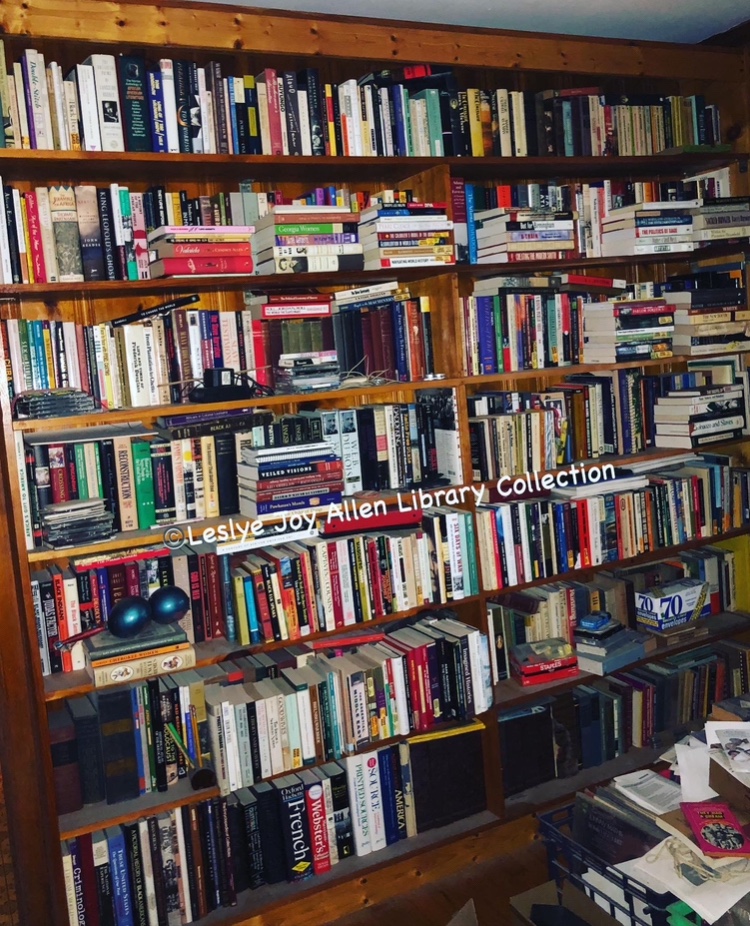
When you are a historian, you have books everywhere. You have to read all the time. I have not seen the top of my dining room table in nearly 15 years as it is covered with stacks of books. Books occupy every nook and cranny of my home.
With the United States ranking 36th in the world for literacy, with a 79% literacy rate, with only 25% of literate adults reading above the 6th grade level, we are already dumb. We can expect to see more decline in literacy with Felon 47 living on Pennsylvania Avenue.
So, I have a proposal. It might not change anything, but it is worth a try. Walk out of your door with a book in your hand or tucked under your arm everyday for at least a month.
Let kids and other adults see you walk with that book. And don’t say you can’t do this. You have carried books before when you were in grade school.
Make your book/s visible at your job, on a trip to a store. Hell, go for a walk with your book until someone asks you why you always have a book in your hand or under your arm. And then have the audacity to tell them why.
“…the plant of freedom has grown only a bud and not yet a flower.” — Martin Luther King, Jr.
“God is your first and your last teacher. God is your harshest teacher: subtle, demanding. Learn or die.” — Octavia Butler, (from “The Parable of the Sower, 1993)
I woke up before dawn annoyed that January 20, 2025 is inauguration day for Felon 47 and it is also the federal holiday celebrating the birth and life of Martin Luther King, Jr. I also could not help thinking about how our abuse of the earth has contributed to the fires in California.
A week ago, I re-read Octavia Spencer’s prescient novel “Parable of the Sower.” Butler’s protagonist Lauren, the daughter of a preacher, lives in a safe and comfortable, walled-up cul-de-sac. Outside those walls are desperately poor people, racial and economic inequality, and drug addicts that use a drug called “pyro” that makes its users want to set fires.
Lauren tries to convince others to accept that the world has changed and will continue to change. The others prefer to pretend nothing has happened to the earth and its inhabitants.
Butler predicted ecological disaster by fire coming over 30 years ago, and named her novel after a biblical parable. Right after I finished reading the book again, I thought about how M. L. got his name.
Many people do not know that M. L. (what we called him here in Atlanta) was born Michael King, Jr. I knew many elderly Black Atlanta citizens who called him “Mike” their entire lives.
His father, best known as “Daddy King,” attended a World Baptist Conference in Germany in 1934. Reborn and rejuvenated after he learned more about the philosophies of Protestant reformer Martin Luther, Daddy King soon renamed himself and his son “Martin Luther King, Sr. and Jr.”
In 1957, “Michael King, Jr.” was officially changed to “Martin Luther King, Jr.” on his birth certificate. There are other stories about why and when Daddy King changed their names, but I like this story the best.
I bring this up because another story goes that when the German Protestant leader Martin Luther was asked what he would do if he knew the world was going to end tomorrow, he allegedly answered, “I would plant an apple tree today.”
While I am a believer in Goddess/God, I am not particularly religious. I know too well how organized religion has failed us in so many ways. I am, however, a historian who finds truth and sustenance in some parts of the Christian Bible that the incoming administration and so many preachers and billionaires have totally corrupted.
In the Bible’s Parable of the Sower, Yeshu’a ben Yosef (bka Jesus) tells a story about a farmer who sows seeds in four different types of soil. It is not until the farmer’s seeds are sowed in good soil that he yields a good crop. In this parable, which has many lessons, Yeshu’a emphasized that we must pay attention to where we plant our seeds if we expect anything to grow. We yield a good harvest when we take responsibility for how and where we do our planting.
To place seeds in the ground is an act of faith. When you plant, you do so with the faith that you will yield something. You do it with the belief that you, or your loved ones, will live long enough to reap the reward, be it vegetables or fruits or flowers or justice or equality.
On this Martin Luther King, Jr. holiday, may we go forward intentionally, reminded that we are obligated to be good stewards of the earth that we do not own. California’s fires are the result of our excess and failure to clean up the earth which is the only home we have.
May we plant in the best soil, in the best social and educational policies, in the best radicalism, in the truth. May we sow our seeds in our gardens and farms and tend them with a faith that tells us we will reap a good harvest and that we will have enough to sustain us in order to stave off the worst excesses of the incoming administration. May we humble ourselves, unlike Felon 47 and his underlings, and remember that we live on this earth that we did not create and will die whether we are paupers or billionaires. May we learn the life lessons of one of the best sowers, namely Martin Luther King, Jr.
I love bookstores & libraries and librarians, but particularly librarians. They are natural allies to historians or anyone doing research. When you tell them what you are looking for they can point you right to it. I love archivists for the same reason, but archivists deal with materials that are older, and rarer than the books you see on the shelves in bookstores and in public, school and university libraries. This blog, however, is more than a shout out to the folks who handle books, it is for anyone who has written or who plans to write a book.
Here’s a tip. Do your best to get your book reviewed by a librarian. Here’s why.
While most scholarly articles and many scholarly books are peer-reviewed (which means exactly what it says: reviewed by one’s academic peers), the majority of novels, memoirs, some scholarly works, and popular authors’ books are not reviewed by their peers or by librarians.
There is one advantage that a librarian-reviewed book has: If the librarians responsible for purchasing books like the book and recommend the book, they will buy it and other libraries will buy it too! Library sales are not like other purchases. Let me explain.
Let’s say you are a new author. You and/or your publisher (if you have one) get a local bookstore to buy 100 copies of your book for 50 percent off of the retail price of each book. The typical timeline to return copies of books that did not sell is around 6 months. Let’s say, all but 20 copies of your book sold, so the bookstore returns the unsold books for a refund. Now, you certainly sold more books to the local bookstore than to a public or university library, BUT libraries’ sales are final and books are never returned unless there’s some physical damage to the actual book.
So, here’s a suggestion. Scholars and Librarians rarely review books that do not appear to have some scholarly value. Yet, you can always send your manuscript—whether it is a Science Fiction Thriller, a Memoir, or a Book of Poetry—along with a Cover Letter, requesting a review of your book.
Library Journals like Kirkus Reviews (librarians read this one all the time), Library Journal, Booklist, School Library Journal are some of the journals that librarians read and publish in. If you get a positive review in any one of these, you are bound to sell a few books and potentially earn another audience of readers because Bookstores and Libraries and Librarians Rock!
“If libraries order your book, you’re golden, because those sales are non-returnable—an author and publisher’s dream.” — from Returns 101: What New Authors Need to Know
Vice-President Kamala Harris at Bold Fork Books, on Small Business Saturday, November 30, 2024. Bold Fork Books is a Culinary Bookstore located in Washington, D. C.
Back in the day in Atlanta, Ted Turner, the TV mogul, was keen on making sure television shows like Jacques Cousteau’s nature shows stayed on the air. Turner believed in the preservation of our natural environment. He drove an economy car and at one time he had an office without air conditioning. This was his contribution to not contributing to dirtying up our environment. When I was a teen, I thought he was just another eccentric White multi-millionaire. Yet, when I listened to his reasoning about cleaning up the environment, he made so much sense.
Now, my late maternal grandmother, Lorena Wilkes Wilson was born in 1886. She lived through the Atlanta Race Riot of 1906 when she was a student at Clark College (now Clark Atlanta University). I remember that sunny, warm, Fall day when I was in my teens. A large flock of birds swarmed our front yard. I heard them. “Some bad weather is coming,” Grandma said. “It’s probably going to snow,” she said. I looked at her confused, “Grandma, it’s almost seventy degrees outside. Where is the snow coming from?” She stared back. “The birds know. They plan for bad weather. So when you see a swarm of them, you can be sure some bad weather is on its way.” Well…
right after that week of unseasonably warm temperatures, the snow came just as Grandma predicted. A well-read, well-educated Black woman from a small Georgia town she was. I remembered that my grandmother was born before there were any weather men and women on TV. She relied on nature to tell her how to prepare for bad weather, when to plant, and how to dress. I also remembered how cool Ted Turner was talking about saving animal populations and not disturbing the food chain. Yet, I also remember people being turned off by things like recycling and driving economy, rather than luxury, cars. Most people I knew then really didn’t want to hear any of this.
As I currently watch reports about one hurricane after another, about how deforestation has destroyed our natural speed bumps, I am grateful to Grandma and Ted Turner. I wonder what people would think or say if I told them that I recently spoke with a scientist who told me that almost all of us are consuming tiny bits of plastic every time we eat seafood because we have dumped so much plastic on the ocean floor that the fish are now infested with much of this plastic. The scientist said there was a guy working on some technology to clean up that ocean dumping ground. Yet, I honestly hope that what I just wrote made you a little sick to your stomach.
I hope you will recycle your bottles and cans and papers rather than throw them in the trash. I hope you will think about the health and well-being of future generations. And I hope someday that one of your children or grandchildren writes about you and thanks you the way I have to thank Ted Turner and my maternal Grandmother. They both taught me to pay attention to and to respect all of creation on and in the only home we have; and to treat this home like the temporary home that it is and one that I must share with all of creation. I hope you will too! Àṣé!
I’m still not blogging as much for a while…So, you are welcome to read my older blogs until I return later (trust, there is some good stuff in my archives at my blog)…I have to get my dissertation finished, and blogging and responding to every little detail is not on the agenda…In the meantime, stay focused, and stay woke, and for God’s sake don’t fall for the easy answers because the news media is full of “easy answers.” Do your research. Think for yourself. Peace and Blessings. I will see you when I see you. — Leslye Joy Allen
Still not blogging as much for a while…So, you are welcome to read my older blogs until I return later (trust, there is some good stuff in my archives at my blog)…I have to get my dissertation finished, and blogging and responding to every little detail is not on the agenda…In the meantime, stay focused, and stay woke, and for God’s sake don’t fall for the easy answers because the news media is full of “easy answers.” Do your research. Think for yourself. Peace and Blessings. I will see you when I see you. — Leslye Joy Allen



 Leslye Joy Allen