Dads and Public Spaces

by ©️Leslye Joy Allen

When I was a little girl I went everywhere my Daddy. I often had solo trips to a store, a library, and the park with my school teacher Mama too, but I was a Daddy’s Girl. I remember when it was just the two of us and I had to use the restroom, Daddy and I would often run into a woman who was a friend of our family and she would take me into the women’s restroom so I could do my business.

On many occasions when I was small and I had to use the restroom, Daddy would place his hands over my eyes, walk into the men’s restroom and yell, “Father coming in with his daughter; zip it up or hide it!” He would find a stall with a door, line the toilet seat with paper and then sit me on it. 

I bring this up because public spaces like restrooms were not designed for fathers and daughters nor fathers with infants. A mother could take her little ones of any gender and age into the women’s restroom. Dads could certainly take sons into the men’s restroom. My Daddy, like so many other Black fathers I knew defied the limitations of public spaces. He never once said that he couldn’t take me with him somewhere because he wasn’t sure if I could use the restroom. 

If you are one of my subscribers on Substack, you have probably seen a few videos on my feed of The Library Dads, which is a non-profit organization that has scheduled weekly library visits for Dads with their children at the public library. It was founded in Atlanta by a young father named Khari Arnold who took his 4-month-old daughter to the library to familiarize her with books. That was her first of many visits.

Arnold noticed a strikingly advanced development of his daughter’s cognitive skills over the course of a year because he read to her all the time. This program is designed to help fathers become involved in the educational and literacy development of their children; and to deepen their bonds with their children. That’s Khari Arnold on the far left in the top photo.
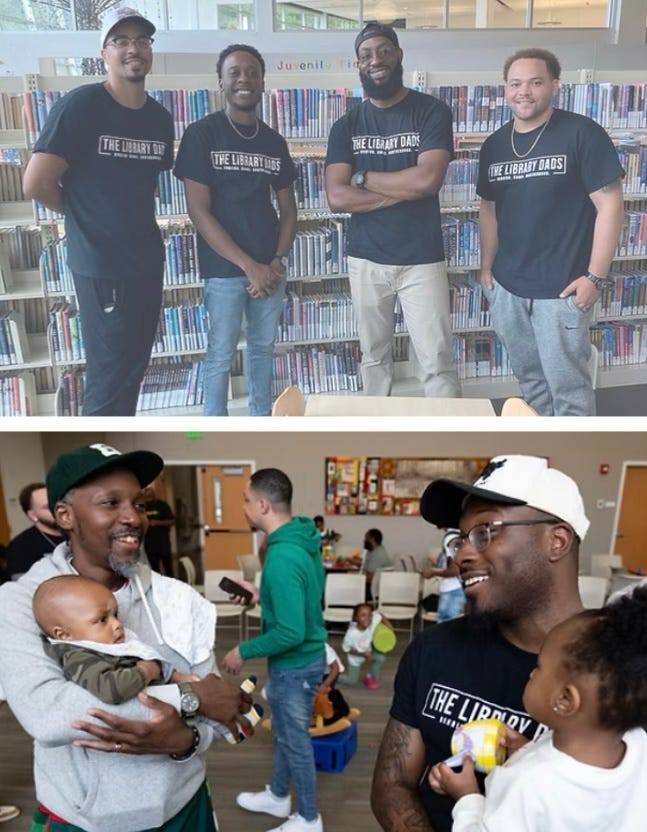
What struck me about The Library Dads was not just their active engagement with their offspring every Saturday at the public library, but also their pushback against the limits of certain public spaces that are less accommodating for fathers and their small children.

My Mama and Daddy took me to the library regularly as did many of the Black parents I knew growing up. I know they both would be impressed with The Library Dads for a variety of reasons. Yet, I must add one more reason that helps us all… 

In addition to these young men taking responsibility for their children’s education and development, they also shift the narrative that tends to center on mothers as almost solely responsible for their children’s development. They are a most welcome pushback on the confining and inaccurate gender definitions that the Western world imposes on us all. Go Library Dads!

©️Leslye Joy Allen

I am an Independent Historian, Oral Historian and Dramaturge. Please consider supporting my work with a few bucks for Coffee and Eggs via my CashApp.

You can also subscribe to my writings on Substack and stay in the loop with the best new research, history, journalism, prose, poetry, and etcetera.

All blogs written by Leslye Joy Allen are protected by U. S. Copyright Law and licensed under a Creative Commons Attribution-NonCommercial-NoDerivs 3.0 Unported License. Any partial or total reference to any blog authored by Leslye Joy Allen, or any total or partial excerpt of any blog authored by Leslye Joy Allen must contain a direct reference to this hyperlink: https://leslyejoyallen.com with Leslye Joy Allen clearly stated as the author.  Postings or blogs placed here by other writers should clearly reference those writers.  All Rights Reserved.

A Memory from a Small Black Girl in Atlanta

by ©️Leslye Joy Allen

When I was a small girl in Atlanta, Grandma’s lap and bedroom remained my soft landing if I had misbehaved and Mama was patiently waiting to give me that lecture about my behavior. 

Grandma’s bed had a ton of blankets where I couldn’t move if I got in it, but the visit was worth the trip because Grandma had a sweet tooth. There was candy I wasn’t supposed to have in her nightstand and her pockets.

Before I began going to school and even after I started school, Grandma and I had a daily routine of debate and opinions and arguments that could only be had between a 78-year-old woman and her 4-year-old granddaughter whose job was to help sort home grown tomatoes, snap beans, squash and peas from the garden except when I stopped to make mud pies from the rich red Georgia clay after a rain.

We spent hours discussing everything like two old women, but I was a midget version of an old woman. Grandma insisted on me having a reason and an explanation for why I believed certain things, nurturing propositions and hypotheses from my diminutive brain before I knew what a proposition or a hypothesis was. 

So, I became a historian.

©️Leslye Joy Allen

I am an Independent Historian, Oral Historian and Dramaturge. Please consider supporting my work with a few bucks for Coffee and Eggs via my CashApp.

All blogs written by Leslye Joy Allen are protected by U. S. Copyright Law and licensed under a Creative Commons Attribution-NonCommercial-NoDerivs 3.0 Unported License. Any partial or total reference to any blog authored by Leslye Joy Allen, or any total or partial excerpt of any blog authored by Leslye Joy Allen must contain a direct reference to this hyperlink: https://leslyejoyallen.com with Leslye Joy Allen clearly stated as the author.  Postings or blogs placed here by other writers should clearly reference those writers.  All Rights Reserved.
The Intersectionality of Suffragist & Abolitionist Lucy Stone

by ©️Leslye Joy Allen

“Intersectionality is a metaphor for understanding the ways that multiple forms of inequality or disadvantage sometimes compound themselves and create obstacles that often are not understood among conventional ways of thinking.” — Kimberlé Crenshaw

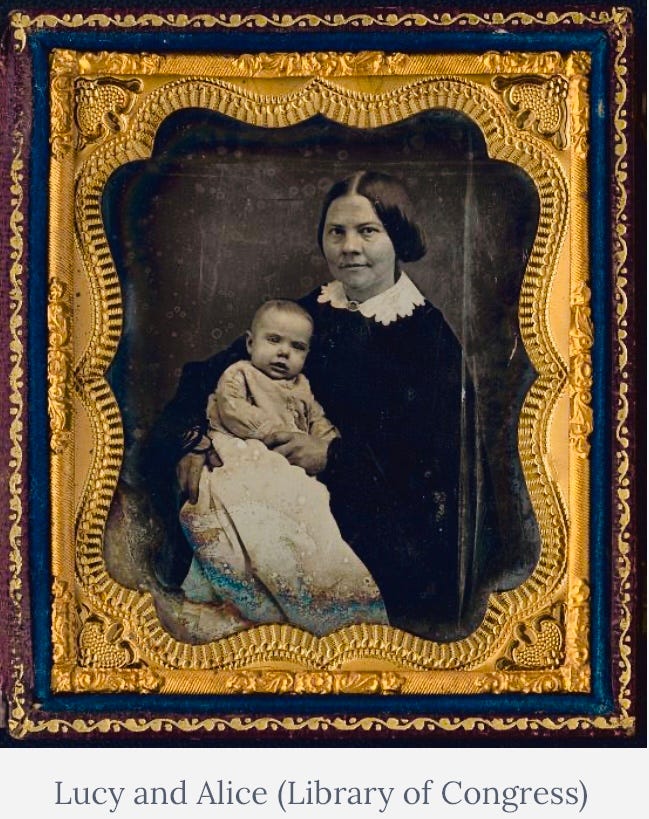
Recently, I responded to a question about the factors that stymied women’s quest for suffrage during the mid-to-late 19th century. I brought up the pragmatism and egalitarianism of suffragist and abolitionist Lucy Stone whose legacy remains largely overlooked. And therein lies the problem.

Susan B. Anthony and Elizabeth Cady Stanton have rightfully earned their place in Women’s history. They battled for the vote in ways almost unimaginable. Yet, they both held racist and classist views. Now before you start yelling about how both of them worked in the abolitionist movement, spare me. You can be anti-slavery and still not think the slave is your social or political equal. The inability to shake off one’s sense of entitlement has extreme consequences for everyone.

When lawmakers decided to include Black men as voters in the 15th Amendment without including the franchise for white women, both Stanton and Anthony were rightfully livid, but livid to the point where they then fought against the passage of the 15th Amendment altogether. It passed, however, in 1869 and was ratified in 1870.

Stanton wrote that it was unconscionable and dangerous to give the vote to Black, Chinese or Irish men because they were inferior. Anyone that did not fit a strict Anglo-Saxon and native-born status was considered inferior. Additionally, neither Stanton nor Anthony had thought about Black women voting at all. 

Stone broke with Anthony and Stanton over their racism. Orator, writer, abolitionist and former slave Frederick Douglass cut his ties to Anthony and Stanton as well. The tragedy was that Douglass had attended the Women’s Conference at Seneca Falls in 1848 and had been a huge and early advocate for women’s rights. Moreover, it was Lucy Stone’s brilliant oratory that had inspired Susan B. Anthony to join the suffrage movement.

Stone read the political winds correctly. She formed the American Woman Suffrage Association which concentrated on gaining women the right to vote on a state-by-state basis. She knew that Congress was not going to grant the franchise to everyone. 

Stone believed that the enfranchisement of Black men was progress. Although she was disappointed that the 15th Amendment did not include women’s suffrage, she did not believe that denying the franchise to others would help women in the long run.

Black men, rather than white women, were granted the right to vote first for a variety of reasons. As a historian, I know that the Republican Party in the 1860s was the party of Lincoln (not the sh*t show it is now) that freed Black American slaves. They controlled both the House and the Senate in 1867 to 1869. They knew that recently freed and enfranchised Black men would inevitably vote Republican and increase the party’s political dominance.

Granting the franchise to white women would have mixed political results as many white women still believed in the lost cause of the South in spite of its loss during the Civil War. They would have voted Democrat which was then the favored party of the former slave-holding South.

Some of Stone’s ideas were tied to her upbringing. She came from a hardworking farming family in Massachusetts. Both of her parents were abolitionists. While quite young, she, along with Lucretia Mott and Abby Kelly Foster helped William Lloyd Garrison establish the American Anti-slavery Society which was founded in 1833.

All of her brothers attended college. Yet, Stone had to postpone her education. She taught school for several years and was able to scrape up enough money to attend Oberlin College, the first college in the nation to accept Black people and women. When she graduated in 1847, she became the first woman in Massachusetts to earn a college degree.

Stone had planned to remain a single woman because she feared losing her independence to a husband. She finally yielded to Henry Browne Blackwell’s persistence. Blackwell was also an abolitionist and women’s rights advocate. Blackwell would learn years later that Stone finally decided to marry him after he met and aided a young slave with her owners while traveling on a train.

When Blackwell asked the girl would she rather be free, she answered “yes.” Blackwell and an accomplice helped get the young girl off of the train and away from her owners. It was that act of liberation that won Stone over.

When Blackwell and Stone married their written protest against laws that denied women equal rights was read before the ceremony. The promise “to obey” was removed from their wedding vows. Stone retained her maiden name and refused to pay taxes as long as she was denied her equal rights.

While neither Stone nor her contemporaries Anthony and Stanton lived long enough to see women receive the right to vote, their different approaches and beliefs underscored a perpetual problem in the quest for women’s equality and the right to vote.

Stone never stopped fighting for the rights of Black people as she continued her fight to get the vote for women. She believed that both causes were interrelated. The same cannot be said of Anthony and Stanton. 

The fight for the right to vote for women was often fractured by racism well into the 20th century. Stone’s stances on racial equality and equal rights for women cost her some popularity among some white women. Anthony and Stanton emerged as the face of white women’s suffrage. Yet, Anthony and Stanton also emerged as suspect to Black men and women. 

After Lucy Stone died of stomach cancer in 1893, her only child, Alice Stone Blackwell reached out to the daughter of Elizabeth Cady Stanton and began the process of repairing the divided women’s suffrage movement. They created a new coalition. Alice Stone Blackwell followed her mother’s mantra to make the world better.

Lucy Stone deserves more historical attention than she receives. Her example should be emulated precisely because she understood the “intersectionality” of gender and race (and the political implications that go along with it) long before Black scholar and lawyer Kimberlé Crenshaw coined the term and defined the theory in the late 20th century. Stone recognized that, no matter how different gender and race may appear, women’s equality was inextricably linked to racial equality. You must fight for both, not just one or the other.

©️Leslye Joy Allen

I am an Independent Historian, Oral Historian and Dramaturge. Please consider supporting my work with a few bucks for Coffee and Eggs via my CashApp.

All blogs written by Leslye Joy Allen are protected by U. S. Copyright Law and licensed under a Creative Commons Attribution-NonCommercial-NoDerivs 3.0 Unported License. Any partial or total reference to any blog authored by Leslye Joy Allen, or any total or partial excerpt of any blog authored by Leslye Joy Allen must contain a direct reference to this hyperlink: https://leslyejoyallen.com with Leslye Joy Allen clearly stated as the author.  Postings or blogs placed here by other writers should clearly reference those writers.  All Rights Reserved.
Walk With a Book

by ©️Leslye Joy Allen

I remember the first time I heard someone say, “If you want to hide something, hide it in a book.” The comment depressed me.

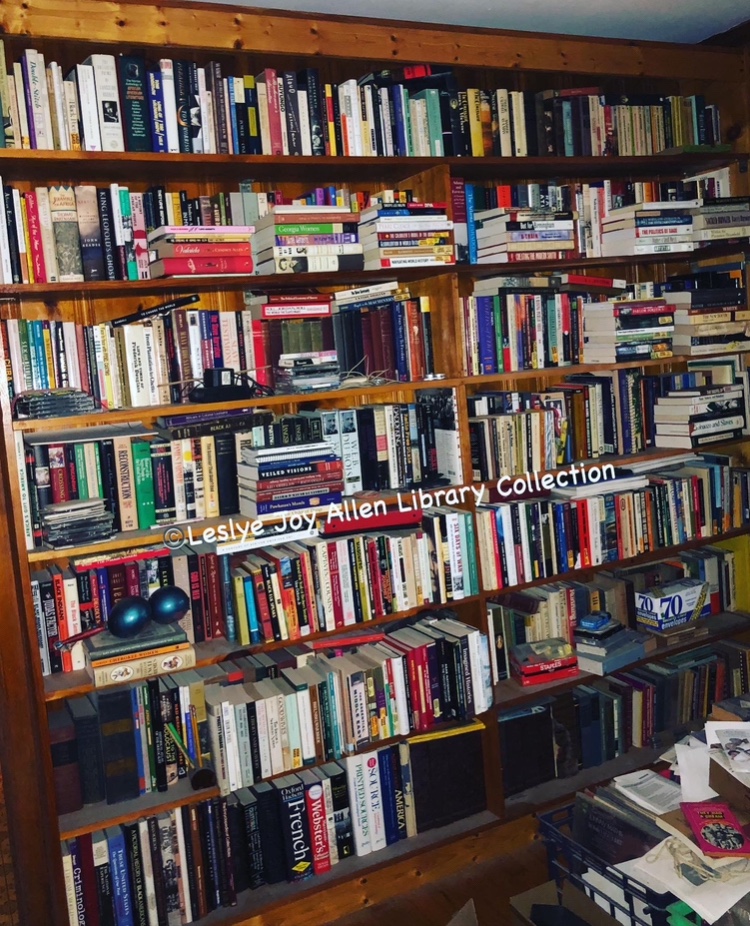
When you are a historian, you have books everywhere. You have to read all the time. I have not seen the top of my dining room table in nearly 15 years as it is covered with stacks of books. Books occupy every nook and cranny of my home.

With the United States ranking 36th in the world for literacy, with a 79% literacy rate, with only 25% of literate adults reading above the 6th grade level, we are already dumb. We can expect to see more decline in literacy with Felon 47 living on Pennsylvania Avenue.

So, I have a proposal. It might not change anything, but it is worth a try. Walk out of your door with a book in your hand or tucked under your arm everyday for at least a month.

Let kids and other adults see you walk with that book. And don’t say you can’t do this. You have carried books before when you were in grade school.

Make your book/s visible at your job, on a trip to a store. Hell, go for a walk with your book until someone asks you why you always have a book in your hand or under your arm. And then have the audacity to tell them why.

©️Leslye Joy Allen

All blogs written by Leslye Joy Allen are protected by U. S. Copyright Law and licensed under a Creative Commons Attribution-NonCommercial-NoDerivs 3.0 Unported License. Any partial or total reference to any blog authored by Leslye Joy Allen, or any total or partial excerpt of any blog authored by Leslye Joy Allen must contain a direct reference to this hyperlink: https://leslyejoyallen.com with Leslye Joy Allen clearly stated as the author.  Postings or blogs placed here by other writers should clearly reference those writers.  All Rights Reserved.
Enough Is Enough

by ©️Leslye Joy Allen

I have more than a few favorite writers, journalists, and/or activists on Substack. One of them is Lorissa Rinehart. When she wrote that too many children are addicted to social media, I got the impression that she drew on scientific studies and her own observations.

She delivered a good hard punch to catch our attention. She wrote:

“If religion is the opium of the masses, then social media is the meth.” —©️Lorissa Rinehart

You should be aware that an addiction to substances like Crystal Meth are among the most difficult of all habits to kick. Rinehart waxed poetic about how the Zuckerbergs and the Musks of this world prey on the minds of our children in much the same way drug dealers pounce on entire communities.

Her statement reminded me that addiction to social media is one thing that aided and abetted our current political climate. She reminded me that our children are particularly vulnerable to social media propaganda pushed by the Far Right.

So, here are some family practices I suggest that I learned from a friend of mine over 15 years ago. My friend limited TV viewing to one night a week with the whole family watching together. Her kids were only allowed 3 days per week to surf the web at home for 1 hour each day with parental controls on.

The rest of the week she and her offspring discussed Art, Music, Current Events, School and Books at the dinner table. After dinner there was homework. After homework they would pick a topic to discuss or a book to read together over the coming week. I must say she now has some of the smartest young adults I have met in quite a while.

Now, before you say that all of this is too difficult to do; that your work schedule is too difficult to navigate around in order to do any of this; or that you are not sure if you can get your kids to participate in anything like this, answer a few questions for yourself.

When is the last time you read a book or visited a library? How often do you have face-to-face conversations with friends and family, with everyone’s cellphone silenced or turned off and put away out of sight?

If you have not done any of the above in quite some time or you have stopped doing most of it regularly, consider how social media has altered how you communicate with others. Come to think of it, social media has altered nearly everybody’s way of communicating.

Social media is not inherently evil nor inherently good. Social media’s information, however, is the easiest information to manipulate and the fastest to spread. Now think of how easy it can manipulate your children’s ideas about the world and themselves, often before you know anything about the ideas that have formed in their heads. Before I say anything else about Meth addiction, think about social drinking.

If you are a social drinker who is not an alcoholic, you tend to know your limit. You might feel a mild buzz, feel a bit relaxed, but not drunk. In your youth you probably learned the hard way when to say “I have had enough.” Long term Meth addicts don’t have any moments of “I have had enough.” They often suffer from everything from depression, psychotic episodes, an inability to sleep, and tooth decay.

Unlike addictions to controlled substances—legal and illegal—social media addiction has no noticeable physical symptoms. So, when it comes to social media, do you know when enough is enough for yourself? More importantly, do you know when enough is enough for your kids? Think about that for a while.

©️Leslye Joy Allen

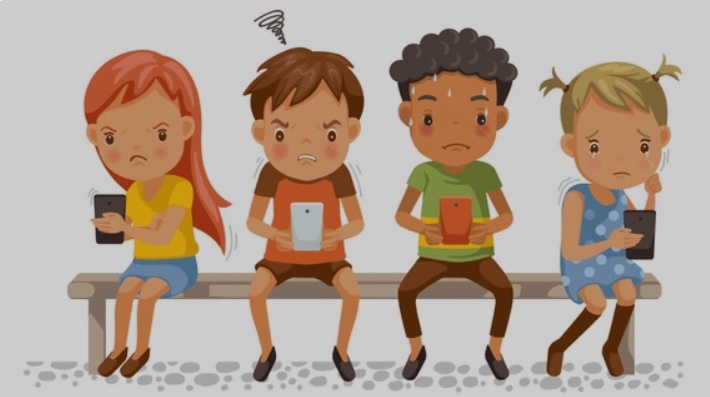
(Stock drawing of kids on their cellphones)

All blogs written by Leslye Joy Allen are protected by U. S. Copyright Law and licensed under a Creative Commons Attribution-NonCommercial-NoDerivs 3.0 Unported License. Any partial or total reference to any blog authored by Leslye Joy Allen, or any total or partial excerpt of any blog authored by Leslye Joy Allen must contain a direct reference to this hyperlink: https://leslyejoyallen.com with Leslye Joy Allen clearly stated as the author.  Postings or blogs placed here by other writers should clearly reference those writers.  All Rights Reserved.