“Syble’s Poem” by Charles Reese (guest blog)

My friend Charles Reese wrote this poem in honor of my late mother Syble Allen Williams (March 1, 1921 – February 9, 2013).  Thanks Charles for this rare gift; it makes her passing a little bit easier to bear.  — Leslye Joy Allen

Syble Allen Williams in 2007 at age 86. (Copyright © 2007-2013 by Leslye Joy Allen) Syble Allen Williams in 2007 at age 86.
(Copyright © by Leslye Joy Allen)

Syble’s Poem

by Charles Reese

Today feels like a poem for Syble

Syble’s poem is moving

Syble’s poem is taking action

Syble’s poem is moving toward something unknown to man or woman

Syble’s poem is moving beyond the limits of state apparatuses, struggling to control freedom outside its natural formation

Where poems are her songs

Holding us up

Keeping us together

Walking in the Spirit

Shouting

Hallelujah

We are moved

We are changed

Because today feels like a poem for our newest Ancestor…

Queen Syble Allen Williams.

Welcome to the fold.

And so it is.

Ashé.  Amen.

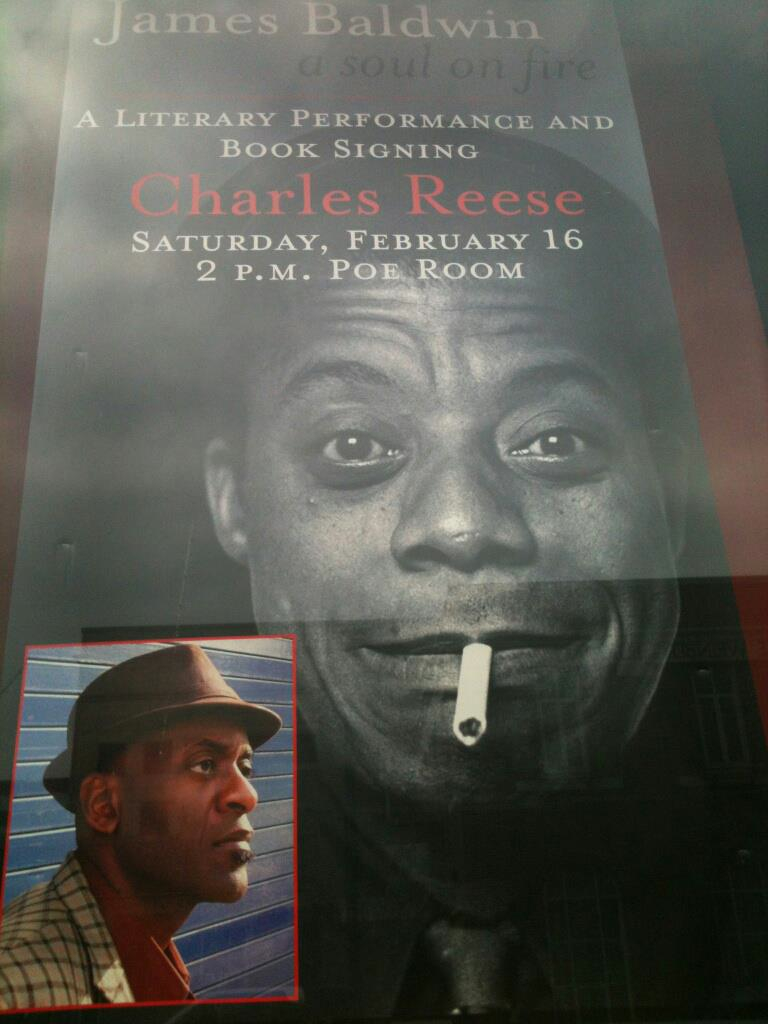
(Charles Reese is an Audelco Award-nominated Actor, Writer, Curator & Founder of The James Baldwin Project; and original actor & editor of the late Howard B. Simon’s Stage Play James Baldwin: A Soul on Fire, published by Glover Lane Press.)

Charles Reese: James Baldwin

Copyright © 2013 by Charles Reese.  All Rights Reserved.  No portion of this poem may be reprinted without permission from the author.

Creative Commons License

This Guest Blog by Charles Reese featured by Leslye Joy Allen is protected under U. S. Copyright Law and is licensed under a Creative Commons Attribution-NonCommercial-NoDerivs 3.0 Unported License.  Any partial or total reference to this blog, or any total or partial excerpt of this blog must contain a direct reference to this hyperlink: http://leslyejoyallen.com with Charles Reese clearly stated as the author and Leslye Joy Allen clearly stated as the owner of this blog.

Leslye Joy Allen and http://leslyejoyallen.com is proud to support the good work of Clean Green Nation  Visit the website to learn more about it: Gregory at Clean Green Nation!

9+ Goals for Black Folks for the Next Four Years and Beyond

by Leslye Joy Allen

Historian, Educator, Theatre and Jazz Advocate & Consultant, Doctoral Student

Copyright © 2012 by Leslye Joy Allen.  All Rights Reserved.

1.  Do not spend one dime at anything owned or managed by Donald Trump.  Trump is within his rights to dislike President Obama; he is within his rights to criticize President Obama’s policies.  He should not be allowed, however, to disrespect the office of the president simply because the person who occupies that office is a person of African descent.  He can call his behavior whatever he wants to call it, but if you are Black, you know exactly what Trump’s problem is.  Do not spend your money with him or with any person or organization that does business with him.  Here’s an extra history lesson on Donald Trump for you:  When Trump filed for bankruptcy over a decade ago because his casinos lost money, he tried to blame federal and state laws that have little control over Native American casinos.  Because Native American Nations are technically sovereign nations within the United States, states and the federal government have not exercised a high degree of regulation on these casinos when they are operated on lands owned by Native American Reservations.  Trump voiced opposition to some states and the federal government’s lack of interference and regulation of Native American casinos because he wanted to monopolize the casino industry.  What kind of a person would deny Native Americans—arguably the most oppressed group of people in the United States—a means of self-determination?

2.  Boycott Florida.  Keep your Black behinds off its beaches and out of its hotels.  Stay out of Disneyland.  Do not even buy Florida oranges and orange juice. Here’s another history lesson: In 1990 White Cubans in Miami and other Florida cities designated South African leader Nelson Mandela persona non grata because he dared praise Fidel Castro for supporting him when Mandela was fighting against an apartheid system that demoralized and murdered hundreds of thousands of South African Blacks.  Do not misunderstand—White Cubans have the right to hate Fidel Castro.  He stripped many of them and their ancestors of their property in the early days of the Cuban Revolution.  Other individuals were imprisoned and brutalized.  To diminish or disregard Castro’s persecution of them is not fair.  However, many of these same White Cubans also persecuted and routinely discriminated against Afro-Cubans.   Moreover, when any group of people suffer persecution—particularly as long and as virulently as Black South Africans—you would think that Mandela, a man wrongly imprisoned for 27 years, would receive some level of understanding and empathy from other persecuted individuals. Mandela did not receive that kind of consideration in Florida.

Florida has also had a lot of trouble with voting procedures. Remember the state needed federal and Supreme Court intervention to settle the 2000 presidential election.  Florida is also the same state that spent much of 2012 trying to disenfranchise voters to the point where it angered so many voters that they came out in record numbers to vote in the presidential election.  That number included entire communities of Latinx, African Americans, Jews, women, and etcetera.  It also took the state three days to finish counting the votes.

This is also the state where in February 2012 Trayvon Martin, a 17-year-old Black boy, was killed walking home from a store, unarmed.  We can grant George Zimmerman, his killer, the right to call the police and say that Martin looked suspicious.  Yet, until he actually saw Martin do something, Zimmerman should have stayed in his car as the 911 Operator told him to do.  Do you need me to keep going?  Do not give Florida your money; and demand this boycott of Florida from all Black organizations, performance artists, politicians, clergy, you name it.  We have earned the right to protect our interests.

3.  Keep your money in your pocket and in your bank account as much as possible.  Many of President Obama’s enemies think that WE Black folks only take handouts from the government rather than earning a combined $836 billion dollars a year working on a variety of jobs and in a variety of professions.  So many of the President’s enemies do not know or believe that WE Black folks place a minimum of over $500 billion dollars (or more) back into the United States economy every year.  Since so many folks assume WE contribute nothing, let us hold on to our money and spend it wisely and only with those businesses, corporations, and individuals that put something tangible back in our communities.  If you want to know where our money goes, visit: Target Market News and read the best consumer and spending reports on Black Americans on the web.

4.  Face the reality that we need to cut federal spending.  Some social programs need a serious overhaul or elimination.  For example, the Housing Voucher Program (formerly called “Section 8 housing”) demands that the people that qualify for such housing must have an income that is at least 50% less than the average income in the neighborhood where the house of their choice is located.  Rental rates are based on the average rental rates in the neighborhood where the houses are located.  Typically Housing voucher renters pay 30 per cent of that average rental rate, with the Department of Housing and Urban Development (HUD) paying the remaining 70 percent to the owner of the property.  Occasionally renters’ portion of rents are raised should they begin to earn higher salaries.  However, there is no time limit on how long an individual can remain in this kind of housing.  There is no concrete incentive in this program for participants to seek higher-paying jobs and risk disqualification from participation in the program. Even worse, if property values suddenly go up in a neighborhood where some Housing Voucher renters live, these same renters have another risk: they might be priced out of the houses they currently rent and live in.  Why continue to rent to a Housing Voucher Renter if you can acquire another renter that can afford the higher rents without the assistance of HUD?  It is time to set some limits.

5.  For that percentage of Black Americans who have problems with Latinos and other immigrants, remember that a considerable number of Latinos and other immigrants are also people with African ancestry (whether they admit it or not).  While I have certainly met many folks who would rather die than highlight or admit any African ancestry, I have also met many more who freely acknowledge and embrace their African ancestry!  Many of them have lived here in this country for a long time and many others who are recent arrivals are here to stay, so you would do well to build or continue building coalitions with them and find ways to work together.

6.  Do not put up with racism, but do not hyperventilate about it either.  Some White folks are not going to change.  Stop wasting your time, efforts and energy trying to change them.  And those White folks that you know that are always so nice to you, but who always try to look the other way when you or someone else brings up a racist incident; and when they can no longer ignore what happened they try to act like that kind of incident is so unusual—Be courteous to them, but keep them at arms length.  No matter how seemingly innocuous and/or well-meaning and/or kind and/or generous they may be, any person or group of people that attempts to deny the obvious are part of the problem.  It is not your job to teach them or fix them.  No one can fix anything if one refuses to look at it for what it is.

7.  Invest in Africa!  Hell, the Chinese are already heavily invested and building in several developing African countries.  You might as well join the effort.

8.  Global Warming is not a joke; and we as a people contribute as much or more to the problem as anyone.  Read everything you can from the National Resources Defense Council (NRDC)  (I have been a member for 15 years).  Study the reports on the household and cosmetic products you use at Environmental Working Group (EWG)  Make sure you read their report Pollution in Minority Newborns,” if you want to know how serious this is.  Check out my old blog “Mercy, Mercy Me: Black, Clean and Green!” plugging a younger and progressive Black man who runs a business that offers products that help clean up the environment and save you money in the process.

9.  Talk to people and listen to people who do some kind of work or express ideas that are different from the work you do and from the ideas you express and believe in.  This is how new ideas are born and it is also the best way to find out what is truly going on with people you may someday have to rely on.  I recently met a group of young academics that only socialized with each other.  These same academics also wrote some of the most useless scholarly work I have ever read.  I also have met many younger performance artists (35 and under) who do the same thing—they only interact with one another and still cannot figure out why no one comes to see the show!  If you do not communicate with folks outside your profession and inadvertently imply that those other folks’ contributions are not as important as your own contributions, then you cannot expect them to follow you or support you.  The current Republican Party and Mitt Romney’s failed presidential campaign provides a good lesson—They lost the election for a variety of reasons.  Yet, they truly lost the bid for the presidency because they only talked to each other and they believed that their opinions were the only ones that mattered; everybody else had to have been wrong.  Do not stay in the same kind of cocoon, that is unless you want to resemble the current Republican Party.

10. This line is for you to add your own personal goal.  You know what you want to do.  You know what you are capable of doing.  Do it!

Peace.

Copyright © 2012 by Leslye Joy Allen.  All Rights Reserved.

Leslye Joy Allen is proud to support the good work of Clean Green Nation.  Visit the website to learn more about it: Gregory at Clean Green Nation!

Creative Commons License This Blog was written by Leslye Joy Allen and is protected by U. S. Copyright Law and licensed under a Creative Commons Attribution-NonCommercial-NoDerivs 3.0 Unported License.  Any partial or total reference to this blog, or any total or partial excerpt of this blog must contain a direct reference to this hyperlink: http://leslyejoyallen.com with Leslye Joy Allen clearly stated as the author.

What I Learned About Creativity from My Worst Subject

By Leslye Joy Allen

Historian, Educator, Theatre and Jazz Advocate & Consultant, Doctoral Student

May in the Park, No. 24
Copyright © 2012 by Leslye Joy Allen

Copyright © 2012 by Leslye Joy Allen. All Rights Reserved.

I do not typically write about Education per se.  Two of my favorite bloggers ModernDayChris and Matt Wilson of Everything Needs to Change do the best writing about the subject, particularly the education of children in our public school systems from Kindergarten to 12th Grade.  This essay is not so much a critique as it is a reminder about something often forgotten when conversations and analyses take place about what is wrong or right or that needs fixing in American education overall.

First, let us be honest.  Not all American public education is flawed; it is often unequal based on race and/or socioeconomic factors.  It can also suffer from certain regional economic problems, which are beyond the scope of this essay.  The quality of American higher education runs the gamut from mediocre to the best in the world.  Yet, there are certain actions and habits that can help any student regardless of the quality of that education.  Of course, the best education nurtures these habits.  So here goes…

For the record, I was possibly the world’s worst Biology student.  After routinely making grades of “A” in subjects like History and English, I nearly flunked Biology in high school.  I will not bore you with the stories about my nausea and headaches when I had to dissect some dead animal preserved in formaldehyde—That is a whole other essay by itself.  When I had to take Biology in college, I determined that I needed to not only study, but also come up with some creative ways to study.  After getting a lousy two out of twenty identifications correct on a Biology Lab Practical Exam, I arranged a meeting with my professor.  (For those of you who have forgotten what a lab practical is, it is simply a test where you identify bacteria, amoebas, and other items physically located in a biology lab, many of which are under a microscope.)

My professor informed me that he typically set up everything in the lab on Saturdays.  I asked if I could come by on Saturdays.  He said that I could, and that I could stay as long as I wished so that I could examine and take notes about all of the items in the lab.  Off to campus on Saturday I went carrying my notebooks and an assortment of colored markers so that I could literally draw what I was examining so that I could study it at home, over and over again.  On nearly ten consecutive Saturdays, I also got a chance to talk at length with my Biology professor.

I joked with him that a historian’s brain dealt with a lot, and it did not have much room for Biology.  My professor admitted that he had never been a good student of History.  We both took note of the fact that History typically tells a story; and it also typically argues a thesis, which is why you can find so many different History books about the same event that argue entirely different positions about why that event happened.  This is why Law students typically have to have some academic background in History—History teaches you to see more than one side of an argument.  Biology, however, is another matter.  That amoeba cell that you just examined under that microscope is going to remain an amoeba cell.  You can either recognize it or you cannot!

During these Saturday sessions, I had the opportunity to ask my professor numerous questions about everything in that lab.  I swiftly took notes of everything he said.  When both he and I were taking breaks from the subject matter, we discussed History, Politics, Performance Arts, and whatever was happening in the news.  He quickly discovered that while I would never be a great biologist, I was a good student in History, and a burgeoning intellectual.  So, what is my point?

The point here is I listen to students and some educators talk about subjects they describe as not preparing students for the kind of work they will be doing as adults.  “Why do I have to take Biology if I am never going to use it?”  That is a fair question.  Yet, my experience with taking a subject I might not have to use or need to use taught me several important lessons about the intrinsic value of a good education beyond the mere mastery of any particular subject matter.

First, when I made a solid “B” as my final grade for Biology, I knew I had earned it.  No one—and I certainly did not—really wants to go back to school on Saturdays.  I went back and stayed long hours and it paid off.  Second, because I was often the only student in the lab on those Saturdays I was free to speak with my professor without interruption.  Technically, I got free tutoring lessons simply by showing up and availing myself of his expertise.  Third, my professor witnessed me making an extra effort in a difficult subject.  While professors do not grade for “effort” (nor should they), it does not hurt for an instructor to see a student put in extra time in order to master a difficult subject.  Fourth, I learned that I could conquer that which was difficult.

I also finally understood lessons that my mom and my uncle, both educators, often emphasized throughout my childhood and adolescence:  Education is as much about endurance as it is anything else.  And as my mom often stated: You cannot expect a student to become the next Einstein if he or she cannot get along with other students (teamwork) and also willingly and creatively work on difficult subject matter.  Importantly, both Mom and my uncle insisted that one of the keys to a good education was the “social” skill of learning how to navigate difficulties and put in extra time without resorting to short cuts or cheating or other forms of skulduggery.  Tackling a subject that one is not good at forces a certain level of creativity—that is creativity often born of unorthodox or unconventional ways to retain and master the subject matter, and pass the class.

It is right about now that the folks that know me well would assume that I would go into one of my soapbox sessions about the necessity of arts education in schools, and how the arts make students more creative and help with spatial reasoning and a host of other skills, including enhanced skills in Mathematics and Sciences.  Well, I am not going to do that, exactly.

Exposure to the arts certainly enriches and develops creativity; and I have never met an artist that was not creative at something.  Yet, creativity is not the exclusive domain of the arts or artists.  I have met many individuals who did not have an artistic bone in their bodies, but who were highly creative people.  If students are to develop into productive individuals who can think their way through and out of complex problems, regardless of academic discipline, then education needs to not only expose students to the arts, but it should also advocate that creativity—artistic or otherwise—is an essential skill for all academic disciplines.  Furthermore, arts education advocacy need not exist on, nor should it lay sole claim to, some creative island minus its other academic counterparts.  Perhaps, this is where the real debate about education needs to begin.  More to come later…

Copyright © 2012 by Leslye Joy Allen. All Rights Reserved.

Leslye Joy Allen is proud to support the good work of Clean Green Nation.  Visit the website to learn more about it: Gregory at Clean Green Nation!

Creative Commons License This Blog was written by Leslye Joy Allen and is protected by U. S. Copyright Law and licensed under a Creative Commons Attribution-NonCommercial-NoDerivs 3.0 Unported License.  Any partial or total reference to this blog, or any total or partial excerpt of this blog must contain a direct reference to this hyperlink: http://leslyejoyallen.com with Leslye Joy Allen clearly stated as the author.

The Persistence of Old Models / Old Beliefs

by Leslye Joy Allen                                                                                                      Historian, Educator, Theatre and Jazz Advocate & Consultant, Doctoral Student

Copyright © 2012 by Leslye Joy Allen. All Rights Reserved.

Last month, I had the good fortune to sit down with, break bread with, and drink good wine a couple of times with award-winning playwright, Black Theatre expert, and educator Paul Carter Harrison.  I have to thank fellow scholar R. Candy Tate for turning what was supposed to be our first meeting (to trade academic notes and talk shop) into a meeting where we added yet another spirited scholar to the mix.  This was one of those rare opportunities we graduate students receive where we can converse with someone who is, arguably, one of the first artists to seriously study Black Theatre and create a scholarly canon that tells us what Black Theatre is and what it is not.

However, I deliberately did not ask Paul about his many books (The Drama of Nommo or Black Theatre: Ritual Performance in the African Diaspora).  Among the many things we discussed was his frustration and anger about what he considered to be some younger playwrights, actors, and directors’ pandering to the tastes of White audiences; and an unfortunate dumbing-down of theatre, television and film in an effort to appeal to audiences of all races for the sole benefit of entertainment just for entertainment’s sake.  He was not ambiguous at all; he was livid.  He saw a disturbing trend where some Black performers decided to cater to what White producers and audiences—even well-meaning White folks—wanted them to appear to be on stage.  No more martyred Black folks, he said.  Exactly how many times must everything WE do be a response to some other group of people?  Exactly how many times must we be characterized as long-suffering and stoic or, for that matter, be the super baadaass Black man who always manages to rush in and save the day?  He made his point.

He saw this pandering as something that, while it might be quite commercially satisfying,  stifled Black creativity and stunted artistic risk-taking while it simultaneously applauded and rewarded the mundane, the ordinary.  He noted that this lack of vision, this lack of adventurousness, would eventually cause a lot of artists to hit a commercial brick wall.  He did not bite his tongue about the fact that certain Black stereotypes and certain Black archetypes had become the norm in film, on TV, and on the stage.  While Paul is a part of my larger ongoing research, which will not be discussed here, he did make me think about not only why artistic and scholarly risk-taking is necessary for growth, but also why stereotypes are particularly dangerous.

After our two marathon conversations, I thought about how people on both sides of the political and racial aisle, so to speak, hold onto and cling to certain images and ideas about Black people.  I have to honestly wonder whether, WE Black folks have any real friends who actually know US; that is, friends outside of our own racial/ethnic group.  I am not kidding; I mean this.  Aside from the racist who assumes that at any given moment I will be spitting out watermelon seeds or that I have bred babies like rabbits, there are also those White folks that go to other extremes.  They are so hell bent on proving that they are not racist that they see beauty and goodness in everything and everybody that is Black—and that is a fallacy as well.  Blackness and Black people become a fetish.  One of the first things that makes us, Black folks, human is our ability to be great or weak, right or wrong, smart or dumb, honest or dishonest.  Any belief, sentiment, or romanticism that strips us of the full range of human expression denies us our humanity, no matter how flattering those beliefs and sentiments might be.  It is dangerous to hold onto those kinds of extremes and expectations.

Only a few days after my meeting and hanging out with Paul, one of my History students, a young White male, told me about this funny video he saw.  According to this student, someone filmed security personnel in a department store.  In the video, all of the security personnel were following all the Black customers assuming that the Black customers would be the customers who would shoplift.  However, while security was following all the Black customers, White shoplifters were stealing everything they could get their hands on.  Both my student and I laughed, but the humor quickly faded when we began to consider what really happens when someone makes assumptions based solely and purely on race, or I should say, on racism.  Now, anyone with half a brain knows that people of all races and ethnicities steal for a variety of reasons.  Nevertheless, this video—that I have never seen, by the way—said something else about misconceptions based solely on race.

When people buy into any stereotype it does something more than degrade and devalue the victim of the stereotype, it tells everyone else exactly who they need to victimize or who they need to “not look like” or “not behave like” in order to get away with whatever they are attempting to get away with.  I am not going to say anything about Trayvon Martin, this time.  However, for all of those frightened and paranoid White folks (and Black folks) who live in gated communities in Florida and elsewhere, I have only one thing to say:  Beware of respectable looking young White males who may be walking through your neighborhoods.

While I am sure most of these young White men will not be planning to commit any crime or do anyone any harm, one of them might have decided that since he did not look a certain way that he could get away with certain things.  When you buy into and believe those old models and old beliefs, eventually, someone figures out that all they have to do is make sure they do not fit the model.  After that, they can get away with anything!  And for those folks who might be feeling guilty for believing the worst stereotypes about Black people,  the last thing you need to do is stop for some poor Black guy on the side of the road at midnight, just to prove a point.

The majority of us Black people work hard, pay our bills, take care of our homes and lawns, and never ever hurt anyone, but that does not mean that all Black people are saints.  If we could just let these old models and old beliefs go, we could proceed in this world based just on facts rather than assumptions.  Now, I have a Black elder statesman of Theatre and a young White male student to thank for raising the level of the discussion.

Copyright © 2012 by Leslye Joy Allen. All Rights Reserved.

Leslye Joy Allen is proud to support Clean Green Nation.  Visit the website to learn more about it: Gregory at Clean Green Nation!

Creative Commons License This Blog was written by Leslye Joy Allen and is protected by U. S. Copyright Law and licensed under a Creative Commons Attribution-NonCommercial-NoDerivs 3.0 Unported License.  Any partial or total reference to this blog, or any total or partial excerpt of this blog must contain a direct reference to this hyperlink: http://leslyejoyallen.com with Leslye Joy Allen clearly stated as the author.

12 Lessons…

…I Learned from My Parents and a Few Great Teachers (Some old advice worth repeating)

by Leslye “Joy” Allen                                                                                                            Historian, Educator, Theatre and Jazz Advocate & Consultant, Doctoral Student

Copyright © 2012 by Leslye Joy Allen. All Rights Reserved.

  1. BE PREPARED TO BURN THE MIDNIGHT OIL.  If you rush and get something done in ten minutes, there are probably ten errors in it.  Take your time and do it right the first time.
  2. DO NOT BE AN ADULT WHO IS ALSO A SPOILED BRAT.  Temper tantrums and crazy demands are bad enough in children, but completely intolerable in adults.  In fact, tantrums and crazy demands will not likely be tolerated by anyone other than an idiot who is a glutton for punishment.  No one owes you anything.  Get over the idea that because you are sad, financially broke, angry, or frustrated that the world must accommodate your bad mood or your rudeness.  Go somewhere alone and be quiet and think about how you got to this point.
  3. DO NOT EXPECT YOUR FAMILY (or SPOUSE) TO CHANGE.  Enough said.
  4. TAKE RESPONSIBILITY FOR THE BAD STUFF.  Remember that there are some memories of bad or traumatic events that will bother you from time to time.  Call a good friend who will let you vent, or seek counseling.  If necessary, shed a few tears.  Yet, do not cry over five minutes.  Get back to your work.  Do not get into the habit of believing that because you have big problems that you bare no responsibility for your life.
  5. BE DEPENDABLE.  No one needs a friend that barely returns a phone call and no employer needs an employee that is chronically late or who does lousy work.
  6. BE INDEPENDENT and take responsibility for your personal and financial life—You are not an adult until you do.  Avoid people that do not encourage your independence. People who support your dreams are not supposed to continuously pay your way, but they should be encouraging you to do so.
  7. CHOOSE  YOUR ASSOCIATES AND FRIENDS AND MATES, CAREFULLY.  Suppose your associates or friends or mates can be defined as any of the following: unreliable, lazy, bigoted, racist, narrow-minded, sexist, uncouth, ill-mannered, elitist, promiscuous, untrustworthy, and/or just plain dumb (you can add your own negatives, if you like).  All you need to ask yourself is whether you would want your son or daughter to acquire about half of these characteristics.  If your answer is no, then you have no business hanging out with, dating, marrying or mating with any of these folks.
  8. DEAL WITH WHAT IS REAL.  Avoiding reality will never change reality.  Daydreaming and talking about what you want to do has its limitations.  Dream big, but stop daydreaming and get to work.
  9. FINISH WHAT YOU START.  So what if what you are working on is going to take five years or more to complete?  Work toward that goal with concrete and practical steps everyday, and avoid taking detours.  It is not what you say you want to do, but what you actually do that matters.
  10. PARTICIPATE IN THE ARTS (music, theatre, paintings, sculpture, dance, writing) in some capacity.  The arts help you remain creative whether you have any artistic talent or not.  Creativity, put to good use, will help you solve problems.  Occasionally, it will help you forget about your problems when necessary.
  11. This is an old adage, but NEVER STOP LEARNING.  Make education a lifelong journey.  Always be ready to discover something new.
  12. MAKE SMILING A HABIT.  Frowning always turns people off.  Smiling helps your appearance and your attitude.

Peace.

Copyright © 2012 by Leslye Joy Allen. All Rights Reserved.

Leslye Joy Allen is proud to support the good work of Clean Green Nation.  Visit the website to learn more about it: Gregory at Clean Green Nation!

Creative Commons License This Blog was written by Leslye Joy Allen and is protected by U. S. Copyright Law and licensed under a Creative Commons Attribution-NonCommercial-NoDerivs 3.0 Unported License.  Any partial or total reference to this blog, or any total or partial excerpt of this blog must contain a direct reference to this hyperlink: http://leslyejoyallen.com with Leslye Joy Allen clearly stated as the author.