Parable of the Sower

by ©️Leslye Joy Allen

“…the plant of freedom has grown only a bud and not yet a flower.” — Martin Luther King, Jr.

“God is your first and your last teacher. God is your harshest teacher: subtle, demanding. Learn or die.” — Octavia Butler, (from “The Parable of the Sower, 1993)

I woke up before dawn annoyed that January 20, 2025 is inauguration day for Felon 47 and it is also the federal holiday celebrating the birth and life of Martin Luther King, Jr. I also could not help thinking about how our abuse of the earth has contributed to the fires in California.

A week ago, I re-read Octavia Spencer’s prescient novel “Parable of the Sower.” Butler’s protagonist Lauren, the daughter of a preacher, lives in a safe and comfortable, walled-up cul-de-sac. Outside those walls are desperately poor people, racial and economic inequality, and drug addicts that use a drug called “pyro” that makes its users want to set fires.

Lauren tries to convince others to accept that the world has changed and will continue to change. The others prefer to pretend nothing has happened to the earth and its inhabitants.

Butler predicted ecological disaster by fire coming over 30 years ago, and named her novel after a biblical parable. Right after I finished reading the book again, I thought about how M. L. got his name.

Many people do not know that M. L. (what we called him here in Atlanta) was born Michael King, Jr. I knew many elderly Black Atlanta citizens who called him “Mike” their entire lives.

His father, best known as “Daddy King,” attended a World Baptist Conference in Germany in 1934. Reborn and rejuvenated after he learned more about the philosophies of Protestant reformer Martin Luther, Daddy King soon renamed himself and his son “Martin Luther King, Sr. and Jr.

In 1957, “Michael King, Jr.” was officially changed to “Martin Luther King, Jr.” on his birth certificate. There are other stories about why and when Daddy King changed their names, but I like this story the best.

I bring this up because another story goes that when the German Protestant leader Martin Luther was asked what he would do if he knew the world was going to end tomorrow, he allegedly answered, “I would plant an apple tree today.”

While I am a believer in Goddess/God, I am not particularly religious. I know too well how organized religion has failed us in so many ways. I am, however, a historian who finds truth and sustenance in some parts of the Christian Bible that the incoming administration and so many preachers and billionaires have totally corrupted.

In the Bible’s Parable of the Sower, Yeshu’a ben Yosef (bka Jesus) tells a story about a farmer who sows seeds in four different types of soil. It is not until the farmer’s seeds are sowed in good soil that he yields a good crop. In this parable, which has many lessons, Yeshu’a emphasized that we must pay attention to where we plant our seeds if we expect anything to grow. We yield a good harvest when we take responsibility for how and where we do our planting.

To place seeds in the ground is an act of faith. When you plant, you do so with the faith that you will yield something. You do it with the belief that you, or your loved ones, will live long enough to reap the reward, be it vegetables or fruits or flowers or justice or equality.

On this Martin Luther King, Jr. holiday, may we go forward intentionally, reminded that we are obligated to be good stewards of the earth that we do not own. California’s fires are the result of our excess and failure to clean up the earth which is the only home we have.

May we plant in the best soil, in the best social and educational policies, in the best radicalism, in the truth. May we sow our seeds in our gardens and farms and tend them with a faith that tells us we will reap a good harvest and that we will have enough to sustain us in order to stave off the worst excesses of the incoming administration. May we humble ourselves, unlike Felon 47 and his underlings, and remember that we live on this earth that we did not create and will die whether we are paupers or billionaires. May we learn the life lessons of one of the best sowers, namely Martin Luther King, Jr.

©️Leslye Joy Allen

King’s Papers are located at the King Institute at Stanford University. I urge you to visit and explore: https://kinginstitute.stanford.edu/message-director

(Martin Luther King, Jr. photographed in 1964 by Dick DeMarsico for World Telegraph and Sun. Courtesy of the Library of Congress)

All blogs written by Leslye Joy Allen are protected by U. S. Copyright Law and licensed under a Creative Commons Attribution-NonCommercial-NoDerivs 3.0 Unported License. Any partial or total reference to any blog authored by Leslye Joy Allen, or any total or partial excerpt of any blog authored by Leslye Joy Allen must contain a direct reference to this hyperlink: https://leslyejoyallen.com with Leslye Joy Allen clearly stated as the author.  Postings or blogs placed here by other writers should clearly reference those writers.  All Rights Reserved.

What Is In A Name?

by ©️Leslye Joy Allen

My late mother struggled with infertility for 13 years before I was born. She told me that not only did doctors test my father’s sperm, but that she had her Fallopian tubes blown out with hot water. Many times she was in so much pain from the treatments that she couldn’t bend down to tie her shoes.

When I was born, my parents were 3 and 4 months away from turning ages 40 and 41, respectively. Mama and Daddy decided on the name “Leslye” because it was gender-neutral and also because my father did not particularly care for the practice of men naming sons after themselves.

“A boy either has a reputation to live up to or one to live down,” Daddy used to say. Anyhow, my name, had I been born a boy, would have been “Leslye Charles Allen” which would have included only my father’s middle name.

My late mother discovered the spelling of “Leslye” in a Reader’s Digest article where a young woman with that name and spelling was being sent on a tour of Europe as her graduation present from her parents.

When Mama brought the name and spelling of “Leslye” up to her good friend Esther Flournoy, my Aunt Esther said, “Cooter (their nickname for each other), what will be the middle name if your baby is a girl?”

Mama told me that she honestly did not know. At that moment, Aunt Esther said, “I like names like ‘Faith,’ ‘Hope,’ and ‘Joy.’”

Mama tried all combinations of these names until she arrived with “Leslye Joy.”

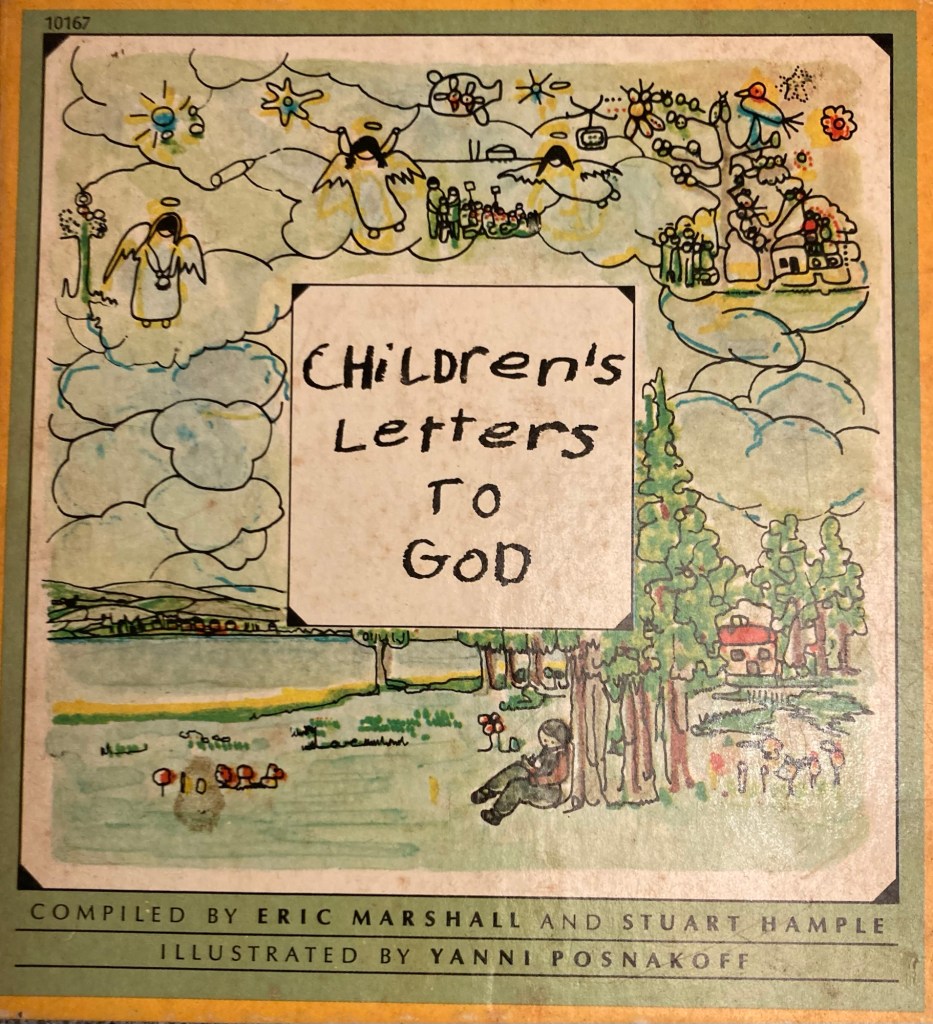
The hilarious and thought provoking book “Children’s Letters to God,” first published in 1966, was the very first book given to me by someone other than my parents.

It was given to me by the woman responsible for my middle name. Most of my classmates from Saint Paul of the Cross Elementary School and Saint Joseph High School never knew my first name was “Leslye” until long after we graduated.

Yet, I have had college professors, most notably Dr. Waqas Khwaja, and those wonderful women who cooked and fed me while I was a student at Agnes Scott College, just simply start calling me by my middle name “Joy” as if they all automatically knew that my middle name was the one that had the most love and history behind it. I was and remain warmed by that.

©️Leslye Joy Allen

“Children’s Letters To God,” 1966

All blogs written by Leslye Joy Allen are protected by U. S. Copyright Law and licensed under a Creative Commons Attribution-NonCommercial-NoDerivs 3.0 Unported License. Any partial or total reference to any blog authored by Leslye Joy Allen, or any total or partial excerpt of any blog authored by Leslye Joy Allen must contain a direct reference to this hyperlink: https://leslyejoyallen.com with Leslye Joy Allen clearly stated as the author.  Postings or blogs placed here by other writers should clearly reference those writers.  All Rights Reserved.
For the Mamas of My Sistahs in Atlanta

by ©️Leslye Joy Allen

I cannot remember everybody’s Mamas first names, but here is what I know.

There is not a Black woman in Atlanta born between say 1945 to 1965 that can name 3 Black women that were bigger bad asses than their own Mamas who had names like Dorothy, Mary, Geraldine, Syble, Sadye, Carrye, Sarah, Hattie, Laware, Mattie, Helen, Mignon, Gloria, Etta Mae, Carolyn, Violet, Lena, Sophia, Vivian, Myrtle, Evelyn, Mamie, Miriam, Frances, Geneva, Cora, Doris, Andrea, Delores, Agnes, and the list goes on. I am sure I have left out a name or two, but…

think of just three women that might outdo your Mamas in any one of their endeavors. Try to do that so that you will fail and know how lucky you are and on whose shoulders you stand. Try it so you know how much you deserve rest, support and praise. Try it so you know you don’t owe anyone anything. They owe you.

©️Leslye Joy Allen

Mama

#MakeAmericaLiterateAgain

All blogs written by Leslye Joy Allen are protected by U. S. Copyright Law and licensed under a Creative Commons Attribution-NonCommercial-NoDerivs 3.0 Unported License. Any partial or total reference to any blog authored by Leslye Joy Allen, or any total or partial excerpt of any blog authored by Leslye Joy Allen must contain a direct reference to this hyperlink: https://leslyejoyallen.com with Leslye Joy Allen clearly stated as the author.  Postings or blogs placed here by other writers should clearly reference those writers.  All Rights Reserved.

A Micro-History of Gender Variations in Ancient Africa, Asia, and North America

by Leslye Joy Allen

Copyright © by Leslye Joy Allen.  All Rights Reserved.

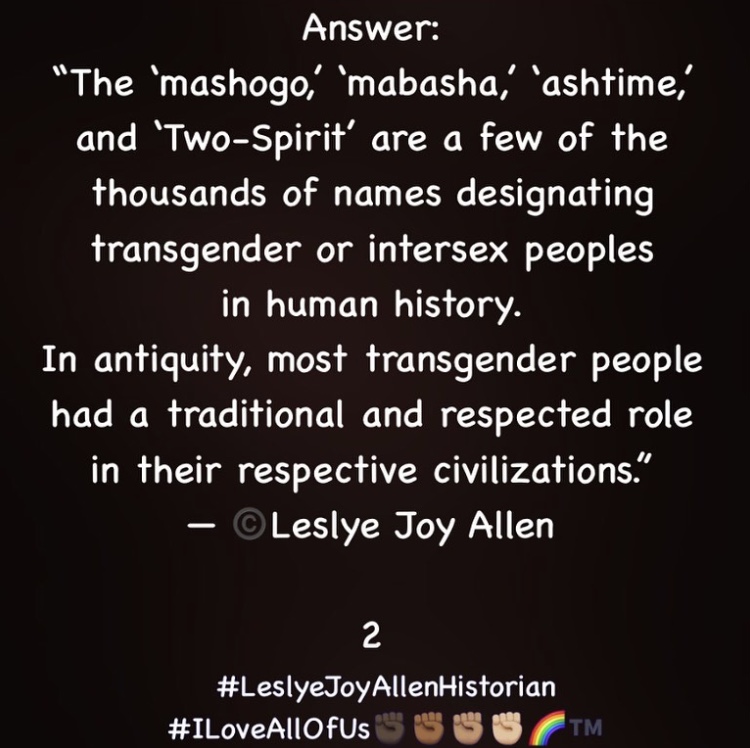
This is an extremely tiny micro-history of Gender that is almost never covered in classrooms. While there is enough data available on this subject that fills thousands of libraries, it is particularly important information in light of the recent excessive violence and neglect of our/my transgender sisters and brothers.

It is important to remember that many ancient African, Asian, and Native American civiliations tended to identify and accept people who were not easily lumped into a single category defined strictly as male and female. There were (and always will be) a tiny minority of individuals who were/are best defined and/or recognized as not fitting into either of the two gender categories emphasized by the Western world.

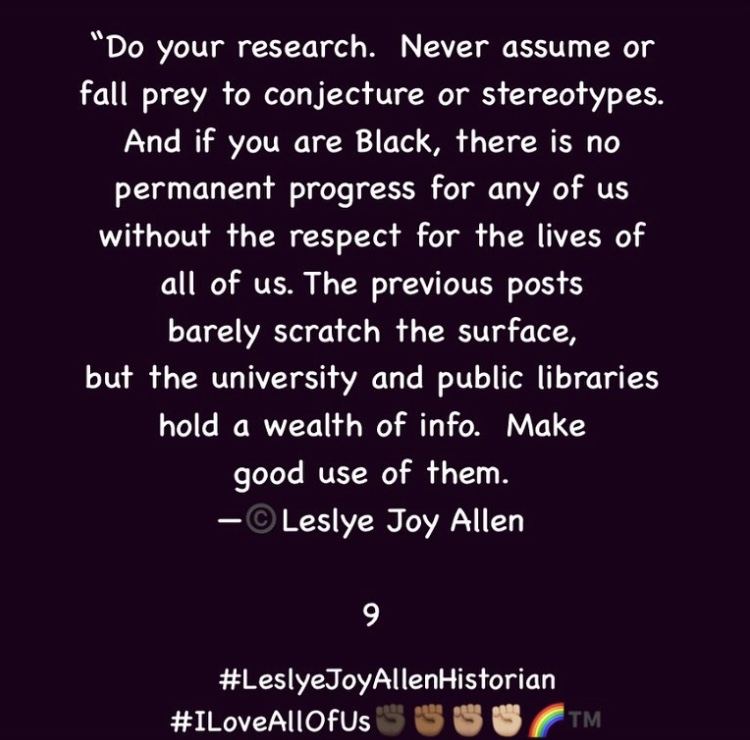
As difficult as it may be to accept, gender is a social construct and has an entirely different meaning from biological sex. Western ideologies, which were largely dispersed through domination and conquest, have their value. Yet, Western colonization of parts of Africa, Asia and the Americas also replaced, altered, and in some cases, destroyed indigenous belief systems and cosmologies that were beneficial to the peoples that created them. Hopefully, the following 9 frames will provoke further study about this topic, gender dysphoria (a very real human status), and a greater understanding of people and peoples who do not neatly fit this very Western concept of being either one thing or the other.

Copyright © by Leslye Joy Allen.  All Rights Reserved.

This blog was written by Leslye Joy Allen and is protected by U. S. Copyright Law and licensed under a Creative Commons Attribution-NonCommercial-NoDerivatives-4.0 International License. Any partial or total reference to this or any blog authored by Leslye Joy Allen, or any total or partial excerpt of this or any blog by Leslye Joy Allen must contain a direct reference to this hyperlink: https://leslyejoyallen.com with Leslye Joy Allen clearly stated as the author. All Rights Reserved.

A Thought About Black Panther

By Leslye Joy Allen

Copyright © 2018 by Leslye Joy Allen.  All Rights Reserved.

“Royal Purple” by © Leslye Joy Allen

This is not a review of the film Black Panther.  This is a brief musing about what crossed my mind after I saw this film.  First, Black Panther is unapologetically “Black.” I use “Black” here to indicate that while the film is set in the fictional African nation of Wakanda, it also includes Africans of a variety of ethnicities, African Americans and a genuine nod to the entire African Diaspora most of whom are descendants of former slaves in the West.  I am a member of that African Diaspora. The film also gives a few cultural nods to the Ndebele, Yorùbá, Maasai, and Akan peoples on the African continent (thank you, actor-vocalist-friend Saycon Sengbloh for pointing this out first).  The film gets the multi-facted roles of African women so very right.  The film also has some serious messages unlike any messages you have ever heard in a Marvel Super Hero movie.  Don’t worry, if you have not seen it yet, I’m not going to ruin it for you.  All I can say is that it is an entertaining joy ride of a film that will make you think…really, really think.  With that said, here’s what I thought about immediately after I saw Black Panther.

Black Panther has stirred up a genuine sense of pride in Black Americans that we don’t get to feel with this much enthusiasm too often.  It has taken decades of hard work to undo some of the psychic and spiritual damage done to Africa’s descendants in the West who have endured brutal chattel slavery, Jim Crow, systematic racism and discrimination, police brutality, you-name-it.  It has taken decades of hard work and scholarship to undo some of the psychic and spiritual damage done to Africa’s descendants in the West who, for centuries, were told that Africa had no real history, no real contributions to civilization when all of what these descendants were told is/was/remains patently false.  However, it is dangerous to over-romanticize any history; to make any and every description of our African ancestors totally positive. Black Panther, in its own unique way through fiction, de-romanticizes history by showing us a multi-ethnic, multi-generational Wakanda with all the friction and righteous compromise and conflict such diversity can foster.  You leave the movie theater proud, but fully aware that Africans (and we African descendants) have tremendous gifts and flaws not because we are or ever have been inferior or superior, but rather because we are human.

I remember a lecture given by the late African scholar, Dr. Ali Mazrui back in 1996 where he stated that to deny Africans the ability to be wrong was also the same as denying them their humanity.  Dr. Mazrui was always controversial.  He said the only African-American activist that he had any real respect for was Randall Robinson, the founder of Trans-Africa. When asked why he only dug Robinson, Dr. Mazrui said, “Robinson not only raises his voice when Whites do something wrong to Africans, Robinson speaks out when Africans are doing something to wrong to other Africans.”  I’ve never forgotten that statement and what that statement truly means.

When you love your people, you praise them when they are right and you don’t make excuses for them when they are wrong.  You work to correct them.  You speak out against racism, colonialism, and the exploitation of your people no matter who the adversary is.  That lecture by Dr. Mazrui, and so many lectures given by visiting and former professors drove home that I could not afford to care as much about how Africans and African-descended peoples looked to the rest of the world more than I cared about how well or how poorly they/we all were doing.  If you love your people you don’t worry about what their image is and how it affects you as much as you worry about their well-being, period.  Black Panther shows just how difficult that can be, but it also shows that it can be gloriously done…

Now, if you don’t exactly understand this post, it is probably because you have not seen Black Panther yet.  It could also be because you know very little about the continent of Africa’s very complicated history.  However, my points will be clearer once you’ve opened a few books and taken the ride to Wakanda.  So, get to the movie theater.  You won’t be disappointed.  Wakanda Forever.

Copyright © 2018 by Leslye Joy Allen.  All Rights Reserved.

This blog was written by Leslye Joy Allen and is protected by U. S. Copyright Law and licensed under a Creative Commons Attribution-NonCommercial-NoDerivs 3.0 Unported License. Any partial or total reference to this or any blog authored by Leslye Joy Allen, or any total or partial excerpt of this or any blog by Leslye Joy Allen must contain a direct reference to this hyperlink: https://leslyejoyallen.com with Leslye Joy Allen clearly stated as the author. All Rights Reserved.