A Time of Drought

By Leslye Joy Allen

rain-on-the-pines-copyCopyright © by Leslye Joy Allen.  All Rights Reserved.

I still remember the first time someone laughed at me for carrying cloth bags to the grocery store to shop. Unfortunately, the person was Black, just like me, and failed to understand the greater implications of climate change and what we all could do to slow it down.  I was told that my using cloth bags instead of plastic bags would probably not make that much difference to the environment.  I replied, “No it probably won’t make that much difference. But at least I can decide not to contribute to the problem.”

I write this blog at the very moment when it is raining heavily in my hometown.  Day before yesterday we saw the first few small showers after enduring over 100 days since rain fell in Atlanta.  The forest fires that have now devoured over 25,000 acres in the Appalachian region of Georgia, Tennessee and other areas are still raging.

Those individuals who did not think much about climate change are beginning to think a little bit more about it now.  With a protest against a dangerous pipeline going on in the Dakotas, along with this multi-state drought, I have only one desire: to point out some things you can do that will cost you basically nothing; and you might learn a few talking points.

  1. Every time a building is torn down and a new building is built in its place, the soil loses some of its ability to absorb water. Demand that your local politicians and city leaders refurbish old buildings rather than tear them down.  It not only preserves a city’s physical heritage it also saves money as buildings built before 1930 are more energy efficient than modern buildings.
  2. Most cloth shopping bags cost between one to two dollars and they are pretty durable. You can leave the petroleum-based plastic bags at the store.
  3. Recycle your paper, and your plastic, glass, and aluminum containers rather than placing them in the trash. Over the long haul, you will save on garbage bags because you will place less garbage in them. If your city does not have a recycling program, start one yourself.
  4. Remember that the chemical methane is naturally reproduced below the earth; and while it is non-toxic, it is volatile. Low income Black communities, Latino communities, and other communities of color are the most likely to live near garbage dumps that produce high levels of methane. If methane seeps into the water supply, you can literally strike a match and the water will burn. If you consume methane at high levels you can die from asphyxiation.  Pay attention to where your garbage dumps are located.
  5. Fracking for precious minerals and resources below the earth is believed to not only produce the potential for methane seeping into drinking water, but is also believed to be responsible for some earthquakes.  The fight against the Dakota pipeline is based not only on a respect for Native Americans’ sacred sites, but also on the potential problems that this pipeline will eventually create.
  6. For people who think that the problem with drinking water was at its worst in Flint, Michigan, think again. Flint is and remains a long-term problem that was on the radar of environmental groups as early as the 1970s.  You can read more about it here. “Before Flint, Before East Chicago, There Was Smeltertown.”
  7. While 70 percent of the earth is actually covered by water, only 2.5 percent of that water is drinkable.
  8. If you believe in a Creator or any higher power, then try treating what has been created as if you did not own it or create it, because you did not.

Àṣé!!!

Copyright © by Leslye Joy Allen. All Rights Reserved.

This blog was written by Leslye Joy Allen and is protected by U. S. Copyright Law and licensed under a Creative Commons Attribution-NonCommercial-NoDerivs 3.0 Unported License. Any partial or total reference to this or any blog authored by Leslye Joy Allen, or any total or partial excerpt of this or any blog by Leslye Joy Allen must contain a direct reference to this hyperlink: https://leslyejoyallen.com with Leslye Joy Allen clearly stated as the author. All Rights Reserved.

On This September 15, 2016

By Leslye Joy Allen

“Self Portrait” by Copyright © 2015 Leslye Joy Allen. All Rights Reserved. “Self Portrait” by Copyright © 2015 Leslye Joy Allen. All Rights Reserved.

Leslye Joy Allen, Copyright © 2016. All Rights Reserved.

Today is my play big brother Walter Dallas’ birthday.  A brilliant director, playwright and composer, I was so glad to talk with him this morning. Today it has also been reported that Sandra Bland’s family has reached a settlement in the wrongful death lawsuit they filed against Texas police officers (Read: Sandra Bland’s Family Reaches $1.9 Million Dollar Settlement).  I can only say that her family fought valiantly for changes to be made at the jail where Sandra Bland died. Her family might have gotten a bigger settlement if Black women’s lives mattered half as much as the lip service we often hear that says that we actually matter.  Talk is cheap.

Today is also the 53rd anniversary of Birmingham, Alabama’s 16th Street Baptist Church bombing that snuffed out the lives of four young black girls named Cynthia Morris (later called Cynthia Wesley), Carole Robertson, Denise McNair, and Addie Mae Collins. Addie Mae’s sister Sarah Collins Rudolph survived the blast, but lost an eye and her sister. Two black boys were killed the same day near the church in additional acts of racial violence; they were Johnny Robinson and Virgil Ware. So how does one celebrate the birthday of a wonderful director, playwright, composer and all-around great guy while remembering the deaths of our children, and of those who died needlessly in police custody and much too soon?

On the surface no visible correlation exists between any of these events. Yet, a birthday is often a milestone to look back at what one has accomplished and what one wants to accomplish in the years ahead. These deaths, however, are painful reminders of the work still ahead of us, a reminder to pause and appreciate those among the living for who they are and what they do because no day is promised to any of us.

It is for me also a reminder of all those butterflies, the white and yellow clouded sulfur butterflies, and the orange and black monarch butterflies, that have followed me for the last two weeks, in my yard, in the street, and in parking lots that remind me of renewal and transformation, and that those who live with us for a long time and those who leave us too soon will return again. Àṣé!”

Leslye Joy Allen, Copyright © 2016. All Rights Reserved.

This blog was written by Leslye Joy Allen and is protected by U. S. Copyright Law and licensed under a Creative Commons Attribution-NonCommercial-NoDerivs 3.0 Unported License. Any partial or total reference to this or any blog authored by Leslye Joy Allen, or any total or partial excerpt of this or any blog by Leslye Joy Allen must contain a direct reference to this hyperlink: http://leslyejoyallen.com with Leslye Joy Allen clearly stated as the author. All Rights Reserved.


They Should Live Where You Live

by Leslye Joy Allen

Copyright © 2016 by Leslye Joy Allen. All Rights Reserved.

“Self Portrait” by Copyright © 2015 Leslye Joy Allen. All Rights Reserved.

“Self Portrait,” Copyright © Leslye Joy Allen. All Rights Reserved.

I am not going to rant about the deaths of unarmed Black men and women, and unarmed men and women of color killed by police or those who have unnecessarily died in police custody.  As someone who was once harassed by police, I need no convincing that this nation has a policing problem.  (And I’m too exhausted with the campaigns for President of the United States to make any commentary about that.)  Yet, as much as this nation has a problem about the often poor relationships between police and communities of color, I would add that it is dangerous to make or create a single national narrative about these relationships. We need several narratives and they need to be local.  Let me give you a scenario that paints one local picture about where I live.

On that rare occasion when I have called police, I typically got a quick response.  And I live in a 99.9% Black middle class Atlanta neighborhood.  Typically, the only time the police are called on the street where I live is when someone has a dog that barks late at night (this usually requires a phone call to Animal Control, as well), or when some kids are playing music too loud and late at night; but none of this happens with any real frequency.  Some homes are occupied by renters who often have to learn that some things are not tolerated in this subdivision.  Now, one of the key differences about my subdivision’s relationship to police is that there is a small group of neighbors, all of who are homeowners, who regularly speak with police about anything they see as out of the ordinary.  I also learned from these same neighbors to call the Non-Emergency Police Line and request that an officer come out to see you personally.  You do this when you want a small matter handled without getting someone arrested.  Let me give you an example.

A dog was barking continuously late at night.  I rarely saw the pet’s owner because she worked odd hours.  She was a renter, looked to be maybe twenty-something years old, but I did not know her, and I rarely saw her long enough to speak to her about the dog.  A neighbor had placed a note in her mailbox about the dog, but nothing happened.  I was awakened late at night and in the early morning to this barking dog for about two weeks.  Every night he would bark, I would go look out my windows to make sure there wasn’t some stranger or some intrusive animal lurking around the house.  I never saw anything.  I called Animal Control, first.

Animal Control said call the police because the owner of the dog was violating a Noise Ordinance by allowing the animal to stay outside and disturb the peace after 10:00 PM.  I called the Non-Emergency Police Line.  The officer that answered the phone asked if I had contacted Animal Control.  I told him that I had spoken with Animal Control, and then I asked him to send a police officer to my home so that I could speak with them.  Because it was not an emergency, he told me someone would come by in about two hours.  In roughly 45 minutes a police officer was pulling up in my driveway.  I walked outside and spoke to the officer, and told him about the dog.

“What do you want me to do?” he asked.  I said, “I want you to go over to her house and just tell her that she either needs to put the dog in the house at night or get the dog one of those collars that deters barking.  Let her know about the Noise Ordinance law because she might not know this. I don’t want anyone cited for anything.  I just need you to let her know that the dog is keeping people up late at night.” 

The police officer did exactly what I asked him to do.  He came back and told me he had spoken with the woman.  Since all backyards on my street are fenced in, it is quite typical for pets to remain safely outside in one’s backyard during the day or night.  I reasoned that because she worked odd hours, often at night, she probably never heard her dog creating a disturbance.  That same evening before she left for work, she put her dog inside her house so the pet would not wake up her neighbors.

Now, what I did to resolve this small problem here in Atlanta might not work somewhere else.  It might not even work in another section of Atlanta.  In a different town or neighborhood, I might have been harassed (or possibly, shot) because I dared complain about a barking dog; and the police might not have even bothered to come out to speak with me or with my neighbor about what the police considered a trivial matter.  In some scenarios, where you live matters almost as much as the color of your skin or the nature of the problem.  However, too often the narratives or plans of action, come from national leaders who do not have a clue about the relationships between police and citizens in any particular neighborhood or town.  Furthermore, what works in Atlanta might not work in New York City and then again it might work in New York City.  Yet, Atlanta is not New York City is not Ferguson is not Baltimore is not Chicago, and etcetera.

Many powerful public voices are speaking out against police brutality and the need for more meaningful dialogues between the police and people in the communities the police are supposed to serve.  They are right for doing so.  Yet, many of those national and/or regional voices do not live where you and I live.  In fact, many “so-called” local activists do not live where we live.  Every Black person I know, knows of at least one activist minister who only visits a particular neighborhood to preach on Sunday, while that same minister no longer lives in the neighborhood where the church is located, but rather lives in some distant suburb.  We all know at least one activist politician who is always speaking out about something that has gone terribly wrong in one of our communities.  The problem is that minister or politician often never sets foot in the neighborhood in question until there is a problem or until it is election time.  Their voices may be necessary, and much of what they have to say might be useful.  Yet, they should not be the only voices defining the narrative about how to address these problems.

If you want to find out more about the police where you live, you can and probably should stop by a nearby police precinct and introduce yourself.  You will find out rather quickly how cordial those police are to you in a few minutes.  It never hurts when a few police officers know you as a law-abiding citizen that tries to look out for your neighborhood.  Additionally, when there is a real problem in your neighborhood, you might get a much swifter response because of that relationship.

Yet, you should also carefully monitor and choose who should speak for you and your community.  Whoever it is ought to know the lay of the land, how the people who live there interact with each other and with law enforcement officials.  It ought to be someone that has a personal vested interest in where you live, not simply someone who shows up when a problem arises so that they can get some good press coverage.  It ought to be someone who lives where you live.

Copyright © 2016 by Leslye Joy Allen.  All Rights Reserved.

This blog was written by Leslye Joy Allen and is protected by U. S. Copyright Law and licensed under a Creative Commons Attribution-NonCommercial-NoDerivs 3.0 Unported License. Any partial or total reference to this or any blog authored by Leslye Joy Allen, or any total or partial excerpt of this or any blog by Leslye Joy Allen must contain a direct reference to this hyperlink: http://leslyejoyallen.com with Leslye Joy Allen clearly stated as the author. All Rights Reserved.


Remembering Dr. Edward B. Allen and the Laws/Allens

by Leslye Joy Allen

Photo taken by Billie Allen in 1994 (Copyright © Leslye Joy Allen Photo & Document Collection. All Rights Reserved.)

Photo taken by Billie Allen in 1994. (Copyright © Leslye Joy Allen Photo & Document Collection. All Rights Reserved.)

I did not meet my cousin Dr. Edward B. Allen until I was well in my twenties.  He was the third and last born of three children born to William Roswell “W. R.” Allen and Mamie Wimbish Allen. His sister Lamay was the eldest, then came Wilhelmina (bka “Billie”) and then there was Ed.  He and I met for the first time at his eldest sister Lamay’s home in Milwaukee, Wisconsin.  His sister Billie Allen and I had long been partners-in-crime, but I had not yet met Ed.  All I knew about him was that he was a dentist.  When I saw him he reminded me of my late father Thomas Charles Allen who was also not very tall, tan-complexioned and balding.  Now, allow me to clarify something that Ed and his two late sisters needed clarified: I, Leslye Joy Allen, share the same “Allen” surname as Ed, but my last name comes from an entirely different Allen family, as I am biologically related to two unrelated sets of “Allens,” all on my father’s side of the family.  Let me explain.

The original family surname was “Layende.”  The Layendes were slaves from Cuba that arrived in the mainland United States.  As a historian, I feel obligated to remind people that the Southern region of the USA and Latin America and the Caribbean were quite fluid and did business with one another all throughout the era of chattel slavery.  This surname “Layende” was later anglicized to “Laws.”  Ed’s paternal great grandfather Milton Laws’ sister Mollie Laws-Maddox was my great grandmother.  They were the son and daughter of slaves David and Sarah Laws.  Sometime before American chattel slavery ended, Milton Laws was sold, and he acquired the last name of “Allen,” and became known as “Milton Allen.”  How he got this last name is not clear, but it is highly probable that Dr. Edward Bowden Allen would have been named Dr. Edward Bowden Laws had this slave sale not taken place.

Not long after Billie Allen asked me to do some family research, I had been searching for two men, one named “Milton Laws” and the other named “Milton Allen” only to discover from our mutual cousin Mittie Ann Tillotson that “Milton Laws” and “Milton Allen” were the same person.  Cousin Mittie Ann was the great granddaughter of Richard Laws, the brother of Milton and Mollie.  When Billie sent me photos of she, Ed, and Lamay’s paternal great grandparents Milton and Laura Allen, the first thing that struck me was how much my paternal grandmother Minnie Belle Maddox-Allen looked like her maternal Uncle Milton Allen (formerly named “Milton Laws.”)  And then things began to click.  Stay with me, now…

Now, Mollie Laws-Maddox’s daughter named Minnie Belle Maddox-Allen was my grandmother (My grandmother also named her daughter, my paternal aunt “Minnie Belle,” so I am also related to two “Minnie Belles.” Whew!!)  My grandmother Minnie Belle Maddox married a man named Will Allen who was not related to my cousin Edward Allen.  Will Allen, my paternal grandfather is where my own surname “Allen” comes from.  You can imagine my early confusion at trying to figure out how my paternal grandmother was related to Ed, Billie and Lamay Allen when “Allen” was her married name, not her maiden name.  But such is the case with African American genealogy.  There are hundreds of descendants of slaves whose family surnames were chosen by newly freedmen and women themselves; they made-up some names; and in many instances the maternal and paternal surname was identical because both slave husband and slave wife belonged to the same owners and both bore the same surname.

This research journey began when Ed’s sister Billie could not remember the name of their paternal grandfather, so off I went to look up their father William Roswell “W. R.” Allen’s Social Security application.  On that application were the names of his parents: Doc Roswell Allen and Mary Willie Jones.  Doc Roswell Allen and my paternal grandmother Minnie Belle Maddox-Allen were first cousins.  Soon after this discovery, and with some prodding from his buoyant wife Shelagh (who l instantly liked), Ed wanted to know more about the family tree.  After, acquiring some more information from Billie I discovered that the physician Dr. Edward G. Bowden, who was my paternal grandmother’s physician, was the man Ed was named for.  Dr. Edward G. Bowden married Elizabeth Allen who was the sister of Doc Roswell Allen and daughter of Milton and Laura Allen.  Doc Roswell Allen’s sister Virgil (who later renamed herself “Virginia”) bore one son out of wedlock, and his name was John Wesley Allen and he was a dentist, the first of many dentists in the family. All of these “Allens” were members of that rather complicated “Laws/Allen” family tree.

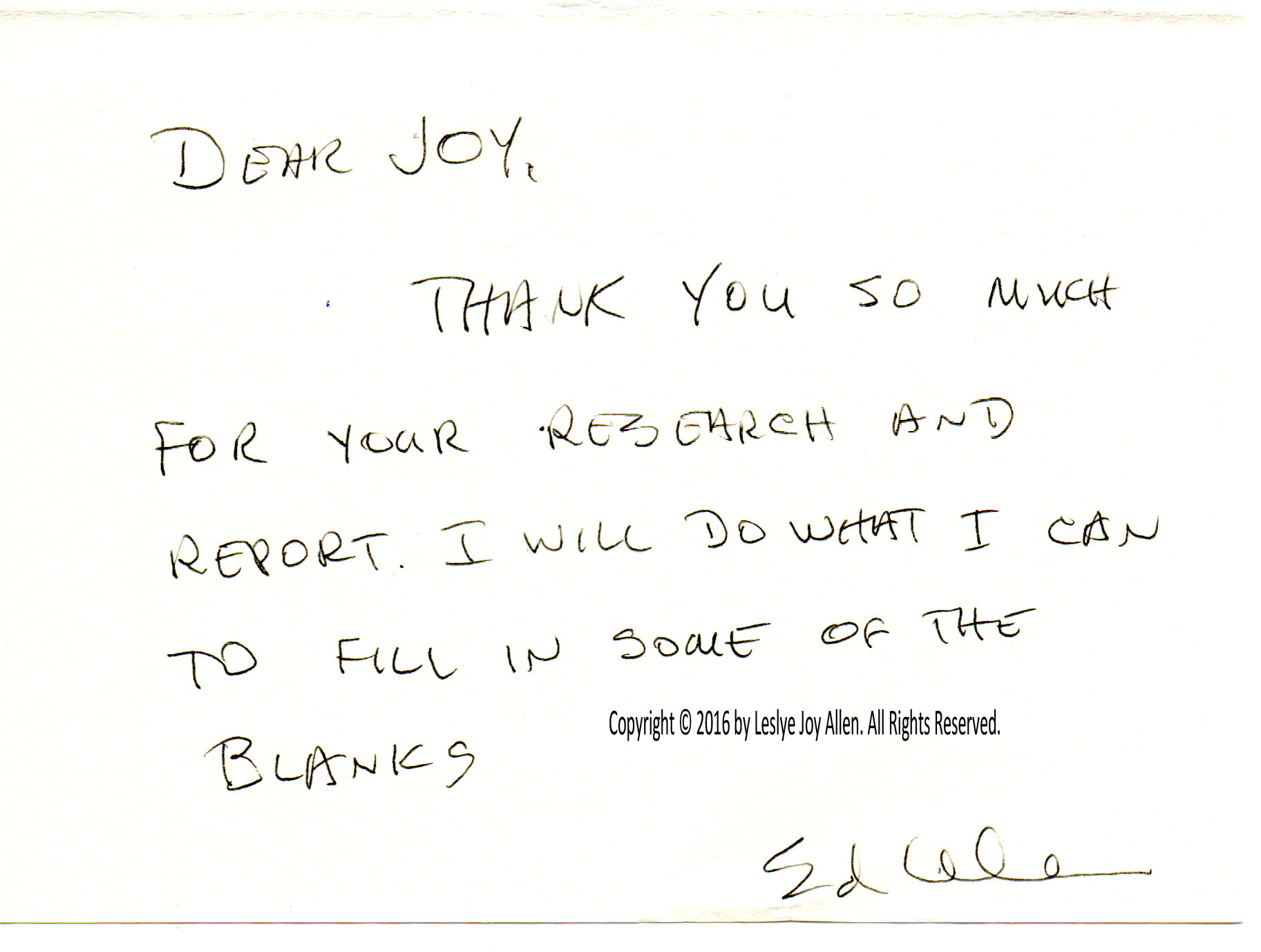
I only saw Ed about four times in my life.  Yet, each time I saw him, something he said to me gave me some nugget of information.  I still remember when he told me he recalled a “John” from his childhood who came to visit but then seemingly disappeared.  I told him Dr. John Wesley Allen was killed in a car accident in the late 1930s. In the late 1990s, I mailed Ed a report of everything I knew about our family.  I don’t think I even knew about the origins of our slave ancestors the “Layendes” from Cuba when I sent that report to Ed, but he was grateful to receive it.   I still have the “Thank You” note he sent me, a “Thank You” note that his sister Billie said was uncharacteristic of her brother.  I laughed because I got the sense that Ed knew that the work I did was much more time-consuming and tedious than most people realize.

I remember Ed as a renaissance man who loved the good life, who could be aloof, who was often funny with a dry wit, who was a man who loved a good drink, but one who also yearned to know more about the home and people he left when he journeyed North to escape some of the harsher realities of life for Black people in the South that colored much of the 20th century.  Although we did not know each other well, I consider it my privilege to have known him and to have been able to help him answer some of the questions about our family tree and heritage.  We always yearn for home, that sense of understanding where and from whom we have come. We yearn for home, no matter where we go.  And now Ed has gone home (May 27, 1926 to July 18, 2026).  Àṣé.

Copyright © 2016 by Leslye Joy Allen.  All Rights Reserved.

"Thank You Note" from Dr. Edward B. Allen to Leslye Joy Allen, July 1997. ((Copyright © Leslye Joy Allen Photo & Document Collection. All Rights Reserved.)

“Thank You Note” from Dr. Edward B. Allen to Leslye Joy Allen, July 1997. (Copyright © Leslye Joy Allen Photo & Document Collection. All Rights Reserved.)

This blog was written by Leslye Joy Allen and is protected by U. S. Copyright Law and licensed under a Creative Commons Attribution-NonCommercial-NoDerivatives-4.0 International License. Any partial or total reference to this or any blog authored by Leslye Joy Allen, or any total or partial excerpt of this or any blog by Leslye Joy Allen must contain a direct reference to this hyperlink: https://leslyejoyallen.com with Leslye Joy Allen clearly stated as the author. All Rights Reserved.

Black and Latino Playwrights Conference…

A quick conversation between Artistic Director and Actor Eugene Lee and Leslye Joy Allen

Copyright © 2016 by Leslye Joy Allen. All Rights Reserved.

Joy:  Hello Eugene.  Tell me how and why you became an actor; and when did you start writing plays?

Eugene:  I chose Theatre and Political Science as my majors in college and began my studies of the craft of acting there.  I started writing plays while in New York in between gigs.

Joy:  Who trained you as an actor, writer, etc.?  Who among your teachers remains the most important and influential to you and why?

Eugene:  My professors at Southwest Texas State.  I’ve studied in professional classes and workshops on both coasts as well.  I’ve learned from a broad spectrum of theatre artists along the way and could never lessen anyone’s impact or contribution to my smorgasbord education.

Joy:  How did you become involved in the Black and Latino Playwrights Conference?  Why is this conference important?

Eugene:  I was approached by my alma mater about taking the helm of this phenomenon.  It’s sort of patterned after the Eugene O’Neill playwrights conference at Yale University for development of new plays.  This conference fills a void in that it provides some much needed resources to help writers find their play and their voice as a writer.  The mission statement for the conference is “To study the Craft.  To nurture the Writer.  To celebrate the work.” Simple.  There is a need to nourish our storytellers, else we end up with more revisionist history.  WE have to tell our stories and to do so we much develop the skill set.  The collaborative aspect of finding a play involves bringing together resources like director, actor, dramaturgical support, stage management, etc.

Joy:  What has changed about writing plays from when you began writing until today?

Eugene:  I don’t know.  All the basic fundamental elements of playwriting are pretty much the same, though some writers find creative ways to tweak and turn those to fit the needs of their storytelling and style etc.

Joy:  What advice would you give to young playwrights of color?

Eugene:  Learn the craft.  Dare to care.  Write.  That’s the secret to writing.  Write.  Writers write.  Great stories in your head don’t have export until they’re on a page. Writers read probably more than they write. These are short responses.  I’m in the throes of tech rehearsals here in Boston.  I can probably elaborate more after my plate empties a bit. Thank you Joy, for all you do.

Joy:  Thanks Eu-genius!  Looking forward to a more extensive conversation, once you have a bit more time, my friend.


Copyright © 2016 by Leslye Joy Allen. All Rights Reserved.

This interview was conducted by Leslye Joy Allen and is protected by U. S. Copyright Law and licensed under a Creative Commons Attribution-NonCommercial-NoDerivs 3.0 Unported License.   Any partial or total reference to this or any interview or blog authored by Leslye Joy Allen, or any total or partial excerpt of this or any interview or blog by Leslye Joy Allen must contain a direct reference to this hyperlink: http://leslyejoyallen.com with Leslye Joy Allen clearly stated as the author.  Postings, interviews, or blogs placed here by other writers should clearly reference those writers. All Rights Reserved.