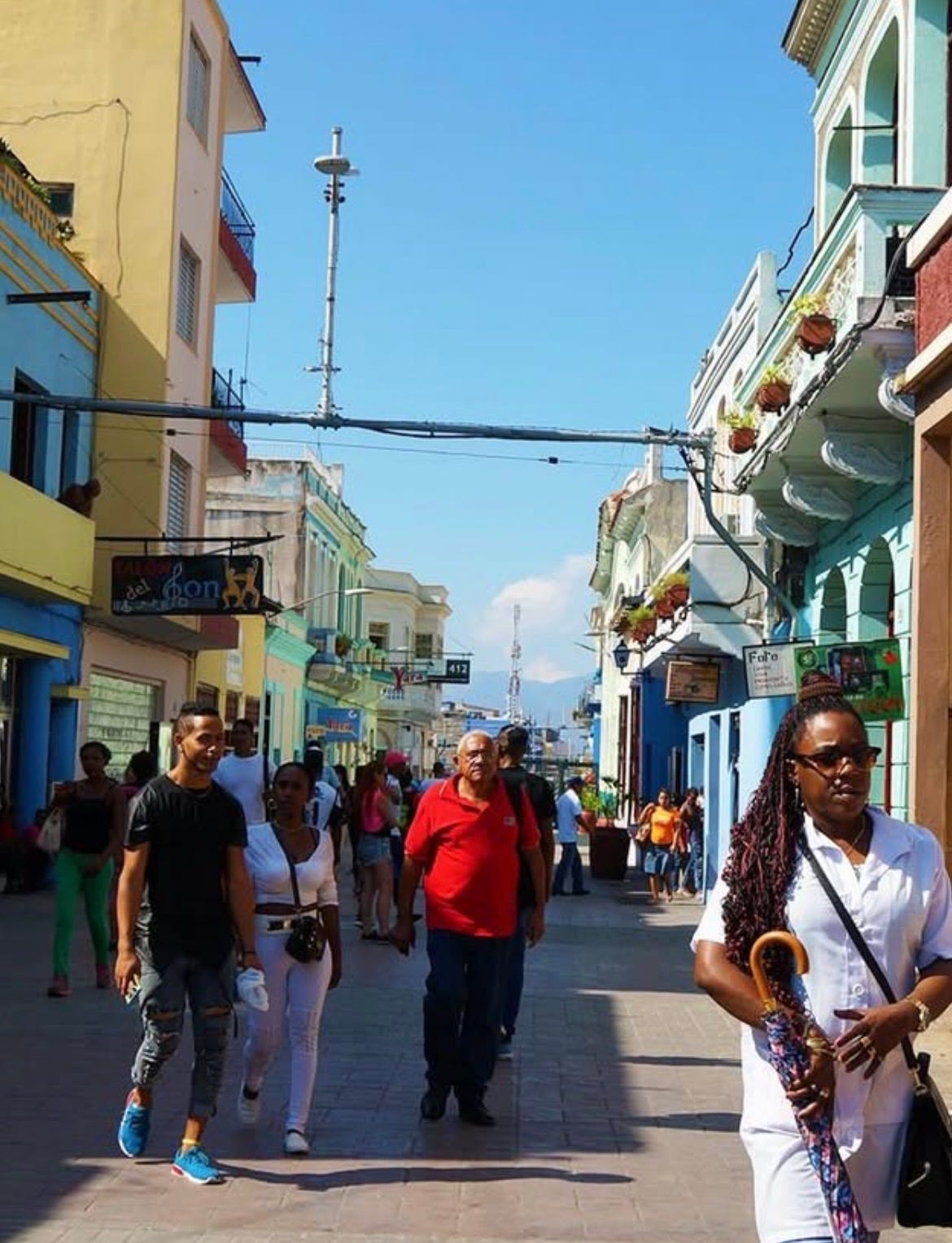
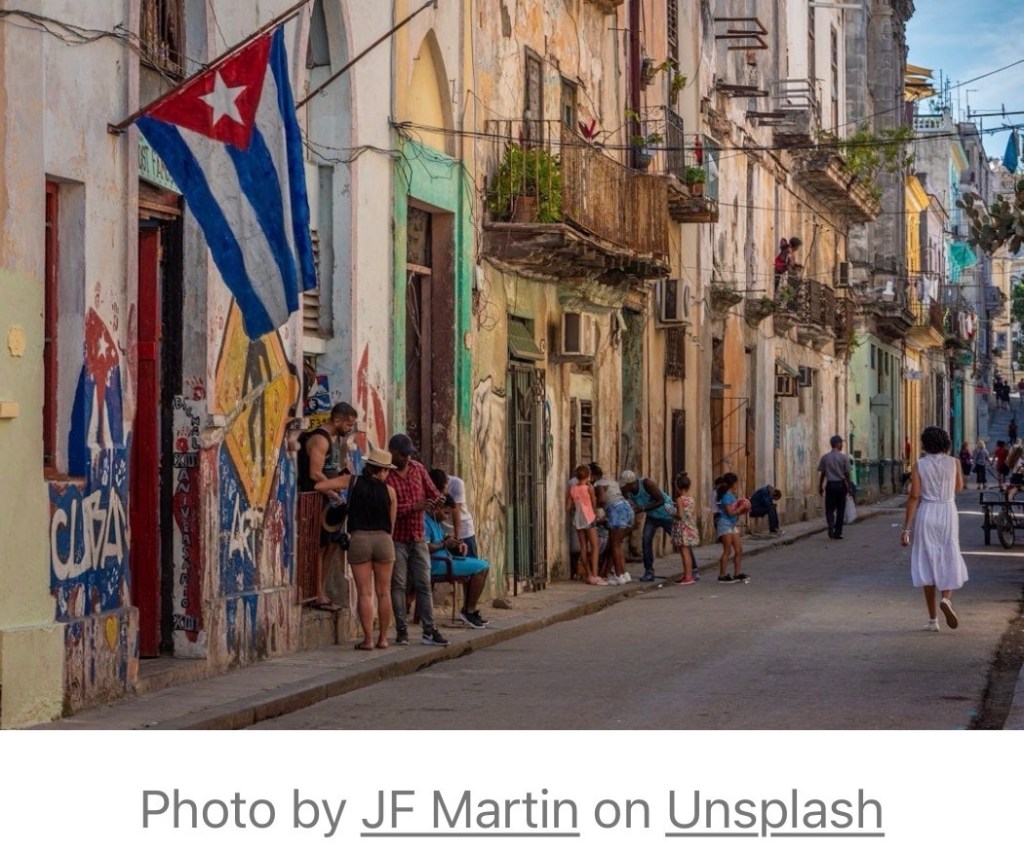
The following below that is written in italics is partially a meditation on Cuba. It is a response I wrote to a piece about Cuba’s current crisis exacerbated by American neglect and cruelty that was written by Arturo Dominguez. A link to his exceptional article is at the very end of this essay. What’s in italics is a rumination I wrote to Arturo:
“I still remember reading that when Afro-Cuban musical artists came to perform in the United States that they had to perform in the U.S. for free. When asked why they were willing to perform for nothing, the answer was always the same: “We want to see where Dizzy Gillespie was born.”
Thanks for this report Arturo Dominguez because every time there is a sanction, a deprivation, I am reminded that no one suffers in Cuba but the people themselves. I still remember the heinous and wretched Helms-Burton Act which banned ships who docked in Cuba’s ports from docking in the United States for several months.
I remember my professors having to fly out of Atlanta to Canada and then taking a flight from some airport in Canada to Havana to do whatever research they were performing on their visits.
The United States has done nothing but made an example of Cuba as a message to other countries in Latin America and the Caribbean that says “This is how far we’ll go; this is how bad we’ll treat you, if you don’t fall in line.”
I might just turn this comment into a meditation.”
A few moments after reading Arturo’s essay I stumbled on one of my favorite thinkers Vijay Prashad who also was offering his thoughts on the viciousness of the United States government against the Cuban people because it is the people that suffer—No one else. (A link to Vijay’s essay is at the end.)
I don’t have the strength to comment on Prashad’s piece right now except that it is brilliant and accurate. I will leave it to you dear reader to examine both his and Arturo’s essays at your leisure. I have only one thing to say.
One line of my paternal family was sold as slaves from Santiago de Cuba to the mainland United States during the period of slavery in this Western hemisphere. My paternal great grandmother was born a slave named Mollie Laws. Her previous family surname was Layende.
Like most people during the 1700s and 1800s, when one moved (or was sold) some place else the last name was changed to adapt to the new culture one was inhabiting. In the United States, it was typically expected that you Anglicize your name to something that English speakers could pronounce. So “Layende” became “Laws.”
Anyhow I used to relay my personal history to my History students in an effort to make sure that they understood that Chattel slavery took place throughout the Western world. Importantly, what we now call the United States received less than 6 percent of all the Africans transported to this hemisphere during the trans-Atlantic slave trade. The majority of Africans (around 95 percent) landed in what is now named Latin America and the Caribbean.
I don’t have any deep analysis here about how difficult Afro-American genealogy can be. I don’t have any deep commentary about the many cultures and cultural differences that exist between all of the descendants of Africa who occupy this hemisphere except I have always known that for better or worse I belong to them.
Right after I read Arturo’s essay and then Vijay’s essay, I recalled a favorite memory from the classroom. A student whose name escapes me now came to class after Spring Break with a faded photograph he took while out on the Atlantic ocean.
He learned that I had roots in Cuba and so did he. He pulled out this faded photo taken on the water. Far off in the distance I saw something that looked like a line stretched across the water.
“What is that long line in the water that I see in the distance?,” I asked.
“That line across the water in the distance is Cuba, Ms. Allen. I hope you get there someday.”
I am an Independent Historian, Oral Historian and Dramaturge. Please consider supporting my work and research with a few bucks for Coffee and Eggs via my CashApp or become a paid subscriber to me on Substack to help me sustain my research.
The photo below of Don Warden is from the archives of Khalid and Jamila al Mansour. Don Warden was one of the founders of the Afro-American Association at the University of California at Berkeley. The other founding members were Donald Hopkins, Otho Green, and Henry Ramsey.
This organization formed in late 1961 and began as a student study group in 1962 at the University of California at Berkeley when there were literally no identifiable Afro-American and African Studies programs on any U. S. college and university campus. The group devoured works by Ralph Ellison, W.E.B. DuBois and other Black scholars that were left out of many colleges curricula. Study meetings of its members initially began at the off-campus home of a UC Berkeley student, and grew from there. In fact, chapters of this organization appeared on hundreds of college campuses in the United States with members numbering in the thousands by the mid-1960s.
The objective of the group was to read and study about the Afro-American, African, and Afro-Diasporic past in order to confront the institutional racism, colonialism and bigotry found in the United States and throughout the world.
Warden, a UC Berkeley law student, regularly went into Black neighborhoods and literally spoke to young Black citizens directly on street corners or wherever they were. He encouraged them to study about Afro-American and African history in order to fight against their feelings of worthlessness that often accompanied experiencing chronic racism.
He listened to them tell him about their problems of unemployment, poor housing, you name it. He, like most of his members, espoused that in order to change all systems of oppression, one needed to study about the past in order to do so. Warden eventually became a lawyer for the Black Panther Party of Self-Defense as well as granting legal assistance to the Nation of Islam when Malcolm X was still a member of the group.
The Afro-American Association was heavily influenced by the ideologies of Black American activists Robert F. Williams and Malcolm X. The AAA understood that only sustained study of Black people/s would foster the kind of thinking and strategies for combating systems that sought to suppress and control Black and Brown communities all over the world. Only deep research would correct the far-too-often feelings of inadequacy that came with being Black and oppressed.
In 1962 when this study group, that was soon named the Afro-American Association, began its study group meetings at UC Berkeley there were roughly only about 100 Black students out of 20,000 white students. And in 1962 there were only two members of the group that were not born in the United States. One was from Jamaica; the other was from India.
In 1962 this tall, skinny, young Black man from Orange Hill, Jamaica and this petite and short, very brown young woman from Chennai, Tamil Nadu (in Southern India) dressed in her Sari and sandals met in an AAA group meeting.
The young man from Jamaica gave a pristine evaluation of how Great Britain had created a rather stiff and proper group of elite Black Jamaicans that often mimicked the mores and habits of British society. It was done, he said, to shield the world from knowing how racist the British empire actually was. The young man was calm, studious with very edgy ideas about the colonization of Black people/s around the world.
The young brown woman in her Sari and sandals was intrigued. She too had been a British subject in her native state of Tamil Nadu in southern India. She knew something about what this young man spoke of, but not all of it. Back then, the typical path for academically talented Indian and Jamaican students was to study in England, that is if they could secure a path to graduate school.
She rejected that path because there was no major in Biochemistry in India or in the UK that would have been available to a female. The skinny guy from Jamaica also rejected the educational path to the UK. His decision was so unusual that the approval for his exit from Jamaica took so long that he arrived at UC Berkeley two weeks after the Fall 1961 semester begun.
He, Dr. Donald Harris became a leading economist and she, Dr. Shyamala Gopalan-Harris became a leading biomedical scientist, a contributor to the identification of the function of rMNA, which greatly improved treatments for breast cancer.
The early members of the Afro-American Association described her as warm, funny, “down for the cause” of Civil Rights and an end to colonialism, and also a fiery debater. At first one member of the AAA noted that some of them thought she was royalty because of the way she carried herself. Yet, she fit right in, several members noted. He was described as professorial even though he was in his early 20s. While their eventual marriage didn’t last (they married roughly 10 months after meeting), their firstborn daughter Kamala noted that she knew they loved each other and felt that if they had been a bit older and a bit more emotionally mature they might have made it.
She cited them both as activists, and remembers going to protest marches with her parents in a stroller. The blueprint for their activism and for the creation of Afro-American and African Studies as disciplines were rooted in the activities in the Afro-American Association. While at UC Berkeley, Shyamala met and influenced arguably, one of Afro-America’s most important philosophers, Cedric Robinson.
Robinson’s book Black Marxism, first published in 1983, remains one of the most brilliant critiques and reassessments of the Eurocentric theories of Marxism. It has become a must-read in the literary canons of both Afro-American and African Studies.
It was Robinson who coined the phrase “Racial Capitalism.” He argued that capitalism was always based on race and race came before capitalism. Importantly there never was a clean break from European feudalism. He was one of the first Black scholars to identify “race,” as a component that European empires used when feudalism morphed into capitalism.
Any study he maintained had to be central to Black people/s’ lived experiences wherever they were in the world. When I first read him, it became apparent that European Marxist scholars either forgot or tried to ignore that the peoples of Europe were once considered “races,” races and national identities that were eventually erased in exchange for their being identified as “white” which served the interests of European countries in their quest to colonize and dominate large portions of the world.
In 1959, Shyamala Gopalan was standing in line behind Cedric Robinson while they were both registering for classes. Both became members of the Afro-American Association. In the first edition of Black Marxism, there was only one person who was not a Black American listed in his group of early friends that Robinson acknowledged as influential on the development of his ideas. That person was Dr. Shyamala Gopalan-Harris.
So here’s a brief mini-history of the continuing of the Afro-American Association of University of California at Berkeley. Huey Newton and Bobby Seale who founded the Black Panther Party became members. Huey dared to show up at a meeting of AAA without having read the book assigned for that session. The members sent him home. He never showed up again unprepared.
Future Congressman Ron Dellums was a member of the AAA at one time as was Kenny Freeman, a contributor to the Black Panthers 10-Point Plan. The AAA literally laid the academic groundwork for Afro-American and African Studies programs throughout the nation as underscored by historian and author Donna Jean Murch who traced the evolution and development of the Black Panther Party from its roots in the Afro-American Association. None of it began without the required reading and research and the on-the-ground grassroots activism that met Black communities in the Oakland area where they were.
I could go on about how police monitored the group’s members particularly when they spoke on street corners, or visited high schools to encourage reading and research among members of the Black community. Yet, I will not do that mainly because well-meaning, good people have started to use the internet like an online set of Cliffnotes.
If you’re old enough to remember Cliffnotes you also remember that occasionally they were used instead of reading the actual book or doing the actual research. Yet, your ass was grass when a teacher or professor asked you a highly specific question that Cliffnotes did not cover and you hadn’t bothered to read the whole book.
So there’s a small bibliography below with a list of books that are worth your time. The message is clear: Either you put in the time and read or you remain a dilettante on matters that you need to know both for your safety and your sanity.
This essay was previously posted on Substack on January 22, 2026.
I am an Independent Historian, Oral Historian and Dramaturge. Please consider supporting my work and research with a few bucks for Coffee and Eggs via my CashApp or become a paid subscriber to me on Substack to help me sustain my research.
Recommended Readings:
Living For the City: Migration, Education, and the Rise of the Black Panther Party in Oakland, California by Donna Jean Murch
Fanon for Beginners by Deborah Baker Wyrick
Remaking Black Power: How Black Women Transformed an Era by Ashley D. Farmer
Black Marxism: The Making of the Black Radical Tradition by Cedric Robinson
Felon 47 was recently stunned to hear a Liberian official speak good English when the fact is the state that became the nation of Liberia was established by former African-American slaves with the assistance of the American Colonization Society in 1822.
In 1847, the state of Liberia established itself as a Republic and was recognized as such by several European nations.
Yet, Trumpolini was amazed to hear a Liberian speak grammatically correct English when English has been Liberia’s official language ever since its inception as a settlement, then later as a country over 200 years ago.
It gets worse. Back when George W. Bush was president he admitted to Condoleeza Rice that he didn’t know that there were Black people in Brazil. Brazil has more people of African descent than any other nation outside of the continent of Africa itself.
During the trans-Atlantic slave trade 4.9 million Africans were transported to Brazil. Yet, George W. Bush—never the sharpest crayon in the box—was surprised that there were Black folks in Brazil.
This kind of ignorance ranks right up there with the people who don’t know and never knew that the majority of Africans were not transported to the American Colonies/United States, but were transported primarily to Latin America and the Caribbean.
And the worst ignorance of all is the notion that Africans learned specific skills once they left the continent. Africans in the Senegambia region of Africa had been planting rice for over 2,000 years before Yeshu’a ben Yosef (aka “Jesus”) was born. For the record, there is no letter “J” in the Hebrew and Aramaic languages that he spoke.
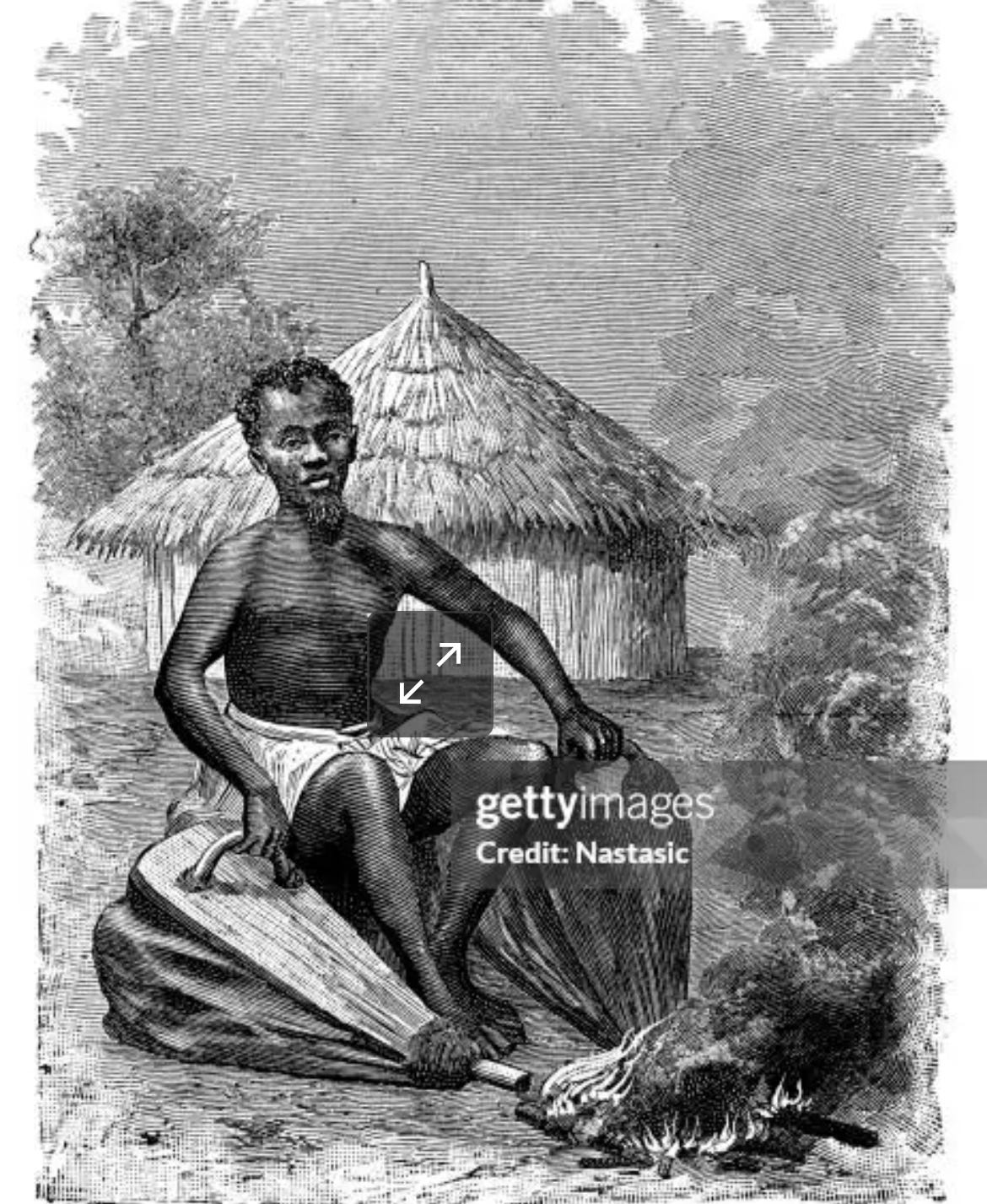
(Graphic of an African Blacksmith)
The Nok culture, the Kingdom of Kush and the Shona people of the continent of Africa were specialists in Iron smeltingthousands of years before there was any trans-Atlantic slave trade. Many African ethnic groups arrived here as Blacksmiths. Africans were transported to what Europeans called the “New World” or the “Americas” to do two things—perform the work Europeans did not want to do and the work Europeans could not do.
Now, just look at what is sitting in the White House: a man meaner than a rattlesnake and dumber than a box of rocks who doesn’t know how to do anything but mistreat people.
When I read comments by many people who express their shock and disgust at Felon 47, I share their pain. Yet, I am reminded of what they have not paid much attention to.
(In the year 2000, prisoners pick cotton at the Ferguson Unit in Texas in the prison’s cotton fields, Photo by Andrew Lichtenstein, Getty Images)
I taught my History students to think outside the box, and connect the dots. After establishing that American Chattel Slavery was an enormous agricultural enterprise that literally funded and built the United States, I would have my students read the 13th amendment to the U.S. Constitution which allegedly ended slavery in the United States:
“Section 1: Neither slavery nor involuntary servitude, except as a punishment for crime whereof the party shall have been duly convicted, shall exist within the United States, or any place subject to their jurisdiction.
Section 2: Congress shall have power to enforce this article by appropriate legislation.”
First, it was always possible to abolish slavery without it ever being justified as a punishment for a crime. The loophole stands out because it was deliberately placed there.
Second, Congress had the power to enforce the 13th amendment through further legislation. So, if Congress was silent about abuses of this amendment, one might get away with imprisoning and/or forcing the labor of just about anyone. Ava DuVernay’s documentary 13th brilliantly examines the loophole in the amendment, but I want to go just a bit further.
Now, how many of you on the Left have recently complained about Democrats in Congress not fighting hard enough against the policies of Felon 47? We can cherrypick the most vocal Democrats, can’t we?
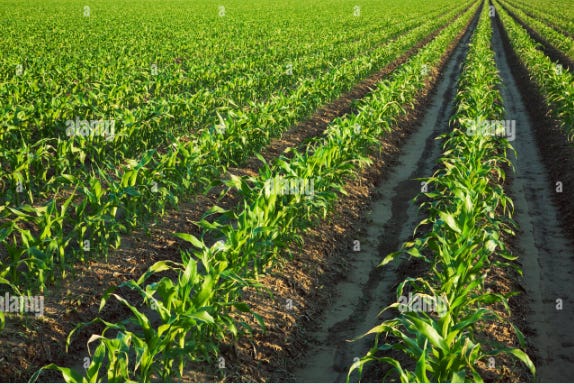
(Field of mid-growth grain Corn plants near England, Arkansas. Stock photo at Alamy)
Beccia noted that these days I.C.E. rarely shows up at American farms even though “six in ten agricultural workers are noncitizen immigrants.” She argued that Felon 47 is deporting Brown immigrants as a ruse to throw raw meat to his racist, stupid ass base.
He pretends that he is cleaning up the country by putting alleged criminal riff-raff out of the country, while he capitalizes on a different type of immigrant status, namely H-2A visas that have been in use for years.
Here’s the rub as Beccia points out— Felon 47 did not start any of this. Mega agribusinesses like BayerAg, Syngenta, AcreTrader, Archer Daniels Midland Co., CHS, Inc., Freight Farmers, Heinz Seeds, Seedo Corporation, Sakata Seed Corporation, DOW, Rijk Zwaan and many others will reap in the profits while American farmers (many of whom are MAGA supporters) will still struggle financially.
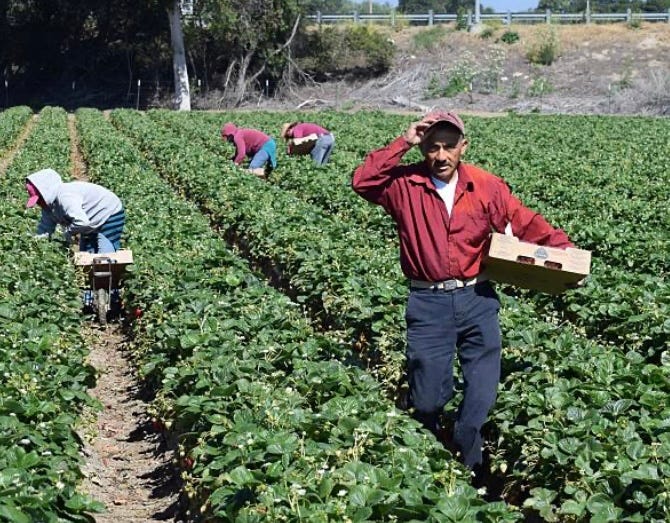
By using immigrants with H-2A visas, there is less money to be paid out, no pressure to guarantee permanent employment, and no negotiations to be made for poor immigrant workers if they are mistreated.
Unless you have your own garden and grow your own food, the French Fries you ordered at McDonald’s (made from a corn product, not a potato), and the food that sits on your table was produced by slave labor. Sidebar: H-2A visas allow businesses to hire foreign workers on a temporary basis when there are not enough American workers to fill the jobs.
(Salinas, CA, USA—June 19, 2015: Seasonal farm workers pick and package strawberries)
Agribusinesses are so brutally profit-driven that the countries of Ethiopia, Ghana, Kenya, Malawi, Nigeria, South Africa, Tanzania, Uganda, Zambia, and Zimbabwe have made it illegal for native and neighboring farmers to trade seeds with each other.
Under pressure from agribusinesses to insure that the “intellectual property rights” of their seeds are not violated, agribusinesses pressured various African governments to eliminate farmers’ traditional farming methods in order to force farmers to purchase seeds rather than allowing them to trade their own. Their lobbyists threaten, cajole, and promise money to political parties and politicians in order to ensure these companies make a profit.
So, students/readers as we think about all of this on our way out the door of my classroom, let’s consider the following. It would be fair to say that the average civic-minded American citizen would do well to contact their representatives to make their grievances and requests known. Many of us can and often do lobby our representatives to encourage them to represent our interests.
At the same time, multi-billion dollar businesses employ and pay lobbyists. The average citizen does not have that kind of wealth. So, here’s a few questions students/readers: Why is lobbying even legal? Have you figured out yet why some Democrats are just going along with the program as if nothing is happening?
I’m not going to write a full analysis of the late historian Mike Davis’ exceptional book “Late Victorian Holocausts: El Niño Famines and the Making of the Third World.” I do, however, want to revisit it and emphasize a few points Davis made about European colonialism in the late 19th century.
Davis’ examination of famines and droughts in Southeast Asia, China, Africa, and Latin America underscored how indigenous peoples were dispossessed of their land; and their time-honored farming traditions were also dismissed. It created ecological and environmental problems we now deal with today but rarely think about.
Davis acknowledged that land theft, the closing off of common farming areas, and violence against these populations were key components of European colonization and expansion, but he added one more element—the weather.
European colonizers studied El Niño weather patterns to determine when populations in Southeast Asia, Latin America, Africa, China, and etcetera, would be at their most vulnerable.
El Niño is part of a long-existing and large weather pattern. During El Niño, areas of the Pacific Ocean experience unusually high surface temperatures. El Niño disrupts typical weather patterns, affects rainfall, temperatures, and etcetera. The period when these waters are much cooler is called La Niña.
Europeans studied when the weather was working against the people and the lands they wished to colonize—The colonizers struck most often at those times proving that famines are human-made.
The book’s preface offers a detailed account of former U. S. President Ulysses Grant and his family on vacation in 1877 after he left office. He and his family visited Europe first, but soon ended up visiting places devastated by famine. Grant took notes about what he saw, but he did not report the degree of ecological destruction he witnessed.
Davis’ book was published in 2001 and it remains a rare gift because his research proved that heads of state and monarchs in the western world tended to ignore the long-term ecological damage from their destruction of natural resources. Indigenous populations were seen as inferior, therefore their farming techniques and cooperation with their native ecologies were dismissed by Europeans as well.
The fires that recently destroyed homes and huge areas of California were made worse by what is called “Hydroclimate Whiplash.” When heavy rains due to El Niño soak the ground leading to the excessive growth of vegetation, what follows next are extremely long dry spells.
The dried up vegetation becomes little more than fuel for fires. The results of El Niño are much more troublesome now due to climate change. It’s not just happening in California. It’s happening everywhere around the world.
What is often left out of discussions about climate change and the usage of El Niño’s disruptive weather patterns, is the racism against and the subjugation of peoples of color by Europeans and others that has aided and abetted climate change crises around the world.
Davis was not the first historian to understand what European colonialism did to the natural environments of countries around the world, but his book “Late Victorian Holocausts” is one of the few histories to recognize that the routine and natural disruptions of El Niño were deliberately weaponized against Africans, Asians, and Latin Americans in horrific ways that few individuals realize.



 Leslye Joy Allen