The Intersectionality of Suffragist & Abolitionist Lucy Stone

by ©️Leslye Joy Allen

“Intersectionality is a metaphor for understanding the ways that multiple forms of inequality or disadvantage sometimes compound themselves and create obstacles that often are not understood among conventional ways of thinking.” — Kimberlé Crenshaw

Recently, I responded to a question about the factors that stymied women’s quest for suffrage during the mid-to-late 19th century. I brought up the pragmatism and egalitarianism of suffragist and abolitionist Lucy Stone whose legacy remains largely overlooked. And therein lies the problem.

Susan B. Anthony and Elizabeth Cady Stanton have rightfully earned their place in Women’s history. They battled for the vote in ways almost unimaginable. Yet, they both held racist and classist views. Now before you start yelling about how both of them worked in the abolitionist movement, spare me. You can be anti-slavery and still not think the slave is your social or political equal. The inability to shake off one’s sense of entitlement has extreme consequences for everyone.

When lawmakers decided to include Black men as voters in the 15th Amendment without including the franchise for white women, both Stanton and Anthony were rightfully livid, but livid to the point where they then fought against the passage of the 15th Amendment altogether. It passed, however, in 1869 and was ratified in 1870.

Stanton wrote that it was unconscionable and dangerous to give the vote to Black, Chinese or Irish men because they were inferior. Anyone that did not fit a strict Anglo-Saxon and native-born status was considered inferior. Additionally, neither Stanton nor Anthony had thought about Black women voting at all. 
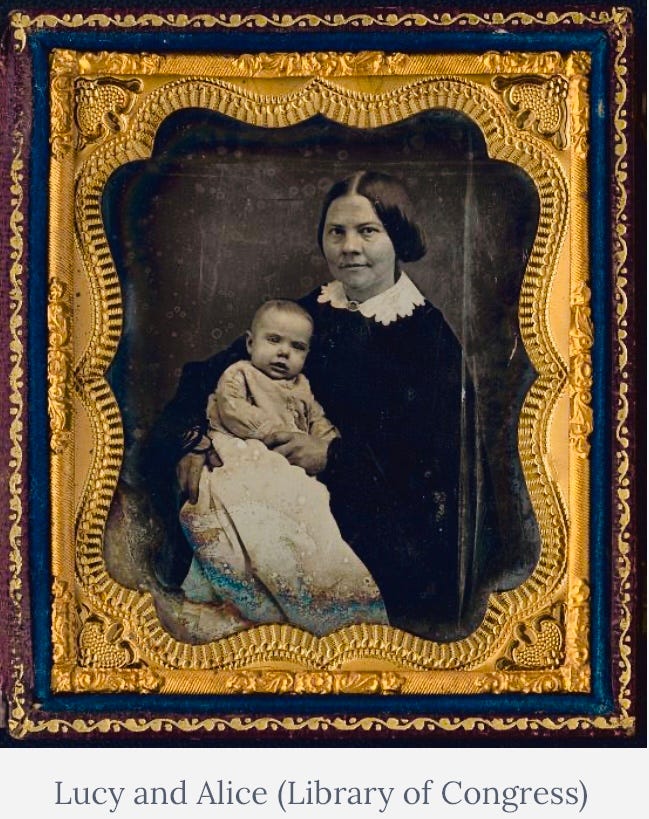
Stone broke with Anthony and Stanton over their racism. Orator, writer, abolitionist and former slave Frederick Douglass cut his ties to Anthony and Stanton as well. The tragedy was that Douglass had attended the Women’s Conference at Seneca Falls in 1848 and had been a huge and early advocate for women’s rights. Moreover, it was Lucy Stone’s brilliant oratory that had inspired Susan B. Anthony to join the suffrage movement.

Stone read the political winds correctly. She formed the American Woman Suffrage Association which concentrated on gaining women the right to vote on a state-by-state basis. She knew that Congress was not going to grant the franchise to everyone. 

Stone believed that the enfranchisement of Black men was progress. Although she was disappointed that the 15th Amendment did not include women’s suffrage, she did not believe that denying the franchise to others would help women in the long run.

Black men, rather than white women, were granted the right to vote first for a variety of reasons. As a historian, I know that the Republican Party in the 1860s was the party of Lincoln (not the sh*t show it is now) that freed Black American slaves. They controlled both the House and the Senate in 1867 to 1869. They knew that recently freed and enfranchised Black men would inevitably vote Republican and increase the party’s political dominance.

Granting the franchise to white women would have mixed political results as many white women still believed in the lost cause of the South in spite of its loss during the Civil War. They would have voted Democrat which was then the favored party of the former slave-holding South.

Some of Stone’s ideas were tied to her upbringing. She came from a hardworking farming family in Massachusetts. Both of her parents were abolitionists. While quite young, she, along with Lucretia Mott and Abby Kelly Foster helped William Lloyd Garrison establish the American Anti-slavery Society which was founded in 1833.

All of her brothers attended college. Yet, Stone had to postpone her education. She taught school for several years and was able to scrape up enough money to attend Oberlin College, the first college in the nation to accept Black people and women. When she graduated in 1847, she became the first woman in Massachusetts to earn a college degree.

Stone had planned to remain a single woman because she feared losing her independence to a husband. She finally yielded to Henry Browne Blackwell’s persistence. Blackwell was also an abolitionist and women’s rights advocate. Blackwell would learn years later that Stone finally decided to marry him after he met and aided a young slave with her owners while traveling on a train.

When Blackwell asked the girl would she rather be free, she answered “yes.” Blackwell and an accomplice helped get the young girl off of the train and away from her owners. It was that act of liberation that won Stone over.

When Blackwell and Stone married their written protest against laws that denied women equal rights was read before the ceremony. The promise “to obey” was removed from their wedding vows. Stone retained her maiden name and refused to pay taxes as long as she was denied her equal rights.

While neither Stone nor her contemporaries Anthony and Stanton lived long enough to see women receive the right to vote, their different approaches and beliefs underscored a perpetual problem in the quest for women’s equality and the right to vote.

Stone never stopped fighting for the rights of Black people as she continued her fight to get the vote for women. She believed that both causes were interrelated. The same cannot be said of Anthony and Stanton. 

The fight for the right to vote for women was often fractured by racism well into the 20th century. Stone’s stances on racial equality and equal rights for women cost her some popularity among some white women. Anthony and Stanton emerged as the face of white women’s suffrage. Yet, Anthony and Stanton also emerged as suspect to Black men and women. 

After Lucy Stone died of stomach cancer in 1893, her only child, Alice Stone Blackwell reached out to the daughter of Elizabeth Cady Stanton and began the process of repairing the divided women’s suffrage movement. They created a new coalition. Alice Stone Blackwell followed her mother’s mantra to make the world better.

Lucy Stone deserves more historical attention than she receives. Her example should be emulated precisely because she understood the “intersectionality” of gender and race (and the political implications that go along with it) long before Black scholar and lawyer Kimberlé Crenshaw coined the term and defined the theory in the late 20th century. Stone recognized that, no matter how different gender and race may appear, women’s equality was inextricably linked to racial equality. You must fight for both, not just one or the other.

©️Leslye Joy Allen

I am an Independent Historian, Oral Historian and Dramaturge. Please consider supporting my work with a few bucks for Coffee and Eggs via my CashApp.

All blogs written by Leslye Joy Allen are protected by U. S. Copyright Law and licensed under a Creative Commons Attribution-NonCommercial-NoDerivs 3.0 Unported License. Any partial or total reference to any blog authored by Leslye Joy Allen, or any total or partial excerpt of any blog authored by Leslye Joy Allen must contain a direct reference to this hyperlink: https://leslyejoyallen.com with Leslye Joy Allen clearly stated as the author.  Postings or blogs placed here by other writers should clearly reference those writers.  All Rights Reserved.

For Henry G. Sanders

by ©️Leslye Joy Allen

I know a lot of great actors and Henry G. Sanders is one of them. I have watched him perform for over 50 years from “The Killer of Sheep” to “Dr. Quinn Medicine Woman” to “Selma” and beyond. His most recent and notable role has been the character “Prosper Denton” on Ava DuVernay’s “QUEEN SUGAR.”

Yesterday I was relieved when Henry, who lives in Altadena, California, texted me to let me know that he and his family were okay, but “We lost the house.”

It hurt to think of this gracious man, at age 82, having to rebuild. And contrary to popular belief most actors are not rich. The stories about how Henry and his wife have taken in so many struggling young people are too numerous to mention in a single blog. His generosity with his time to me will never be forgotten.

One of his relatives has started a Go Fund Me campaign to help Henry and his family. Here’s the hyperlink: https://www.gofundme.com/f/help-my-family-rebuild-after-eaton-canyon-fire.

I hope you will give generously.

©️Leslye Joy Allen

Ava DuVernay asks for help for Henry G. Sanders and his family.

All blogs written by Leslye Joy Allen are protected by U. S. Copyright Law and licensed under a Creative Commons Attribution-NonCommercial-NoDerivs 3.0 Unported License. Any partial or total reference to any blog authored by Leslye Joy Allen, or any total or partial excerpt of any blog authored by Leslye Joy Allen must contain a direct reference to this hyperlink: https://leslyejoyallen.com with Leslye Joy Allen clearly stated as the author.  Postings or blogs placed here by other writers should clearly reference those writers.  All Rights Reserved.

Saying Goodbye to Dr. Kuhn

By Leslye Joy Allen

“Self Portrait” by Copyright © 2015 Leslye Joy Allen.  All Rights Reserved.

“Self Portrait” by Copyright © 2015 Leslye Joy Allen. All Rights Reserved.

Copyright © 2015 by Leslye Joy Allen. All Rights Reserved.

I am writing this tribute now, because I have to mentally recalibrate, take a brief break over the holidays and get back to work on writing my dissertation. Dr. Kuhn would not want anything less than that.   Dr. Clifford Matthew Kuhn, Associate Professor of History at Georgia State University and the first Executive Director of the Oral History Association joined the ancestors the second week of November.  He was 63-years-old…he was also my Dissertation Advisor…

He was…there is that word: was.  You would think that as a historian I would be accustomed to the past tense.  Yet, referring to him as anything other than vibrantly and intellectually alive is difficult. Preparing for the Georgia State University Memorial for Dr. Clifford Matthew Kuhn on December 13, 2015 is harder than I ever could imagine.  I first met him when he was preparing the centennial of the 1906 Atlanta Race Riot back in early 2006…

Dr. Glenn T. Eskew introduced us because he recalled my telling him that my late maternal grandmother, born in 1886, was a 20-year-old student at then Clark Normal School (later Clark College, now Clark Atlanta University) when the campuses of Atlanta’s Historically Black Colleges became the refuge for so many of the Black victims of the Atlanta Race Riot.  Dr. Kuhn was delighted to find a graduate student such as myself that had a personal story that I could tell about this particularly painful moment in Atlanta’s history.  Dr. Clarissa Myrick Harris, who partnered with Dr. Kuhn, interviewed me while filmmaker Ms. Bailey Barash filmed it for posterity.  I was proud and humbled to contribute my grandmother’s story.

Nearly everything I know about Oral History, I learned from Dr. Kuhn: how to get people to talk about their lives; how to make sure they know that they are not obligated to tell their stories; how to make sure that I, the historian and interviewer, did not and will not ever exploit their memories; how to truly listen. I remember everything he taught me.

One of the last things he said to me was that he was so proud of a brief and recent assignment I had in the Georgia State University Library’s Digital Collections where I conducted four interviews for the Planning Atlanta Project. He recommended me for that position and I was glad that I did well and did not let him down…

As I prepare myself, as best I can, to attend Georgia State University’s Memorial Celebration for Dr. Kuhn, I fondly recall a conversation where we discovered that both of us loved Jazz.  Not long after that conversation, there were a few times when we were supposed to be doing something academic, but we drifted into a deep discussion about everyone from Duke Ellington to Nina Simone to Wayne Shorter to Ahmad Jamal.  Yet, that is natural for us historians.  WE have to be aware of everything, so we often look at and listen to everything.  Our conversations were often mixtures of him talking lovingly about his wife Kathie Klein and his two sons Josh and Gabe Klein-Kuhn and History and Jazz.   I will miss that…  

So, below is one for the late, great historian and scholar Dr. Clifford Matthew Kuhn: a video of the great Jazz pianist Ahmad Jamal playing the classic “Poinciana.”  When the percussionists in Jamal’s quartet go into full swing around the time 4:53, I found myself ferociously patting my foot to the infectious rhythms and crying at the same time. Àṣé.


Copyright © 2015 by Leslye Joy Allen. All Rights Reserved.

This Blog was written by Leslye Joy Allen and is protected by U. S. Copyright Law and licensed under a Creative Commons Attribution-NonCommercial-NoDerivs 3.0 Unported License. Any partial or total reference to this blog or any total or partial excerpt of this blog must contain a direct reference to this hyperlink: http://leslyejoyallen.com with Leslye Joy Allen clearly and visibly stated as the author. All Rights Reserved.

“Thanks” and “Giving”

Copyright © 2015 by Leslye Joy Allen. All Rights Reserved. 

“Self Portrait” by Copyright © 2015 Leslye Joy Allen.  All Rights Reserved.

“Self Portrait” by Copyright © 2015 Leslye Joy Allen. All Rights Reserved.

This blog is going to be short and to the point. I do not have too many words of wisdom to grant to anyone reading this. You will either recognize what you have to be thankful for or you will not recognize that which should make you thankful. You will either thank the people that have made a difference in your life or you will not thank them. You will understand that it does not matter if your station in life is “I-am-to-the-manner-born” or “I-am-just-the-next-Joe-on-the-street.”

You will either give the talents that you have been born with and/or cultivated to someone or some entity or you will not give those talents.  Every time I see a relative or a friend make the mistake of believing that their jockeying for “number one” is going to do them any good I want to scream.  I cannot help them.  I can only ask God to help them and then be grateful for being an only child.

Only children have never been much good at recognizing other folk’s competitive streaks precisely because we rarely engage in it.  We are IT.  When we lose our parents, when they are both gone, no one grieves like us. Yet, we gain clarity. We understand that no matter how full your life is and how filled with people your life is, that life is always a solo act.  It is up to you.

You love, you work, you laugh, you cry. Yet, at the end of the day, the only thing that matters is what you did that made a difference, and that made someone’s life better, that made your life better. Do you give thanks for being able to give; and do you give so that you might give thanks?  Àṣé.

Copyright © 2015 by Leslye Joy Allen. All Rights Reserved.

This Blog was written by Leslye Joy Allen and is protected by U. S. Copyright Law and licensed under a Creative Commons Attribution-NonCommercial-NoDerivs 3.0 Unported License. Any partial or total reference to this blog or any total or partial excerpt of this blog must contain a direct reference to this hyperlink: http://leslyejoyallen.com with Leslye Joy Allen clearly and visibly stated as the author. All Rights Reserved.

A Schoolteacher’s Story

by Leslye Joy AllenGE DIGITAL CAMERA

Copyright © 2014 by Leslye Joy Allen. All Rights Reserved.

I have been blessed.  My late Dad was a full-time, hands-on Dad that believed that females had the right to do whatever their skills, talent, and intellect allowed them to do. I do not remember ever being told by my father that I should not do or try something because I was “a girl.”  And it was Daddy who introduced me to great Jazz and Popular song.  Manhood for me was defined by him as a love of Billy Eckstine, Nat “King” Cole, and Johnny Mathis (my favorite), but that is a story for another blog.  I should add that in addition to his trying to be genteel or dapper as his musical heroes were, Daddy was also quick to intervene in situations when he thought a woman was in physical trouble.  I thought of him and my Mama after a recent encounter with one of my Mama’s oldest and dearest friends.

I recently ran into one of my late Mama’s former co-workers and good friends. Like my late Mama, she was also an elementary school teacher. This particular schoolteacher remains one of my favorite people on the planet.  She and I hit it off when I was about three-years-old, when I literally wandered in this woman’s classroom, a classroom adjacent to my Mama’s classroom via their shared cloakroom.  She was also was one of the people who wrote one of my recommendation letters to college.  Now in her eighties, she is still so much fun and packs a lot of spirit in one tiny mocha-colored frame.

This same schoolteacher told me that she had once been a battered wife.  I never met or knew her first husband.  I only knew her second husband that she married much later in life.  He was a tall, handsome man with golden-colored skin and wavy-curly white hair.  He was also funny and quite gentle, and thankfully nothing like her first husband.  She and husband number two had a good time together for over thirty years before he passed away.  Yet, she still remembered her tragic first marriage.

After more than a few beatings from her first husband, she told me she left him when their children were quite small and filed for divorce.  One day, however, her soon-to-be ex-husband showed up unannounced at her new home waving a gun at her, angry that she had left him.

“Out of the corner of my eye,” she said, “I saw our five-year-old son walking toward us.  All I could think about was what if this fool pulls the trigger or what if the gun goes off and kills my child.”

Therefore, this schoolteacher—who is barely five feet tall and who has never weighed more than a 115 pounds—wrestled with her six-foot-tall first husband for that gun.

“I was terrified that my child would get killed,” she said.  “I finally got my hands on the handle of the gun, the barrel aimed at his chest; and I pulled the trigger and it only clicked. He brought an UNLOADED gun to scare me, but I ended up scaring him and I scared myself.”

“He was shaking like a leaf and he said, ‘You really would’ve killed me, wouldn’t you?!’ I looked down and saw that he had urinated in his pants because I pulled that trigger.  It still bothers me that I pulled that trigger, but my child, all I could think of was my child.  He left and never came back.”

For most of us, we remember at least one female schoolteacher that we liked or even loved.  While I have plenty of male teachers to thank, like most of us, our female teachers were typically the majority when we were in grade school.  There was always one teacher who sparked our desire to learn or who did something or said something that we fondly remember or that changed our lives for the better.  At least I hope we all have that memory.

Now, I have nothing profound to say about domestic abuse or gun violence.  I only ask that you remember your favorite female schoolteacher and try imagining her being beaten or having to face the same ugly scenario as my Mom’s friend faced over fifty years ago.

Coda: A couple of years ago the United Nations Secretary General initiated a campaign to end violence against women.  U. N. Secretary General Ban Ki-Moon named it Orange Day” and designated the 25th day of each month as Orange Day in recognition of the ongoing fight to end violence against women.

The irony for me is that my mother, who was darker complexioned than I, had beautiful copper undertones in her skin and wore the color Orange better than anybody I know.  And while my Dad never abused my mom or any woman, one of the last things my Mama told me before she passed on to the ancestors was that before she ever knew or married my Dad, was that she had an early boyfriend who did not hesitate to give her a black eye!  So this blog is as much for her as it is for her good friend, and men like Dad.

You can read more about the United Nations “Orange Day” campaign here: http://endviolence.un.org/orangeday.shtml

Learn more about the law and the abuse of women at:

Can a United States Federal Judge Keep His Job is He is Criminally Charged with Domestic Abuse?  YES!    

FREE MARISSA NOW.COM which covers information and updates about the Florida woman facing 60 years in prison for firing a warning shot at an abusive husband.

Copyright © 2014 by Leslye Joy Allen. All Rights Reserved.

This Blog was written by Leslye Joy Allen and is protected by U. S. Copyright Law and licensed under a Creative Commons Attribution-NonCommercial-NoDerivs 3.0 Unported License. Any partial or total reference to this blog, or any total or partial excerpt of this blog must contain a direct reference to this hyperlink: http://leslyejoyallen.com with Leslye Joy Allen clearly and visibly stated as the author. All Rights Reserved.
