The Black Study Group That Transformed a Generation: The Afro-American Association

by © Leslye Joy Allen

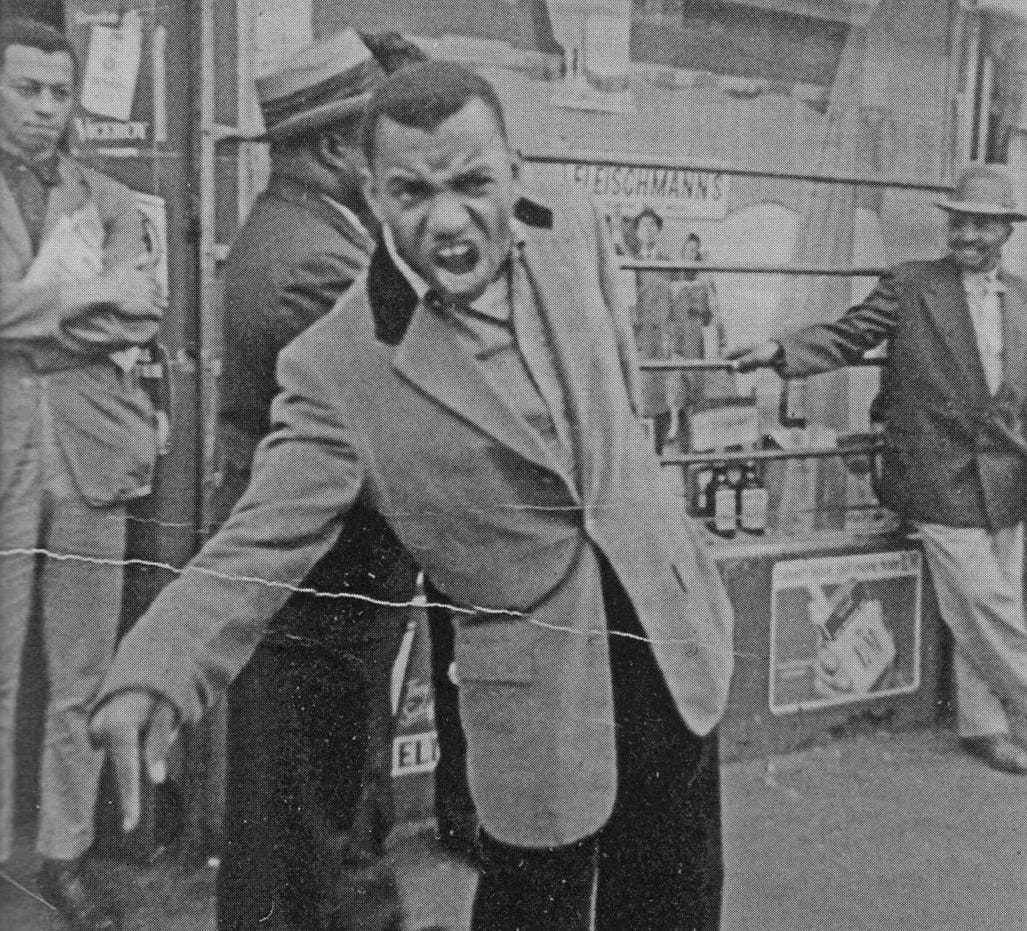
The photo below of Don Warden is from the archives of Khalid and Jamila al Mansour. Don Warden was one of the founders of the Afro-American Association at the University of California at Berkeley. The other founding members were Donald Hopkins, Otho Green, and Henry Ramsey. 

This organization formed in late 1961 and began as a student study group in 1962 at the University of California at Berkeley when there were literally no identifiable Afro-American and African Studies programs on any U. S. college and university campus. The group devoured works by Ralph Ellison, W.E.B. DuBois and other Black scholars that were left out of many colleges curricula. Study meetings of its members initially began at the off-campus home of a UC Berkeley student, and grew from there. In fact, chapters of this organization appeared on hundreds of college campuses in the United States with members numbering in the thousands by the mid-1960s.
The objective of the group was to read and study about the Afro-American, African, and Afro-Diasporic past in order to confront the institutional racism, colonialism and bigotry found in the United States and throughout the world. 

Warden, a UC Berkeley law student, regularly went into Black neighborhoods and literally spoke to young Black citizens directly on street corners or wherever they were. He encouraged them to study about Afro-American and African history in order to fight against their feelings of worthlessness that often accompanied experiencing chronic racism. 

He listened to them tell him about their problems of unemployment, poor housing, you name it. He, like most of his members, espoused that in order to change all systems of oppression, one needed to study about the past in order to do so. Warden eventually became a lawyer for the Black Panther Party of Self-Defense as well as granting legal assistance to the Nation of Islam when Malcolm X was still a member of the group.

The Afro-American Association was heavily influenced by the ideologies of Black American activists Robert F. Williams and Malcolm X. The AAA understood that only sustained study of Black people/s would foster the kind of thinking and strategies for combating systems that sought to suppress and control Black and Brown communities all over the world. Only deep research would correct the far-too-often feelings of inadequacy that came with being Black and oppressed. 

In 1962 when this study group, that was soon named the Afro-American Association, began its study group meetings at UC Berkeley there were roughly only about 100 Black students out of 20,000 white students. And in 1962 there were only two members of the group that were not born in the United States. One was from Jamaica; the other was from India.

In 1962 this tall, skinny, young Black man from Orange Hill, Jamaica and this petite and short, very brown young woman from Chennai, Tamil Nadu (in Southern India) dressed in her Sari and sandals met in an AAA group meeting.

The young man from Jamaica gave a pristine evaluation of how Great Britain had created a rather stiff and proper group of elite Black Jamaicans that often mimicked the mores and habits of British society. It was done, he said, to shield the world from knowing how racist the British empire actually was. The young man was calm, studious with very edgy ideas about the colonization of Black people/s around the world. 

The young brown woman in her Sari and sandals was intrigued. She too had been a British subject in her native state of Tamil Nadu in southern India. She knew something about what this young man spoke of, but not all of it. Back then, the typical path for academically talented Indian and Jamaican students was to study in England, that is if they could secure a path to graduate school. 

She rejected that path because there was no major in Biochemistry in India or in the UK that would have been available to a female. The skinny guy from Jamaica also rejected the educational path to the UK. His decision was so unusual that the approval for his exit from Jamaica took so long that he arrived at UC Berkeley two weeks after the Fall 1961 semester begun.

He, Dr. Donald Harris became a leading economist and she, Dr. Shyamala Gopalan-Harris became a leading biomedical scientist, a contributor to the identification of the function of rMNA, which greatly improved treatments for breast cancer. 

The early members of the Afro-American Association described her as warm, funny, “down for the cause” of Civil Rights and an end to colonialism, and also a fiery debater. At first one member of the AAA noted that some of them thought she was royalty because of the way she carried herself. Yet, she fit right in, several members noted. He was described as professorial even though he was in his early 20s. While their eventual marriage didn’t last (they married roughly 10 months after meeting), their firstborn daughter Kamala noted that she knew they loved each other and felt that if they had been a bit older and a bit more emotionally mature they might have made it. 

She cited them both as activists, and remembers going to protest marches with her parents in a stroller. The blueprint for their activism and for the creation of Afro-American and African Studies as disciplines were rooted in the activities in the Afro-American Association. While at UC Berkeley, Shyamala met and influenced arguably, one of Afro-America’s most important philosophers, Cedric Robinson.

Robinson’s book Black Marxism, first published in 1983, remains one of the most brilliant critiques and reassessments of the Eurocentric theories of Marxism. It has become a must-read in the literary canons of both Afro-American and African Studies.

It was Robinson who coined the phrase “Racial Capitalism.” He argued that capitalism was always based on race and race came before capitalism. Importantly there never was a clean break from European feudalism. He was one of the first Black scholars to identify “race,” as a component that European empires used when feudalism morphed into capitalism. 

Any study he maintained had to be central to Black people/s’ lived experiences wherever they were in the world. When I first read him, it became apparent that European Marxist scholars either forgot or tried to ignore that the peoples of Europe were once considered “races,” races and national identities that were eventually erased in exchange for their being identified as “white” which served the interests of European countries in their quest to colonize and dominate large portions of the world.

In 1959, Shyamala Gopalan was standing in line behind Cedric Robinson while they were both registering for classes. Both became members of the Afro-American Association. In the first edition of Black Marxism, there was only one person who was not a Black American listed in his group of early friends that Robinson acknowledged as influential on the development of his ideas. That person was Dr. Shyamala Gopalan-Harris.

So here’s a brief mini-history of the continuing of the Afro-American Association of University of California at Berkeley. Huey Newton and Bobby Seale who founded the Black Panther Party became members. Huey dared to show up at a meeting of AAA without having read the book assigned for that session. The members sent him home. He never showed up again unprepared. 

Future Congressman Ron Dellums was a member of the AAA at one time as was Kenny Freeman, a contributor to the Black Panthers 10-Point Plan. The AAA literally laid the academic groundwork for Afro-American and African Studies programs throughout the nation as underscored by historian and author Donna Jean Murch who traced the evolution and development of the Black Panther Party from its roots in the Afro-American Association. None of it began without the required reading and research and the on-the-ground grassroots activism that met Black communities in the Oakland area where they were.

I could go on about how police monitored the group’s members particularly when they spoke on street corners, or visited high schools to encourage reading and research among members of the Black community. Yet, I will not do that mainly because well-meaning, good people have started to use the internet like an online set of Cliffnotes

If you’re old enough to remember Cliffnotes you also remember that occasionally they were used instead of reading the actual book or doing the actual research. Yet, your ass was grass when a teacher or professor asked you a highly specific question that Cliffnotes did not cover and you hadn’t bothered to read the whole book.

So there’s a small bibliography below with a list of books that are worth your time. The message is clear: Either you put in the time and read or you remain a dilettante on matters that you need to know both for your safety and your sanity.

© Leslye Joy Allen

This essay was previously posted on Substack on January 22, 2026.

I am an Independent Historian, Oral Historian and Dramaturge. Please consider supporting my work and research with a few bucks for Coffee and Eggs via my CashApp or become a paid subscriber to me on Substack to help me sustain my research.

Recommended Readings:

Living For the City: Migration, Education, and the Rise of the Black Panther Party in Oakland, California by Donna Jean Murch

Fanon for Beginners by Deborah Baker Wyrick

Remaking Black Power: How Black Women Transformed an Era by Ashley D. Farmer

Black Marxism: The Making of the Black Radical Tradition by Cedric Robinson

Oregon Police Department Surveillance Files on Donald Warden and the Afro-American Association which kept surveillance documents on Donald Warden when he visited Oregon to encourage students to read and research.

The Afro-American Association: Forerunner to the Panthers

“How Kamala Harris’ Immigrant Parents Found a Home, and Each Other, in a Black Study Group” by Ellen Barry, September 13, 2020, New York Times.

The Truths We Hold: An American Journey by Kamala Harris

Remembering Cedric Robinson: Humanistic Imaginaries and the Black Radical Tradition

All blogs written by Leslye Joy Allen are protected by U. S. Copyright Law and licensed under a Creative Commons Attribution-NonCommercial-NoDerivs 3.0 Unported License. Any partial or total reference to any blog authored by Leslye Joy Allen, or any total or partial excerpt of any blog authored by Leslye Joy Allen must contain a direct reference to this hyperlink: https://leslyejoyallen.com with Leslye Joy Allen clearly stated as the author.  Postings or blogs placed here by other writers should clearly reference those writers.  All Rights Reserved.

The Loophole, the Farmer and the Lobbyist

by ©️Leslye Joy Allen

When I read comments by many people who express their shock and disgust at Felon 47, I share their pain. Yet, I am reminded of what they have not paid much attention to.

(In the year 2000, prisoners pick cotton at the Ferguson Unit in Texas in the prison’s cotton fields, Photo by Andrew Lichtenstein, Getty Images)

I taught my History students to think outside the box, and connect the dots. After establishing that American Chattel Slavery was an enormous agricultural enterprise that literally funded and built the United States, I would have my students read the 13th amendment to the U.S. Constitution which allegedly ended slavery in the United States:

“Section 1: Neither slavery nor involuntary servitude, except as a punishment for crime whereof the party shall have been duly convicted, shall exist within the United States, or any place subject to their jurisdiction.

Section 2: Congress shall have power to enforce this article by appropriate legislation.”

First, it was always possible to abolish slavery without it ever being justified as a punishment for a crime. The loophole stands out because it was deliberately placed there.

Second, Congress had the power to enforce the 13th amendment through further legislation. So, if Congress was silent about abuses of this amendment, one might get away with imprisoning and/or forcing the labor of just about anyone. Ava DuVernay’s documentary 13th brilliantly examines the loophole in the amendment, but I want to go just a bit further.

Now, how many of you on the Left have recently complained about Democrats in Congress not fighting hard enough against the policies of Felon 47? We can cherrypick the most vocal Democrats, can’t we? 

That leads me to something writer Carlyn Beccia wrote in her brilliant investigative essay “Don’t Tell MAGA, But Trump Plans to Increase Immigrant Labor.” (I highly, highly recommend reading this “free” essay ASAP.)

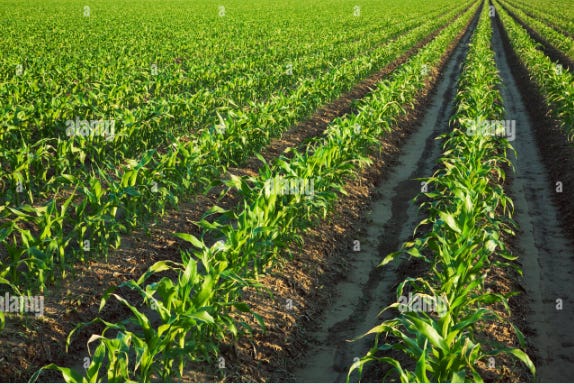
(Field of mid-growth grain Corn plants near England, Arkansas. Stock photo at Alamy)

Beccia noted that these days I.C.E. rarely shows up at American farms even though “six in ten agricultural workers are noncitizen immigrants.” She argued that Felon 47 is deporting Brown immigrants as a ruse to throw raw meat to his racist, stupid ass base. 

He pretends that he is cleaning up the country by putting alleged criminal riff-raff out of the country, while he capitalizes on a different type of immigrant status, namely H-2A visas that have been in use for years.

Here’s the rub as Beccia points out— Felon 47 did not start any of this. Mega agribusinesses like BayerAg, Syngenta, AcreTrader, Archer Daniels Midland Co., CHS, Inc., Freight Farmers, Heinz Seeds, Seedo Corporation, Sakata Seed Corporation, DOW, Rijk Zwaan and many others will reap in the profits while American farmers (many of whom are MAGA supporters) will still struggle financially. 

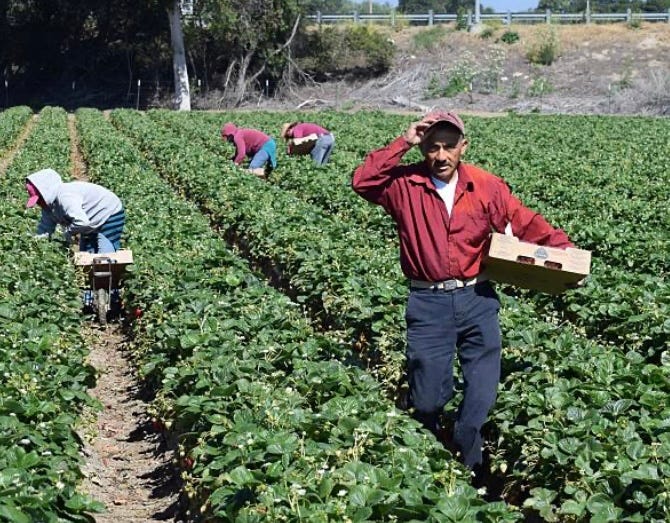
By using immigrants with H-2A visas, there is less money to be paid out, no pressure to guarantee permanent employment, and no negotiations to be made for poor immigrant workers if they are mistreated. 

Unless you have your own garden and grow your own food, the French Fries you ordered at McDonald’s (made from a corn product, not a potato), and the food that sits on your table was produced by slave labor. Sidebar: H-2A visas allow businesses to hire foreign workers on a temporary basis when there are not enough American workers to fill the jobs.

(Salinas, CA, USA—June 19, 2015: Seasonal farm workers pick and package strawberries)

Agribusinesses are so brutally profit-driven that the countries of Ethiopia, Ghana, Kenya, Malawi, Nigeria, South Africa, Tanzania, Uganda, Zambia, and Zimbabwe have made it illegal for native and neighboring farmers to trade seeds with each other. 

Under pressure from agribusinesses to insure that the “intellectual property rights” of their seeds are not violated, agribusinesses pressured various African governments to eliminate farmers’ traditional farming methods in order to force farmers to purchase seeds rather than allowing them to trade their own. Their lobbyists threaten, cajole, and promise money to political parties and politicians in order to ensure these companies make a profit. 

So, students/readers as we think about all of this on our way out the door of my classroom, let’s consider the following. It would be fair to say that the average civic-minded American citizen would do well to contact their representatives to make their grievances and requests known. Many of us can and often do lobby our representatives to encourage them to represent our interests.

At the same time, multi-billion dollar businesses employ and pay lobbyists. The average citizen does not have that kind of wealth. So, here’s a few questions students/readers: Why is lobbying even legal? Have you figured out yet why some Democrats are just going along with the program as if nothing is happening?

Class dismissed.

©️Leslye Joy Allen

I am an Independent Historian, Oral Historian and Dramaturge. Please consider supporting my work with a few bucks for Coffee and Eggs via my CashApp.

You can also subscribe to my writings on Substack and stay in the loop with the best new research, history, journalism, prose, poetry, and etcetera.

All blogs written by Leslye Joy Allen are protected by U. S. Copyright Law and licensed under a Creative Commons Attribution-NonCommercial-NoDerivs 3.0 Unported License. Any partial or total reference to any blog authored by Leslye Joy Allen, or any total or partial excerpt of any blog authored by Leslye Joy Allen must contain a direct reference to this hyperlink: https://leslyejoyallen.com with Leslye Joy Allen clearly stated as the author.  Postings or blogs placed here by other writers should clearly reference those writers.  All Rights Reserved.
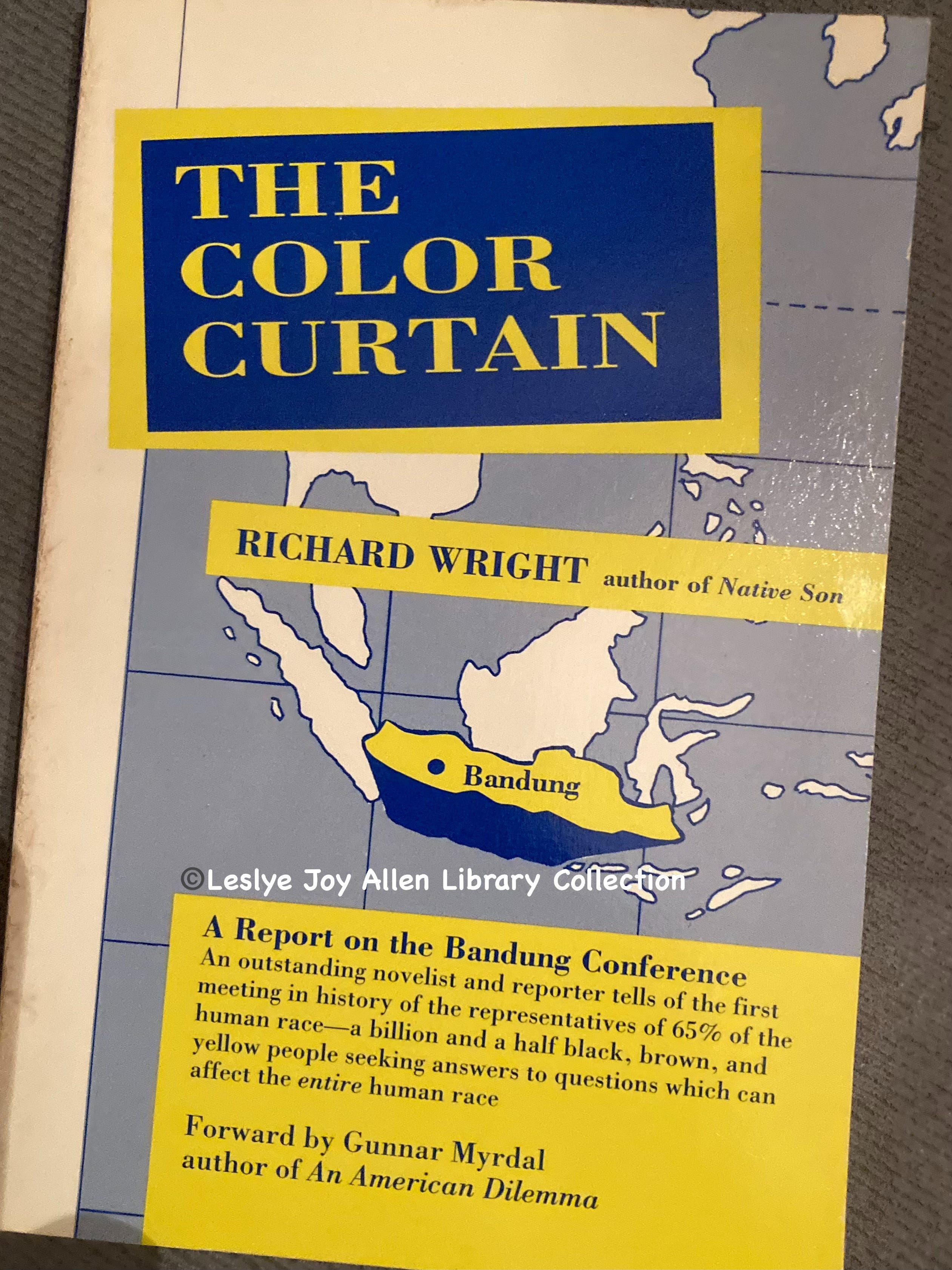
Revisiting “The Color Curtain”

by ©️Leslye Joy Allen

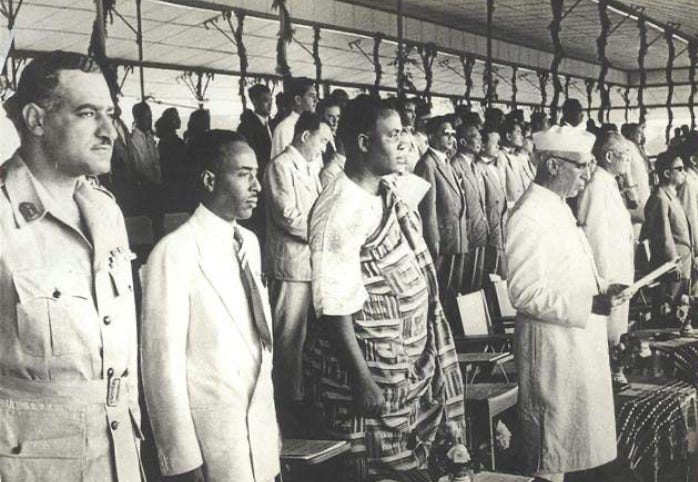
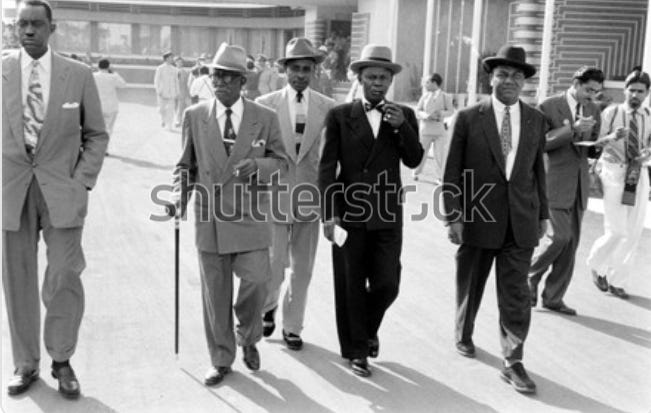
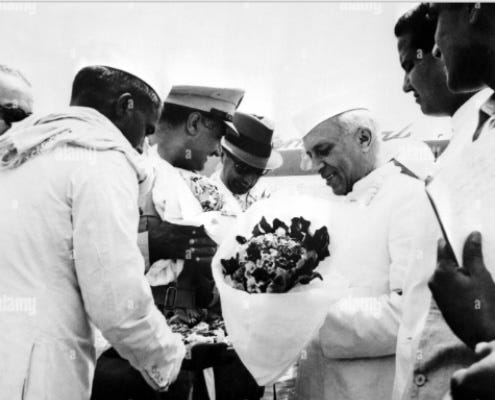
The Bandung Conference was held in April of 1955. It was a meeting of representatives from 29 nations that then contained 65 percent of the world’s population, which were peoples of color that had been colonized or interfered with by European powers. 

This conference was commonly known as the Asian-African Conference. Indonesia, India, Pakistan, Burma and Ceylon organized it and then invited 25 more countries to send representatives and observers. The invited countries were (in alphabetical order here): Afghanistan, Cambodia, China, Egypt, Ethiopia, Ghana (then called “The Gold Coast”), Iran, Iraq, Japan, Jordan, Laos, Lebanon, Liberia, Libya, Nepal, the Philippines, Saudi Arabia, Sudan, Syria, Thailand, Turkey, Vietnam Democratic Republic, South Vietnam, and Yemen. 

After World War II ended, the only two military superpowers were the United States and the U.S.S.R. which competed with each other for influence in the Third World.  The United States was initially invited to the conference but refused to send a representative. The USA denounced this conference. While these newly independent nations did not want to align with the Eastern bloc or the West, the Soviet Union (U.S.S.R.) did gain considerable influence in the region. Black Americans Richard Wright, and US Congressman Adam Clayton Powell, Jr., however, did attend. 

Black novelist Richard Wright recorded what he witnessed at this conference where Africans, Asians, Black Americans, East Indians, Indigenous Peoples and other peoples of color met in Bandung, Indonesia to figure out a way forward in the new post-colonial era. No European nations were invited.

The conference allowed newly independent nations to assert their sovereignty. European colonialism’s oppression and exploitation and interference in African and Asian countries engendered a need for these nations to meet so that they could successfully deal with each other. 

The outcome of this conference was the Non-Aligned Movement which discouraged countries in attendance from aligning with First World and Second World nations. It also produced an agreement called “The Ten Principles of Peaceful Coexistence” which emphasized cooperation, respect for boundaries and sovereignty, non-interference in each country’s affairs, and resistance to any aggression from the Western World.

I encourage everyone to read author Richard Wright’s observations about Bandung and recognize that not only are all of these nations of color much more geopolitically complex than they were 70 years ago, they are also more heavily populated today with much younger populations than Europe. 

Referred to now as The Global Community, people of color now make up roughly 85 percent of all the people on this earth. Felon 47 and his yes-people know what these numbers mean which is why they want to stave off the inevitable by attempting to occupy and place Canada and Greenland under the US umbrella. Yet, the United States is disadvantaged in numerous ways.

Even though the USA still has perhaps the most skilled military in the world, China has the largest military. The USA is now seen as a pariah by most of the world courtesy of the person sitting in the Oval Office and his inept Defense Secretary Pete Hegseth, who may soon be replaced. Even worse, most of the US population is unilingual whereas many individuals in The Global Community are multilingual. That does not bode well for this nation that is slowly becoming isolationist to the point where we could lose allies, or worse, we lose knowledge about what the rest of the world is planning.

It would be interesting if another Asian-African conference, such as the one held in 1955, were held today or sometime in the near future. I also wonder which nations would not be invited.

©️Leslye Joy Allen

I am an Independent Historian, Oral Historian and Dramaturge. Please consider supporting my work with a few bucks for Coffee and Eggs via my CashApp.

You can also subscribe to my writings on Substack and stay in the loop with the best new research, history, journalism, prose, poetry, and etcetera.

All blogs written by Leslye Joy Allen are protected by U. S. Copyright Law and licensed under a Creative Commons Attribution-NonCommercial-NoDerivs 3.0 Unported License. Any partial or total reference to any blog authored by Leslye Joy Allen, or any total or partial excerpt of any blog authored by Leslye Joy Allen must contain a direct reference to this hyperlink: https://leslyejoyallen.com with Leslye Joy Allen clearly stated as the author.  Postings or blogs placed here by other writers should clearly reference those writers.  All Rights Reserved.
Revisiting “Late Victorian Holocausts”

by ©️Leslye Joy Allen

I’m not going to write a full analysis of the late historian Mike Davis’ exceptional book “Late Victorian Holocausts: El Niño Famines and the Making of the Third World.” I do, however, want to revisit it and emphasize a few points Davis made about European colonialism in the late 19th century.

Davis’ examination of famines and droughts in Southeast Asia, China, Africa, and Latin America underscored how indigenous peoples were dispossessed of their land; and their time-honored farming traditions were also dismissed. It created ecological and environmental problems we now deal with today but rarely think about.

Davis acknowledged that land theft, the closing off of common farming areas, and violence against these populations were key components of European colonization and expansion, but he added one more element—the weather.

European colonizers studied El Niño weather patterns to determine when populations in Southeast Asia, Latin America, Africa, China, and etcetera, would be at their most vulnerable.

El Niño is part of a long-existing and large weather pattern. During El Niño, areas of the Pacific Ocean experience unusually high surface temperatures. El Niño disrupts typical weather patterns, affects rainfall, temperatures, and etcetera. The period when these waters are much cooler is called La Niña.

Europeans studied when the weather was working against the people and the lands they wished to colonize—The colonizers struck most often at those times proving that famines are human-made.

The book’s preface offers a detailed account of former U. S. President Ulysses Grant and his family on vacation in 1877 after he left office. He and his family visited Europe first, but soon ended up visiting places devastated by famine. Grant took notes about what he saw, but he did not report the degree of ecological destruction he witnessed.

Davis’ book was published in 2001 and it remains a rare gift because his research proved that heads of state and monarchs in the western world tended to ignore the long-term ecological damage from their destruction of natural resources. Indigenous populations were seen as inferior, therefore their farming techniques and cooperation with their native ecologies were dismissed by Europeans as well.

The fires that recently destroyed homes and huge areas of California were made worse by what is called “Hydroclimate Whiplash.” When heavy rains due to El Niño soak the ground leading to the excessive growth of vegetation, what follows next are extremely long dry spells.

The dried up vegetation becomes little more than fuel for fires. The results of El Niño are much more troublesome now due to climate change. It’s not just happening in California. It’s happening everywhere around the world.

What is often left out of discussions about climate change and the usage of El Niño’s disruptive weather patterns, is the racism against and the subjugation of peoples of color by Europeans and others that has aided and abetted climate change crises around the world.

Davis was not the first historian to understand what European colonialism did to the natural environments of countries around the world, but his book “Late Victorian Holocausts” is one of the few histories to recognize that the routine and natural disruptions of El Niño were deliberately weaponized against Africans, Asians, and Latin Americans in horrific ways that few individuals realize.

by ©️Leslye Joy Allen

All blogs written by Leslye Joy Allen are protected by U. S. Copyright Law and licensed under a Creative Commons Attribution-NonCommercial-NoDerivs 3.0 Unported License. Any partial or total reference to any blog authored by Leslye Joy Allen, or any total or partial excerpt of any blog authored by Leslye Joy Allen must contain a direct reference to this hyperlink: https://leslyejoyallen.com with Leslye Joy Allen clearly stated as the author.  Postings or blogs placed here by other writers should clearly reference those writers.  All Rights Reserved.
Revisit the French Resistance—The Maquis

by ©️Leslye Joy Allen

In this current political climate in the United States, there is something that every member of the Left/Resistance needs to remember: People that only respect violence and who cheer violence will typically have to be dealt with violently. They don’t respond to reason or kindness or common sense. You will not write them away or blog them away. Calling them names won’t work either.

You’re going to have to accept that they are monsters. You don’t reason with monsters anymore than you reason with poisonous snakes. This is what you need to remember about MAGA supporters and those nuts that stormed the capital on January 6, 2021.

I am not going to teach a full history lesson in this blog. Yet, it would help you to review the French Revolution (1789-1799) where crops failed and the economy tanked while the nobility and the clergy paid almost no taxes as commoners bore the brunt of taxation and starvation while Louis XVI kept spending on himself.

You also would do well to study France’s Maquis (“the underbrush”) which was its underground guerilla movement that fought against the Nazis during World War II. In some instances they were successful; in others they were not. Yet, you better recognize that American insularity and that feeling we tend to embrace that says, “We will be okay as long as we protest and go through the courts,” will not necessarily save us.

In the next four years we may have no other choice but to get our hands dirty. Even worse, our obsession with the internet, and the attention we receive from it, may eventually work against us. Some strategies do not need publicity. We need more face-to-face private conversations whenever possible.

So, here’s a few good articles about the Maquis, including its African and Afro-Muslim participants, and the current research historians are still working on.

©️Leslye Joy Allen

Overview of the French Resistance

France to Rename Streets after African WW2 Heroes

In the Footsteps of African Resistance Fighters

Addi Bâ Mamadou, called
“The Black Terrorist”
by the Nazis

All blogs written by Leslye Joy Allen are protected by U. S. Copyright Law and licensed under a Creative Commons Attribution-NonCommercial-NoDerivs 3.0 Unported License. Any partial or total reference to any blog authored by Leslye Joy Allen, or any total or partial excerpt of any blog authored by Leslye Joy Allen must contain a direct reference to this hyperlink: https://leslyejoyallen.com with Leslye Joy Allen clearly stated as the author.  Postings or blogs placed here by other writers should clearly reference those writers.  All Rights Reserved.