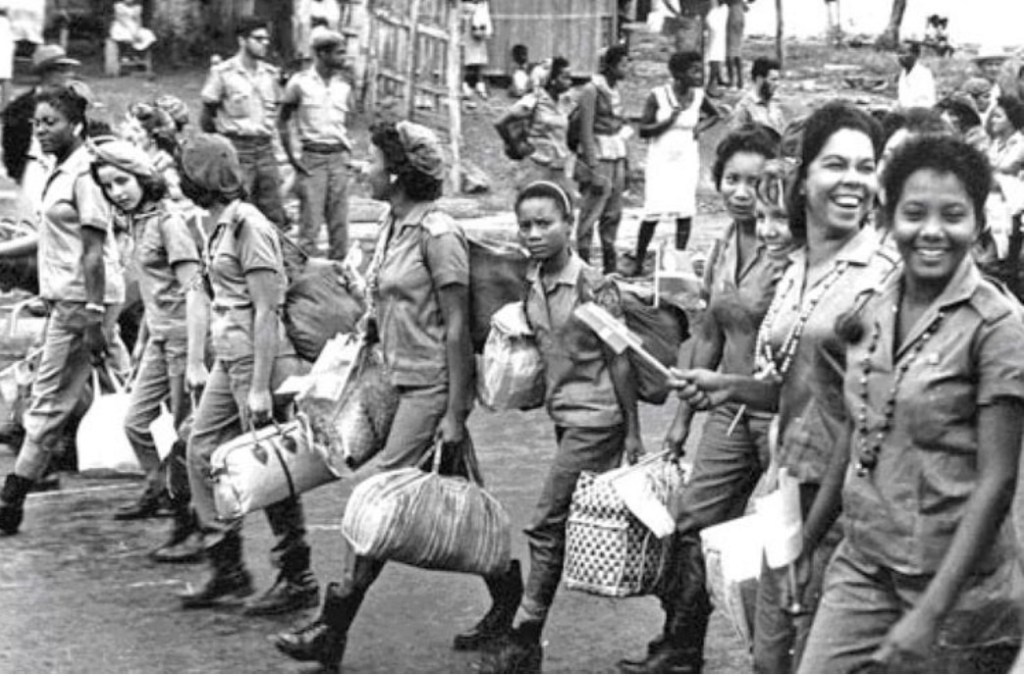
A Personal Prayer of Cuba

by ©️Leslye Joy Allen

The following below that is written in italics is partially a meditation on Cuba. It is a response I wrote to a piece about Cuba’s current crisis exacerbated by American neglect and cruelty that was written by Arturo Dominguez. A link to his exceptional article is at the very end of this essay. What’s in italics is a rumination I wrote to Arturo:

“I still remember reading that when Afro-Cuban musical artists came to perform in the United States that they had to perform in the U.S. for free. When asked why they were willing to perform for nothing, the answer was always the same: “We want to see where Dizzy Gillespie was born.”

Thanks for this report Arturo Dominguez because every time there is a sanction, a deprivation, I am reminded that no one suffers in Cuba but the people themselves. I still remember the heinous and wretched Helms-Burton Act which banned ships who docked in Cuba’s ports from docking in the United States for several months.

I remember my professors having to fly out of Atlanta to Canada and then taking a flight from some airport in Canada to Havana to do whatever research they were performing on their visits.

The United States has done nothing but made an example of Cuba as a message to other countries in Latin America and the Caribbean that says “This is how far we’ll go; this is how bad we’ll treat you, if you don’t fall in line.”

I might just turn this comment into a meditation.”

A few moments after reading Arturo’s essay I stumbled on one of my favorite thinkers Vijay Prashad who also was offering his thoughts on the viciousness of the United States government against the Cuban people because it is the people that suffer—No one else. (A link to Vijay’s essay is at the end.)
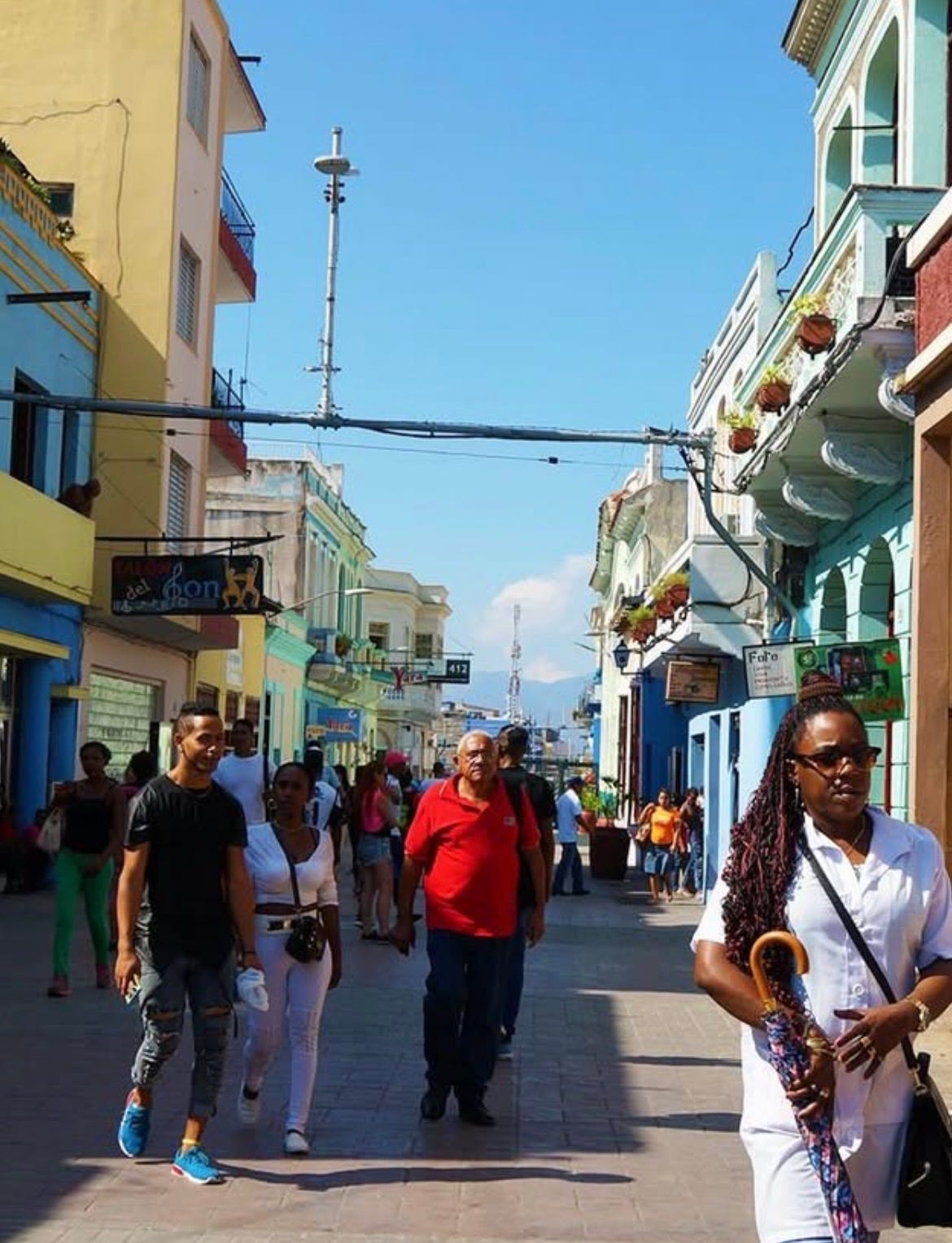
I don’t have the strength to comment on Prashad’s piece right now except that it is brilliant and accurate. I will leave it to you dear reader to examine both his and Arturo’s essays at your leisure. I have only one thing to say.

One line of my paternal family was sold as slaves from Santiago de Cuba to the mainland United States during the period of slavery in this Western hemisphere. My paternal great grandmother was born a slave named Mollie Laws. Her previous family surname was Layende. 

Like most people during the 1700s and 1800s, when one moved (or was sold) some place else the last name was changed to adapt to the new culture one was inhabiting. In the United States, it was typically expected that you Anglicize your name to something that English speakers could pronounce. So “Layende” became “Laws.”

Anyhow I used to relay my personal history to my History students in an effort to make sure that they understood that Chattel slavery took place throughout the Western world. Importantly, what we now call the United States received less than 6 percent of all the Africans transported to this hemisphere during the trans-Atlantic slave trade. The majority of Africans (around 95 percent) landed in what is now named Latin America and the Caribbean. 

I don’t have any deep analysis here about how difficult Afro-American genealogy can be. I don’t have any deep commentary about the many cultures and cultural differences that exist between all of the descendants of Africa who occupy this hemisphere except I have always known that for better or worse I belong to them.

Right after I read Arturo’s essay and then Vijay’s essay, I recalled a favorite memory from the classroom. A student whose name escapes me now came to class after Spring Break with a faded photograph he took while out on the Atlantic ocean. 

He learned that I had roots in Cuba and so did he. He pulled out this faded photo taken on the water. Far off in the distance I saw something that looked like a line stretched across the water. 

“What is that long line in the water that I see in the distance?,” I asked. 

That line across the water in the distance is Cuba, Ms. Allen. I hope you get there someday.” 

©️Leslye Joy Allen

I am an Independent Historian, Oral Historian and Dramaturge. Please consider supporting my work and research with a few bucks for Coffee and Eggs via my CashApp or become a paid subscriber to me on Substack to help me sustain my research.

All blogs written by Leslye Joy Allen are protected by U. S. Copyright Law and licensed under a Creative Commons Attribution-NonCommercial-NoDerivs 3.0 Unported License. Any partial or total reference to any blog authored by Leslye Joy Allen, or any total or partial excerpt of any blog authored by Leslye Joy Allen must contain a direct reference to this hyperlink: https://leslyejoyallen.com with Leslye Joy Allen clearly stated as the author.  Postings or blogs placed here by other writers should clearly reference those writers.  All Rights Reserved.

Hyperlinks to additional articles are below photos.
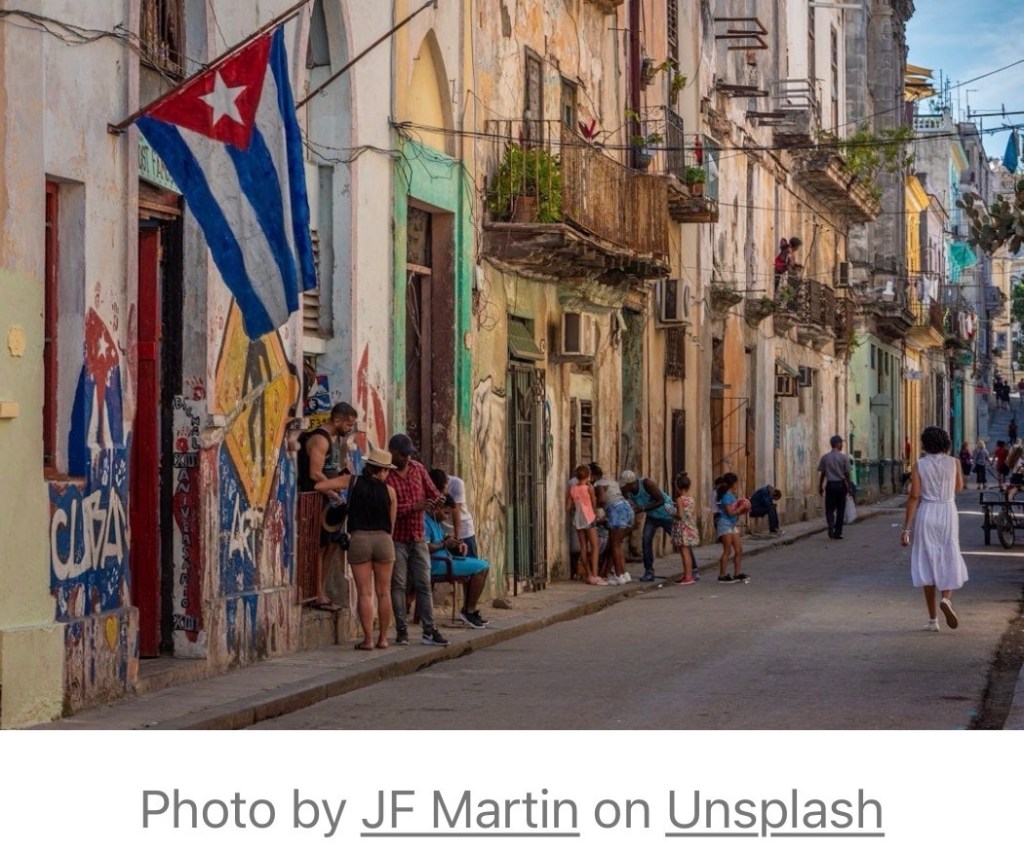
(from Analysis: Cuba on the Brink)

(from Why is the United States Afraid of Cuba?)

Black and Latino Playwrights Conference…

A quick conversation between Artistic Director and Actor Eugene Lee and Leslye Joy Allen

Copyright © 2016 by Leslye Joy Allen. All Rights Reserved.

Joy:  Hello Eugene.  Tell me how and why you became an actor; and when did you start writing plays?

Eugene:  I chose Theatre and Political Science as my majors in college and began my studies of the craft of acting there.  I started writing plays while in New York in between gigs.

Joy:  Who trained you as an actor, writer, etc.?  Who among your teachers remains the most important and influential to you and why?

Eugene:  My professors at Southwest Texas State.  I’ve studied in professional classes and workshops on both coasts as well.  I’ve learned from a broad spectrum of theatre artists along the way and could never lessen anyone’s impact or contribution to my smorgasbord education.

Joy:  How did you become involved in the Black and Latino Playwrights Conference?  Why is this conference important?

Eugene:  I was approached by my alma mater about taking the helm of this phenomenon.  It’s sort of patterned after the Eugene O’Neill playwrights conference at Yale University for development of new plays.  This conference fills a void in that it provides some much needed resources to help writers find their play and their voice as a writer.  The mission statement for the conference is “To study the Craft.  To nurture the Writer.  To celebrate the work.” Simple.  There is a need to nourish our storytellers, else we end up with more revisionist history.  WE have to tell our stories and to do so we much develop the skill set.  The collaborative aspect of finding a play involves bringing together resources like director, actor, dramaturgical support, stage management, etc.

Joy:  What has changed about writing plays from when you began writing until today?

Eugene:  I don’t know.  All the basic fundamental elements of playwriting are pretty much the same, though some writers find creative ways to tweak and turn those to fit the needs of their storytelling and style etc.

Joy:  What advice would you give to young playwrights of color?

Eugene:  Learn the craft.  Dare to care.  Write.  That’s the secret to writing.  Write.  Writers write.  Great stories in your head don’t have export until they’re on a page. Writers read probably more than they write. These are short responses.  I’m in the throes of tech rehearsals here in Boston.  I can probably elaborate more after my plate empties a bit. Thank you Joy, for all you do.

Joy:  Thanks Eu-genius!  Looking forward to a more extensive conversation, once you have a bit more time, my friend.


Copyright © 2016 by Leslye Joy Allen. All Rights Reserved.

This interview was conducted by Leslye Joy Allen and is protected by U. S. Copyright Law and licensed under a Creative Commons Attribution-NonCommercial-NoDerivs 3.0 Unported License.   Any partial or total reference to this or any interview or blog authored by Leslye Joy Allen, or any total or partial excerpt of this or any interview or blog by Leslye Joy Allen must contain a direct reference to this hyperlink: http://leslyejoyallen.com with Leslye Joy Allen clearly stated as the author.  Postings, interviews, or blogs placed here by other writers should clearly reference those writers. All Rights Reserved.

A Personal Bibliography (After “Four Little Girls”)

By Leslye Joy Allen                                                                                                     Historian, Educator, Theatre and Jazz Advocate & Consultant, Ph.D. Candidate

Copyright © 2013 by Leslye Joy Allen.  All Rights Reserved.

“Books II” by Leslye Joy Allen, Copyright © 2013.  All Rights Reserved.

“Books II” by Leslye Joy Allen, Copyright © 2013. All Rights Reserved.

When Erich McMillan-McCall, founder of Project1Voice said, “We need a bibliography,” I knew I was about to be called upon to begin pulling together books that focused on the lives and accomplishments of Black women.  I almost declined because there really is no shortage of books written by or about or which target Black women and girls as a reading audience.  The real task was not finding books, but rather which ones should be on the list.   Erich (pronounced “Eh-rish”) asked me to do this as part of his overall focus on Black women, but also in some ways as a response to the reading of the Christina Ham play “Four Little Girls” that streamed live online at the Kennedy-Center’s website at 6:00 PM EST on Sunday, September 15, 2013.

Although Diane McWhorter’s Pulitzer Prize-winning book Carry Me Home gives a detailed account of that fateful Sunday morning when Cynthia, Addie Mae, Carole, and Denise were killed, there is no book written exclusively about these four little girls who died in that church bombing on September 15, 1963.  Indeed, it can be debated that the White racist terrorists that bombed Birmingham, Alabama’s Sixteenth Street Baptist Church that ended the lives of these girls did not specifically set out to kill young Black females.  Often the targets of racial violence were and tend to be Black males, or at least many folks think the targets are always Black males.  After all, two Black boys, 16-year-old Johnny Robinson and 13-year-old Virgil Ware were shot and killed the same day in the immediate aftermath of the church bombing.  Yet, Black women and girls were not only routine victims of sexual violence, but were often beaten or killed with impunity during slavery, the era of Jim Crow, and well into and beyond the Civil Rights era.  Black female martyrdom and valor in the struggle for human and civil rights is often muted in favor of other types of narratives.  A perfect example of this is how most people view Rosa Parks.

Too often the public (and a few historians) mistakes Rosa Parks’ refusal to give up her seat to a White person in Montgomery, Alabama in 1955 as just an example of what happens when a Black woman simply gets tired of racial injustice.  But it was much, much more than that.  Historian Danielle L. McGuire aptly noted that Parks had a long career of dangerous work as an NAACP investigator in the decades before her fateful act in 1955.  McGuire also reported that the very first question Rosa Parks’ mother asked her after Parks was released from jail for her now-famous refusal to give up her seat to a white bus passenger was: “Did they beat you?”  That kind of question was, at one time, almost as typical for Black women as the sun coming up.

One way to dispel myths and increase our understanding of our lives and the world we live in is to read and do our own research.  One way to honor those four little girls tragically killed on that fateful Sunday in 1963 (and all of our Black heroines) is to examine and celebrate our resilient and diverse and often brilliant Black womanhood, a womanhood denied to them.  So here goes…

The books contained in the .pdf attachment at the end of this blog were my favorites and the first books that came to mind, along with a few marvelous book suggestions about Black female musicians courtesy of my good friend and alumna sister from Agnes Scott College, ethnomusicologist Dr. Birgitta Johnson.

Some books are old and some relatively new.   There are no separate sections where fiction is separated from nonfiction.  The only separate section in this bibliography is a section of books devoted exclusively to and for Black girls from preschool to middle school.  A few parents might find this useful.   I am also happy to report that books for and about Black girls is a growing industry.

My book list is not comprehensive.  For some of you who read all the time, you might find some glaring omissions.  I make no apologies.  I never choose a book simply because it was or is popular, and neither should you.   I also have not been fond of everything on the bestseller list now or in the past.  This list is MY LIST and it is hardly an exhaustive list of all the books I have read about Black women and/or any other subject.  Yet it is a beginning.  For those of you who read occasionally, you might find this list particularly useful so that you can begin that journey where you read and discover new things, new ideas, and new writers.

Now, for those of you who might be tempted to send me some remark about how I left out what you consider to be the “best book ever,” do not despair and save your energy.  The attached bibliography has an important page with a header that reads: “Add Your Favorite Books Here.”  THIS IS YOUR PAGE.  This is where I hope you will begin to write down the authors and titles of those books that have mattered the most to you.  I hope you will create your own bibliography, because if you do, we can begin to shape a real dialogue that is truly about ALL OF US.   I invite you to start one part of your/our journey by clicking here: **By, About, and For Black Women, a Personal Bibliography by Leslye Joy Allen.pdf**

Portable Document Files (.pdf ) have to be opened with an Adobe Reader.  If you have a problem opening the file above, please visit http://www.adobe.com, click on the section near the top of the page that is marked “Download,” then highlight and click “Adobe Reader” and download the Adobe Reader free of charge.

Also be sure to visit the Gist of Freedom, free podcasts devoted to preserving our rich African American History at: http://www.blackhistoryuniversity.com

Leslye Joy Allen is also a perpetual and proud supporter of the good work of Clean Green Nation.  Visit the website to learn more about it: Gregory at Clean Green Nation!

Copyright © 2013 by Leslye Joy Allen.  All Rights Reserved.
Creative Commons License This Blog was written by Leslye Joy Allen and is protected by U. S. Copyright Law and licensed under a Creative Commons Attribution-NonCommercial-NoDerivs 3.0 Unported License.  Any partial or total reference to this blog, or any total or partial excerpt of this blog must contain a direct reference to this hyperlink: http://leslyejoyallen.com with Leslye Joy Allen clearly stated as the author.