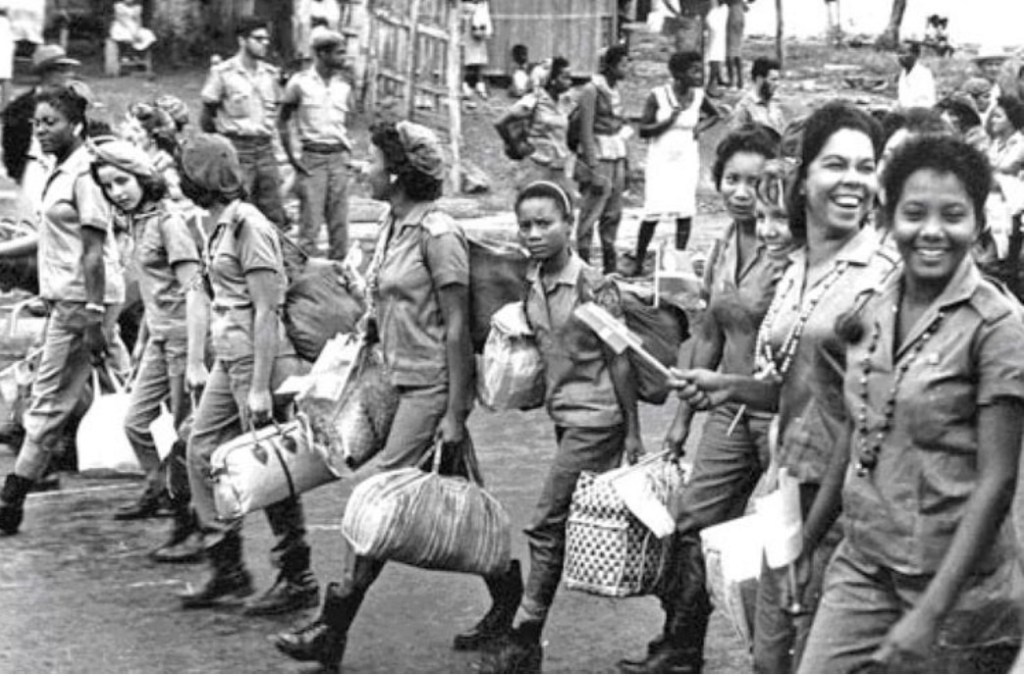
A Personal Prayer of Cuba

by ©️Leslye Joy Allen

The following below that is written in italics is partially a meditation on Cuba. It is a response I wrote to a piece about Cuba’s current crisis exacerbated by American neglect and cruelty that was written by Arturo Dominguez. A link to his exceptional article is at the very end of this essay. What’s in italics is a rumination I wrote to Arturo:

“I still remember reading that when Afro-Cuban musical artists came to perform in the United States that they had to perform in the U.S. for free. When asked why they were willing to perform for nothing, the answer was always the same: “We want to see where Dizzy Gillespie was born.”

Thanks for this report Arturo Dominguez because every time there is a sanction, a deprivation, I am reminded that no one suffers in Cuba but the people themselves. I still remember the heinous and wretched Helms-Burton Act which banned ships who docked in Cuba’s ports from docking in the United States for several months.

I remember my professors having to fly out of Atlanta to Canada and then taking a flight from some airport in Canada to Havana to do whatever research they were performing on their visits.

The United States has done nothing but made an example of Cuba as a message to other countries in Latin America and the Caribbean that says “This is how far we’ll go; this is how bad we’ll treat you, if you don’t fall in line.”

I might just turn this comment into a meditation.”

A few moments after reading Arturo’s essay I stumbled on one of my favorite thinkers Vijay Prashad who also was offering his thoughts on the viciousness of the United States government against the Cuban people because it is the people that suffer—No one else. (A link to Vijay’s essay is at the end.)
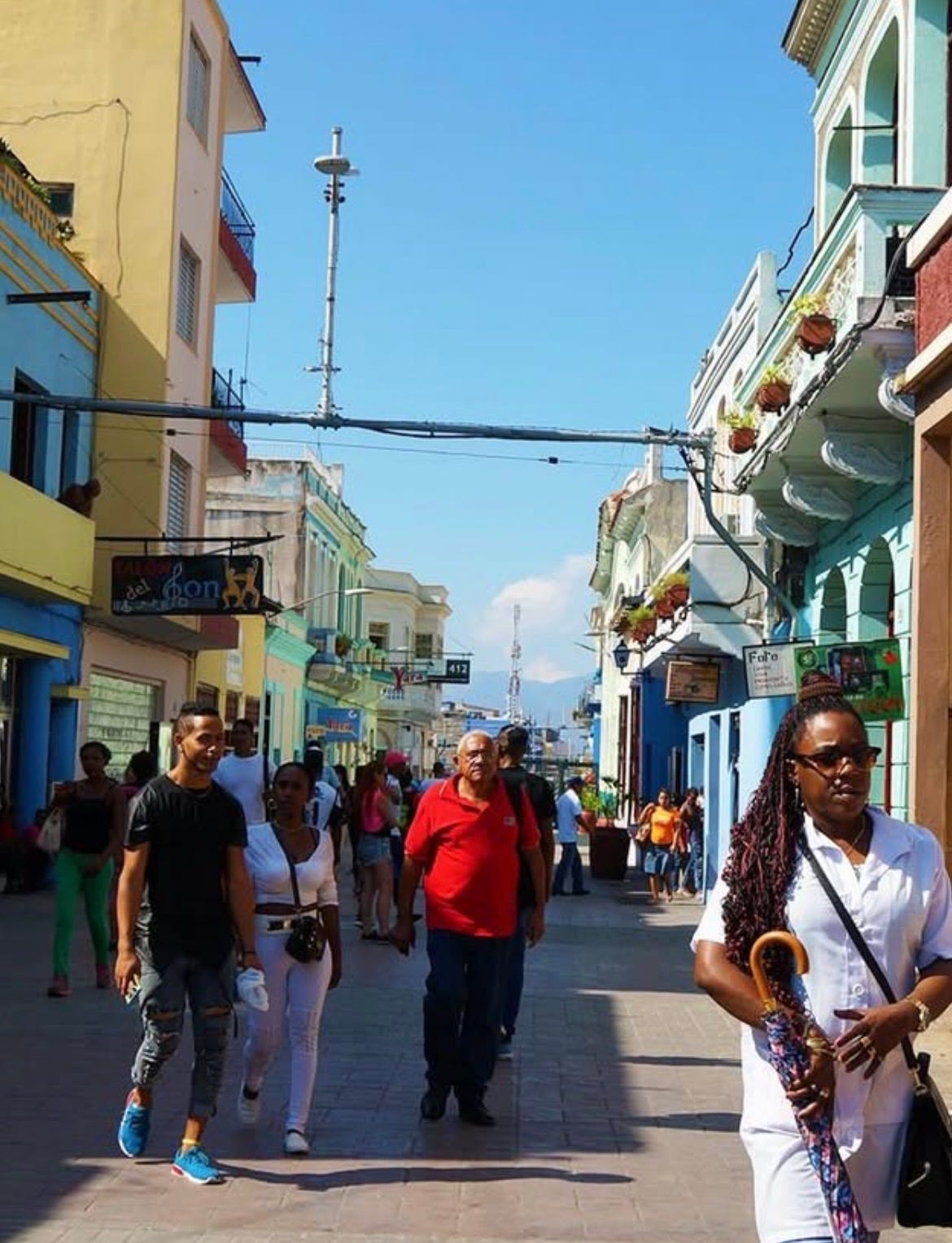
I don’t have the strength to comment on Prashad’s piece right now except that it is brilliant and accurate. I will leave it to you dear reader to examine both his and Arturo’s essays at your leisure. I have only one thing to say.

One line of my paternal family was sold as slaves from Santiago de Cuba to the mainland United States during the period of slavery in this Western hemisphere. My paternal great grandmother was born a slave named Mollie Laws. Her previous family surname was Layende. 

Like most people during the 1700s and 1800s, when one moved (or was sold) some place else the last name was changed to adapt to the new culture one was inhabiting. In the United States, it was typically expected that you Anglicize your name to something that English speakers could pronounce. So “Layende” became “Laws.”

Anyhow I used to relay my personal history to my History students in an effort to make sure that they understood that Chattel slavery took place throughout the Western world. Importantly, what we now call the United States received less than 6 percent of all the Africans transported to this hemisphere during the trans-Atlantic slave trade. The majority of Africans (around 95 percent) landed in what is now named Latin America and the Caribbean. 

I don’t have any deep analysis here about how difficult Afro-American genealogy can be. I don’t have any deep commentary about the many cultures and cultural differences that exist between all of the descendants of Africa who occupy this hemisphere except I have always known that for better or worse I belong to them.

Right after I read Arturo’s essay and then Vijay’s essay, I recalled a favorite memory from the classroom. A student whose name escapes me now came to class after Spring Break with a faded photograph he took while out on the Atlantic ocean. 

He learned that I had roots in Cuba and so did he. He pulled out this faded photo taken on the water. Far off in the distance I saw something that looked like a line stretched across the water. 

“What is that long line in the water that I see in the distance?,” I asked. 

That line across the water in the distance is Cuba, Ms. Allen. I hope you get there someday.” 

©️Leslye Joy Allen

I am an Independent Historian, Oral Historian and Dramaturge. Please consider supporting my work and research with a few bucks for Coffee and Eggs via my CashApp or become a paid subscriber to me on Substack to help me sustain my research.

All blogs written by Leslye Joy Allen are protected by U. S. Copyright Law and licensed under a Creative Commons Attribution-NonCommercial-NoDerivs 3.0 Unported License. Any partial or total reference to any blog authored by Leslye Joy Allen, or any total or partial excerpt of any blog authored by Leslye Joy Allen must contain a direct reference to this hyperlink: https://leslyejoyallen.com with Leslye Joy Allen clearly stated as the author.  Postings or blogs placed here by other writers should clearly reference those writers.  All Rights Reserved.

Hyperlinks to additional articles are below photos.
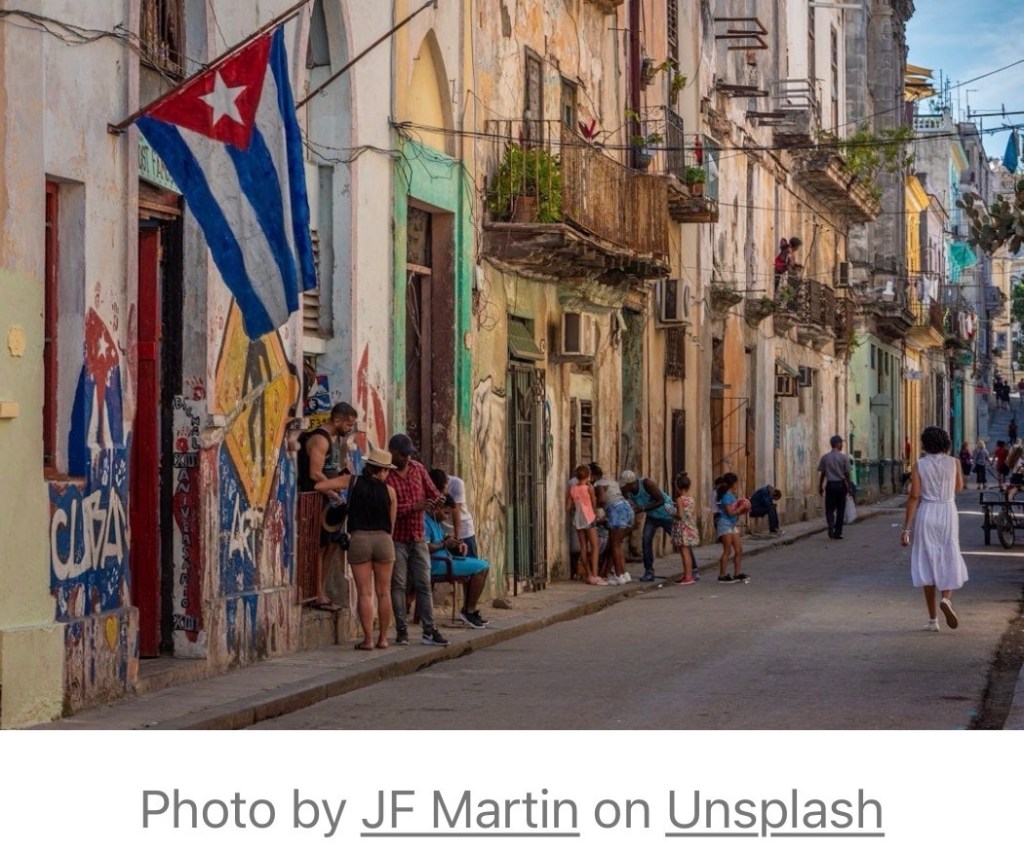
(from Analysis: Cuba on the Brink)

(from Why is the United States Afraid of Cuba?)

They Should Live Where You Live

by Leslye Joy Allen

Copyright © 2016 by Leslye Joy Allen. All Rights Reserved.

“Self Portrait” by Copyright © 2015 Leslye Joy Allen. All Rights Reserved.

“Self Portrait,” Copyright © Leslye Joy Allen. All Rights Reserved.

I am not going to rant about the deaths of unarmed Black men and women, and unarmed men and women of color killed by police or those who have unnecessarily died in police custody.  As someone who was once harassed by police, I need no convincing that this nation has a policing problem.  (And I’m too exhausted with the campaigns for President of the United States to make any commentary about that.)  Yet, as much as this nation has a problem about the often poor relationships between police and communities of color, I would add that it is dangerous to make or create a single national narrative about these relationships. We need several narratives and they need to be local.  Let me give you a scenario that paints one local picture about where I live.

On that rare occasion when I have called police, I typically got a quick response.  And I live in a 99.9% Black middle class Atlanta neighborhood.  Typically, the only time the police are called on the street where I live is when someone has a dog that barks late at night (this usually requires a phone call to Animal Control, as well), or when some kids are playing music too loud and late at night; but none of this happens with any real frequency.  Some homes are occupied by renters who often have to learn that some things are not tolerated in this subdivision.  Now, one of the key differences about my subdivision’s relationship to police is that there is a small group of neighbors, all of who are homeowners, who regularly speak with police about anything they see as out of the ordinary.  I also learned from these same neighbors to call the Non-Emergency Police Line and request that an officer come out to see you personally.  You do this when you want a small matter handled without getting someone arrested.  Let me give you an example.

A dog was barking continuously late at night.  I rarely saw the pet’s owner because she worked odd hours.  She was a renter, looked to be maybe twenty-something years old, but I did not know her, and I rarely saw her long enough to speak to her about the dog.  A neighbor had placed a note in her mailbox about the dog, but nothing happened.  I was awakened late at night and in the early morning to this barking dog for about two weeks.  Every night he would bark, I would go look out my windows to make sure there wasn’t some stranger or some intrusive animal lurking around the house.  I never saw anything.  I called Animal Control, first.

Animal Control said call the police because the owner of the dog was violating a Noise Ordinance by allowing the animal to stay outside and disturb the peace after 10:00 PM.  I called the Non-Emergency Police Line.  The officer that answered the phone asked if I had contacted Animal Control.  I told him that I had spoken with Animal Control, and then I asked him to send a police officer to my home so that I could speak with them.  Because it was not an emergency, he told me someone would come by in about two hours.  In roughly 45 minutes a police officer was pulling up in my driveway.  I walked outside and spoke to the officer, and told him about the dog.

“What do you want me to do?” he asked.  I said, “I want you to go over to her house and just tell her that she either needs to put the dog in the house at night or get the dog one of those collars that deters barking.  Let her know about the Noise Ordinance law because she might not know this. I don’t want anyone cited for anything.  I just need you to let her know that the dog is keeping people up late at night.” 

The police officer did exactly what I asked him to do.  He came back and told me he had spoken with the woman.  Since all backyards on my street are fenced in, it is quite typical for pets to remain safely outside in one’s backyard during the day or night.  I reasoned that because she worked odd hours, often at night, she probably never heard her dog creating a disturbance.  That same evening before she left for work, she put her dog inside her house so the pet would not wake up her neighbors.

Now, what I did to resolve this small problem here in Atlanta might not work somewhere else.  It might not even work in another section of Atlanta.  In a different town or neighborhood, I might have been harassed (or possibly, shot) because I dared complain about a barking dog; and the police might not have even bothered to come out to speak with me or with my neighbor about what the police considered a trivial matter.  In some scenarios, where you live matters almost as much as the color of your skin or the nature of the problem.  However, too often the narratives or plans of action, come from national leaders who do not have a clue about the relationships between police and citizens in any particular neighborhood or town.  Furthermore, what works in Atlanta might not work in New York City and then again it might work in New York City.  Yet, Atlanta is not New York City is not Ferguson is not Baltimore is not Chicago, and etcetera.

Many powerful public voices are speaking out against police brutality and the need for more meaningful dialogues between the police and people in the communities the police are supposed to serve.  They are right for doing so.  Yet, many of those national and/or regional voices do not live where you and I live.  In fact, many “so-called” local activists do not live where we live.  Every Black person I know, knows of at least one activist minister who only visits a particular neighborhood to preach on Sunday, while that same minister no longer lives in the neighborhood where the church is located, but rather lives in some distant suburb.  We all know at least one activist politician who is always speaking out about something that has gone terribly wrong in one of our communities.  The problem is that minister or politician often never sets foot in the neighborhood in question until there is a problem or until it is election time.  Their voices may be necessary, and much of what they have to say might be useful.  Yet, they should not be the only voices defining the narrative about how to address these problems.

If you want to find out more about the police where you live, you can and probably should stop by a nearby police precinct and introduce yourself.  You will find out rather quickly how cordial those police are to you in a few minutes.  It never hurts when a few police officers know you as a law-abiding citizen that tries to look out for your neighborhood.  Additionally, when there is a real problem in your neighborhood, you might get a much swifter response because of that relationship.

Yet, you should also carefully monitor and choose who should speak for you and your community.  Whoever it is ought to know the lay of the land, how the people who live there interact with each other and with law enforcement officials.  It ought to be someone that has a personal vested interest in where you live, not simply someone who shows up when a problem arises so that they can get some good press coverage.  It ought to be someone who lives where you live.

Copyright © 2016 by Leslye Joy Allen.  All Rights Reserved.

This blog was written by Leslye Joy Allen and is protected by U. S. Copyright Law and licensed under a Creative Commons Attribution-NonCommercial-NoDerivs 3.0 Unported License. Any partial or total reference to this or any blog authored by Leslye Joy Allen, or any total or partial excerpt of this or any blog by Leslye Joy Allen must contain a direct reference to this hyperlink: http://leslyejoyallen.com with Leslye Joy Allen clearly stated as the author. All Rights Reserved.


One Helluva Conversation with My Students Today…

by Leslye Joy Allen

Copyright © 2014 by Leslye Joy Allen. All Rights Reserved.

Leslye Joy Allen, Copyright © 2013.  All Rights Reserved.  Self-Portrait.

Leslye Joy Allen, Copyright © 2013. All Rights Reserved. Self-Portrait.

Today I spoke with my history students…I reminded them of some advice that both of my parents gave to me.

Mom and Dad said that I must never speak for any person or any group of people that I did not know personally or at least have some first hand knowledge about.

I reminded these students that no matter what they saw on the news, or who they liked on the news, that a good portion of who or what was reported was tainted, including the news that comes from the Left and the Right…

And don’t start whining because you know I am on the Left or leaning Left…because several of my journalist friends on both sides of the political aisle have reminded me that in these last days of 2014 that journalists and news rooms have forgotten their duties and started twisting and altering stories just to…

stir up more trouble and unrest so that they could have something to talk about or write about…because you know if it bleeds, it leads

So, I reminded my students that the only promise I have actually kept to my parents was that I would never try to pass myself off as representative, or a spokesperson for anyone or anything I did not know well…

So, again, I put on my sneakers and walked miles through my neighborhood with my iron pipe to ward off crazy stray dogs (and fools, if necessary)…and I talked to old folk on their front porches, and…

Watched children play and ride their bikes in the street, and reminded myself that no one on CNN or MSNBC or any other network has bothered to visit some of these neighborhoods which is why…

I will avoid the shrill and unnecessary and unproductive conversations and debates of those on the so-called Left and the so-called Right who do nothing but spout their, “I’m-right-and-you’re-wrong” diatribes until I see all or any of them put their sneakers on…

and stroll through the neighborhoods and speak to the people they allegedly claim to speak for…and that admonition goes for our local elected officials and our clergy too…

My students are fired up and that was/is enough for me.


Copyright © 2014 by Leslye Joy Allen. All Rights Reserved.

This Blog was written by Leslye Joy Allen and is protected by U. S. Copyright Law and licensed under a Creative Commons Attribution-NonCommercial-NoDerivs 3.0 Unported License. Any partial or total reference to this blog, or any total or partial excerpt of this blog must contain a direct reference to this hyperlink: http://leslyejoyallen.com with Leslye Joy Allen clearly and visibly stated as the author. All Rights Reserved.