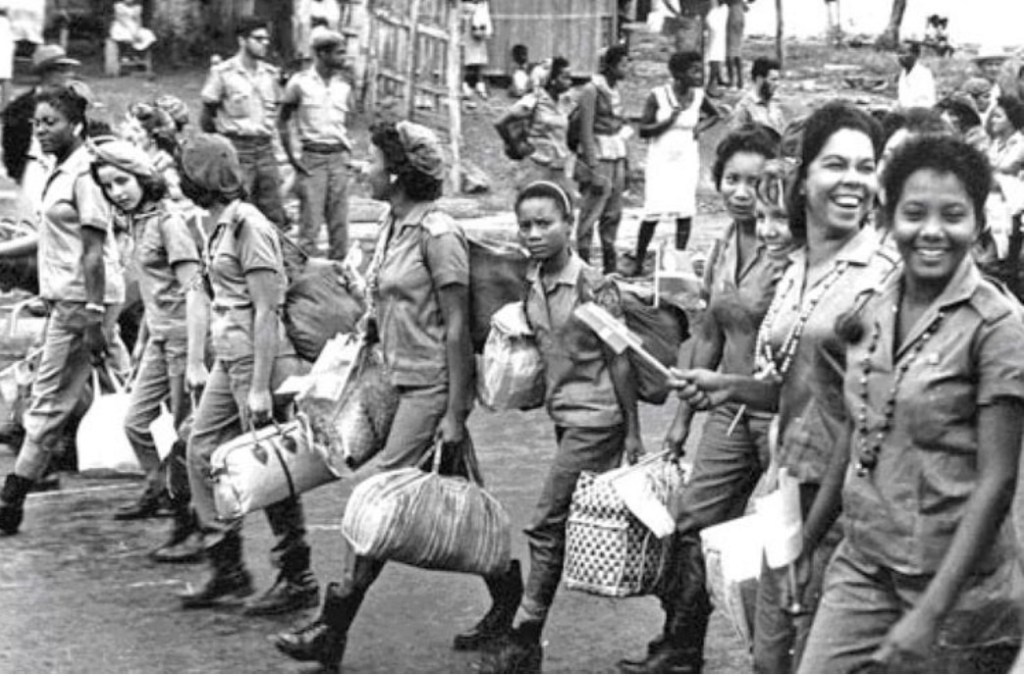
A Personal Prayer of Cuba

by ©️Leslye Joy Allen

The following below that is written in italics is partially a meditation on Cuba. It is a response I wrote to a piece about Cuba’s current crisis exacerbated by American neglect and cruelty that was written by Arturo Dominguez. A link to his exceptional article is at the very end of this essay. What’s in italics is a rumination I wrote to Arturo:

“I still remember reading that when Afro-Cuban musical artists came to perform in the United States that they had to perform in the U.S. for free. When asked why they were willing to perform for nothing, the answer was always the same: “We want to see where Dizzy Gillespie was born.”

Thanks for this report Arturo Dominguez because every time there is a sanction, a deprivation, I am reminded that no one suffers in Cuba but the people themselves. I still remember the heinous and wretched Helms-Burton Act which banned ships who docked in Cuba’s ports from docking in the United States for several months.

I remember my professors having to fly out of Atlanta to Canada and then taking a flight from some airport in Canada to Havana to do whatever research they were performing on their visits.

The United States has done nothing but made an example of Cuba as a message to other countries in Latin America and the Caribbean that says “This is how far we’ll go; this is how bad we’ll treat you, if you don’t fall in line.”

I might just turn this comment into a meditation.”

A few moments after reading Arturo’s essay I stumbled on one of my favorite thinkers Vijay Prashad who also was offering his thoughts on the viciousness of the United States government against the Cuban people because it is the people that suffer—No one else. (A link to Vijay’s essay is at the end.)
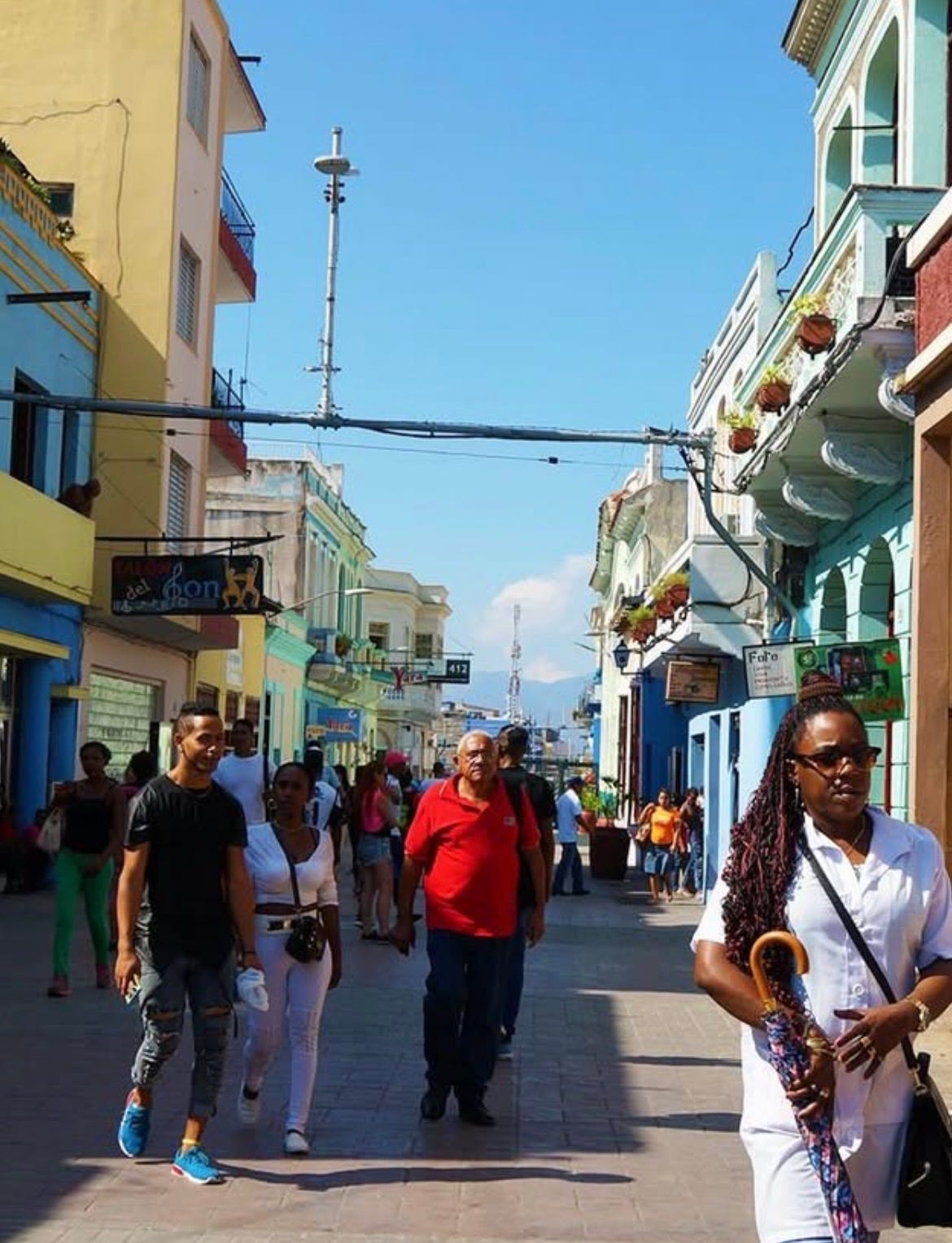
I don’t have the strength to comment on Prashad’s piece right now except that it is brilliant and accurate. I will leave it to you dear reader to examine both his and Arturo’s essays at your leisure. I have only one thing to say.

One line of my paternal family was sold as slaves from Santiago de Cuba to the mainland United States during the period of slavery in this Western hemisphere. My paternal great grandmother was born a slave named Mollie Laws. Her previous family surname was Layende. 

Like most people during the 1700s and 1800s, when one moved (or was sold) some place else the last name was changed to adapt to the new culture one was inhabiting. In the United States, it was typically expected that you Anglicize your name to something that English speakers could pronounce. So “Layende” became “Laws.”

Anyhow I used to relay my personal history to my History students in an effort to make sure that they understood that Chattel slavery took place throughout the Western world. Importantly, what we now call the United States received less than 6 percent of all the Africans transported to this hemisphere during the trans-Atlantic slave trade. The majority of Africans (around 95 percent) landed in what is now named Latin America and the Caribbean. 

I don’t have any deep analysis here about how difficult Afro-American genealogy can be. I don’t have any deep commentary about the many cultures and cultural differences that exist between all of the descendants of Africa who occupy this hemisphere except I have always known that for better or worse I belong to them.

Right after I read Arturo’s essay and then Vijay’s essay, I recalled a favorite memory from the classroom. A student whose name escapes me now came to class after Spring Break with a faded photograph he took while out on the Atlantic ocean. 

He learned that I had roots in Cuba and so did he. He pulled out this faded photo taken on the water. Far off in the distance I saw something that looked like a line stretched across the water. 

“What is that long line in the water that I see in the distance?,” I asked. 

That line across the water in the distance is Cuba, Ms. Allen. I hope you get there someday.” 

©️Leslye Joy Allen

I am an Independent Historian, Oral Historian and Dramaturge. Please consider supporting my work and research with a few bucks for Coffee and Eggs via my CashApp or become a paid subscriber to me on Substack to help me sustain my research.

All blogs written by Leslye Joy Allen are protected by U. S. Copyright Law and licensed under a Creative Commons Attribution-NonCommercial-NoDerivs 3.0 Unported License. Any partial or total reference to any blog authored by Leslye Joy Allen, or any total or partial excerpt of any blog authored by Leslye Joy Allen must contain a direct reference to this hyperlink: https://leslyejoyallen.com with Leslye Joy Allen clearly stated as the author.  Postings or blogs placed here by other writers should clearly reference those writers.  All Rights Reserved.

Hyperlinks to additional articles are below photos.
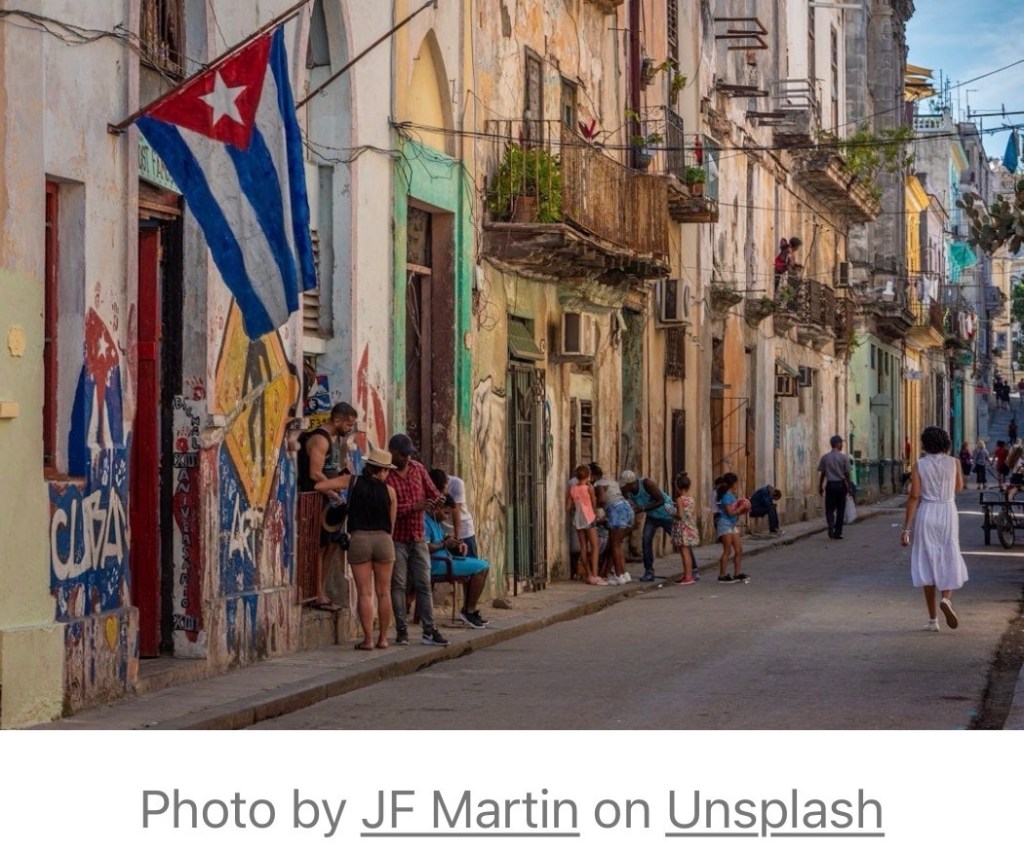
(from Analysis: Cuba on the Brink)

(from Why is the United States Afraid of Cuba?)

Ms. Allen’s U. S. History 2110: Songs of Social Consciousness and Protest, 1960s to 1980

By Leslye Joy Allen                                                                                                     Historian, Educator, Theatre and Jazz Advocate & Consultant, Ph.D. Candidate

Copyright © 2013 by Leslye Joy Allen.  All Rights Reserved.

One of the fun things about teaching history is not only helping young people discover new ideas, but also having them help you, the instructor, re-discover some of those ideas.  One of the things we did as a class this semester was revisit some of the music of the early 1960s up to 1980 that had socially conscious and/or protest lyrics.  Many of the songs on the following list were songs that I personally remembered and contributed.  Yet, many of the songs were discovered by several of my students, along with a few suggestions by a few friends.  My students and I had a good laugh about how some people upload music to YouTube in violation of copyright law.  Yet, we all agreed that when one video or recording of a song was removed, another video would take its place.  So, if any of the hyperlinks below have become inactive, I can only encourage you to do a quick search for the title of the song and/or artist.

My musical repertoire dates back to before Ragtime, thanks to my late birth to parents who were much older than the average age for first-time parents, and who were late born babies themselves.  I was tempted to create a mammoth song list that touched on every possible social or political concern for the last hundred years. This list is hardly comprehensive or even representative of all the music that I know of that can be counted as having lyrical content that speaks about some social or political issue.  Yet, it remains a great list when one considers that the music represented here is much, much older than the majority of my history students and that these songs still have relevance and meaning.  Also, a comprehensive list would be too long to be useful.  The idea of this assignment was to get students to look up and listen to music and access other art forms and discover that all of these art forms are important cultural markers which help tell so many stories and contribute to the history of any given era.

Many of my students have commented that too much of the music today seems empty of meaningful content.   I agree.  So, below is the list in date, rather than alphabetical, order. I hope you enjoy what my students discovered; and I hope you will make your own lists of songs of social consciousness and protest and then introduce those songs, musicians, songwriters, and messages to some young person that you know.  You may even learn something new in the process.  Peace.

(1962) “The Death of Emmitt Till” by Bob Dylan: http://www.youtube.com/watch?v=RVKTx9YlKls

(1963) “Masters of War” by Bob Dylan: http://www.youtube.com/watch?v=Mvr72uTd7kc

(early 1960s**) “Ain’t Gonna Let Nobody Turn Me Round” by Sweet Honey in the Rock: http://www.youtube.com/watch?v=c5Z1trynEHs  (**Many singers have sung “Ain’t Gonna Let Nobody Turn Me Round.”  It remains a Traditional Negro Folk Song, adapted by the SNCC Freedom Singers, who began singing it at rallies in the early 1960s.  Dr. Bernice Johnson Reagon, who founded the vocal group “Sweet Honey in the Rock” was an original member of the Freedom Singers.  The version above is a more recent version that she and the members of Sweet Honey in the Rock recorded for a PBS Series titled “Soundtrack for a Revolution.”)

(1963**) “Cotton Fields” by Odetta: http://www.youtube.com/watch?v=tXQDgqXnaT8 (**Odetta recorded this song live with Lawrence Mohr in 1954.  Yet, she released this studio-recorded version in 1963)

(1964) “Mississippi, Goddamn” by Nina Simone: http://www.youtube.com/watch?v=fVQjGGJVSXc

(1965) “I Ain’t Marching Anymore” by Phil Ochs: http://www.youtube.com/watch?v=gv1KEF8Uw2k

(1965) “Draft Dodger Rag” by Phil Ochs: http://www.youtube.com/watch?v=tFFOUkipI4U (This song has some very humorous lyrics.  It quickly became one of the anthems of the Anti-Vietnam Movement).

(1965) “People Get Ready” by The Impressions (featuring Curtis Mayfield): http://www.youtube.com/watch?v=l04yM7-BWbg

(1966) “Love Me, I’m A Liberal” by Phil Ochs: http://www.youtube.com/watch?v=u52Oz-54VYw

(1967) “We’re a Winner (Movin’ on Up)” by The Impressions (featuring Curtis Mayfield): http://www.youtube.com/watch?v=uLMRzDFMvEo

(1968) “Say It Loud, I’m Black and I’m Proud” by James Brown: https://www.youtube.com/watch?v=j0A_N-wmiMo

(1968) “Why? (The King of Love is Dead)” by Nina Simone: http://www.youtube.com/watch?v=Wh6R0BRzjW4

(1968) “Revolution” by The Beatles: http://www.youtube.com/watch?v=u2LKMogdjm8

(1969) “Freedom” by Richie Havens: http://www.youtube.com/watch?v=rynxqdNMry4

(1969) “Choice of Colors” by The Impressions (featuring Curtis Mayfield): http://www.youtube.com/watch?v=SNV1Y01xNk8

(1970) “Young, Gifted and Black” by Nina Simone: http://www.youtube.com/watch?v=PEMOxRxcJpo 

(1970) “War” by Edwin Starr: http://www.youtube.com/watch?v=dQHUAJTZqF0

(1970) “Ball of Confusion” by The Temptations: http://www.youtube.com/watch?v=JWtIvoub6XU 

(1970) “If There’s Hell Below, We’re All Gonna Go” by Curtis Mayfield: http://www.youtube.com/watch?v=l2cTc7DofrA&list=PL1AE86EA721372D55

(1970) “Heaven Help Us All” by Stevie Wonder : http://www.youtube.com/watch?v=_gOLnLz9KjY

(1971) “Bring the Boys Home” by Freda Payne: http://www.youtube.com/watch?v=–fFhunuUJM

(1971) “People Make the World Go Round” by The Stylistics: http://www.youtube.com/watch?v=8EDUBOGTVv0  (One of my students was amazed by the remarkably high falsetto voice of the lead singer.  His name is Russell Thompkins.)

(1971) “Inner City Blues (Make Me Wanna Hollar)” by Marvin Gaye: http://www.youtube.com/watch?v=X1uelY2SGmw

(1971) “What’s Going On?” by Marvin Gaye: http://www.youtube.com/watch?v=H-kA3UtBj4M

(1971) “Mercy, Mercy Me (The Ecology)” by Marvin Gaye: http://www.youtube.com/watch?v=EMuWmU1iNJo

(1972) “King Heroin” by James Brown: http://www.youtube.com/watch?v=NoLrrnXiRCk

(1972) “I’m Just Another Soldier” by The Staple Singers: http://www.youtube.com/watch?v=BdoPI3fjwMI

(1972) “I’ll Take You There” by The Staple Singers: http://www.youtube.com/watch?v=xO0Q3192Jrs

(1973) “We Were all Wounded at Wounded Knee” by Redbone: http://www.youtube.com/watch?v=2VB2LdOU6vo  (This song was only released in Europe in 1973.  It was released much later in the USA on a compilation.  Redbone was the only Native American Soul/Pop group to have a hit record during the 1970s.  That hit song was released in 1974 and titled “Come and Get Your Love.”)

(1973) “I Can’t Write Left-Handed” by Bill Withers: http://www.youtube.com/watch?v=l6qhfY-aLnk (This song was recorded live at Carnegie Hall in 1972 and released in 1973 on the album Bill Withers at Carnegie Hall.)

(1973) “Someday We’ll All Be Free” by Donny Hathaway: http://www.youtube.com/watch?v=mDHmhBjl70o

(1973) “Fish Ain’t Bitin’” Lamont Dozier: http://www.youtube.com/watch?v=DXnv71BRXU0

(1973) “If You’re Ready” by The Staple Singers: http://www.youtube.com/watch?v=HanwLunJau0

(1975) “I Am Woman” by Helen Reddy: http://www.youtube.com/watch?v=Zu4xpDuf84A

(1975) “Wake Up Everybody” by Harold Melvin & the Bluenotes (featuring Teddy Pendergrass on lead vocals): http://www.youtube.com/watch?v=-TDfPgd3Kyc

(1977) “A Real Mother For Ya'” by Johnny Guitar Watson: http://www.youtube.com/watch?v=IdTgyyUcAYQ

(1980) “At Peace With Woman” by The Jones Girls: http://www.youtube.com/watch?v=hGa8dK9GILk

Leslye Joy Allen is a perpetual and proud supporter of the good work of Clean Green Nation.  Visit the website to learn more about it: Gregory at Clean Green Nation!

Copyright © 2013 by Leslye Joy Allen.  All Rights Reserved.
Creative Commons License This Blog was written by Leslye Joy Allen and is protected by U. S. Copyright Law and licensed under a Creative Commons Attribution-NonCommercial-NoDerivs 3.0 Unported License.  Any partial or total reference to this blog, or any total or partial excerpt of this blog must contain a direct reference to this hyperlink: http://leslyejoyallen.com with Leslye Joy Allen clearly stated as the author.