Dads and Public Spaces

by ©️Leslye Joy Allen

When I was a little girl I went everywhere my Daddy. I often had solo trips to a store, a library, and the park with my school teacher Mama too, but I was a Daddy’s Girl. I remember when it was just the two of us and I had to use the restroom, Daddy and I would often run into a woman who was a friend of our family and she would take me into the women’s restroom so I could do my business.

On many occasions when I was small and I had to use the restroom, Daddy would place his hands over my eyes, walk into the men’s restroom and yell, “Father coming in with his daughter; zip it up or hide it!” He would find a stall with a door, line the toilet seat with paper and then sit me on it. 

I bring this up because public spaces like restrooms were not designed for fathers and daughters nor fathers with infants. A mother could take her little ones of any gender and age into the women’s restroom. Dads could certainly take sons into the men’s restroom. My Daddy, like so many other Black fathers I knew defied the limitations of public spaces. He never once said that he couldn’t take me with him somewhere because he wasn’t sure if I could use the restroom. 

If you are one of my subscribers on Substack, you have probably seen a few videos on my feed of The Library Dads, which is a non-profit organization that has scheduled weekly library visits for Dads with their children at the public library. It was founded in Atlanta by a young father named Khari Arnold who took his 4-month-old daughter to the library to familiarize her with books. That was her first of many visits.

Arnold noticed a strikingly advanced development of his daughter’s cognitive skills over the course of a year because he read to her all the time. This program is designed to help fathers become involved in the educational and literacy development of their children; and to deepen their bonds with their children. That’s Khari Arnold on the far left in the top photo.
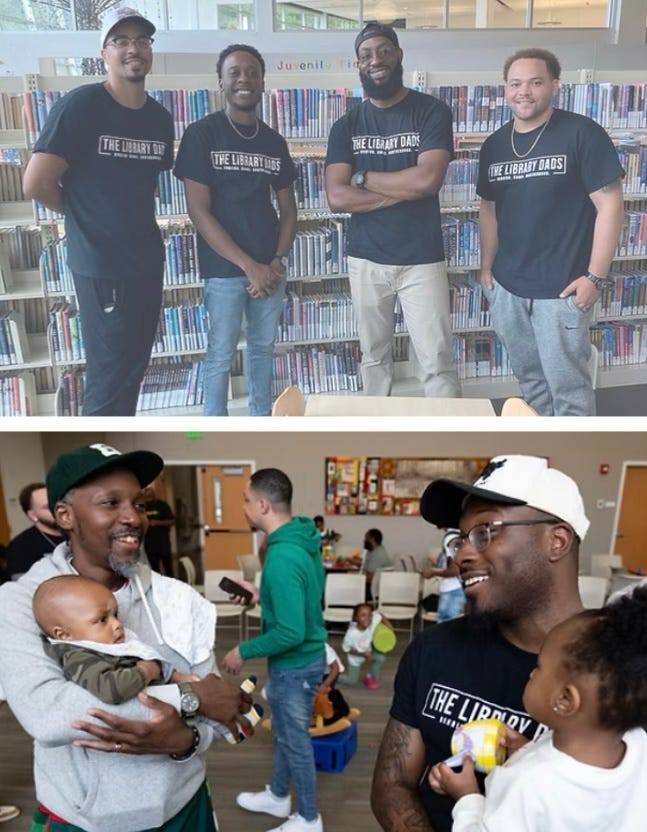
What struck me about The Library Dads was not just their active engagement with their offspring every Saturday at the public library, but also their pushback against the limits of certain public spaces that are less accommodating for fathers and their small children.

My Mama and Daddy took me to the library regularly as did many of the Black parents I knew growing up. I know they both would be impressed with The Library Dads for a variety of reasons. Yet, I must add one more reason that helps us all… 

In addition to these young men taking responsibility for their children’s education and development, they also shift the narrative that tends to center on mothers as almost solely responsible for their children’s development. They are a most welcome pushback on the confining and inaccurate gender definitions that the Western world imposes on us all. Go Library Dads!

©️Leslye Joy Allen

I am an Independent Historian, Oral Historian and Dramaturge. Please consider supporting my work with a few bucks for Coffee and Eggs via my CashApp.

You can also subscribe to my writings on Substack and stay in the loop with the best new research, history, journalism, prose, poetry, and etcetera.

All blogs written by Leslye Joy Allen are protected by U. S. Copyright Law and licensed under a Creative Commons Attribution-NonCommercial-NoDerivs 3.0 Unported License. Any partial or total reference to any blog authored by Leslye Joy Allen, or any total or partial excerpt of any blog authored by Leslye Joy Allen must contain a direct reference to this hyperlink: https://leslyejoyallen.com with Leslye Joy Allen clearly stated as the author.  Postings or blogs placed here by other writers should clearly reference those writers.  All Rights Reserved.
Threading Grandma’s Needles, and Kamala Harris

by ©️ Leslye Joy Allen

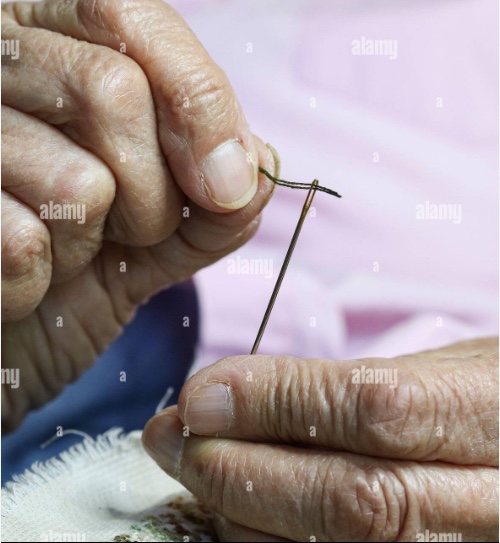
When I was a small girl around the age of 4 or 5, my maternal grandmother would often ask me to thread her needle. I was a late born baby to my parents and Grandma was well into her seventies when I was born.

Grandma was a scholar who read a couple of books a week. I knew instinctively that the reason why she asked me to thread her needle was because the eye of a sewing needle is narrow and often hard to see. The best pair of eyes could have trouble getting that thread through that tiny eye. By the time I was around 4 or 5, Grandma was in her eighties, and I enjoyed doing what I could for my Grandma.

(Stock photo of an elderly woman’s hands threading a needle, Alamy)

Grandma’s eyes were not as steady as they once were; and neither were her hands. But once that needle was threaded, she could sew up a storm. As I have now passed the age of 60, it now takes me damned near 15 minutes to thread a needle. But you do what you can and what you have to do. This brings me to another observation.

For several months this year, after I rolled my herbie-curbie (that’s the name for our garbage cans on wheels in Atlanta) to the curb of my driveway, I arrived back home and instead of my herbie-curbie being left at the curb of my driveway as is customary, someone had rolled it all the way up to the gate to my backyard so I wouldn’t have to retrieve it.

Last week, I was home when the sanitation workers were out. Before I exited my door to retrieve my herbie-curbie, I saw my 20-something neighbor who is autistic grab its handle and roll it up to my gate. He went from house-to-house doing the same thing—saving his older neighbors the trip to the end of the curb.

I bring this up because when I finally saw who was doing this favor on his own, it dawned on me that he was doing what he could do to assist his neighbors.

Then I thought about all of these folks barking about where is Kamala Harris? During the first wave of complaints, she was actually in fire-ravaged California assessing damage, talking with the mayor and governor and firefighters, and assisting her neighbors who had lost their homes.

The second wave of complaints came recently. Now, I have already said that Harris is a private citizen and has done her duty while so many others fail to do so much as contact their representatives and complain.

What is most annoying is the manner in which folks have complained. I watched Harris lose weight on the campaign trail after being given a near-impossible task of organizing a campaign in just over 100 days after a stubborn Joe Biden took his sweet time stepping aside when so many of his colleagues begged him to do so.

I have also been around white women who felt like I was their property and who felt like I was obligated to do whatever they requested, and were insulted when I said “No” even when my work or school schedule and obligations would not permit me to accommodate them.

I have been around men (black and white) who treated me the same way. That is an unfortunate experience that Black women have endured ever since we have been here in this country. We are not supposed to have own lives, but we are supposed to stand ready to salvage somebody else’s. Wedged between battling racism and sexism and misogynoir simultaneously, we are often left hanging when we are having problems.

Instead of these complainers interrogating the majority of white women and men who voted for Felon 47, they want Harris out there speaking for them. And if she did, you know good and damned well Felon 47 and his minions, along with his bought-and-paid-for news rooms would paint her as a “Sore Loser” while his dumb-as-cat-shit voters nodded in agreement while he continued to pick their pockets and threaten their livelihoods. Unlike my sweet autistic neighbor, they do not do what they can but they expect someone else to do it.

Instead of bothering to contact Kamala Harris’ office or website or her page on IG to ask her a question, they went on a rampage of demands. They don’t even know what she might be doing behind the scenes.

So, let me share this bit of my history. I represent only the third generation of my families not born into slavery. I will leave you with what my paternal Great Grandmother said to her mistress who just couldn’t believe Great Grandma would want to leave her mistress and be free. With a nap sack on her shoulder, and right before she went searching for her other siblings who had been sold to other slave owners, she said the following:

“You can do your own work and you can pick your own cotton.”

©️ Leslye Joy Allen

I am an Independent Historian, Oral Historian and Dramaturge. Please consider supporting my work with a few bucks for Coffee and Eggs via my CashApp.

All blogs written by Leslye Joy Allen are protected by U. S. Copyright Law and licensed under a Creative Commons Attribution-NonCommercial-NoDerivs 3.0 Unported License. Any partial or total reference to any blog authored by Leslye Joy Allen, or any total or partial excerpt of any blog authored by Leslye Joy Allen must contain a direct reference to this hyperlink: https://leslyejoyallen.com with Leslye Joy Allen clearly stated as the author.  Postings or blogs placed here by other writers should clearly reference those writers.  All Rights Reserved.

Race and Reproductive Rights

by ©️Leslye Joy Allen

I remember a conversation with my late cousin Billie Allen, who was an actor, dancer and stage director. She was here in Atlanta in 2003 directing her close friend, actor Ruby Dee in “Saint Lucy’s Eyes,” a play written by Bridgette Wimberly.

The play was about a woman who performed back room abortions for young women who were in serious trouble. The protagonist named “Old Woman” performed abortions out of mercy and out of a sense that those pregnant women were having their futures derailed by unplanned pregnancies.

Billie mailed me a copy of the play before it came to Atlanta’s Alliance Theatre, and not long after it had a successful off-Broadway premiere at New York’s Women’s Project Theater in 2001. Turning me into her personal dramaturge again, she and I discussed the hot topic of abortion. Then she shared with me something I did not know.

She told me that back in the 1940s and 1950s, when a Hollywood actress became pregnant and had too many professional and contractual obligations to a studio, she typically went to Puerto Rico to have an abortion.

I soon learned that in 1937, the Puerto Rican legislature made abortion and contraception legal. It also made sterilization legal. That’s the kicker—sterilization. An island with a population of people, many of who have Indian, African, and Spanish ancestry were often seen as expendable.

Puerto Rico’s legislature voted with all of the eugenicist and racist taint that emanated from the United States’ highly racist sterilization programs that were completely in line with the eugenics (racial cleansing) going on in Nazi Germany.

I mentioned to Billie that I had seen a short documentary called “La Operación,” by Ana María García back in the early 1980s. It was a documentary about how people involved with “population control” arrived in Puerto Rico in the 1950s and 1960s and sterilized about a third of the island’s women who were of childbearing age.

While there were certainly Puerto Rican women who no longer wanted to have more children, many women were sterilized without knowing exactly what was being done to them.

Puerto Rico was the location of where the first large scale trials of birth control pills took place before “the pill” debuted in 1960 in the United States. Various pills were first tested on a tiny group of women in Boston. Yet, the largest group of clinical guinea pigs were Puerto Rican women; other women of color in the Western hemisphere soon followed.

In 1933 Margaret Sanger, long heralded as a leader in the birth control movement, wrote in Birth Control Review that “Eugenic sterilization is an urgent need …We must prevent multiplication of this bad stock.” People of color were the bad stock.

In 1939 in a letter to Dr. Clarence Gamble, one of the architects of the United States’ eugenics movement (and heir to the Proctor & Gamble fortune), Sanger wrote that they should use Black male ministers to appeal to Black women to get them to agree to be sterilized. She sought to use Black women’s typical deference to Black clergy to accomplish her mission.

By 1955 biologist Gregory Pincus visited Puerto Rico and found it the best location to test birth control pills. After all, the island had no laws preventing contraception. Pincus and his partner John Rock, a gynecologist, promoted their work as poverty-prevention by making it possible for poor Puerto Rican women to have fewer babies.

And here we cisgender women are right now in 2025. We all worry about losing the right to make decisions about our own bodies; and we should. Yet, early birth control and abortion initiatives were never about women having the right to make their own reproductive choices.

The primary objective was to slow or stop the biological reproduction of any woman who did not belong to an accepted class or status of women classifiable as “white.”

Without fully understanding the racist origins of the state’s reproductive control over women, you will miss its original intent. Reproductive procedures, no matter how necessary they are, remain a political football; and Puerto Rican women, and other women of color were its first sacrifices.

©️Leslye Joy Allen

I am an Independent Historian, Oral Historian and Dramaturge. Please consider supporting my work with a few bucks via my CashApp.

My copy of the script of “Saint Lucy’s Eyes,” and one of several promotional posters for “La Operación.”

All blogs written by Leslye Joy Allen are protected by U. S. Copyright Law and licensed under a Creative Commons Attribution-NonCommercial-NoDerivs 3.0 Unported License. Any partial or total reference to any blog authored by Leslye Joy Allen, or any total or partial excerpt of any blog authored by Leslye Joy Allen must contain a direct reference to this hyperlink: https://leslyejoyallen.com with Leslye Joy Allen clearly stated as the author.  Postings or blogs placed here by other writers should clearly reference those writers.  All Rights Reserved.

Pawns and Queens: Analogies For a New Era

by ©️Leslye Joy Allen

We historians often find data in some file in an obscure archive, in letters written by someone’s grandmother, in photos, newspaper clippings, legal records. Our discipline demands that we dig, analyze, rethink and revise, constantly. I liken our work to studying the function of each piece in a Chess game. We get different perspectives about the same set of circumstances depending on which Chess piece we examine.

I was a mediocre Chess player. I had a few friends who played like champions. So, I often just watched them play. I remain, however, fascinated by the game’s objectives and, specifically, the roles of Pawns and Queens.

Pawns are the most numerous pieces in Chess; they are the foot soldiers. Each player has eight Pawns. A Pawn can move one or two squares forward if that move is its first move. After the first move, a Pawn can only move one square forward unless the square is blocked by some other piece. A Pawn can capture or attack another piece, however, by moving diagonally to the left or right.

The Pawn is the only piece in a Chess game that can change ranks. Depending on the skill of a Chess player, a Pawn can become a Bishop, a Rook or a Queen. In spite of a Pawn’s ability to advance to a higher rank, it is still considered the lowest ranking piece in the game. It is only worth one point.

The objective of the game is to capture your opponent’s King where that King has no way out, which means Checkmate. While the King is considered the most important piece in the game, it is the Queen that is considered the most powerful piece.

Queens are the only pieces that can move across the board in any manner as long as they are not successfully blocked by other pieces. If you lose, it is highly likely that you lost because your opponent’s Queen checkmated your King. Chess players feel much more confident when they have successfully captured or blocked her.

You can still win the game without capturing the Queen, but you have to be extremely strategic and precise to do so. You can also win without making good moves with your Pawns, but it is highly unlikely.

Chess is now over 1,500 years old. While there is some skepticism about its precise origins, many Chess historians believe that the Indian board game called “Chaturanga” was the earliest predecessor of Chess. There were many other versions that followed, but are too numerous to mention here.

In early versions of Chess, there was a piece called “Vizier” or “Advisor” for centuries. In the 1500s, in the era of great and powerful Queens in Europe, like Spain’s Isabella and England’s Elizabeth, “Viziers” or “Advisors” were redesigned and renamed “Queens.” You can learn an awful lot of world history just by examining Chess.

So here’s the deal: There is no such thing as a Chess game where Queens/Women Heads of State/Women in general are not powerful and flexible while the Kings/Men Heads of State/Men in general are highly important but who have or exercise fewer tactical moves.

There is also no such thing as a Chess game where Pawns/Foot Soldiers/Laborers are not essential to success, even while they are considered less important.

Apply any and all of the above to what you see happening in the United States and the world right now. I refuse to tell you how to analyze and interpret this history because there are so many interpretations and analogies that can be extrapolated from this board game.

All I will say is that nothing is going to change or be corrected without the skill of devoted Pawns, and the power and daring of Queens.

©️Leslye Joy Allen

Shutterstock photo of a Pawn and a Queen on a Chessboard.

All blogs written by Leslye Joy Allen are protected by U. S. Copyright Law and licensed under a Creative Commons Attribution-NonCommercial-NoDerivs 3.0 Unported License. Any partial or total reference to any blog authored by Leslye Joy Allen, or any total or partial excerpt of any blog authored by Leslye Joy Allen must contain a direct reference to this hyperlink: https://leslyejoyallen.com with Leslye Joy Allen clearly stated as the author.  Postings or blogs placed here by other writers should clearly reference those writers.  All Rights Reserved.

Barbara Lee, Her Terms

by ©️Leslye Joy Allen

I was nearing 12 years old when Barbara Lee’s mentor Shirley Chisholm ran for president. The young Barbara Lee was in college then and a single mother when she worked on Chisholm’s campaign. Kamala Harris was nearing 8 years old.

Shirley Chisholm knew that as a Black American woman with roots in the West Indies that she was not likely to win the nomination for president from the Democratic Party.

Yet, Chisholm knew that if we Black Democrats stuck together we could put some real teeth in the Democratic Party platform that ultimately nominated George McGovern, who lost.

Black Congressmen like Walter Fauntroy and Ronald Dellums cut back room deals and ultimately sold Shirley Chisholm out in order to win and/or maintain favor with white men who ran the Democratic Party. Do not bother to be surprised.

When Black American men have access to white men with power, they rarely give up that access in order to stand with any Black woman…and ALL Black women know this by instinct and from experience.

Chisholm ultimately forgave Dellums’ betrayal; and then Dellums gave Barbara Lee an internship in his office which she parlayed into a successful congressional run for Dellums’ old district which was once California’s 9th, now the 12th District.

Much later, I remembered Congresswoman Lee as being the only member of the Congressional Black Caucus (CBC) that voted against giving then-president George W. Bush the right to invade Iraq shortly after this country endured the tragedy of 9/11.

Lee knew, like most folks with any degree of sense, that Iraq’s Saddam Hussein had nothing to do with the terrorists that struck the Twin Towers on 9/11.

One of the ugliest confrontations I ever had with my then-Congressman John Lewis occurred not long after he, along with the rest of the CBC, voted to grant Bush the power to invade Iraq. I called Lewis a traitor to his face and accused him of violating every principle Martin Luther King, Jr. ever taught him.

“You didn’t even bother to ask for a vote on this!,” I said. I love/d the late John Lewis, but he and the rest of the CBC, were dead wrong for abdicating their duties as representatives in order to grant a sitting president the right to invade another country. The next time I saw him, we hugged. He was feeble. Soon after that last hug, he was gone.

I remember that Congresswoman Barbara Lee had to have extra security because she did not vote in favor of such an invasion in a climate where Americans wanted to feel like we were going after our real enemies.

Instead, Lee used her conscience and common sense, knowing full well that she would be re-elected to her district no matter how she voted. Just imagine if our representatives had enough of a spine to hold on to their principles and to the knowledge that their constituents are in their corner?

Back when Lee took this stand, I was working part-time at my alma mater Agnes Scott College. As the nation was bracing for the possibility of sending US Troops to Iraq, the Agnes Scott College community was having regular talks about the potential for war.

When a faculty member worried that we were heading to war and that there was nothing we could do, I just couldn’t stand that phrase “there’s nothing we can do.”

I said, “You can send a letter of support to California Congresswoman Barbara Lee.”

I have never regretted that suggestion.

©️ Leslye Joy Allen

All blogs written by Leslye Joy Allen are protected by U. S. Copyright Law and licensed under a Creative Commons Attribution-NonCommercial-NoDerivs 3.0 Unported License. Any partial or total reference to any blog authored by Leslye Joy Allen, or any total or partial excerpt of any blog authored by Leslye Joy Allen must contain a direct reference to this hyperlink: https://leslyejoyallen.com with Leslye Joy Allen clearly stated as the author.  Postings or blogs placed here by other writers should clearly reference those writers.  All Rights Reserved.