When I was a little girl I went everywhere my Daddy. I often had solo trips to a store, a library, and the park with my school teacher Mama too, but I was a Daddy’s Girl. I remember when it was just the two of us and I had to use the restroom, Daddy and I would often run into a woman who was a friend of our family and she would take me into the women’s restroom so I could do my business.
On many occasions when I was small and I had to use the restroom, Daddy would place his hands over my eyes, walk into the men’s restroom and yell, “Father coming in with his daughter; zip it up or hide it!” He would find a stall with a door, line the toilet seat with paper and then sit me on it.
I bring this up because public spaces like restrooms were not designed for fathers and daughters nor fathers with infants. A mother could take her little ones of any gender and age into the women’s restroom. Dads could certainly take sons into the men’s restroom. My Daddy, like so many other Black fathers I knew defied the limitations of public spaces. He never once said that he couldn’t take me with him somewhere because he wasn’t sure if I could use the restroom.
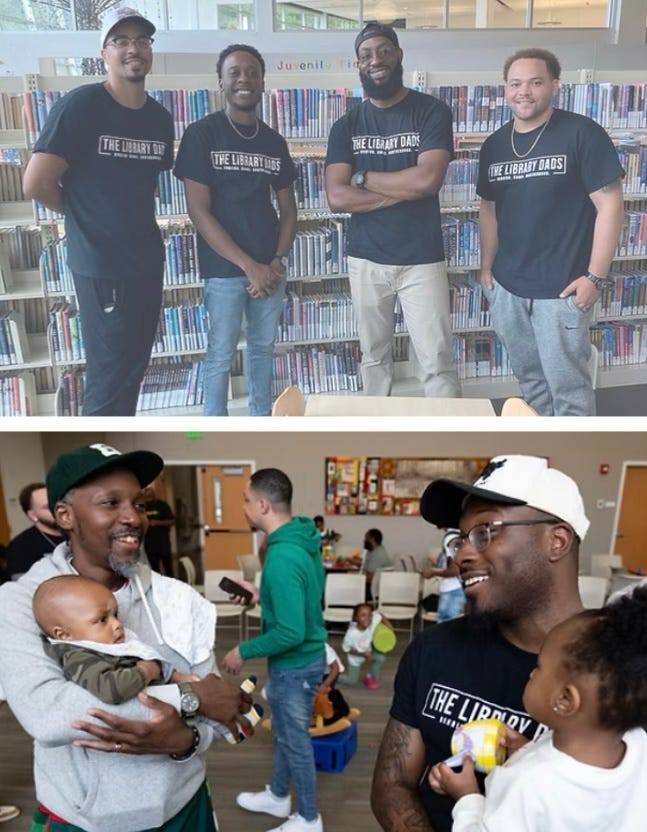
If you are one of my subscribers on Substack, you have probably seen a few videos on my feed of The Library Dads, which is a non-profit organization that has scheduled weekly library visits for Dads with their children at the public library. It was founded in Atlanta by a young father named Khari Arnold who took his 4-month-old daughter to the library to familiarize her with books. That was her first of many visits.
Arnold noticed a strikingly advanced development of his daughter’s cognitive skills over the course of a year because he read to her all the time. This program is designed to help fathers become involved in the educational and literacy development of their children; and to deepen their bonds with their children. That’s Khari Arnold on the far left in the top photo.
What struck me about The Library Dads was not just their active engagement with their offspring every Saturday at the public library, but also their pushback against the limits of certain public spaces that are less accommodating for fathers and their small children.
My Mama and Daddy took me to the library regularly as did many of the Black parents I knew growing up. I know they both would be impressed with The Library Dads for a variety of reasons. Yet, I must add one more reason that helps us all…
In addition to these young men taking responsibility for their children’s education and development, they also shift the narrative that tends to center on mothers as almost solely responsible for their children’s development. They are a most welcome pushback on the confining and inaccurate gender definitions that the Western world imposes on us all. Go Library Dads!
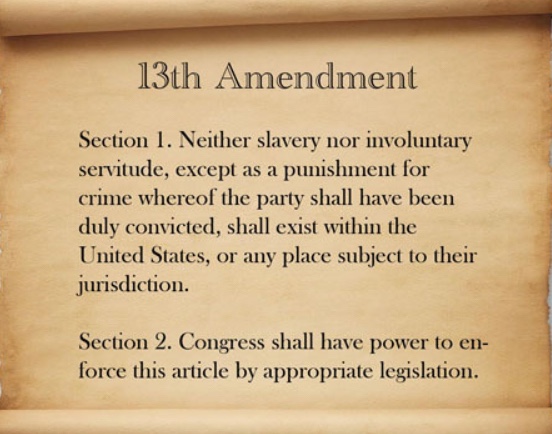
The first time I taught a US History class, I had my students study the wording of the 13th Amendment of the US Constitution and debate whether or not slavery had actually been abolished or had it simply been reconstructed:
“Section 1. Neither slavery nor involuntary servitude, except as a punishment for crime whereof the party shall have been duly convicted, shall exist within the United States, or any place subject to their jurisdiction.
Section 2. Congress shall have power to enforce this article by appropriate legislation.”
By the time master filmmaker Ava DuVernay finished her documentary 13th, I was salivating with anticipation. She did not and never does disappoint. She traced the origins of that loophole in the 13th Amendment that allowed for servitude to be imposed for crimes well into the 21st century.
Slavery had/has gone away in some form. Yet, one of my favorite Black judges, the late New York Supreme Court Judge Bruce M. Wright noted the awful way Black and Brown defendants were treated. Wright earned the nickname “Turn ‘Em Loose Bruce” because he had witnessed one too many Black men and women end up in court because they stole something trying to feed their families only to be sentenced to anywhere from 10 to 20 years in prison. So, Wright gave them some minimal punishment, but he often turned them loose.
I remember his description of a case where a Black man had an extremely sick wife. Neither he nor his wife could afford her medicine. So, in desperation, the man stole a television set from the hotel where he worked. He pawned the television to purchase his wife’s medications. This man had never committed a crime before in his life, but he was sentenced to 10 years in prison.
Now here’s the next rub. For people old enough to remember, the only thing we knew for sure about prisoners when we were growing up was that prisoners pressed license plates. Well, folks that isn’t true anymore. Now American prisoners make…Clothing, Computers, Electronics, Furniture, and all that discounted stuff you find at Walmart and Target. US prisons generate anywhere from 2 to 5 billion a year in profit while prisoners who do the work never earn the standard minimum wage.
So, as you rightly fight for and ponder the fate of Kilmar Abrego Garcia, an American citizen who sits unlawfully in a jail in El Salvador, think about Felon 47 and El Salvador’s Nayib Bukele giving each other a high-five and talking about not returning individuals who are wrongfully detained while they also discuss building more prisons in El Salvador. I’m going to leave it right there.
In the past week or two there have been doctors saying how healthy Felon 47 is, along with Fund Managers openly wondering if he is insane. I have another hypothesis.
I don’t really think Felon 47 is insane, I think he is evil and crazy (there is a difference). I still remember when the late Dr. Frances Cress Welsing wrote that we have never scientifically studied “Evil.” She noted that at the Nuremberg Trials of Nazis where they were tried for “Crimes Against Humanity,” where they exterminated millions of Jews, Gypsies, Afro-Germans, LGBTQIA, and the Disabled, those Nazis were ruled to be perfectly sane by the world’s leading psychologists.
Now, I don’t want to make light of anyone’s mental health or this nation’s severe mental health crisis. Yet, every time some man does something horrible, particularly if he’s a white man, people speculate about his mental health instead of calling him the evil son-of-a-bitch that he is. I feel the same way about these school shooters who are overwhelmingly white and male who try to kill everybody they can, all because they can’t get a girlfriend.
Felon 47 is trying his best to get rid of every brown skinned person who migrated to the USA without giving any of them due process as he shreds all the basic tenets of our Constitution. He’s sending a majority of people who are not criminals off to other countries while his sycophants explain these actions as a part of keeping America safe. Short of putting them all into ovens to get rid of them the way Nazis would, he has ordered them all to an uncertain fate somewhere else in the world.
Everything Felon 47 is doing to immigrants and legal citizens, who happen to not be white, is going to make this nation a hundred times less safe. Go piss off the world and you will find out that the world is not majority white; it never has been.
People who voted for Felon 47 are also crazy and evil too—and dumb. Did this previous italicized sentence upset you a bit? Did it sound like I was unfairly vilifying an entire segment of the US population without giving them an opportunity to explain their choices or even redeem themselves? Well, I don’t give a damn because that is exactly what Felon 47 and his supporters are doing to immigrants, women, Black folks, Latinos, LGBTQIA, and the Disabled.
Felon 47 supporters voted for this; and even if some of them can prove they didn’t think Felon 47 would do all of this harm, no self-respecting Black or Brown person with half a brain is going to try to weed out who might be on their side from those who would kill or harm us. We have never had that kind of time to deal with anyone or anything that normalizes evil.
This essay is a revisit and an edit to a memory I wrote about 10 years ago, but a memory I hope might help someone else, particularly a Black or Brown woman.
Most of my encounters with police have been rare and routine. Most of the police officers I have dealt with have been courteous and helpful. I have made the occasional phone call about the neighbor whose dog has been running around the neighborhood terrorizing a few people. The police come out, speak with the offender, and the matter is resolved. Yet, I remember this incident…
A police officer discovered I had a “First Insurance Cancellation Suspension” on my driver’s license. For those of you born late in the 20th century, let me explain. An insurance cancellation suspension was common if you changed cars or changed insurance companies. You used to get a form in the mail from the Department of Motor Vehicles instructing you to record your new insurance or your new car. Occasionally, however, you might not receive the form by mail, and you could easily forget about it.
If your new car/new insurance data had not arrived at the Department of Motor Vehicles when you bought a new car or changed your car insurance, you could end up with this particular type of suspension. You typically had to go to the Department of Motor Vehicles, show them your new purchase, along with your new insurance card.
In what appeared to be a routine road check for driver’s license and insurance, the Decatur, Georgia Police held me for three hours only a few months after I purchased a car from my elderly uncle. This happened in the spring of 1998 when I was back in college to complete my Bachelor’s degree at Agnes Scott College.
After checking my Driver’s License number the officer stated that I had a “First Insurance Cancellation Suspension” on the car I previously owned. I showed him my new insurance card on the car I was driving. I knew I would have to straighten out the suspension before I drove any car again. Since I was about a mile from the campus, I asked him if he could radio the Agnes Scott College Police and have someone from that police department drive down the street, and pick me (and the car) up.
I explained that I would have my Mama come pick me up at Agnes Scott and we would go to the Department of Motor Vehicles and get the suspension problem cleared up.
“I’m not calling anybody,” he yelled. I pulled out my student ID. He said, “I don’t need that. Girl, get out of the car.” I was a grown woman then in my thirties; and while I might not have looked as old as my birth certificate said I was, I was nobody’s “girl.” I kept my mouth closed, but I am sure he sensed my displeasure.
I got out of the car and he instructed me to lie down in the street. When I asked why are you doing this? He told me to shut up. While I lay down in the street for over 30 minutes, he and another two officers pulled the back seat out of my car. They searched the trunk. If it had not been for the little old man that came out of his house to watch, I do not know what else might have happened. I was terrified, but I suffer from something my Mama used to call, “Your Daddy’s Disease.”
She said my father never showed fear when under pressure. I don’t show it either. Daddy always looked fearless, even menacing, when some horrible event was going on. Then later when everything was all over, he would fall apart, shaking and reaching for a good stiff drink. “That kind of thing can get you killed, Joy,” Mama said, “When someone expects you to be afraid, sometimes the worst thing you can do is look like you have no fear.”
This event was before everyone had a cellphone. A female police officer appeared and asked me if I wanted to call my Mama using her phone. The first police officer decided to write me a simple ticket for driving with a suspended license and he left me standing there in the street. He drove off.
That sweet little old man stood there and talked with me until Mama arrived. He told me he thought the Decatur police were doing some kind of sweep. “They’re looking for somebody that’s up to no good, and they’re tryin’ to find ‘em in these road blocks,” he said. Mama arrived in about 30 minutes and picked me up. My new best friend—that sweet observant little old Black man told me to leave my car where it was until the suspension problem was straightened out.
“Them SOBs are probably waiting somewhere watching and waiting for you to drive off so they can give you another ticket or take you to jail. I’ll watch your car until you get back,” he said.
Mama asked me how my clothes got so dirty. I lied and told her I slipped and fell. She would have had a heart attack if I told her what really happened to her only child. We headed to the Department of Motor Vehicles. The clerk handed me a simple form that I filled out citing that I no longer owned the previous vehicle and therefore had no insurance on that vehicle.
I had to write down the serial number and model of my current car and provide my proof of insurance. The clerk recorded my data and lifted my “First Insurance Cancellation Suspension.” All of this took about 20 minutes.
I did argue my case in traffic court. The police officer rolled his eyes at me as I explained in detail his refusal to call the Agnes Scott College police even after I showed him my student ID. I told the judge every detail and showed him my insurance card, the purchase of my car, and the statement from the Department of Motor Vehicles that lifted my insurance cancellation suspension.
To add as much injury as I could, I said, “I missed my Latin Class because of this!” The judge dismissed my case. I paid no fine. I was lucky. Yet, I sensed that what happened to me was not rare. This kind of treatment happens to women, and particularly Black women and women of color, with a frequency that many people do not want to admit.
Black women encounter more than our share of rudeness and physical intimidation from male police. This offending officer was Black. It’s easy to talk about racist cops, but it is not so easy to talk about SEXIST ones. And for the record, I don’t like Black men who are cops anymore than I like White men who are cops. Here’s the rub…
I consider myself to be an average size woman. By the time I was 50 years old, I managed to gain enough weight to make it to a whopping 135 pounds at 5 feet, 5 inches tall. At the time of this incident, I weighed only about 115 pounds. That police officer was at least 6’ 2” tall and weighed well over 200 pounds. He called me a girl. He told me to shut up. He did not throw me to the ground, Thank God. Yet, just imagine how easy it would have been for him to do so.
This is not a full book review. I don’t have the strength to do that right now. Yet, when you are a historian there are certain books that stay with you because they are so provocative. One of them is “Ordinary Men: Reserve Police Battalion 101 and the Final Solution in Poland” by Christopher R. Browning.
People often forget that the Holocaust in Nazi Germany didn’t just extinguish millions of Jews, but it also exterminated Afro-Germans, Gypsies, LGBTQIA, and people with disabilities. Anything or anyone that was viewed as defective was subject to be put to death. But that’s not exactly what I want to write about here.
The title of this book says it all. This battalion was charged with the duty of marching groups of Jews out to a ditch, having them lay in that ditch; then the battalion would shoot them to death.
The first time they carried out this heinous order, most of the men balked at having to carry out such an awful task. Several men vomited at the sight of the murders; others ran and went AWOL. Yet, most of the men stayed behind and followed their orders.
By the time I got to the end of this book, I was mortified. That same battalion that initially balked at killing Jews that were laid in a ditch now carried out the orders with precision and without blinking. They became professional killers doing a job, not men who once had some empathy, sympathy, and consciences.
We prefer to believe that most people cannot be manipulated and threatened in order to convert them into monsters under the appropriate circumstances. “Ordinary Men“ showed me that it was relatively easy to find and nurture the dark side of human beings.
Those of us who are fighting as hard as we can against the excesses and abuse of Felon 47 need to remember one thing—Felon 47 and the Muskrat are only TWO men. They cannot do what they are doing without willing accomplices.
Stay the course my Fellow Resisters. But watch the people around you and watch your back; and NEVER normalize or explain away bad behavior even when it’s yours.





 Leslye Joy Allen