The other day I told a friend about the year I got a chance to watch a Brown Thrasher build a nest in a tall shrub near my carport. I watched her pick up pine needles and leaves, and craft them together until a nest was in place.
I watched her sit on her eggs. Then later still, I heard the sound of chicks; and finally I saw her nudge them out of the nest. Her babies were gone. She left the nest as well. That nest stayed intact, however, for several years.
Then I remember when the late Dr. Sadye Young told me about her father who built whole houses without any floor plans. Although she was then a retired college professor, Dr. Young knew her way around a house. She had learned certain aspects of building because when she was a child, she often accompanied her father when he was building a home. My eyes brightened because my late maternal Uncle Frank could do the same thing.
Both of these men built foundations, installed plumbing, wiring, and etcetera without any floor plans. Neither of these men had college degrees. Both had been apprentices of carpenters, plumbers, and electricians. But neither of them set foot in a college classroom and majored in architectural engineering. Yet, the homes they built stood the test of time.
Dr. Young’s father and my uncle had something in common with each other and with that Brown Thrasher. They built homes from scratch. They relied on their observations, practice, and their skills, not on architectural drawings. That Brown Thrasher relied on her instincts.
The current state of affairs in this country is going to require all of us to go back to some basics that many of us have lost. We all have instincts, yet we no longer use them. My late maternal grandmother (born in 1886) could predict when it was going to snow simply by observing whole flocks of birds gathering.
We now rely quite heavily on gadgets and technology and self-appointed pundits to tell us everything. But real knowledge comes from reading, research, study, practice, listening, and observation. It is only when we do all of the above that we can trust our gut instincts again.
As Felon 47 attempts to destroy one institution after another, we better ready ourselves to rebuild from his wreckage. Depending on how bad the damage is, we need to prepare to rebuild from scratch which is made more difficult by a population accustomed to having everything done with the press of a button. It is not going to work like that this time.
“Intersectionality is a metaphor for understanding the ways that multiple forms of inequality or disadvantage sometimes compound themselves and create obstacles that often are not understood among conventional ways of thinking.” — Kimberlé Crenshaw
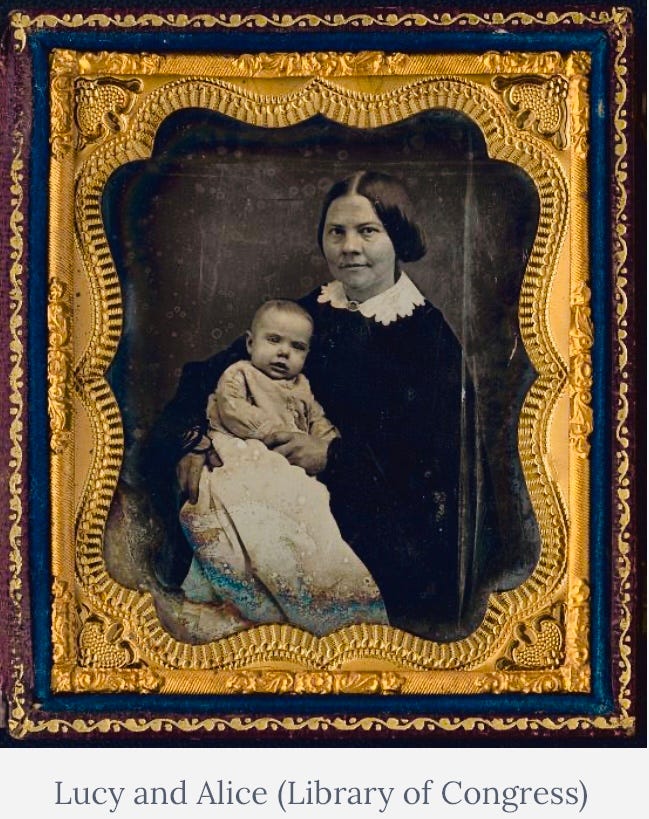
Recently, I responded to a question about the factors that stymied women’s quest for suffrage during the mid-to-late 19th century. I brought up the pragmatism and egalitarianism of suffragist and abolitionist Lucy Stone whose legacy remains largely overlooked. And therein lies the problem.
Susan B. Anthony and Elizabeth Cady Stanton have rightfully earned their place in Women’s history. They battled for the vote in ways almost unimaginable. Yet, they both held racist and classist views. Now before you start yelling about how both of them worked in the abolitionist movement, spare me. You can be anti-slavery and still not think the slave is your social or political equal. The inability to shake off one’s sense of entitlement has extreme consequences for everyone.
When lawmakers decided to include Black men as voters in the 15th Amendment without including the franchise for white women, both Stanton and Anthony were rightfully livid, but livid to the point where they then fought against the passage of the 15th Amendment altogether. It passed, however, in 1869 and was ratified in 1870.
Stanton wrote that it was unconscionable and dangerous to give the vote to Black, Chinese or Irish men because they were inferior. Anyone that did not fit a strict Anglo-Saxon and native-born status was considered inferior. Additionally, neither Stanton nor Anthony had thought about Black women voting at all.
Stone broke with Anthony and Stanton over their racism. Orator, writer, abolitionist and former slave Frederick Douglass cut his ties to Anthony and Stanton as well. The tragedy was that Douglass had attended the Women’s Conference at Seneca Falls in 1848 and had been a huge and early advocate for women’s rights. Moreover, it was Lucy Stone’s brilliant oratory that had inspired Susan B. Anthony to join the suffrage movement.
Stone read the political winds correctly. She formed the American Woman Suffrage Association which concentrated on gaining women the right to vote on a state-by-state basis. She knew that Congress was not going to grant the franchise to everyone.
Stone believed that the enfranchisement of Black men was progress. Although she was disappointed that the 15th Amendment did not include women’s suffrage, she did not believe that denying the franchise to others would help women in the long run.
Black men, rather than white women, were granted the right to vote first for a variety of reasons. As a historian, I know that the Republican Party in the 1860s was the party of Lincoln (not the sh*t show it is now) that freed Black American slaves. They controlled both the House and the Senate in 1867 to 1869. They knew that recently freed and enfranchised Black men would inevitably vote Republican and increase the party’s political dominance.
Granting the franchise to white women would have mixed political results as many white women still believed in the lost cause of the South in spite of its loss during the Civil War. They would have voted Democrat which was then the favored party of the former slave-holding South.
Some of Stone’s ideas were tied to her upbringing. She came from a hardworking farming family in Massachusetts. Both of her parents were abolitionists. While quite young, she, along with Lucretia Mott and Abby Kelly Foster helped William Lloyd Garrison establish the American Anti-slavery Society which was founded in 1833.
All of her brothers attended college. Yet, Stone had to postpone her education. She taught school for several years and was able to scrape up enough money to attend Oberlin College, the first college in the nation to accept Black people and women. When she graduated in 1847, she became the first woman in Massachusetts to earn a college degree.
Stone had planned to remain a single woman because she feared losing her independence to a husband. She finally yielded to Henry Browne Blackwell’s persistence. Blackwell was also an abolitionist and women’s rights advocate. Blackwell would learn years later that Stone finally decided to marry him after he met and aided a young slave with her owners while traveling on a train.
When Blackwell asked the girl would she rather be free, she answered “yes.” Blackwell and an accomplice helped get the young girl off of the train and away from her owners. It was that act of liberation that won Stone over.
While neither Stone nor her contemporaries Anthony and Stanton lived long enough to see women receive the right to vote, their different approaches and beliefs underscored a perpetual problem in the quest for women’s equality and the right to vote.
Stone never stopped fighting for the rights of Black people as she continued her fight to get the vote for women. She believed that both causes were interrelated. The same cannot be said of Anthony and Stanton.
The fight for the right to vote for women was often fractured by racism well into the 20th century. Stone’s stances on racial equality and equal rights for women cost her some popularity among some white women. Anthony and Stanton emerged as the face of white women’s suffrage. Yet, Anthony and Stanton also emerged as suspect to Black men and women.
After Lucy Stone died of stomach cancer in 1893, her only child, Alice Stone Blackwell reached out to the daughter of Elizabeth Cady Stanton and began the process of repairing the divided women’s suffrage movement. They created a new coalition. Alice Stone Blackwell followed her mother’s mantra to make the world better.
Lucy Stone deserves more historical attention than she receives. Her example should be emulated precisely because she understood the “intersectionality” of gender and race (and the political implications that go along with it) long before Black scholar and lawyer Kimberlé Crenshaw coined the term and defined the theory in the late 20th century. Stone recognized that, no matter how different gender and race may appear, women’s equality was inextricably linked to racial equality. You must fight for both, not just one or the other.
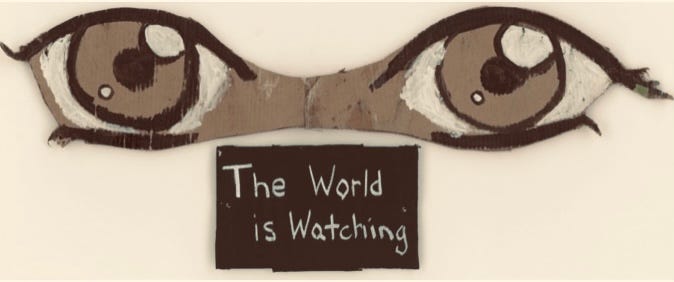
The photo below is of a creation titled “The World is Watching.” The artist is not known. It is located at the Library of Congress which has a long history of collecting Protest Art and Protest Photography. Visually stunning and a reminder that protests and activism change with the technology of the times.
I was born during the last years of what was called the Baby Boom. As a Baby Boomer, I did not grow up from Childhood to Early adulthood with a Personal Computer, the Internet, and definitely not Social Media or a cellphone with a camera.
I learned of protest marches and various forms of activism via word-of-mouth, letters, signs on school and church bulletin boards, and via Black-owned newspapers. Sometimes these protests were featured on the 6 O’Clock News.
Fast forward to the late 20th and early 21st centuries and you have young adults who grew up with everything we Baby Boomers grew up without. Millennials get messages out there in cyberspace in a matter of seconds. They can rally thousands (even millions) of people with brief blurbs and blogs in a matter of a couple of days and occasionally a couple of minutes. There are, however, a few drawbacks.
In addition to creating mediums that make it seem as if a few “likes” on social media has resolved the problem, it also exposes certain tactics that should not be seen by everyone. Social Media exposes protest tactics to our enemies as much as it exposes those tactics to our friends. So let me share the following history. Ignore it; modify it; and/or adapt this in any way you see fit.
The Black American Civil Rights Movement typically had a 3-pronged approach.
Back in the day, you had a set of individuals who could not physically participate in protest marches because they were the folks who were designated to bail you out of jail if you were arrested. The folks who were part of the Black community who had a degree of affluence and wealth were often in this position. Although many of them were out there in the streets protesting.
Another group was the observers. These were individuals who lined routes of marches who watched and recorded what they saw. Sometimes they would stand on sidewalks and pretend to be window shoppers or they would sit near the windows inside places of business so that they could see what was going on outside in order to report what they saw. There were no cellphones with cameras in them back then. Their hardest role was to not intervene when they saw any physical violence. They had to record what they saw.
Finally, there were the Black protesters themselves who were trained in non-violent resistance in order to highlight the sheer brutality of their oppressors. They were trained to endure and not fight back.
Now, I am not at all advocating for any of you to quietly endure any form of brutality and violence as you fight against this onslaught of abuse from the administration of Felon 47. What I am suggesting is that you create a 3 or even 4 or 5-pronged approach to how you protest and advocate for the causes you believe in.
Right now, activism is highly tied to how much press and social media presence one can generate. That’s not a bad strategy, but the limitations of that approach is that almost anyone can see it. You win most against enemies when enemies do not know EXACTLY what is coming at them all the time. And that is not my original idea. It actually comes from Sun Tzu, a Chinese General and Strategist born around 544 B.C.E. Some ideas stand the test of time. Study those ideas. Onward!
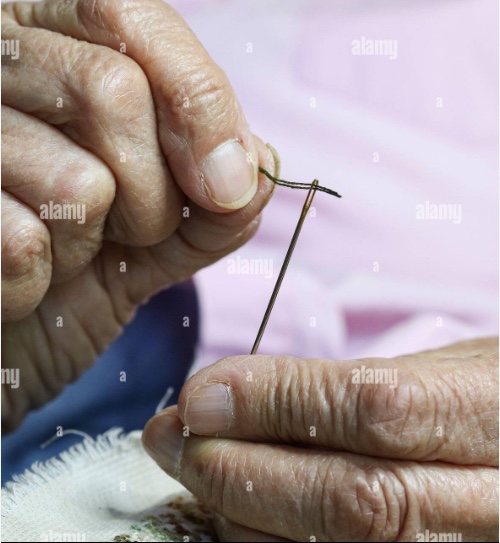
When I was a small girl around the age of 4 or 5, my maternal grandmother would often ask me to thread her needle. I was a late born baby to my parents and Grandma was well into her seventies when I was born.
Grandma was a scholar who read a couple of books a week. I knew instinctively that the reason why she asked me to thread her needle was because the eye of a sewing needle is narrow and often hard to see. The best pair of eyes could have trouble getting that thread through that tiny eye. By the time I was around 4 or 5, Grandma was in her eighties, and I enjoyed doing what I could for my Grandma.
(Stock photo of an elderly woman’s hands threading a needle, Alamy)
Grandma’s eyes were not as steady as they once were; and neither were her hands. But once that needle was threaded, she could sew up a storm. As I have now passed the age of 60, it now takes me damned near 15 minutes to thread a needle. But you do what you can and what you have to do. This brings me to another observation.
For several months this year, after I rolled my herbie-curbie (that’s the name for our garbage cans on wheels in Atlanta) to the curb of my driveway, I arrived back home and instead of my herbie-curbie being left at the curb of my driveway as is customary, someone had rolled it all the way up to the gate to my backyard so I wouldn’t have to retrieve it.
Last week, I was home when the sanitation workers were out. Before I exited my door to retrieve my herbie-curbie, I saw my 20-something neighbor who is autistic grab its handle and roll it up to my gate. He went from house-to-house doing the same thing—saving his older neighbors the trip to the end of the curb.
I bring this up because when I finally saw who was doing this favor on his own, it dawned on me that he was doing what he could do to assist his neighbors.
Then I thought about all of these folks barking about where is Kamala Harris? During the first wave of complaints, she was actually in fire-ravaged California assessing damage, talking with the mayor and governor and firefighters, and assisting her neighbors who had lost their homes.
The second wave of complaints came recently. Now, I have already said that Harris is a private citizen and has done her duty while so many others fail to do so much as contact their representatives and complain.
What is most annoying is the manner in which folks have complained. I watched Harris lose weight on the campaign trail after being given a near-impossible task of organizing a campaign in just over 100 days after a stubborn Joe Biden took his sweet time stepping aside when so many of his colleagues begged him to do so.
I have also been around white women who felt like I was their property and who felt like I was obligated to do whatever they requested, and were insulted when I said “No” even when my work or school schedule and obligations would not permit me to accommodate them.
I have been around men (black and white) who treated me the same way. That is an unfortunate experience that Black women have endured ever since we have been here in this country. We are not supposed to have own lives, but we are supposed to stand ready to salvage somebody else’s. Wedged between battling racism and sexism and misogynoir simultaneously, we are often left hanging when we are having problems.
Instead of these complainers interrogating the majority of white women and men who voted for Felon 47, they want Harris out there speaking for them. And if she did, you know good and damned well Felon 47 and his minions, along with his bought-and-paid-for news rooms would paint her as a “Sore Loser” while his dumb-as-cat-shit voters nodded in agreement while he continued to pick their pockets and threaten their livelihoods. Unlike my sweet autistic neighbor, they do not do what they can but they expect someone else to do it.
Instead of bothering to contact Kamala Harris’ office or website or her page on IG to ask her a question, they went on a rampage of demands. They don’t even know what she might be doing behind the scenes.
So, let me share this bit of my history. I represent only the third generation of my families not born into slavery. I will leave you with what my paternal Great Grandmother said to her mistress who just couldn’t believe Great Grandma would want to leave her mistress and be free. With a nap sack on her shoulder, and right before she went searching for her other siblings who had been sold to other slave owners, she said the following:
“You can do your own work and you can pick your own cotton.”
If you blow up the photo below you will see a letter written to me from the late Congressman John Lewis from 2008. If you look in the lower right corner of this photo you will see a photo insert of a red file folder about an inch thick. These are all the letters I have received from my representatives over about 4 decades. This was when you received their responses via snail mail.
Letter from Congressman John Lewis and File folder of letters
These days, your representatives respond to you by email. I urge you to call them, contact them, and then print their email responses.
I miss my phone and letter debates with the late John Lewis. I still remember one of our debates that descended into a full fledged argument in a grocery store parking lot in our town of Atlanta. That’s the beauty of being in Atlanta. Many of your elected officials live and shop where you do. So, you can give them your opinion while you check out your groceries.
I bring this scenario up because there is something very different when you receive a physical letter as opposed to an email. The letter has a real signature. Each one of these letters are a personal piece of history. Politics today is quite impersonal—and it is messing everyone up.
We are now confronted with politics as only spectacle—the pithy quote on social media, the doctored video that creates a sense of urgency when there is no need for urgency, or the edited video that creates a fictional persona instead of showing the real person behind the title.
I’m glad Bernie Sanders and Alexandria Ocasio Cortez are hitting the road and going on tour to talk to people all across the United States to find out what real people are thinking.
Communication from a distance is fine. Technology has made it possible for us to share an idea with thousands of strangers. Yet…
No matter how easy posting on social media, text messaging and sending emails are, there is no replacement for speaking to someone face-to-face or listening to a live voice or reading a real letter with a real signature. That personal touch is sorely lacking in both the Democratic and Republican Parties, and it is destroying democracy with almost the same degree of swiftness as Felon 47’s cruel policies.
It is one thing to put your finger up in the wind and assume what you need to do to be re-elected. It is quite another to look a constituent in the eye and answer a tough question or admit you don’t have the answers. Democratic voters are starving for that attention; and I pray our elected officials figure this out before it is too late.



 Leslye Joy Allen