Sacred Places

By Leslye Joy Allen

Tropical Blue Ocean Water (public domain) Tropical Blue Ocean Water (public domain)

I was among the people supremely delighted at the decision of the Army Corps of Engineers to halt any further construction of the Dakota Pipeline on Sunday, December 4, 2016 until further study of its environmental impact on the water supply in that area. I am not going to preach about the fact that eventually that pipeline would have negatively affected the water supply. You can read my previous blog “A Time of Drought,” to get an idea.

For environmentalists, like myself, this was an incredible victory because for the first time, in a long time, the environment was front and center.  The many Native American nations, along with military servicemen and women, environmentalists, and peoples from around the globe were involved in this protest. Often protests of this nature compete with news stories about who-wore-what to some awards show or the endless stories that moan and groan about things some people obviously have no intention of doing anything about, else they would not spend so much time moaning and groaning about them in the first place…

This time something as precious as water was at the forefront; and access to clean water is something that everyone can understand, even when they are less informed about other matters related to the environment…

Now, what I am about to say here might stun a few folks…

What a lot of people often fail to recognize is that in almost every instance where the earth or air or water has been disturbed or polluted, whether it is to extract oil or some other resource or to build some structure, there has almost always been some violation of the sacred, some disturbing of something that meant something precious to someone or to some group of people…

For my Atlanta readers, you might know, or might need reminding, that underneath a portion of Interstate 75-South lies an old cemetery filled with the graves of Black folks, our brothers and sisters. Where Interstate 75-South meets Cleveland Avenue lies a marble marker that designates the graves of roughly 1,700 former slaves who were buried in Gilbert Cemetery which had been created as a burial place for slaves in the early 1840s.

Because the area around this grave came to be known as “Plunkett Town” which was still occupied by poor, rural Blacks as late as the 1960s, the graveyard there did not illicit much concern until work crews from the Georgia Department of Transportation discovered the damaged burial grounds while building Interstate 75.  By the time of the discovery, the graves had already been disturbed, and the plans and money to build that highway were already in place.  No one considered the graveyards to be more important than building a much-needed highway.  What has been left there is a marker letting people who bother to look know that they are driving over a graveyard…

This is exactly what we all have been doing to Native Americans’ sacred sites ever since Europeans arrived on these shores, eventually and forcibly transporting millions of Africans here to perform heavy labor as slaves…

This is not a moral judgement, but rather food for thought.  Too often we—and that includes environmentalists as well, and I am just as guilty—do not think of water as anything other than something that will come out of a faucet when we turn that faucet on.  And as long as we can pay our Water Bill, we seem assured that when we turn that knob, water will come out…

But go pour a glass of water.  Look at it!  Say a prayer to it!  Respect it!

The Standing Rock protest that has temporarily halted the Dakota Pipeline might not have converted any new environmentalists; I know too well from experience that a lot of people do not want to be inconvenienced in any way, even if that small inconvenience will help clean up the environment, or at least slow down the toxicity of the natural environment…

Yet, we all need to stay on guard because this battle may come up again as a new president moves into the White House in January 2017.  However, for the time being, recognize what this protest and this small victory has made us all pay attention to: respect for the dead and for the most precious resource on earth: water.  If you are not humbled by this, I do not know what else to tell you except that you will eventually be humbled by this, whether you want to be or not.

Àṣé.”

Copyright © 2016 by Leslye Joy Allen.  All Rights Reserved.

This blog was written by Leslye Joy Allen and is protected by U. S. Copyright Law and licensed under a Creative Commons Attribution-NonCommercial-NoDerivs 3.0 Unported License. Any partial or total reference to this or any blog authored by Leslye Joy Allen, or any total or partial excerpt of this or any blog by Leslye Joy Allen must contain a direct reference to this hyperlink: https://leslyejoyallen.com with Leslye Joy Allen clearly stated as the author. All Rights Reserved.


A Time of Drought

By Leslye Joy Allen

rain-on-the-pines-copyCopyright © by Leslye Joy Allen.  All Rights Reserved.

I still remember the first time someone laughed at me for carrying cloth bags to the grocery store to shop. Unfortunately, the person was Black, just like me, and failed to understand the greater implications of climate change and what we all could do to slow it down.  I was told that my using cloth bags instead of plastic bags would probably not make that much difference to the environment.  I replied, “No it probably won’t make that much difference. But at least I can decide not to contribute to the problem.”

I write this blog at the very moment when it is raining heavily in my hometown.  Day before yesterday we saw the first few small showers after enduring over 100 days since rain fell in Atlanta.  The forest fires that have now devoured over 25,000 acres in the Appalachian region of Georgia, Tennessee and other areas are still raging.

Those individuals who did not think much about climate change are beginning to think a little bit more about it now.  With a protest against a dangerous pipeline going on in the Dakotas, along with this multi-state drought, I have only one desire: to point out some things you can do that will cost you basically nothing; and you might learn a few talking points.

  1. Every time a building is torn down and a new building is built in its place, the soil loses some of its ability to absorb water. Demand that your local politicians and city leaders refurbish old buildings rather than tear them down.  It not only preserves a city’s physical heritage it also saves money as buildings built before 1930 are more energy efficient than modern buildings.
  2. Most cloth shopping bags cost between one to two dollars and they are pretty durable. You can leave the petroleum-based plastic bags at the store.
  3. Recycle your paper, and your plastic, glass, and aluminum containers rather than placing them in the trash. Over the long haul, you will save on garbage bags because you will place less garbage in them. If your city does not have a recycling program, start one yourself.
  4. Remember that the chemical methane is naturally reproduced below the earth; and while it is non-toxic, it is volatile. Low income Black communities, Latino communities, and other communities of color are the most likely to live near garbage dumps that produce high levels of methane. If methane seeps into the water supply, you can literally strike a match and the water will burn. If you consume methane at high levels you can die from asphyxiation.  Pay attention to where your garbage dumps are located.
  5. Fracking for precious minerals and resources below the earth is believed to not only produce the potential for methane seeping into drinking water, but is also believed to be responsible for some earthquakes.  The fight against the Dakota pipeline is based not only on a respect for Native Americans’ sacred sites, but also on the potential problems that this pipeline will eventually create.
  6. For people who think that the problem with drinking water was at its worst in Flint, Michigan, think again. Flint is and remains a long-term problem that was on the radar of environmental groups as early as the 1970s.  You can read more about it here. “Before Flint, Before East Chicago, There Was Smeltertown.”
  7. While 70 percent of the earth is actually covered by water, only 2.5 percent of that water is drinkable.
  8. If you believe in a Creator or any higher power, then try treating what has been created as if you did not own it or create it, because you did not.

Àṣé!!!

Copyright © by Leslye Joy Allen. All Rights Reserved.

This blog was written by Leslye Joy Allen and is protected by U. S. Copyright Law and licensed under a Creative Commons Attribution-NonCommercial-NoDerivs 3.0 Unported License. Any partial or total reference to this or any blog authored by Leslye Joy Allen, or any total or partial excerpt of this or any blog by Leslye Joy Allen must contain a direct reference to this hyperlink: https://leslyejoyallen.com with Leslye Joy Allen clearly stated as the author. All Rights Reserved.

On This September 15, 2016

By Leslye Joy Allen

“Self Portrait” by Copyright © 2015 Leslye Joy Allen. All Rights Reserved. “Self Portrait” by Copyright © 2015 Leslye Joy Allen. All Rights Reserved.

Leslye Joy Allen, Copyright © 2016. All Rights Reserved.

Today is my play big brother Walter Dallas’ birthday.  A brilliant director, playwright and composer, I was so glad to talk with him this morning. Today it has also been reported that Sandra Bland’s family has reached a settlement in the wrongful death lawsuit they filed against Texas police officers (Read: Sandra Bland’s Family Reaches $1.9 Million Dollar Settlement).  I can only say that her family fought valiantly for changes to be made at the jail where Sandra Bland died. Her family might have gotten a bigger settlement if Black women’s lives mattered half as much as the lip service we often hear that says that we actually matter.  Talk is cheap.

Today is also the 53rd anniversary of Birmingham, Alabama’s 16th Street Baptist Church bombing that snuffed out the lives of four young black girls named Cynthia Morris (later called Cynthia Wesley), Carole Robertson, Denise McNair, and Addie Mae Collins. Addie Mae’s sister Sarah Collins Rudolph survived the blast, but lost an eye and her sister. Two black boys were killed the same day near the church in additional acts of racial violence; they were Johnny Robinson and Virgil Ware. So how does one celebrate the birthday of a wonderful director, playwright, composer and all-around great guy while remembering the deaths of our children, and of those who died needlessly in police custody and much too soon?

On the surface no visible correlation exists between any of these events. Yet, a birthday is often a milestone to look back at what one has accomplished and what one wants to accomplish in the years ahead. These deaths, however, are painful reminders of the work still ahead of us, a reminder to pause and appreciate those among the living for who they are and what they do because no day is promised to any of us.

It is for me also a reminder of all those butterflies, the white and yellow clouded sulfur butterflies, and the orange and black monarch butterflies, that have followed me for the last two weeks, in my yard, in the street, and in parking lots that remind me of renewal and transformation, and that those who live with us for a long time and those who leave us too soon will return again. Àṣé!”

Leslye Joy Allen, Copyright © 2016. All Rights Reserved.

This blog was written by Leslye Joy Allen and is protected by U. S. Copyright Law and licensed under a Creative Commons Attribution-NonCommercial-NoDerivs 3.0 Unported License. Any partial or total reference to this or any blog authored by Leslye Joy Allen, or any total or partial excerpt of this or any blog by Leslye Joy Allen must contain a direct reference to this hyperlink: http://leslyejoyallen.com with Leslye Joy Allen clearly stated as the author. All Rights Reserved.


Remembering Dr. Edward B. Allen and the Laws/Allens

by Leslye Joy Allen

Photo taken by Billie Allen in 1994 (Copyright © Leslye Joy Allen Photo & Document Collection. All Rights Reserved.)

Photo taken by Billie Allen in 1994. (Copyright © Leslye Joy Allen Photo & Document Collection. All Rights Reserved.)

I did not meet my cousin Dr. Edward B. Allen until I was well in my twenties.  He was the third and last born of three children born to William Roswell “W. R.” Allen and Mamie Wimbish Allen. His sister Lamay was the eldest, then came Wilhelmina (bka “Billie”) and then there was Ed.  He and I met for the first time at his eldest sister Lamay’s home in Milwaukee, Wisconsin.  His sister Billie Allen and I had long been partners-in-crime, but I had not yet met Ed.  All I knew about him was that he was a dentist.  When I saw him he reminded me of my late father Thomas Charles Allen who was also not very tall, tan-complexioned and balding.  Now, allow me to clarify something that Ed and his two late sisters needed clarified: I, Leslye Joy Allen, share the same “Allen” surname as Ed, but my last name comes from an entirely different Allen family, as I am biologically related to two unrelated sets of “Allens,” all on my father’s side of the family.  Let me explain.

The original family surname was “Layende.”  The Layendes were slaves from Cuba that arrived in the mainland United States.  As a historian, I feel obligated to remind people that the Southern region of the USA and Latin America and the Caribbean were quite fluid and did business with one another all throughout the era of chattel slavery.  This surname “Layende” was later anglicized to “Laws.”  Ed’s paternal great grandfather Milton Laws’ sister Mollie Laws-Maddox was my great grandmother.  They were the son and daughter of slaves David and Sarah Laws.  Sometime before American chattel slavery ended, Milton Laws was sold, and he acquired the last name of “Allen,” and became known as “Milton Allen.”  How he got this last name is not clear, but it is highly probable that Dr. Edward Bowden Allen would have been named Dr. Edward Bowden Laws had this slave sale not taken place.

Not long after Billie Allen asked me to do some family research, I had been searching for two men, one named “Milton Laws” and the other named “Milton Allen” only to discover from our mutual cousin Mittie Ann Tillotson that “Milton Laws” and “Milton Allen” were the same person.  Cousin Mittie Ann was the great granddaughter of Richard Laws, the brother of Milton and Mollie.  When Billie sent me photos of she, Ed, and Lamay’s paternal great grandparents Milton and Laura Allen, the first thing that struck me was how much my paternal grandmother Minnie Belle Maddox-Allen looked like her maternal Uncle Milton Allen (formerly named “Milton Laws.”)  And then things began to click.  Stay with me, now…

Now, Mollie Laws-Maddox’s daughter named Minnie Belle Maddox-Allen was my grandmother (My grandmother also named her daughter, my paternal aunt “Minnie Belle,” so I am also related to two “Minnie Belles.” Whew!!)  My grandmother Minnie Belle Maddox married a man named Will Allen who was not related to my cousin Edward Allen.  Will Allen, my paternal grandfather is where my own surname “Allen” comes from.  You can imagine my early confusion at trying to figure out how my paternal grandmother was related to Ed, Billie and Lamay Allen when “Allen” was her married name, not her maiden name.  But such is the case with African American genealogy.  There are hundreds of descendants of slaves whose family surnames were chosen by newly freedmen and women themselves; they made-up some names; and in many instances the maternal and paternal surname was identical because both slave husband and slave wife belonged to the same owners and both bore the same surname.

This research journey began when Ed’s sister Billie could not remember the name of their paternal grandfather, so off I went to look up their father William Roswell “W. R.” Allen’s Social Security application.  On that application were the names of his parents: Doc Roswell Allen and Mary Willie Jones.  Doc Roswell Allen and my paternal grandmother Minnie Belle Maddox-Allen were first cousins.  Soon after this discovery, and with some prodding from his buoyant wife Shelagh (who l instantly liked), Ed wanted to know more about the family tree.  After, acquiring some more information from Billie I discovered that the physician Dr. Edward G. Bowden, who was my paternal grandmother’s physician, was the man Ed was named for.  Dr. Edward G. Bowden married Elizabeth Allen who was the sister of Doc Roswell Allen and daughter of Milton and Laura Allen.  Doc Roswell Allen’s sister Virgil (who later renamed herself “Virginia”) bore one son out of wedlock, and his name was John Wesley Allen and he was a dentist, the first of many dentists in the family. All of these “Allens” were members of that rather complicated “Laws/Allen” family tree.

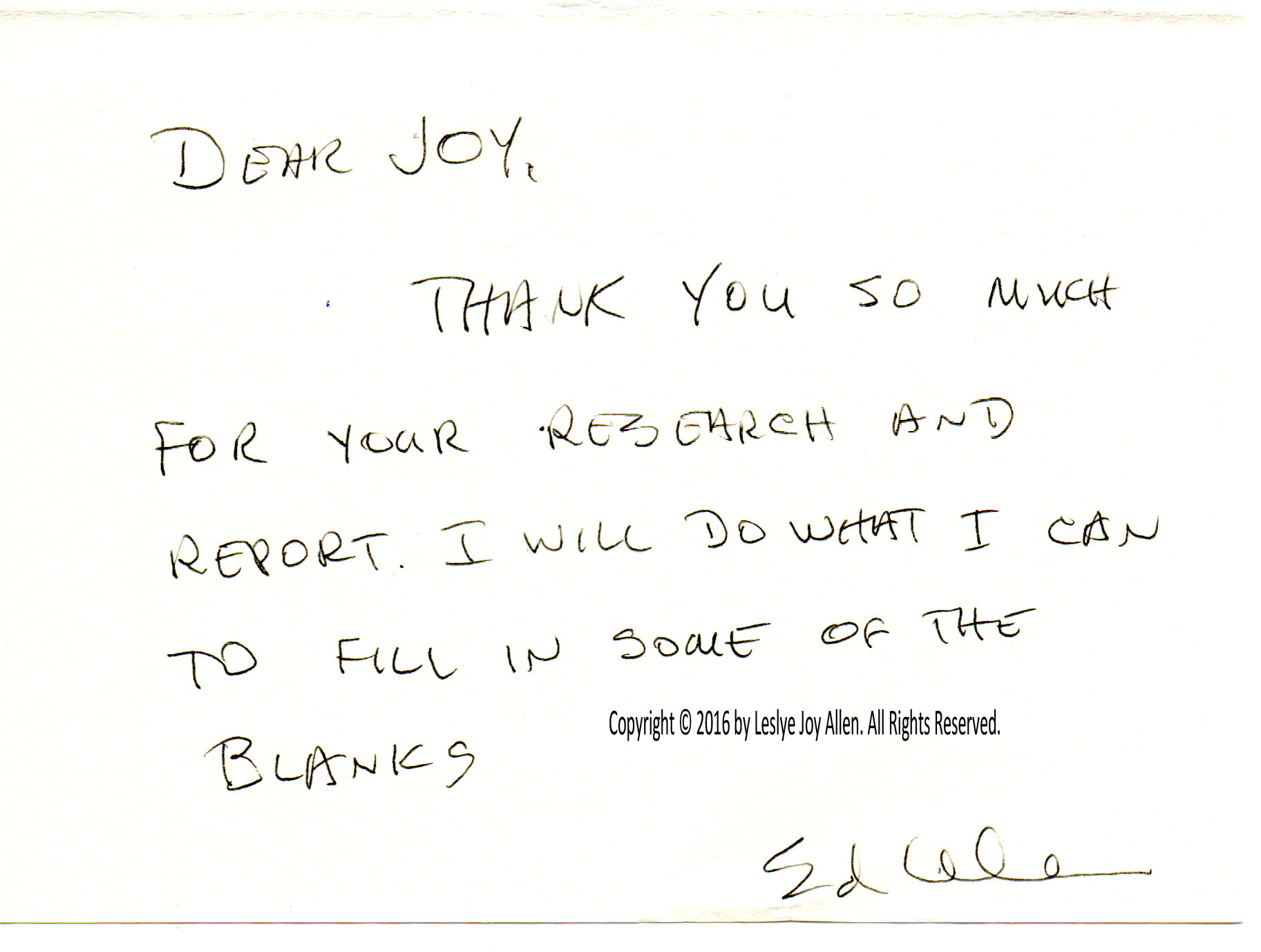
I only saw Ed about four times in my life.  Yet, each time I saw him, something he said to me gave me some nugget of information.  I still remember when he told me he recalled a “John” from his childhood who came to visit but then seemingly disappeared.  I told him Dr. John Wesley Allen was killed in a car accident in the late 1930s. In the late 1990s, I mailed Ed a report of everything I knew about our family.  I don’t think I even knew about the origins of our slave ancestors the “Layendes” from Cuba when I sent that report to Ed, but he was grateful to receive it.   I still have the “Thank You” note he sent me, a “Thank You” note that his sister Billie said was uncharacteristic of her brother.  I laughed because I got the sense that Ed knew that the work I did was much more time-consuming and tedious than most people realize.

I remember Ed as a renaissance man who loved the good life, who could be aloof, who was often funny with a dry wit, who was a man who loved a good drink, but one who also yearned to know more about the home and people he left when he journeyed North to escape some of the harsher realities of life for Black people in the South that colored much of the 20th century.  Although we did not know each other well, I consider it my privilege to have known him and to have been able to help him answer some of the questions about our family tree and heritage.  We always yearn for home, that sense of understanding where and from whom we have come. We yearn for home, no matter where we go.  And now Ed has gone home (May 27, 1926 to July 18, 2026).  Àṣé.

Copyright © 2016 by Leslye Joy Allen.  All Rights Reserved.

"Thank You Note" from Dr. Edward B. Allen to Leslye Joy Allen, July 1997. ((Copyright © Leslye Joy Allen Photo & Document Collection. All Rights Reserved.)

“Thank You Note” from Dr. Edward B. Allen to Leslye Joy Allen, July 1997. (Copyright © Leslye Joy Allen Photo & Document Collection. All Rights Reserved.)

This blog was written by Leslye Joy Allen and is protected by U. S. Copyright Law and licensed under a Creative Commons Attribution-NonCommercial-NoDerivatives-4.0 International License. Any partial or total reference to this or any blog authored by Leslye Joy Allen, or any total or partial excerpt of this or any blog by Leslye Joy Allen must contain a direct reference to this hyperlink: https://leslyejoyallen.com with Leslye Joy Allen clearly stated as the author. All Rights Reserved.

Honor Thy Father and Thy Mother

By Leslye Joy Allen, Copyright © 2016. All Rights Reserved.Weary Self-Portrait 2

I am not going to wax poetic about the recent brutality and violence meted out to Black people at the hands of police officers; or wax poetic about the tragic deaths of some police officers. The people that know me know where I stand. I am in no mood to be eloquent.  I will share, however, with you FIVE basic life rules taught to me by my late parents that have always been my hedge of protection.

  1. You always support Black businesses and the businesses in your community that invest in where you live. This is simply common sense.
  2. You never apologize for wanting to work with and for and live among your own people. Only fools fail to take care of home first.
  3. You never support a church or member of the clergy that is more interested in what is on the collection plate than what is happening to the flock he or she serves. This same rule applies to business owners.
  4. You must learn to stand all by yourself some times. It does not matter if you are the only person that shows up on the picket line; or you are the only person who walks out in protest. You do what is right simply because it is right.
  5. If you do not believe in the abilities of yourself and your people, you cannot believe in God. It is sacrilegious to believe yourself inferior and/or incapable while professing some faith in a higher power.

Living by the five rules above is how I honor my mother and my father. Àṣé!

Leslye Joy Allen, Copyright © 2016. All Rights Reserved

This blog was written by Leslye Joy Allen and is protected by U. S. Copyright Law and licensed under a Creative Commons Attribution-NonCommercial-NoDerivs 3.0 Unported License.   Any partial or total reference to this or any blog authored by Leslye Joy Allen, or any total or partial excerpt of this or any blog by Leslye Joy Allen must contain a direct reference to this hyperlink: http://leslyejoyallen.com with Leslye Joy Allen clearly stated as the author. All Rights Reserved.